Local dimming can pulse on static high-contrast images because the monitor keeps recalculating backlight zones, highlight protection, black-level targets, and sometimes flicker-based dimming behavior, even when the image appears still.
Does a white logo, mouse cursor, spreadsheet grid, or subtitle on a dark screen seem to breathe brighter and dimmer while nothing is moving? With the right monitor settings, you can usually tell within a few minutes whether the issue is local dimming behavior, brightness control, or content processing. Here is how to identify the cause and tune the display for steadier gaming, work, and HDR viewing.
Why Static Images Can Still Trigger Dynamic Brightness
Local dimming is designed to improve contrast by adjusting parts of the backlight independently instead of lighting the whole screen at one level; local dimming is especially useful for deeper blacks and stronger HDR separation. The catch is that a static image is not always static to the monitor’s control system. A blinking cursor, anti-aliased text edge, video compression noise, desktop overlay, notification, or subtle pixel-level change can make the dimming algorithm re-evaluate zone brightness.
On an LCD monitor, the pixels do not emit their own light. The LCD layer modulates a backlight, and with local dimming that backlight is split into zones. If a bright object sits inside or near a dark region, the monitor has to choose between lighting the zone enough to preserve the bright object or dimming it enough to keep the surrounding black area dark. That conflict is the foundation of pulsing, blooming, and occasional shadow crushing.
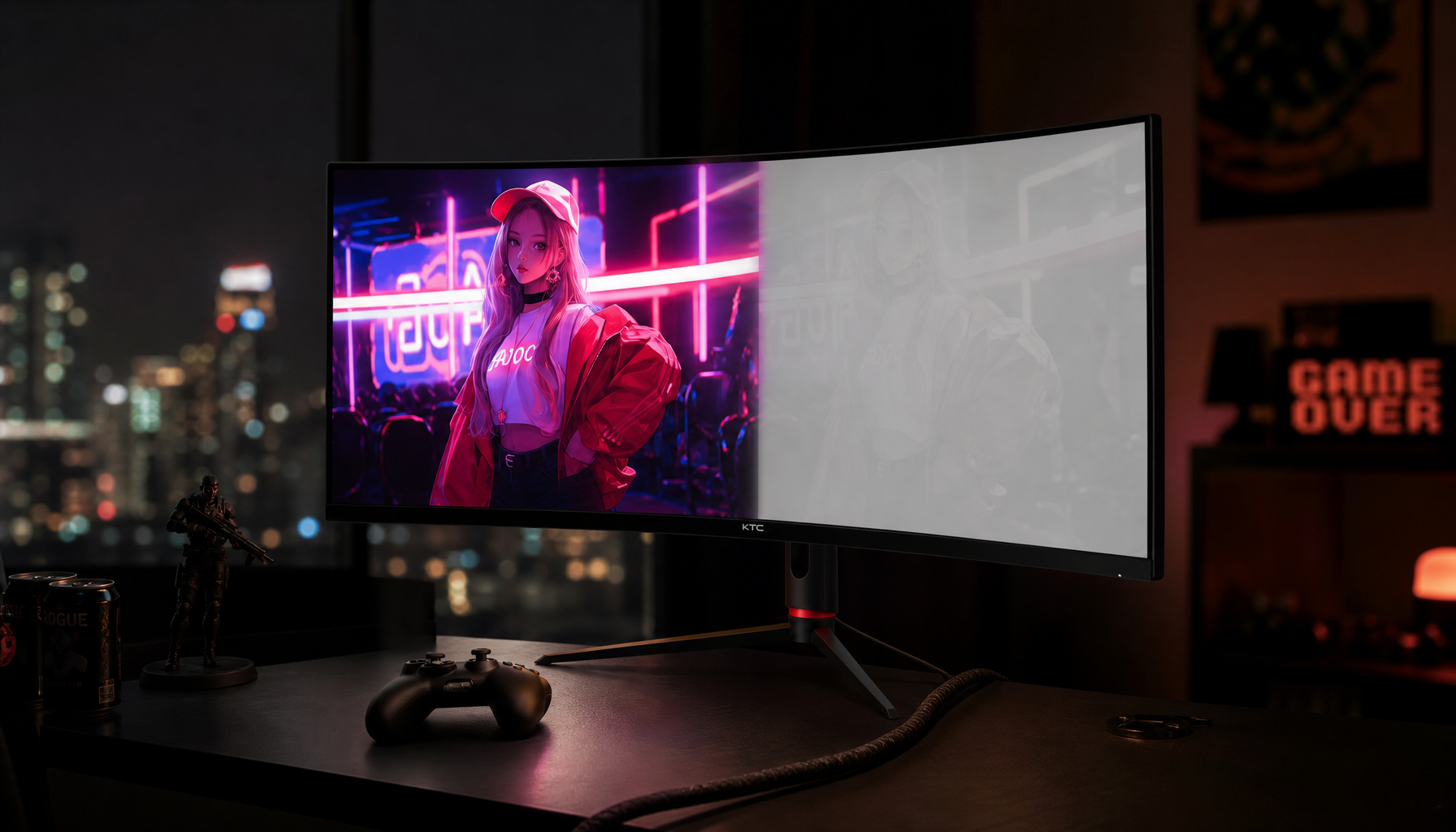
A simple desktop example is a white mouse pointer on a black wallpaper. If the pointer is small but bright, one backlight zone may brighten to support it. If the local dimming algorithm has aggressive halo control, it may then pull that zone down to protect the black background. The result can look like a slow brightness “breath,” even though the pointer and background barely changed.

The Core Mechanism: Zone Decisions, Not Pixel Decisions
More dimming zones generally allow finer brightness control, but zone count alone does not guarantee stable behavior. A 27-inch or 32-inch mini-LED monitor may have hundreds or thousands of zones, while each zone still covers far more area than a single pixel. That means the backlight cannot perfectly match tiny bright details.
This mismatch matters most in high-contrast static images. A white crosshair on a dark game menu, a thin white gridline in a design app, or bright text over a black terminal window may occupy only a small part of a zone. The monitor must decide whether that zone is “mostly dark” or an “important highlight.” If the decision threshold sits near the content’s brightness level, the zone can toggle between two states and create visible pulsing.
Mini-LED monitors try to reduce this with better algorithms, but tuning varies by brand, mode, and panel. Some mini-LED settings guidance treats local dimming as a feature that can improve HDR contrast while also requiring different profiles for work and HDR content; SDR office and web use is specifically where consistent panel brightness often matters more than deep blacks.
Why It Happens More in Dark Themes and HDR
High-contrast content stresses local dimming because the backlight has to serve opposite goals in neighboring areas. HDR makes the gap larger: bright highlights may ask for much higher luminance, while the surrounding scene asks for very low black levels. That is exactly what HDR is supposed to do, but it also makes algorithmic transitions easier to see.
Brightness is usually discussed in nits, where one nit equals one candela per square meter. A monitor running a 1,000-nit HDR highlight beside near-black UI elements is managing a much wider luminance range than a 250-nit office setup. If a zone ramps from low output to high output and back again, your eyes notice the transition because the contrast jump is large.
Dark mode can make this worse during productivity work. A black code editor with white text, a dark spreadsheet theme, or a black slide deck with bright icons creates many small highlight islands. Local dimming was built for cinematic contrast and HDR impact, not necessarily for perfectly steady brightness around thin UI elements during eight hours of desktop work.

Scenario |
Why Pulsing Appears |
Best First Adjustment |
White cursor on black wallpaper |
One small highlight controls a larger backlight zone |
Lower or disable local dimming for desktop use |
HDR game menu with bright logo |
High peak brightness fights black-level protection |
Try a medium local dimming level |
Dark spreadsheet or code editor |
Fine text and gridlines cross zone thresholds |
Use SDR mode with uniform brightness enabled |
Movie subtitles on black bars |
Bright text lights zones around dark content |
Reduce halo control aggression if available |
PWM Flicker Can Be Confused With Local Dimming Pulse
Not every brightness fluctuation is caused by the local dimming map. Some displays also use pulse-width modulation, where the light output rapidly turns on and off to simulate a lower brightness level; PWM display options are often discussed by sensitive users because the flicker can cause discomfort for some people. PWM flicker is usually faster and more uniform across the screen, while local dimming pulse is usually tied to specific bright objects or zones.
The distinction matters because the fixes differ. If the whole screen seems to shimmer at low brightness, especially on solid colors, PWM or backlight driving may be involved. If only the area around bright text, subtitles, or UI elements rises and falls, local dimming is more likely. A practical test is to open a full-screen solid gray image, then a black screen with a white cursor or small white window. Whole-screen flicker points toward dimming electronics; object-linked pulsing points toward local dimming.
Some users have reported low-brightness screen flutter in older LED-backlit devices, with support discussions pointing to backlight behavior, power state, and brightness level as possible contributors; low-brightness flicker is a useful reminder that perceived pulsing can come from more than one layer of the display system. On monitors, that layer may be the backlight driver, local dimming processor, HDR tone mapping, or operating system brightness behavior.
Brightness, Contrast, and Comfort Are Linked
A brighter monitor is not automatically a better monitor. Display brightness should match the room because higher luminance values improve visibility in bright environments but can become uncomfortable in dark rooms. When brightness is set too high in a dim room, even small local dimming changes become more obvious because your eyes are adapted to darkness.
For office productivity, a steady image often beats maximum contrast. If you are writing, coding, editing spreadsheets, or browsing dashboards, the monitor should feel like lit paper, not a flashlight. For gaming and HDR video, stronger local dimming makes more sense because the payoff is higher highlight impact, deeper blacks, and more scene depth.
Visual comfort research also supports tuning for readability rather than raw spectacle. A systematic review of digital display preferences found that high luminance contrast and adequate color contrast are common comfort factors, especially during prolonged reading. That does not mean maxing out HDR brightness for documents; it means preserving clear separation without unstable luminance shifts.
How to Diagnose the Cause
Start by checking whether the pulse follows objects or affects the whole screen. Open a black background with one small white window, then move the window slowly across the screen. If the brightening follows the window or changes as it crosses different areas, local dimming zones are reacting. If the entire panel pulses at a fixed rhythm regardless of content, look at brightness level, adaptive brightness, PWM behavior, or power-saving settings.

Next, compare SDR and HDR. If the pulsing appears mainly in HDR, the monitor’s HDR tone mapping and local dimming level are probably too aggressive for that content. If it appears in SDR desktop use, local dimming may simply be the wrong mode for that workflow. Some manufacturer tuning guidance recommends turning local dimming off for SDR office, web, document, and desktop use because uniform brightness is usually more comfortable there.
Then test brightness. Lower the monitor brightness in a dark room and raise room lighting slightly. If the pulse becomes less visible, your eyes were amplifying the contrast change. If the pulse remains obvious, reduce local dimming strength, switch from an aggressive HDR preset to a balanced one, or use a separate desktop profile.
Practical Settings That Usually Work
For office work, use SDR, disable local dimming, and enable brightness uniformity if your monitor offers it. This gives up some black depth, but it stabilizes white pages, dark UI panels, and fine text. It is the better choice for long sessions where your attention should stay on the work, not the backlight behavior.
For HDR gaming, keep local dimming enabled but avoid assuming the strongest setting is the best setting. A high local dimming level can deepen blacks, but it can also exaggerate pulsing around static HUD elements, loading screens, maps, and white menu text. A medium setting often preserves most of the HDR punch while reducing visible zone transitions.
For movies, local dimming usually earns its place. Subtitles on black backgrounds are the main stress test. If subtitles cause obvious halos or brightness breathing, try a less aggressive halo or local dimming preset, reduce subtitle brightness if the app allows it, or move subtitles out of black letterbox bars when possible.
For portable smart screens, be more conservative. Smaller displays are often used in variable lighting, from airplanes to hotel desks to bright client sites. A display with user-controlled brightness and predictable SDR behavior is more reliable for productivity than one that chases dramatic contrast in every mode.
Pros and Cons of Local Dimming
Benefit |
Tradeoff |
Deeper blacks than standard LCD backlighting |
Can pulse around small bright objects |
Stronger HDR highlight separation |
Can create halos or blooming |
Better dark-room gaming and movie depth |
Can crush shadow detail if too aggressive |
More efficient use of backlight in mixed scenes |
May add processing complexity or behavior that changes by mode |
Helps LCDs approach OLED-like contrast |
Still cannot dim each pixel independently |
When It Is a Defect Versus Normal Behavior
Some mild pulsing in difficult test scenes is normal for zone-based LCD displays. A static white cursor on pure black is a worst-case pattern because it asks one zone to be bright and dark at the same time. If the pulsing is faint and disappears when local dimming is reduced, the monitor is probably behaving within the limits of its backlight design.
It becomes a practical defect when pulsing is visible in normal work, distracts during gameplay, or appears even with local dimming disabled. It is also more concerning if the brightness jumps are sudden, random, or accompanied by full-screen flicker. At that point, update firmware, reset monitor picture settings, try another cable and input, disable adaptive brightness features, and test another source device before deciding the panel or driver electronics are at fault.
The Best Profile Strategy
Use separate profiles instead of forcing one setting to handle everything. For desktop productivity, prioritize uniformity, moderate brightness, and local dimming off. For HDR games and movies, enable local dimming and tune it to the lowest level that still gives satisfying black depth. For competitive gaming, test input feel and HUD stability, because a dramatic HDR profile is not always the fastest or clearest profile.
The most reliable monitor is not the one with the most extreme brightness spec. It is the one that gives you control over local dimming strength, HDR behavior, brightness uniformity, and color mode so you can match the screen to the task. Pulsing brightness is the display telling you that its contrast engine is working too hard for the content in front of it; tune the mode, and the image becomes calmer, cleaner, and easier to trust.