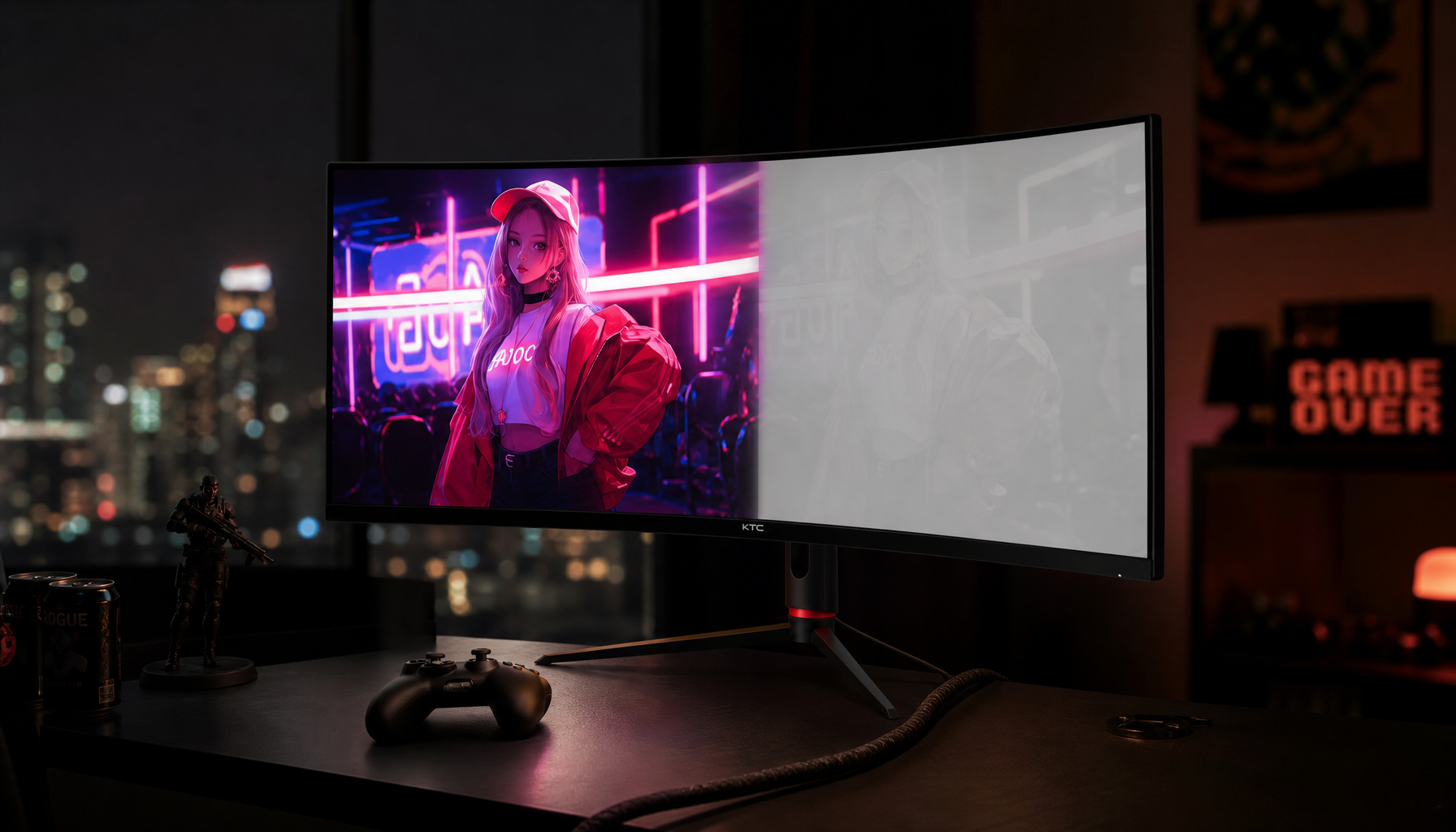
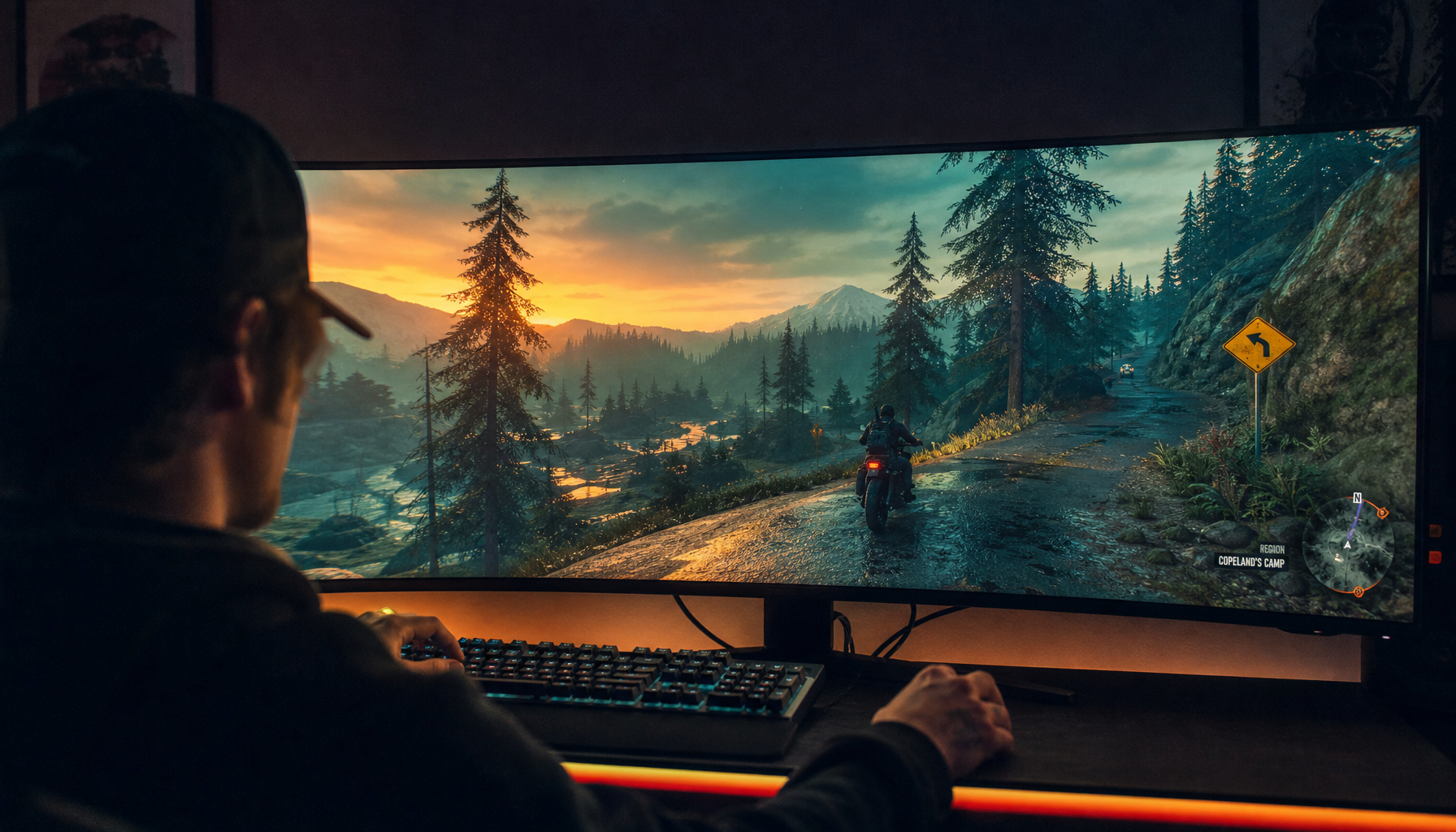
Local dimming can deepen blacks when dark areas are large, yet reduce usable contrast when small bright and dark elements share the screen because each backlight zone must compromise between them.
Does a starfield, white subtitle, spreadsheet cursor, or game HUD suddenly make your otherwise deep black screen look gray and hazy? In practical testing, a simple white cursor on a black background exposes the issue immediately: it shows whether the display preserves dark surroundings or lights up a visible patch around the cursor. Here is how to judge that behavior and choose settings that preserve both impact and clarity.

Local Dimming Improves One Kind of Contrast Better Than Another
On an LCD monitor, the image-producing layer cannot block every trace of backlight. Local dimming adjusts backlight brightness in specific screen zones, lowering illumination behind darker parts of an image while allowing brighter regions to stay illuminated. In a predominantly dark movie scene or game level, that can deliver visibly deeper blacks and stronger HDR punch.
The important distinction is between a simple dark-versus-bright transition and a mixed-brightness scene. A black loading screen with a large bright logo gives the display a relatively straightforward job. A night scene containing tiny stars, subtitles, a minimap, a mouse cursor, and shadow texture asks the backlight to support bright and dark pixels in nearly the same location.
That is where the measured or visible benefit can shrink. In one monitor test set, only 4 of 23 locally dimmed monitors improved checkerboard contrast by 10% or more. A checkerboard pattern matters because it places bright and dark areas beside each other, much like real desktop interfaces, dark games with HUDs, and high-contrast editing timelines.
Why Mixed-Brightness Content Forces a Compromise
A dimming zone is not a pixel. It is an area of the backlight serving many pixels at once. When one small bright object appears inside an otherwise dark zone, the monitor has two imperfect choices: brighten the zone enough to preserve the object’s luminance, which lifts nearby blacks, or keep the zone dim to protect black depth, which reduces the highlight or hides surrounding shadow detail.
Scene Element |
Backlight Decision |
What You May See |
Bright subtitle over a dark movie scene |
Raise the shared zone |
Gray glow around text |
White cursor on a dark desktop |
Preserve cursor visibility |
A moving illuminated patch |
Dark enemy beside a bright explosion |
Limit spill or preserve peak brightness |
Lost shadow detail or blooming |
Spreadsheet grid beside a bright selected cell |
Smooth brightness transitions |
Uneven surface tones |
This is why a monitor can advertise impressive dynamic contrast while looking less convincing in actual mixed content. Bright objects on dark backgrounds can produce haloing because the illuminated backlight region is larger than the object itself. With fewer or larger zones, the mismatch is easier to notice.

Consider a dark game menu with a small bright crosshair centered over near-black scenery. If the crosshair occupies only a tiny fraction of one zone, the entire zone may brighten to support it. The crosshair remains crisp, but the darkness around it becomes a visible square or cloud, reducing the contrast you actually perceive while aiming.
Effective Contrast Is About Separation, Not Marketing Ratios
Contrast ratio is the difference between a display’s darkest black and brightest white. That definition is useful, but it does not tell the whole story for a monitor being used for games, office work, or portable productivity. Effective contrast is the separation you can still perceive when highlights, text, controls, shadows, and dark backgrounds appear at the same time.
A full-screen black measurement followed by a full-screen white measurement gives local dimming ideal conditions: the display may darken nearly the entire backlight for black and release maximum brightness for white. Real content rarely behaves that politely. An esports HUD, subtitle track, video editing playhead, or small notification icon continuously mixes luminance across nearby regions.
For productivity users, this matters because sufficient color contrast improves readability for text, charts, and meaningful interface elements. If aggressive zone dimming darkens secondary labels, subtle borders, or disabled controls, the monitor may look more dramatic while becoming less dependable for scanning documents or comparing visual states.
For accessibility, the stakes are larger than image style. Good contrast helps users navigate, read, and interact with buttons, links, diagrams, maps, and other controls. Local dimming does not change a website’s designed contrast ratio, but it can change how reliably that intended contrast appears on the screen in dark themes or unevenly illuminated regions.
More Zones Help, but They Do Not Automatically Solve the Problem
Full-array local dimming places controllable lighting behind the panel rather than relying on broad edge-lit regions. Mini-LED builds on that approach with smaller light sources and potentially hundreds or thousands of controllable zones. In principle, smaller zones let a bright highlight illuminate less surrounding darkness.
Yet zone count is only part of performance. The algorithm must decide quickly how much light each region receives, especially during rapid camera movement or at high refresh rates. An overaggressive setting may create deeper static blacks while exposing brighter halos, changing brightness around moving objects, or hiding faint detail in dark corners.
This is why two monitors with similar zone counts can behave differently in a dark racing game or a portable-screen movie session. Firmware may prioritize HDR impact on one model and tighter halo control on another. Manufacturer guidance captures this tradeoff clearly: local dimming is recommended for HDR content, while less aggressive custom settings may better preserve shadow detail and reduce distracting halo behavior.
When Local Dimming Helps Most
Local dimming is at its strongest when content contains broad, separated regions of light and darkness. A moonlit landscape with a bright horizon, a cinematic interior with controlled highlights, or a richly graded HDR adventure game can benefit from darker blacks without forcing every zone into constant conflict.
It is also compelling for immersive gaming monitors that must deliver bright HDR effects without the static-content wear concern associated with emissive display technologies. A well-tuned Mini-LED display can give explosions, sunlight, reflections, and neon signage serious energy while holding darker surroundings below the gray haze of a conventional backlit LCD.
The advantage becomes less consistent in desktop SDR work, particularly with dark mode, white text, toolbars, document pages, and mouse movement. Some manufacturer guidance recommends turning local dimming off for SDR office use because consistent brightness is often more valuable than theatrical black depth on a productivity desktop.
When It Can Look Worse
The most revealing scenes are not elaborate demo reels. They are everyday problem cases: white subtitles against black letterbox bars, a cursor moving across a dark background, loading spinners, starfields, small HUD markers, and dim interface panels beside bright windows.
High local-dimming strength can make these scenes look unstable. A bright subtitle may cause nearby blacks to rise. A small inventory icon may trigger a soft glow. A dark opponent close to a muzzle flash may become harder to read because the monitor either raises the local black level or suppresses the highlight to keep spill under control.
Ambient light changes your judgment as well. In a bright office, moderate haloing can be difficult to notice, while greater brightness improves visibility. In a dark gaming room, the same halo becomes obvious because your eyes are adapted to low light and the lifted black area stands out sharply.
Practical Settings for Gaming, Work, and Portable Screens
Start by deciding which behavior matters most in your actual workload. For HDR games and movies, enable local dimming and test a dark scene containing small highlights, subtitles, and motion. If the deepest setting makes shadow detail disappear or halos dominate the image, step down to a medium mode; the slightly higher black floor can deliver a cleaner, more believable picture.
For competitive gaming, test local dimming in the exact mode you use, including HDR and variable refresh rate where applicable. A display may look impressive in a static movie frame yet produce visible brightness shifts around moving HUD elements during play. Use a night map, crosshair, scoreboard overlay, and bright effects to evaluate visibility, not only spectacle.
For office work, code editors, spreadsheets, and browsing, prioritize stable luminance. Dark desktop themes with white text are a demanding mixed-brightness pattern, and local dimming can make panel regions brighten and fade as windows or the cursor move. Turning the feature off in SDR often makes text, dividers, chart labels, and document backgrounds more consistent across the screen.

For a portable smart screen, evaluate the display in both a dim room and the brighter setting where you actually travel or work. A feature that looks rich during evening video playback may be distracting when reading email, adjusting presentations, or managing multiple compact windows.
Pros and Cons in Real Use
Local Dimming Strength |
Advantages |
Tradeoffs |
Best Fit |
Off |
Stable brightness and predictable desktop appearance |
Shallower LCD blacks and weaker HDR depth |
SDR office work and reading |
Medium or balanced |
Better black depth with restrained artifacts |
Some haloing remains |
Mixed gaming and entertainment |
High or aggressive |
Strongest dark-scene impact and HDR drama |
More visible glow, transition shifts, or lost shadow detail |
Carefully chosen HDR content |
How to Test a Monitor Before You Trust Its Contrast
Use content that challenges zones instead of content designed to flatter them. A black background with a white cursor shows whether illumination follows small moving elements. Subtitles over a dark movie expose glowing and distracting brightness changes. A dark game scene with a bright HUD reveals whether the display protects both tactical visibility and immersion.

Then compare local dimming off, medium, and high at the brightness you will realistically use. If the highest setting gives deeper blacks only by obscuring dark detail or surrounding every bright object with haze, it is not delivering more useful contrast for your workload. The best setting is the one that keeps blacks convincingly dark while preserving information you need to read, track, or react to.
The Display Decision That Matters
Local dimming does not fail because it reduces light; it struggles because mixed-brightness scenes demand pixel-level precision from zone-level hardware. Choose full-array or Mini-LED displays with adjustable dimming behavior, evaluate them with your actual games and work screens, and treat stable detail as seriously as peak HDR impact. A strong display should make dark scenes deeper without making bright information harder to trust.