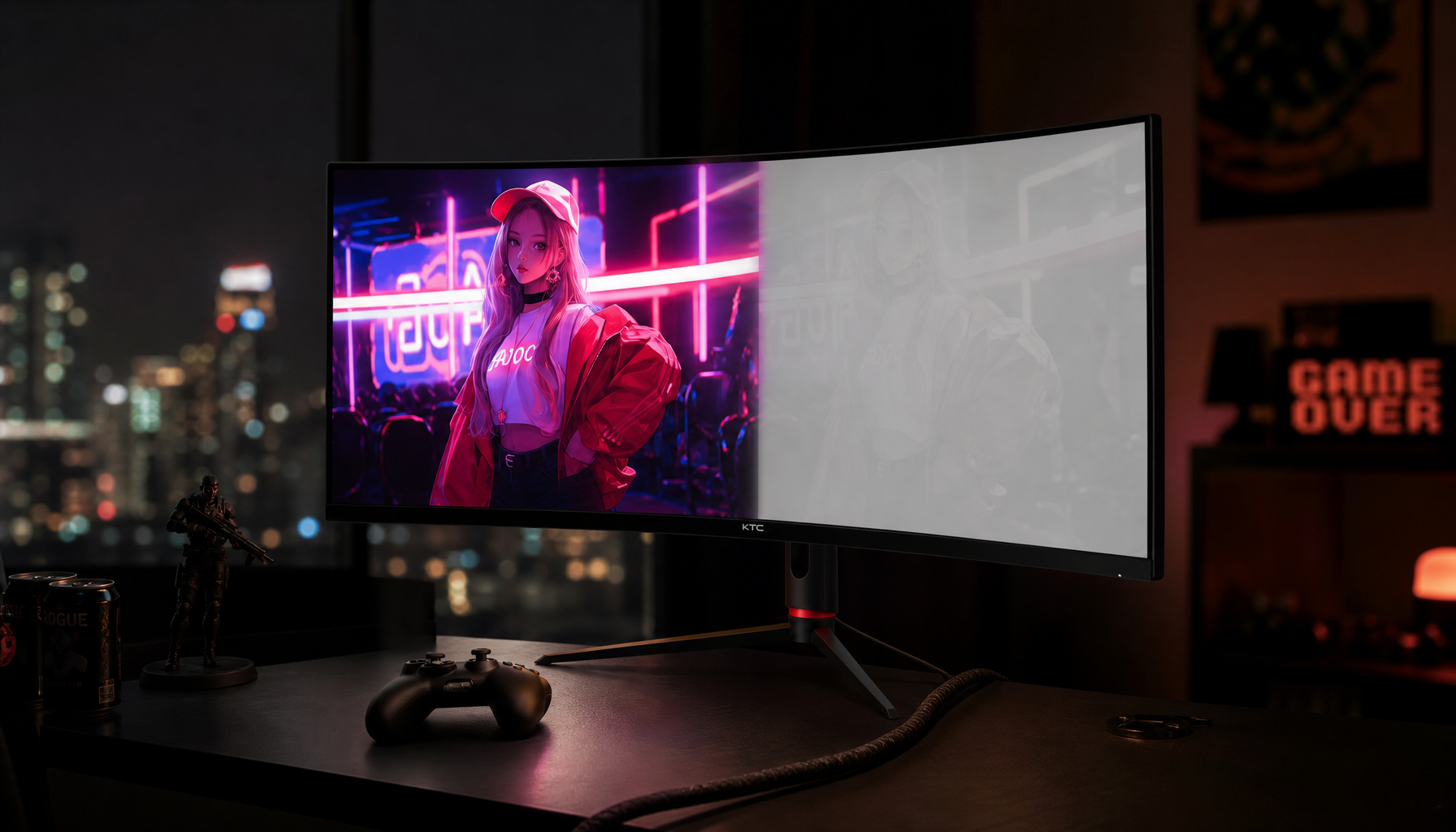
Visible brightness steps happen when a display’s backlight zones, dimming algorithm, response timing, and panel limits cannot change luminance finely enough to match the image. The result is a staircase-like jump in brightness instead of a clean fade from dark to bright.
Does a moonlit game scene look like it “snaps” from one brightness level to another as you pan the camera? A practical fix is often testable in minutes: lowering the local dimming strength, changing the HDR preset, or disabling dimming for desktop work can reduce the stepping without replacing the monitor. You’ll learn why the artifact appears, how to separate normal Mini-LED behavior from poor tuning, and which settings matter most.

What Local Dimming Is Actually Trying to Do
Local dimming exists because most gaming monitors, office displays, and portable smart screens based on LCD technology use a shared backlight. The LCD layer can block some light, but it cannot shut off each pixel the way OLED can, so dark areas may look gray unless the backlight is controlled more intelligently.
A local dimming system divides the LED backlight into controllable zones, then brightens or dims those zones based on what is on screen. In a good HDR scene, that lets a monitor keep a bright spell effect, neon sign, or specular reflection intense while reducing the backlight behind nearby shadows.
The tradeoff is precision. A 4K monitor has more than 8 million pixels, while even a strong Mini-LED backlight may have hundreds or a few thousand zones. Each zone still controls a block of pixels, so the display has to estimate the best brightness for an area that may contain black text, gray fog, and a white cursor at the same time.
Why Brightness Steps Appear
Zone Count Creates Coarse Brightness Geography
The simplest cause is that the backlight grid is lower resolution than the image. When a small bright object moves across a dark background, it crosses from one dimming zone to another. If the next zone turns on more strongly than the previous one, your eye sees a sudden jump.
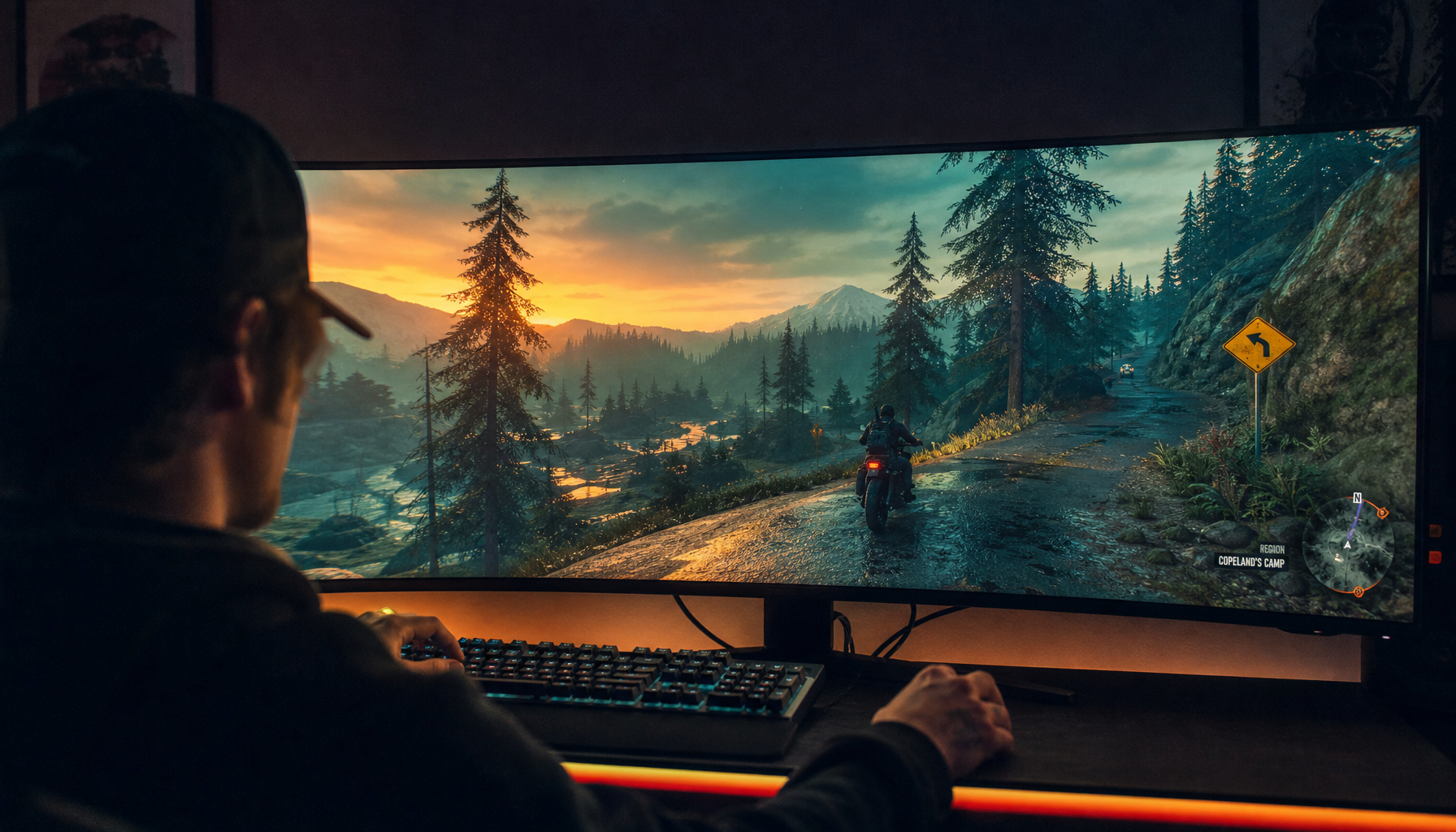
This is why star fields, subtitles, desktop cursors, health bars, loading spinners, and white windows on dark wallpaper are brutal tests. The object may be smaller than one zone, but the whole zone has to respond. On a 27-inch gaming monitor, a lower-zone Mini-LED system may look impressive in bright HDR trailers yet show obvious stepping in a dark cave when a torch moves across stone walls.

A monitor’s local dimming type matters here. Edge-lit dimming tends to control larger bands or broad sections, so transitions can look chunkier. Full-array local dimming places zones behind the panel, giving the system more precise control. Mini-LED improves this further by using smaller LEDs and more zones, but it still cannot match per-pixel light control.
Backlight approach |
Transition behavior |
Best fit |
Global dimming |
Whole screen rises or falls together |
Basic SDR use |
Edge-lit local dimming |
Large brightness bands may appear |
Budget displays, light HDR |
Full-array local dimming |
Better object tracking with some halos |
HDR movies and gaming |
Mini-LED full-array |
Finer control, still zone-limited |
High-brightness HDR and mixed use |
OLED |
Pixel-level transitions |
Dark-room contrast, no zone blooming |
Algorithms Choose Between Smoothness and Accuracy
A local dimming algorithm is constantly making compromises. It can preserve bright highlights, deepen blacks, protect shadow detail, reduce blooming, avoid flicker, or respond quickly, but it rarely maximizes all of those at once.
Research on efficient local dimming describes the problem as an optimization task: the system must provide enough luminance for the image while minimizing LED current. That technical framing explains why visible steps happen. If the monitor condenses the image into a lower-resolution brightness map or uses aggressive power-saving logic, nearby zones may be assigned noticeably different brightness values.
Some manufacturers intentionally spread light across neighboring zones to soften halos. That can make transitions look smoother, but it can also lift blacks and reduce the punch of HDR. Others clamp the light tightly around bright objects, which improves black depth but can create abrupt zone boundaries. Neither choice is universally correct; it depends on whether you value cinematic black levels, competitive visibility, desktop stability, or highlight intensity.
Slow Zone Response Makes the Step Easier to See
Brightness steps become more distracting when the backlight update lags behind motion. In a fast pan, the LCD pixels may update quickly while the backlight zones chase behind. Your eye catches a delayed bright patch, a dark leading edge, or a small light trail.
This is especially relevant for high-refresh gaming. A 144 Hz or 240 Hz panel refreshes quickly, but the dimming processor still has to analyze frames, calculate zone values, and drive the LEDs. If that pipeline is too conservative, the transition can look like a sequence of visible brightness plateaus instead of continuous movement.
The same principle appears in local dimming backlight research. A local dimming backlight using matrix-style addressing can face reduced duty time as the number of controlled rows increases, which constrains luminance behavior and control timing. Modern monitor backlights are not all built like that research prototype, but the engineering lesson holds: more controllable regions demand faster, smarter driving.
Why It Shows Up More in Some Content
Dark Rooms Expose the Artifact
Local dimming artifacts are easiest to see in a dark room because your eyes adapt to low black levels. A small brightness jump that would disappear under office lighting can become obvious during a late-night HDR session.
That is why a monitor can look clean during daytime work and distracting at night. The display may not be defective; your viewing condition has changed. If you use one screen for spreadsheets at 2:00 PM and HDR games at 10:00 PM, different dimming settings may make sense.
Desktop Work Is a Bad Match for Aggressive Dimming
Office productivity is full of high-contrast static elements: black text on white backgrounds, white text on dark code editors, window borders, menus, scrollbars, and cursor movement. Local dimming can interpret those elements as tiny HDR-like highlights, causing brightness shifts around text or panels.

Some Mini-LED setup recommendations suggest turning local dimming off for SDR office, web, document, and desktop use because uniform brightness is usually more comfortable. That matches hands-on monitor tuning experience: a high-impact HDR mode can be excellent in a game, then feel unstable in a browser or spreadsheet.
For a dual-use desk setup, the most reliable workflow is to save two display profiles. Use a steady SDR profile for work with local dimming off or reduced, then switch to an HDR profile with local dimming enabled for games and movies. That single habit removes many “my monitor is pulsing” complaints.
Settings That Reduce Visible Brightness Steps
Lower the Local Dimming Strength
Higher local dimming settings usually deepen blacks, but they also make zone decisions more aggressive. If a scene jumps from dark gray to near black too quickly, reduce the dimming level one step and replay the same scene. The best setting is the one where black depth improves without obvious pulsing, trailing, or stair-stepping.

A simple test is to open a dark video or game scene with a small bright object, then slowly move the camera or cursor. If stepping is obvious on the highest setting but tolerable one level down, the monitor is not failing; the top preset is simply prioritizing contrast over smooth transitions.
Adjust Halo or Blooming Controls Carefully
Some monitors include a halo dimming, blooming reduction, or local contrast control. These settings often tighten the backlight around bright objects. Used moderately, they reduce glow around subtitles and UI. Pushed too hard, they can dim highlights or make brightness changes look mechanical.
A practical compromise is to avoid the strictest halo control unless the scene needs it. Stricter settings can produce deeper blacks, but moderate settings may preserve more peak brightness and HDR impact. For gaming, that matters because a fireball, muzzle flash, or sun reflection should remain bright enough to feel like HDR, not just clean against black.
Do Not Use Contrast Controls as a Local Dimming Fix
The monitor’s contrast slider usually changes panel signal mapping, not the physical precision of local dimming zones. Raising contrast may make the image look punchier, but it can also clip bright detail or crush shadow texture. If the problem is visible zone stepping, start with local dimming strength, HDR mode, black level, and brightness before touching contrast.
A useful real-world sequence is to set the monitor to its intended HDR mode, pick a familiar dark scene, lower local dimming one notch, then adjust black level only enough to recover shadow detail. If dark clothing, cave walls, or night-sky gradients disappear, the setting is too aggressive.
Pros and Cons of Local Dimming Despite the Artifact
Local dimming is still one of the most valuable LCD upgrades when it is tuned well. It can make HDR games more dimensional, keep highlights bright in daylight, and avoid OLED burn-in risk for users who leave static productivity apps open all day. For a mixed gaming and work desk, that reliability has real value.
The downside is behavioral complexity. Unlike a basic LCD, a local dimming monitor is always interpreting the image. That interpretation can create blooming, black crush, flicker, delayed transitions, and visible brightness steps. More zones reduce the odds, but firmware quality and processing strategy decide whether the experience feels premium or distracting.
The strongest buying signal is not zone count alone. Look for full-array Mini-LED architecture, credible HDR capability, mature firmware, strong third-party testing, and user reports that mention desktop stability as well as game performance. A 1,152-zone monitor with poor tuning can be less pleasant than a lower-zone model with better algorithms and cleaner presets.
When Brightness Steps Are Normal and When They Are a Problem
Some stepping is normal on LCD local dimming displays, especially with small bright elements over black backgrounds. If it appears only in stress scenes, high local dimming modes, or dark-room subtitle tests, it is a limitation of the technology rather than a defect.
It becomes a problem when brightness jumps are visible in ordinary gameplay, when the desktop constantly pumps brighter and dimmer, when moving objects leave obvious light trails, or when firmware updates and settings changes do not improve it. At that point, the display may have weak processing, poor default tuning, or a local dimming mode that is not well matched to your use.
A standard LCD backlight can make blacks look gray because dark screen areas still receive light. Local dimming solves part of that problem, but it introduces a new one: the backlight now has to move intelligently. Smoothness depends on how gracefully it moves.
The Practical Verdict
Visible brightness steps are the price of zone-based light control when the hardware or algorithm cannot make fine, fast, subtle transitions. For HDR gaming and movies, keep local dimming on but tune it below the most aggressive preset if stepping distracts you. For office work, coding, browsing, and static UI, use a separate SDR profile with local dimming reduced or disabled.
The best display is not the one with the loudest Mini-LED spec sheet. It is the one that gives you deep contrast when immersion matters and steady brightness when productivity matters.