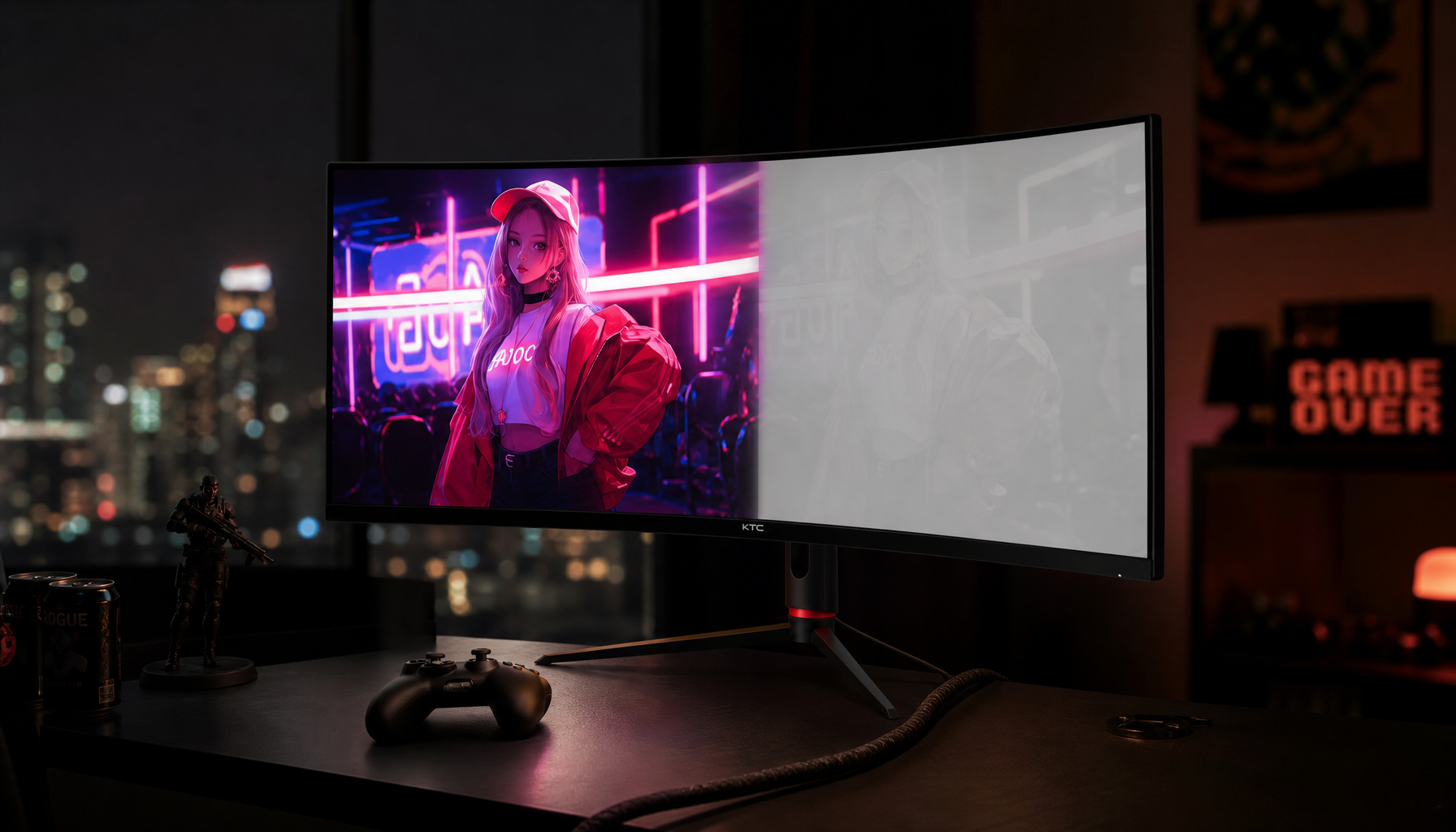
Local dimming boosts contrast by concentrating backlight power where highlights need it, but a full-screen white image asks every zone to run bright at once. To control heat, power draw, uniformity, and panel stress, a monitor often lowers sustained full-field brightness below its small-window peak.
Does your Mini-LED monitor look explosive in HDR highlights, then oddly restrained when a white document, spreadsheet, or snow-filled game scene fills the whole screen? Once you understand the difference between highlight brightness and full-screen brightness, you can choose the right local dimming mode for HDR gaming, creative work, and office use without chasing misleading spec-sheet numbers.
The Core Tradeoff: Peak Brightness Is Not Full-Screen Brightness
Peak brightness usually describes what a display can do in a limited bright area, such as a 10% HDR window or a small sun reflection in a game. Full-screen white is different because the entire backlight, power system, optical stack, and thermal design are loaded at once.
An LCD monitor does not create light at the pixel level. It uses an LED backlight shining through LCD material, and HDR LCDs improve contrast by dynamically brightening or dimming that backlight behind the image. With local dimming, the backlight is split into controlled zones, so a torch in a cave can stay bright while the surrounding shadows dim.
That strategy works well for mixed scenes. It is much harder when the whole screen is white because there are no dark zones to dim and no place to shift perceived brightness. A 1,000-nit spec may describe a small HDR highlight, while a full-screen white desktop may settle far lower to keep the display stable, uniform, and cool.
How Local Dimming Creates More Impact
Local dimming is often misunderstood as a simple brightness booster. It is really a contrast management system.
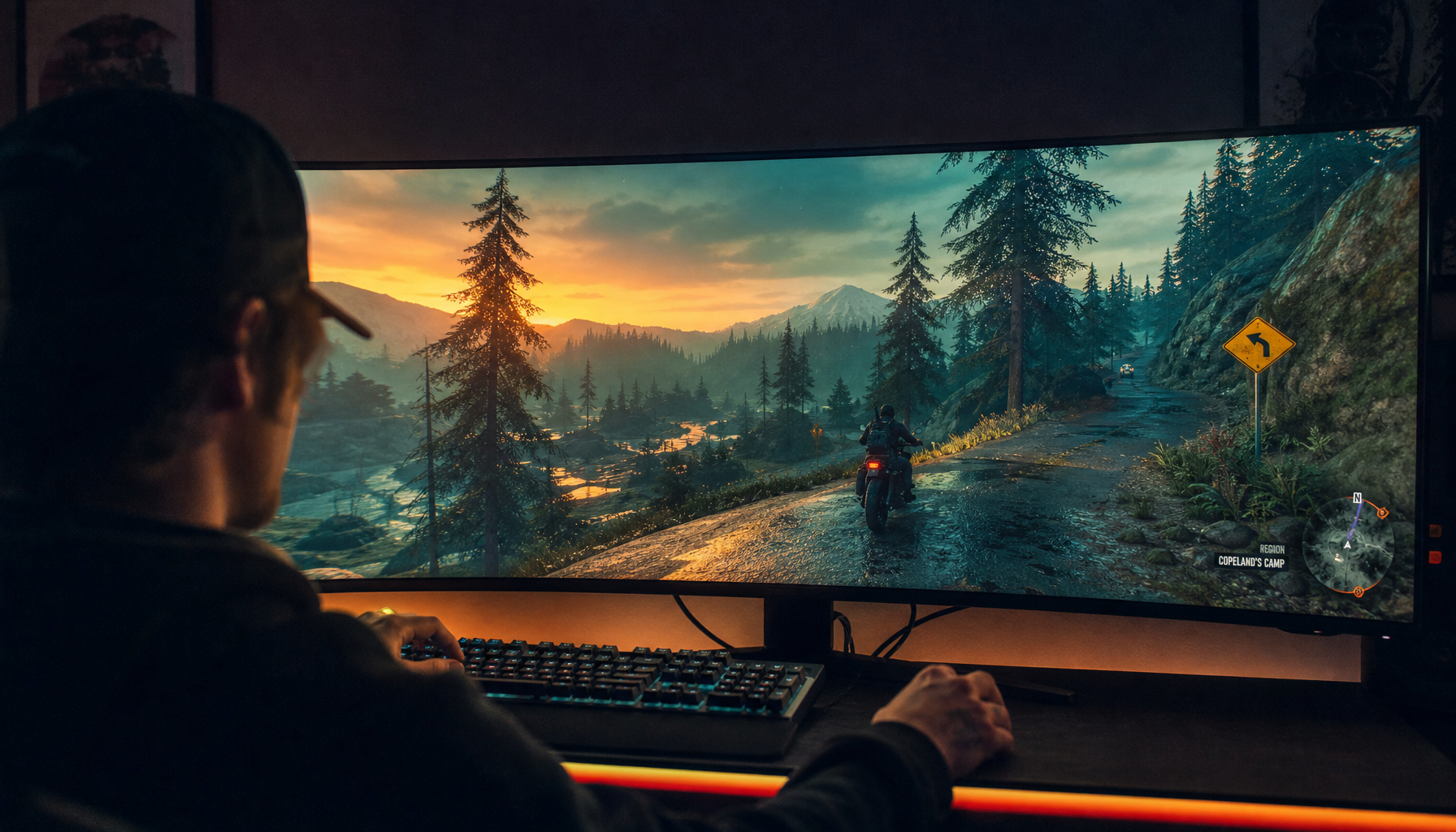
In a dark game scene, a Mini-LED monitor might dim hundreds or thousands of zones behind the black parts of the image while pushing only a handful of zones behind bright sparks, HUD glints, or muzzle flashes. Those bright objects feel more intense because the surrounding black level drops. The image gains depth even if the actual full-panel power budget has not increased.

Full-array local dimming usually outperforms edge-lit approaches because 2D full-array designs place LEDs behind the panel in a matrix and can reach much higher simultaneous contrast than simpler global or edge-lit dimming systems. In practical monitor terms, that means better night scenes, clearer HDR highlights, and fewer washed-out blacks.
The catch is that a full-screen white scene removes the advantage. Every zone is now bright. Instead of selective intensity, the display must deliver sustained light across the whole panel, and that is where effective peak brightness drops.
Why Full-Screen White Forces Brightness Down
The first reason is power. A Mini-LED backlight can push impressive luminance in small zones, but driving every LED zone near maximum at the same time can exceed the monitor’s intended power envelope. The display’s control system reduces output so it can stay within design limits.
The second reason is heat. Dense LED arrays, driver electronics, and LCD materials all generate and retain heat during sustained bright scenes. Outdoor LCD design discussions often emphasize that local dimming can reduce power use by lighting only necessary regions, and lower power draw reduces thermal stress on LEDs, driver ICs, power supplies, and LCD materials. Full-screen white removes that efficiency advantage because nearly everything is necessary at once.
The third reason is uniformity. If every zone is driven aggressively, panel edges, diffusion layers, and LED variations become more visible. A manufacturer may choose a lower full-field brightness target to keep a white document, browser page, or CAD canvas looking even instead of blotchy.

The fourth reason is algorithm behavior. Local dimming processors analyze image content in real time. They are tuned to avoid blooming, pumping, flicker, black crush, and sudden brightness shifts. In a full-white frame, the safest choice is often a stable, capped output rather than maximum output that may trigger thermal roll-off seconds later.
Small Highlights Versus Full-Screen White
The easiest way to evaluate this is to separate HDR punch from sustained canvas brightness. A 32-inch Mini-LED gaming monitor may look intense when a small explosion appears against a dark background. The same monitor may look less spectacular on a full white web page because the display is no longer using contrast separation; it is simply lighting the whole panel.

Scene Type |
What Local Dimming Can Do Well |
Why Brightness May Feel Different |
Small HDR highlight on dark background |
Dims dark zones and boosts bright zones |
Contrast makes the highlight appear more powerful |
Starfield, subtitles, neon signs |
Improves black depth while preserving bright objects |
Blooming may appear if zones are larger than the object |
Full-screen white document or snow scene |
Keeps the image broadly bright and readable |
Power, heat, and uniformity limits cap sustained brightness |
SDR office desktop |
Can add contrast, but may shift brightness by content |
Uniformity and comfort often matter more than drama |
This distinction is also why some users find local dimming impressive in games but distracting in productivity work. A browser with white pages, dark sidebars, and moving windows can cause zones to change brightness as content moves. For spreadsheets, coding, and documents, a steady SDR mode with local dimming reduced or disabled can feel more reliable.
Zone Count Helps, But It Does Not Defeat Physics
More zones usually mean finer control. A 1,152-zone 32-inch Mini-LED monitor can generally manage halos better than a 384-zone monitor of the same size because each zone covers less screen area. Display-measurement guidance explains that Mini-LEDs enable many more backlight elements and dimming zones than conventional LEDs, improving contrast control and reducing blooming.
But zone count does not make full-screen white free. Whether a monitor has 384 zones, 1,152 zones, or more, full-screen white still asks all zones to light up. Higher zone density improves precision in mixed scenes; it does not remove the need for power management, heat control, and brightness limiting.
This is where spec sheets can mislead. A monitor advertised around HDR peak brightness may deliver that only in limited windows. A creator or office user who spends hours on white timelines, dashboards, or documents should care about sustained brightness, uniformity, coating quality, and eye comfort as much as peak nit claims.
Is This the Same as OLED ABL?
It is related in outcome, but different in mechanism. OLED panels use automatic brightness limiting because each pixel emits its own light, and full-screen brightness creates high power and heat demands across the emissive layer. LCD and Mini-LED monitors use a separate backlight, so the limit comes from the backlight system, local dimming algorithm, power supply, thermal design, and panel uniformity targets.
The user experience can look similar: a small white highlight gets very bright, while a full-screen white image is dimmer than expected. The engineering path is different, but the practical lesson is the same. Small-window peak brightness is not the same promise as sustained full-field brightness.
Pros and Cons of Local Dimming for Real Work
Local dimming is a strong advantage for HDR gaming, movie watching, and dark-room immersion. It gives LCD monitors deeper blacks, higher perceived contrast, and more convincing highlight separation. On a good Mini-LED monitor, a night race, sci-fi cockpit, or dimly lit RPG dungeon gains dimensionality that a standard edge-lit LCD cannot match.
The tradeoffs show up in precision work and bright desktop use. Local dimming can cause blooming around bright UI elements, dim small highlights too aggressively, crush shadow detail, or shift brightness as windows move. Structured monitor testing often focuses on artifacts such as blooming, light trails, black crush, and processing speed, which aligns with what demanding gamers notice during play.

For office productivity, the benefit depends on the content. A bright spreadsheet does not need cinematic black levels. A portable smart screen used for email, dashboards, or travel work may be better served by stable brightness and low power draw than aggressive dimming. For HDR games and movies, turn it on. For long SDR work sessions, test whether a lower local dimming setting gives you a calmer image.
Practical Settings Advice
Start by separating SDR and HDR behavior. In SDR, set brightness for the room first, then decide whether local dimming improves comfort or creates visible shifts. If your monitor offers Off, Low, Medium, and High, Medium is often the best first test because it balances contrast with fewer artifacts than the strongest mode.
In HDR, enable local dimming unless the implementation is clearly poor. HDR relies on deep blacks and bright highlights appearing together, and active dimming exists specifically to respond to real-time video content rather than static metadata alone. Use real content to judge it: a dark game menu with bright text, a starfield, a night city scene, and a bright snow map will reveal more than a single white test screen.
For full-screen white brightness, do not force maximum settings just to match a peak brightness number. If the monitor becomes hot, noisy, uneven, or visually unstable, the setting is outside its comfort zone. A slightly lower brightness level with stable uniformity is better for work and often easier on your eyes over a full day.
How to Buy Smarter
When comparing gaming monitors, office displays, and portable smart screens, read peak brightness claims with context. Ask whether the number refers to a small HDR window, a larger window, or sustained full-screen output. If the manufacturer does not say, assume the headline figure is not full-screen white.
For HDR gaming, prioritize full-array or Mini-LED local dimming, strong third-party measurements, reasonable zone density for the screen size, and well-reviewed dimming algorithms. For productivity, prioritize uniformity, text clarity, ergonomic brightness range, and the ability to turn local dimming down or off. For portable screens, battery and heat constraints make sustained brightness especially important, so a lower but stable full-screen output can be more useful than a flashy peak claim.
Local dimming does not fail when full-screen white is dimmer than peak HDR. It is doing what high-performance displays are designed to do: spend brightness where it creates the most visual value, then protect power, heat, and uniformity when the whole panel is under load. The best setup is not the brightest number on paper; it is the mode that keeps your games immersive, your work readable, and your screen behavior predictable.