Your monitor’s contrast slider usually does not change the panel’s true black floor, so dark scenes can still look gray even when you turn it up or down. On many displays, the real limit is the panel and backlight, not the OSD setting; a 300 nit white point with 0.3 nits of black is only 1,000:1, while 0.1 nits of black raises that to 3,000:1.
If you have ever sat in a dark room, opened a game or movie, and wondered why the corners still glow, you are seeing the display’s limits more than a bad setting. The good news is that a few changes do help, and the right monitor choice matters even more. Here is how to tell the difference, what to adjust, and what to look for when buying a monitor for gaming, movies, or everyday use.
What Contrast Really Controls
Brightness vs. contrast ratio are not the same thing. Brightness is how much light the screen emits overall; contrast ratio is the gap between the brightest white and the darkest black. The contrast control on a monitor often affects the top end of that range more than the bottom end, so it can make whites pop, clip highlights, or shift shadow detail without actually lowering the black floor.
Why the slider feels like it should work
Most people expect “contrast” to mean “more separation everywhere.” In practice, if the panel cannot block light well, the black level stays where the hardware puts it. That is why a monitor can look brighter without looking darker in the shadows.
When the setting helps
Keep contrast near default unless whites look blown out or blacks look crushed. If the image looks washed out, brightness, gamma, room light, or HDR mode is often the real problem, not the contrast slider.
Why Blacks Look Gray Anyway
Black levels appear gray in bright rooms because ambient light reflects off the screen and raises the visible black floor. That effect is easy to miss on a spreadsheet, but it is obvious in games, films, and desktop backgrounds with large dark areas.

Room light matters more than most people think
A monitor that looks fine at noon can look milky at night if the room is dark and the screen is still too bright. A practical setup for a typical office is roughly 100 to 150 nits of screen brightness with about 300 to 500 lux of ambient light.
Reflections and gamma change perception
Higher gamma deepens shadows, while a lower gamma can make the image look flat. Reflections from windows, lamps, and white walls can do more damage to perceived black depth than the contrast setting ever will.
The Real Limits: Panel Type and Backlight Behavior
Monitor black levels are limited mainly by how the panel handles light. IPS LCDs use a constant backlight and do not fully block it, so blacks often look gray in dark rooms. VA panels usually deliver deeper native contrast, Mini-LED improves the black floor with local dimming, and OLED can switch pixels fully off.

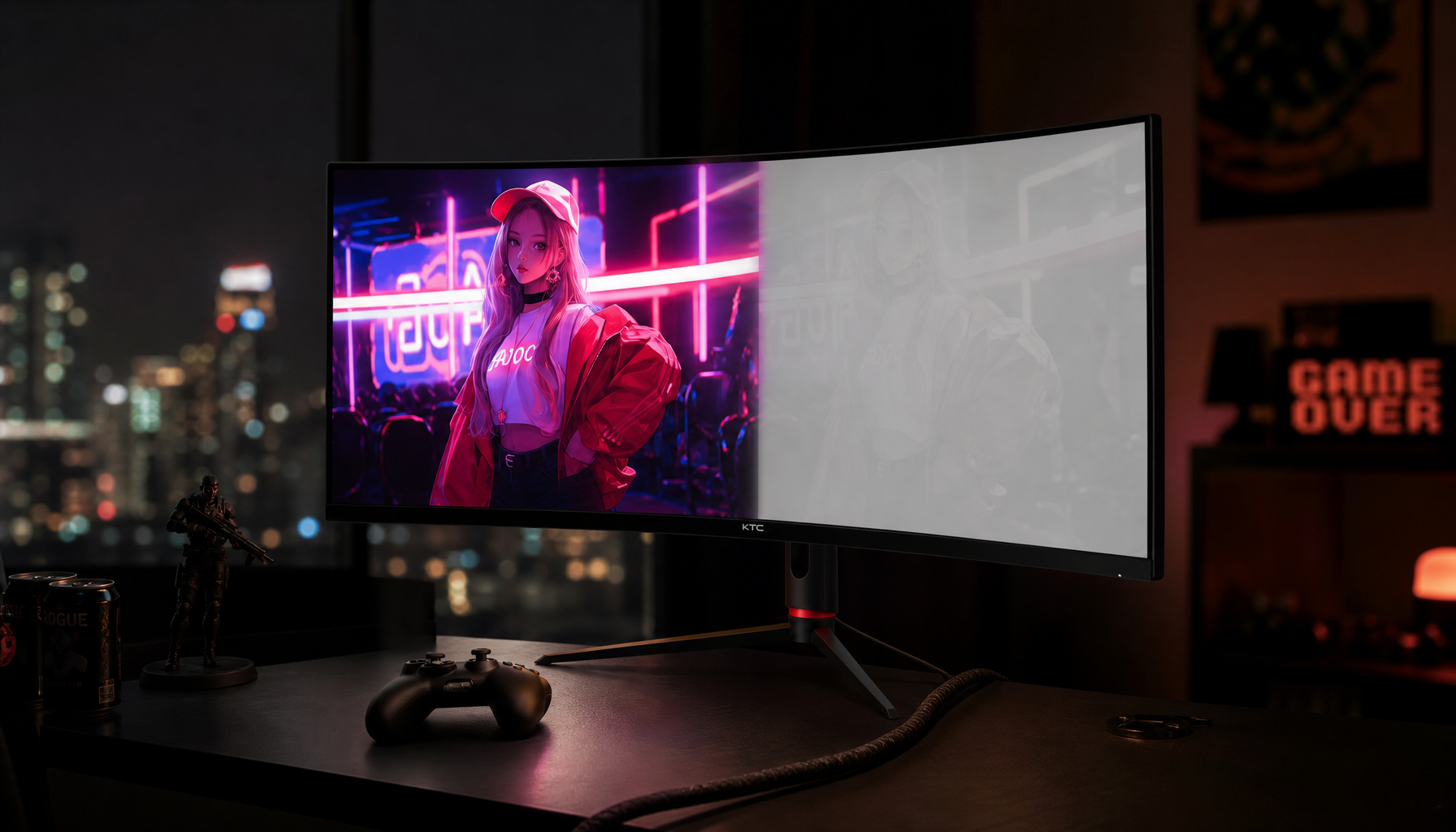
That is why a display such as the a brand’s OLED 27” 2K 240Hz/0.03ms USB-C Gaming Monitor belongs in a different comparison than an LCD with the same contrast slider: its OLED panel behavior is the main reason dark scenes can look different.

IPS glow versus backlight bleed
IPS glow changes with viewing angle and often shows up in corners. Backlight bleed stays in the same physical spot and is more like fixed leakage. If the glow moves when you shift your head, that is one thing; if it stays pinned to one edge, that is another.
Uniformity can be the issue
Some LCDs are simply uneven, with corners brighter than the center. The result is a black image that looks patchy even when settings are unchanged. Severe cases are worth returning or exchanging, especially on a new monitor.
What Settings Actually Help
Gaming monitor dark scenes often look gray because gaming presets raise near-black tones to reveal enemies in shadows. That can be useful in competitive play, but it weakens the separation between true black and dark gray.
Best baseline settings
Start with Standard or Custom mode, set gamma near 2.2, keep shadow boost off or very low, and lower brightness to fit the room. If the monitor supports HDR, make sure the monitor, operating system, cable, GPU, and game are all actually negotiating HDR correctly; a bad HDR setup can look flat and gray.
Bias lighting can help
A dim light behind the monitor reduces the contrast between the screen and the wall behind it. That can make blacks look less washed out without changing the panel at all.

What to Buy If You Care About Black Depth
Black level and uniformity are more important than a high contrast setting if you want darker blacks for gaming or movies. For work, 1,000:1 native contrast is often acceptable. For darker gaming and movie use, 2,000:1 to 3,000:1 or better is a more meaningful target, while OLED still leads if you want the deepest blacks.
Quick comparison
Option |
What it changes |
Black depth |
Best use |
Contrast slider |
Mostly white level and shadow balance |
Low impact |
Fine-tuning after calibration |
Brightness |
Overall screen output |
Medium impact |
Matching the room |
Gamma |
Shadow separation |
Medium impact |
Making dark scenes look more natural |
IPS panel |
Wide viewing angles |
Weakest blacks |
General use, color work |
VA panel |
Higher native contrast |
Deeper blacks |
Movies, mixed gaming |
Mini-LED |
Local dimming zones |
Better blacks, possible blooming |
HDR and darker content |
OLED |
Pixel-level off state |
Deepest blacks |
Best black depth overall |
Watch for Mini-LED tradeoffs
Mini-LED can improve dark scenes, but bright objects may create blooming around them. That is still usually better than a gray black floor, but it is worth knowing before you buy.
Practical Next Steps
If your monitor looks gray in dark scenes, lower brightness first, then check gamma and room light before touching contrast. If the panel is IPS, some glow is normal; if the bleed is severe or uneven in normal use, a return or exchange is the better fix than endless menu tweaking.
For buyers, the priority order is simple: panel technology first, then native contrast, then local dimming or OLED, and only after that the OSD contrast setting. That is the difference between tuning a display and asking it to do something its hardware cannot do.
FAQ
Q: Why does changing contrast not make black screens look darker?
A: Because the monitor usually cannot lower its minimum light output with that control. It tends to reshape the top end of the image more than the black floor.
Q: What setting should I change first for better blacks?
A: Lower brightness first, then set gamma near 2.2 and disable aggressive shadow boost or FPS presets. Also check room reflections.
Q: Is a higher contrast ratio always better?
A: Usually yes for dark content, but the number only matters if it is native contrast, not a marketing dynamic contrast figure. Panel type and uniformity matter just as much.