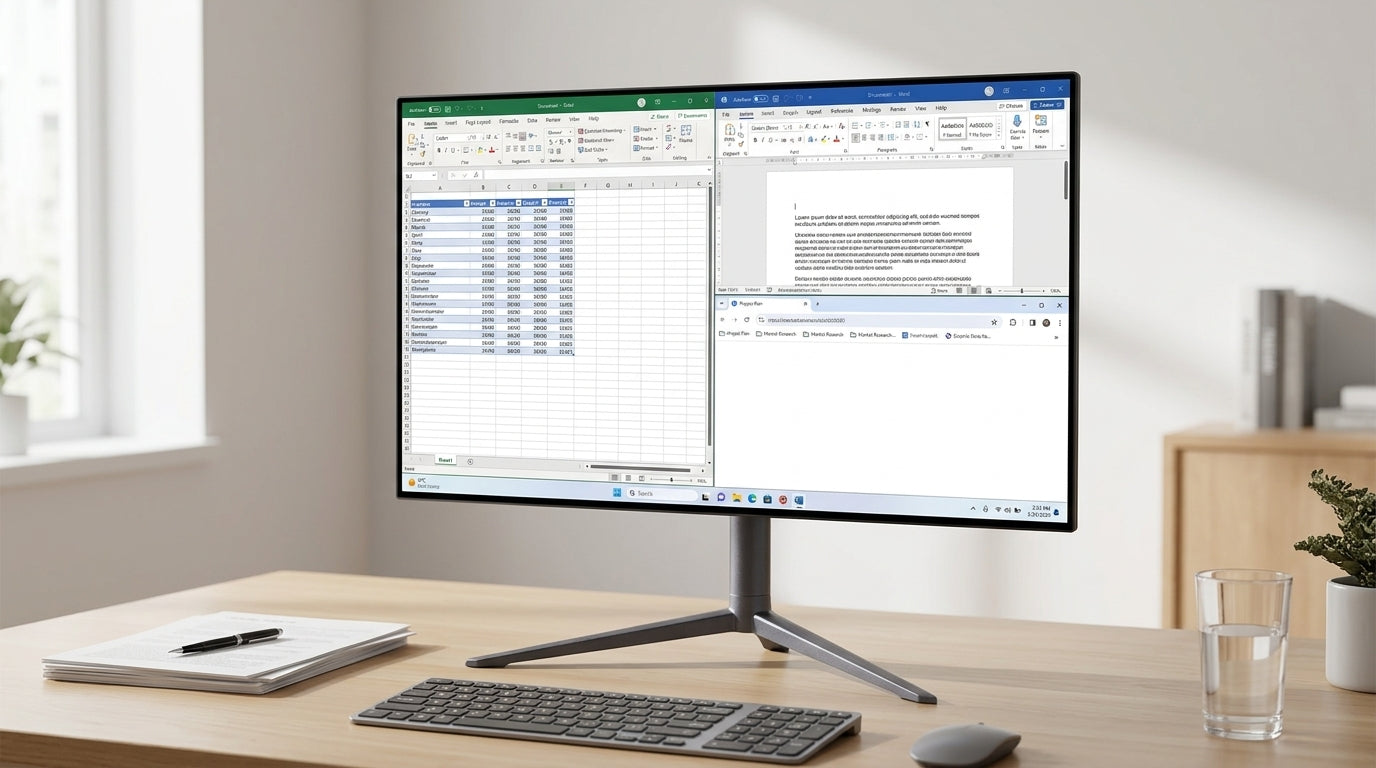
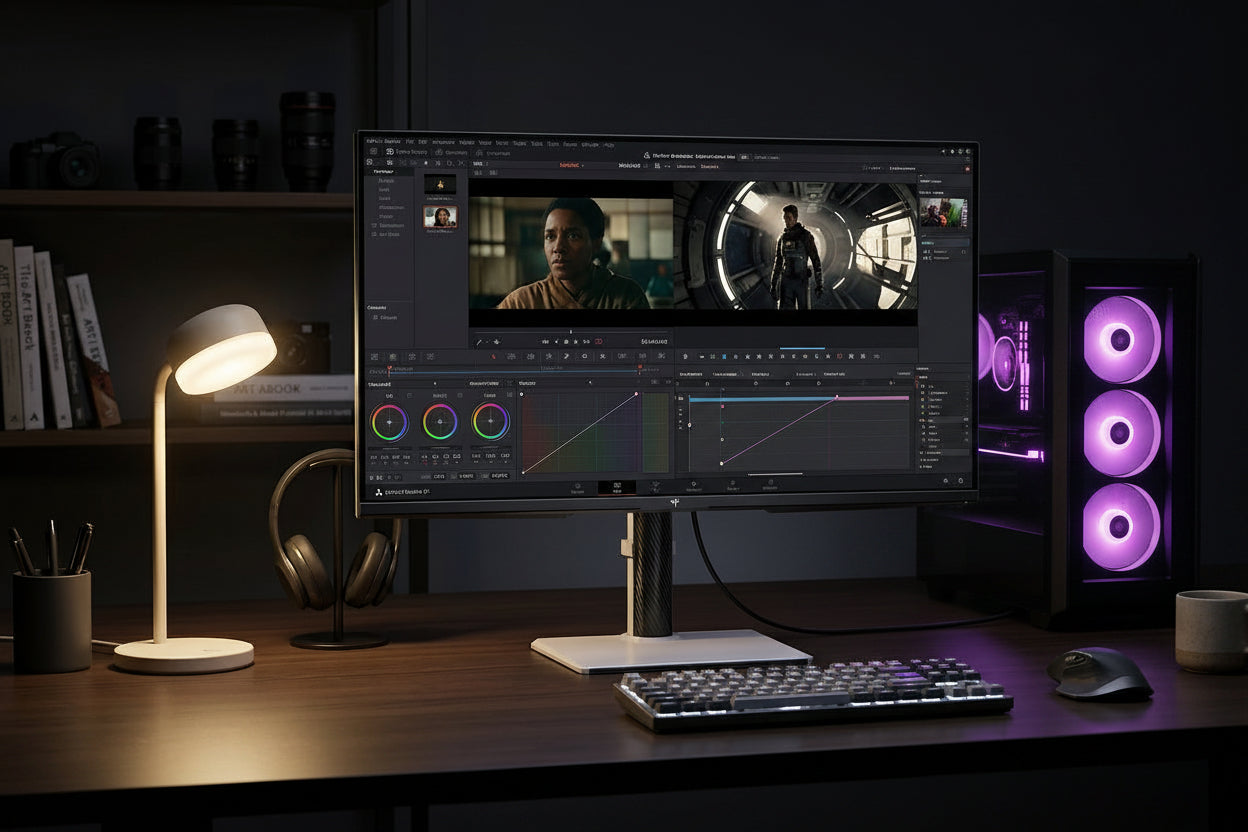
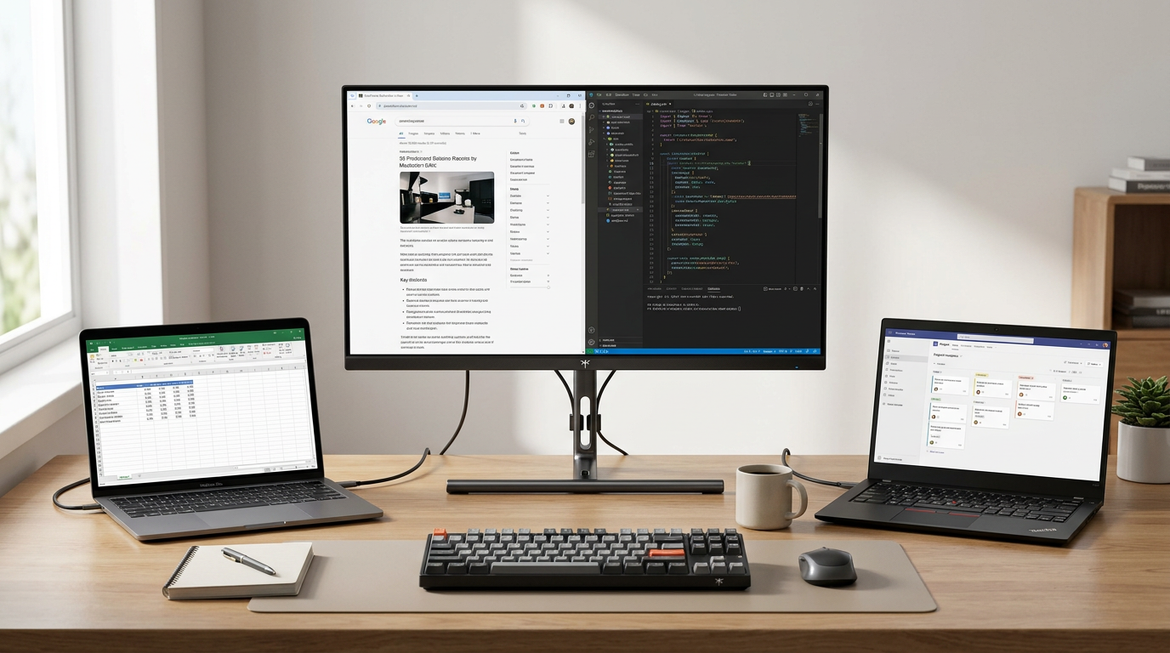
For most RTS players at a normal desk, a 27-inch 1440p monitor offers the best balance of map awareness, readable UI, and fast scanning. Larger options can work better if your seating distance, desk depth, and hardware support them.
Are you missing flanks, floating resources, or dragging your eyes between the minimap and the main fight when a match gets chaotic? In practice, the best screen is the one that lets you read the battlefield quickly without extra head movement or soft-looking detail. The right choice depends on your seating distance, game pace, and hardware.
Why screen size changes situational awareness in RTS
Situational awareness in real-time strategy games is not just about seeing more. It is about how quickly you can absorb the minimap, unit groups, production tabs, resource counters, and the active engagement without losing focus. That makes monitor size a visibility, eye-travel, and clarity issue at the same time.
A larger screen can feel more commanding, but a bigger panel does not automatically show more of the game world by itself. At the same aspect ratio and resolution, it mainly makes the same content physically larger, which can improve comfort and readability while also increasing the distance your eyes travel across the screen. physical size versus performance factors helps clarify that distinction.
That difference matters in RTS. If your minimap sits in one corner and your army control groups sit on the opposite side, a screen that is too large for your seating distance can slow your scan pattern. On the other hand, a screen that is too small can make unit silhouettes, terrain detail, and HUD elements feel cramped, especially in modern strategy games with dense interfaces.
The best size for most players: 27 inches
For a standard desk setup, 27 inches is the strongest all-around choice because it balances immersion with control. recommended monitor sizes for typical desk distances supports the same practical idea: 27 inches works especially well when you sit roughly 26 to 32 inches away and want a screen large enough to read comfortably without turning every glance into a long eye movement.
For RTS specifically, that balance matters. You are rarely making a single centered flick the way an FPS player does. You are constantly sweeping the display, checking supply, production, scouting information, and map state. A 27-inch panel is usually large enough to make those elements easier to parse than on a 24-inch screen, while still small enough to keep the full scene within comfortable vision.
Resolution is what makes 27 inches work especially well. 27-inch pixel density at 1440p shows that 27-inch 1440p lands around 109 pixels per inch, while 27-inch 1080p looks noticeably softer at close range. That softness matters in RTS because fine terrain textures, health bars, and small icons are read constantly, not occasionally.
A simple example helps. If you sit about 28 inches from your monitor and spend half the game bouncing between the center battle and the minimap, 27 inches usually lets you keep both in your visual rhythm without feeling cramped or stretched. That is why it is the safest recommendation for most desks and most strategy players.

When 24 inches is still the better tactical choice
A smaller screen still makes sense if you sit close, play very fast RTS titles, or value instant full-screen comprehension over sheer scale. the benefits of smaller displays at close range reinforces the main advantage: less eye movement when you are near the screen.
That benefit is easiest to notice when your desk is shallow, around 24 inches deep or less, or when you sit in a very upright competitive posture. A 24-inch display keeps every HUD element tighter inside your natural field of view. In a hectic early-game scout defense or multi-prong harassment sequence, that tighter presentation can feel cleaner and faster.

The tradeoff is that 24 inches gives you less physical space for interface-heavy strategy games. Menus, build queues, and map details are more compressed, so long macro sessions can feel busier. If your game leans more toward economy management, city-building layers, or complex late-game army control, 24 inches can start to feel efficient but not spacious.
When 32 inches or ultrawide improves awareness
Bigger screens become more compelling once your game rewards broad information density more than pure scan speed. ultrawides as a fit for strategy games supports 34-inch to 38-inch ultrawides for this use, and larger formats for strategy titles points in the same direction.
The reason is straightforward. RTS games often reward wide information layouts: more visible map space, more comfortable room for dense UI, and a larger battlefield image that reduces squinting during long sessions. On a 34-inch ultrawide, the extra horizontal workspace can make the main combat area and side UI feel less congested, similar to the multitasking advantage described in the extra horizontal workspace.

The catch is ergonomics. A 32-inch screen usually needs more distance, and a 34-inch ultrawide needs even more room to breathe. recommended screen sizes at longer viewing distances suggests 27 to 32 inches when you sit roughly 3 to 4 feet away, while closer desktop distance guidance favors 27 inches at shorter range. If you force a 32-inch or 34-inch screen onto a shallow desk, you can end up with more visual real estate but worse practical awareness because your eyes and neck work harder.
There is also a game-support nuance. Ultrawide can be excellent in strategy games that scale well across 21:9, but support quality is not universal. Some titles handle the added width beautifully; others push the UI into awkward positions or leave you managing stretched layouts. That does not make ultrawide a bad choice, but it does make it a better fit for players who already know their main games support it well.
Resolution and refresh rate matter as much as size
A blurry large screen is a downgrade for strategy. how resolution affects gaming image quality and what to prioritize in monitor image clarity support the same point: resolution affects sharpness, and sharpness affects how easily you can read the image.
For RTS, the most reliable pairings are 24-inch at 1080p, 27-inch at 1440p, and 32-inch at 4K or at least a strong 1440p implementation. A 27-inch 1080p panel can look coarse at a normal desk distance, and that softness hurts the small visual cues strategy players rely on.
Refresh rate still matters, even though RTS is not usually discussed like a twitch shooter. why higher refresh reduces motion blur explains the core benefit. In practice, 144Hz is already a strong target for RTS because it makes map scrolling, unit motion, and camera pans look cleaner. Going to 240Hz can help if your system can actually drive it, but that upgrade matters less than getting the right size-and-resolution match first.
It is also worth separating screen size from frame-rate myths. Your GPU load comes from resolution and settings, not from the physical inches of the panel. A 24-inch 1440p screen and a 27-inch 1440p screen ask the GPU to render the same pixel count; the difference is how large and sharp that image appears to you.
The practical decision table
Screen size |
Best for |
Best seating distance |
Best resolution match |
Main awareness advantage |
Main risk |
24 inches |
Close-up competitive play |
About 20 to 30 inches |
1080p |
Fast full-screen scanning |
UI and map can feel cramped |
27 inches |
Most RTS and mixed gaming |
About 24 to 32 inches |
1440p |
Best balance of readability and scan speed |
Less dramatic than larger formats |
32 inches |
Immersive strategy and sim-heavy play |
About 30 to 36 inches |
1440p minimum, ideally 4K |
Larger battlefield and easier UI reading |
Too much eye travel on shallow desks |
34-inch ultrawide |
Strategy players who want width and workspace |
About 30 inches and up, with a deeper desk |
3440x1440 |
More horizontal space and a cleaner layout |
Game support and desk fit matter more |
So what should you buy?
If you want the safest, highest-value answer for RTS situational awareness, buy a 27-inch 1440p monitor with at least 144Hz, solid pixel response, and adaptive sync. It gives you enough space to read the battlefield and interface clearly while keeping the entire screen manageable during rapid decision-making.
If your desk is deeper, your favorite games have dense interfaces, and you want a more commanding view, a 32-inch 16:9 display or a 34-inch ultrawide can be the better tool. Just do not mistake bigger for better unless your seating distance, resolution, and GPU are aligned. The best setup is the one that keeps your eyes moving quickly, your minimap readable, and your decisions one step ahead.