




A professional day trading monitor setup prioritizes data density and ergonomic efficiency over raw screen size, helping traders track charts, Level 2 data, watchlists, and news feeds without constant window switching or neck strain.

Resolution Choice: Why 4K and 5K Matter for Trading
Interactive Brokers officially recommends 4K resolution for its Trader Workstation software to deliver adequate screen real estate for complex portfolios and real-time data. This establishes 4K as the practical baseline for most day traders rather than a luxury upgrade.
On a 27-inch panel, 5K resolution reaches approximately 218 pixels per inch compared with 163 PPI at 4K. The higher density keeps small-font Level 2 order flow and thin candle wicks sharp, which matters for traders who keep multiple data windows open simultaneously. macOS users gain an additional benefit because 5K panels support native Retina scaling without the blur that can appear when forcing 4K content onto lower-density screen.
Traders running Windows platforms can achieve similar clarity with 4K panels while avoiding the higher cost of 5K hardware. Models such as the KTC 27" 5K@60Hz 2K@120Hz Home&Office Monitor pair well with Mac-based workflows that value text sharpness above refresh rate.
Multi-Screen Layouts: Finding Your Ergonomic Sweet Spot
Ergonomic standards from OSHA advise keeping secondary monitors within a 35-degree viewing angle of the primary screen to reduce chronic neck strain during long sessions. This guideline limits how wide a monitor array can stretch before it becomes counterproductive.
Vertical orientation works well for deep watchlists and news feeds because it maximizes visible rows without forcing excessive head rotation. Many traders combine one horizontal primary monitor for execution windows with vertical secondary screens for data feeds, following guidance in resources such as the Vertical vs. Horizontal: How to Build the Ultimate Dual Monitor Productivity Setup.
A single 32-inch 4K display can outperform a triple-monitor array when desk depth is limited. The larger canvas reduces bezel breaks and cable clutter while still providing enough pixels for multiple chart layouts. Most traders find that three or four total displays represent a practical cognitive limit; beyond that point, scanning friction often offsets any additional information gained.
Recommended Monitor Configurations by Trading Style
Comparison of common layouts showing how monitor count and orientation align with scalping versus information-heavy strategies.
Show data table
| Layout | Scalper Score | Swing/Information Trader Score | Key Trade-off |
|---|---|---|---|
| Single 27-32" 4K/5K | 9 | 6 | Minimal neck movement, less desk depth needed |
| Dual Horizontal 27" | 7 | 7 | Good for charts and execution, limited watchlist rows |
| Mixed Vertical + Horizontal | 6 | 9 | Best for long lists and news; requires 35° angle compliance |
| Triple+ Array | 4 | 8 | Highest data capacity but risks scanning fatigue |
The Mini-LED Advantage: Contrast Without the Burn-In Risk
Mini-LED backlighting delivers higher contrast than standard IPS panels while eliminating the static-image burn-in risk associated with OLED displays. This combination suits trading interfaces that remain on screen for hours with fixed UI elements such as price ladders and watchlists.
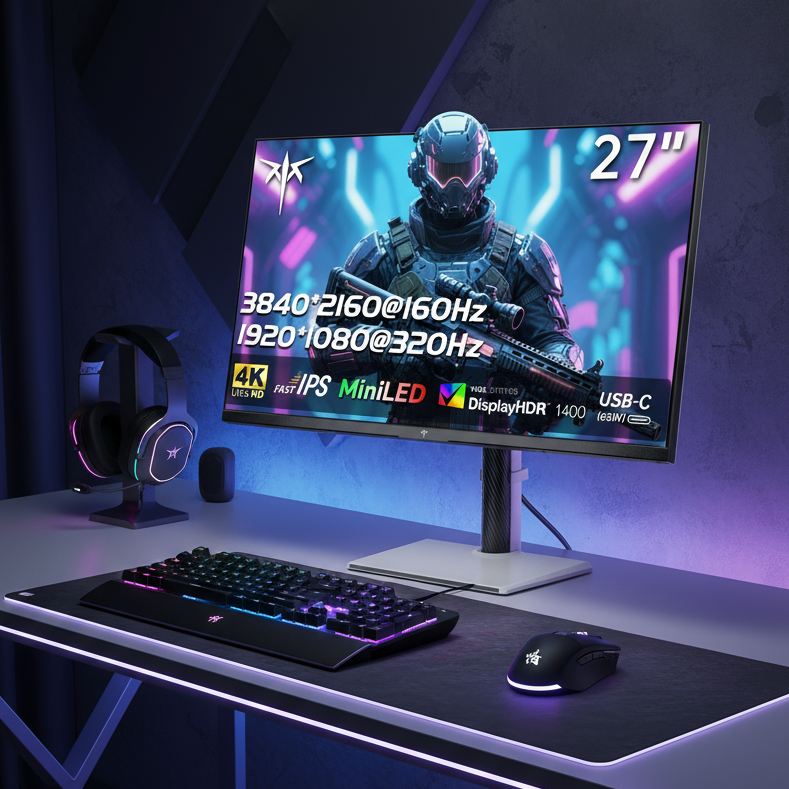
Zone density directly affects blooming around bright text on dark backgrounds. Panels with 1152 or more local-dimming zones, such as the KTC Mini LED 27" 4K 160Hz HDR1400 Gaming Monitor, keep halos small enough that they rarely interfere with thin chart lines. Traders can further reduce artifacts by lowering local-dimming intensity or switching to light-mode themes during active market hours.
The same panel also supports 160 Hz refresh, which smooths scrolling through long watchlists without adding meaningful input lag for non-gaming use. See the Mini-LED IPS vs. Standard IPS: Is the Advanced Backlight Worth the Upgrade? for deeper backlight comparisons.
Hardware Optimization: Avoiding Lag and Cable Clutter
Driving three or more 4K displays smoothly typically requires a dedicated GPU with at least 8 GB of VRAM and strong single-core CPU performance. Insufficient VRAM can cause chart lag or delayed order-book updates during peak market volatility.
USB-C monitors with 90 W power delivery simplify laptop-based setups by carrying video, data, and charging over one cable. The KTC 27" 4K 160Hz/320Hz 90W Gaming Monitor exemplifies this approach for traders who move between home and portable workstations.
VESA mounting recovers desk space and enables precise alignment across multiple screens. Combined with the Home Office Setup Guide: How to Choose the Right Ergonomic Monitor, traders can position panels at consistent heights while routing cables behind the desk.
For budget-conscious users who still need sharp 4K without gaming-level refresh rates, the KTC 27" 4K IPS 60Hz Low blue Light Home&Office Monitor provides a stable, cost-effective foundation.
Building Your Professional Trading Desk: A Decision Checklist
Start by matching primary resolution to your operating system: 5K for Mac Retina scaling or 4K for Windows platforms. Next, decide monitor count based on strategy—scalpers often prefer one or two large screens, while swing traders monitoring multiple data sources benefit from mixed horizontal and vertical layouts.
Prioritize VESA arms or height-adjustable stands so the top of the primary monitor sits at or just below eye level. Finally, evaluate room lighting: Mini-LED panels handle bright offices better, while standard IPS models suffice in controlled lighting with lower power draw.
Test window-management software such as DisplayFusion or macOS Spaces before finalizing the physical layout. Small adjustments in scaling and taskbar placement can eliminate the need for additional monitors.
Frequently Asked Questions About Trading Monitor Configurations
How Many Monitors Do Most Day Traders Actually Need?
Three displays strike the most common balance for active traders: one primary screen for execution, one vertical screen for watchlists, and one for news or Level 2 data. Adding a fourth screen rarely improves decision speed once scanning time exceeds the benefit of extra information.
Is 4K Resolution Necessary for Professional Trading Platforms?
Professional platforms such as Interactive Brokers set 4K as the recommended minimum. Lower resolutions force more window switching or smaller fonts that increase eye strain over multi-hour sessions.
When Should Traders Consider a 5K Monitor Instead of 4K?
5K becomes worthwhile when running macOS with native Retina scaling or when Level 2 data and small-font annotations must remain crisp for six or more hours daily. Windows users rarely need the upgrade unless they specifically value the higher pixel density.
Does Mini-LED Blooming Affect Chart Readability?
Aggressive local dimming can create halos around bright text on dark backgrounds. Panels with 1152 or more zones keep these artifacts small enough that most traders can manage them by adjusting dimming strength or UI theme during market hours.
What Desk Depth Works Best for Multi-Monitor Trading Setups?
A depth of at least 24 inches allows proper monitor arm placement and keeps the primary screen at a comfortable viewing distance. Shallower desks favor a single 32-inch 4K display over multiple 27-inch panels to avoid crowding.


