For most curved monitors, sit about 2.5 to 4 ft away. For a 49-inch ultrawide, start around 40 inches, then adjust closer for gaming or farther back for text-heavy work.
If the sides of your curved gaming monitor look stretched, washed out, or harder to read, your monitor may not be defective. In many real desk setups, moving from about 24 inches to the 36- to 42-inch range can make a 49-inch ultrawide look more even and easier to scan. This guide gives you practical viewing distances, setup checks, and distortion fixes for curved, ultrawide, and high-refresh-rate displays.
Why Curved Monitor Distortion Happens
A curved monitor changes the geometry of the screen by bringing the left and right edges closer to your eyes, but it does not add screen space or improve resolution. The perceived benefit is strongest on wide formats such as 21:9 ultrawide and 32:9 super-ultrawide monitors, where the curve keeps more of the panel inside your forward field of view curved monitors.
Distortion usually appears when your eyes are too close, too far off-center, or outside the curve’s comfortable viewing zone. On a 49-inch ultrawide, sitting around 24 inches away can make the edges look exaggerated, while many setups feel more natural around 35 to 42 inches large ultrawides.

The Curve Is Not the Only Cause
If distortion appears only in certain games, check the game before blaming the monitor. Field of view settings, fullscreen mode, adaptive sync, vertical sync, refresh-rate settings, graphics drivers, and aspect-ratio support can all make a curved display look wrong in one title but normal on the desktop.
Panel type also matters. IPS panels usually hold color and brightness better from side angles, while VA panels can show more gamma shift or side-to-side washout, especially on large ultrawides. TN panels are typically the weakest for off-axis viewing.
How Close Is Too Close?
For standard curved gaming monitors, many users land around 27 to 32 inches for gaming and 30 to 35 inches for productivity. That range is close enough for immersion without forcing your eyes to sweep too aggressively across the edges.
For 49-inch ultrawide monitors, a better starting point is farther back: about 36 to 42 inches for most mixed use. A dedicated racing, flight sim, or immersive FPS setup can work closer, around 36 to 40 inches, while spreadsheet work, timelines, coding, and document editing often feel better around 42 to 48 inches 49-inch ultrawide monitor.

Quick Distance Table
Monitor Type |
Common Curve |
Best Starting Distance |
Better For |
Watch For |
27-inch curved gaming monitor |
1500R-1800R |
27-32 inches |
FPS, esports, compact desks |
Sitting too far can reduce the curve effect |
32-inch curved gaming monitor |
1000R-1800R |
30-36 inches |
Mixed gaming and desktop use |
Tight curves need careful centering |
34-inch ultrawide |
1500R-1800R |
32-40 inches |
21:9 gaming, multitasking |
Text at the edges if too close |
49-inch super-ultrawide |
1000R-1800R |
36-42 inches |
Sim racing, immersive gaming, timelines |
Edge distortion around 24-30 inches |
Shared work display |
1800R or flat |
36 inches or more |
Collaboration, spreadsheets, design review |
Strong curves are worse off-angle |
Does a Stronger Curve Mean You Should Sit Closer?
Yes, generally. A lower R number means a tighter curve: 1000R is stronger than 1500R, and 1500R is stronger than 1800R. Curve ratings roughly map to viewing distance, with 1000R around 3.3 ft, 1500R around 4.9 ft, and 1800R around 5.9 ft viewing distance.
That does not mean you must sit exactly at the radius distance. Desk depth, screen size, resolution, font scaling, and your game’s field of view all change what feels right. Treat the curve rating as a reference point, then fine-tune by checking whether the center and edges look equally comfortable.
1000R, 1500R, and 1800R in Practice
A 1000R monitor works best for a close, single-user gaming setup where the display is centered directly in front of you. It can feel intense if you sit too far back or use the screen for shared viewing.

For a 49-inch 1000R model such as the a 49-inch DQHD 180Hz 1000R curved gaming monitor, starting around 40 inches is a practical baseline before adjusting for game type, text size, and desk depth.
A 1500R curve is a practical middle ground for gaming plus productivity. A 1800R curve is gentler and usually easier for everyday work, shared desks, spreadsheets, and layouts where straight lines matter.
Set Up the Monitor Before Replacing It
Start by centering yourself, not just the monitor. Your chair, keyboard, mouse, and main content window should line up with your body. If your torso is centered on the desk but your active game window or browser sits off to one side, the curve can look uneven even when the monitor is physically fine.
Height matters too. Keep the top edge of the screen at or slightly below eye level, with your eyes angled slightly downward, roughly 10 to 20 degrees. On deep ultrawide stands, a 30-inch desk may still put the screen too close because the stand consumes several inches of depth.

Practical Adjustment Checklist
- Move your chair so your nose lines up with the screen center.
- Start at 40 inches for a 49-inch ultrawide, then adjust in 2-inch steps.
- Put the top edge of the display at or slightly below eye level.
- Use an arm mount if the stock stand pushes the screen too close.
- Set the game aspect ratio and FOV for ultrawide support.
- Match the monitor’s refresh rate in your operating system and the game.
- Increase scaling or font size instead of sitting too close for text.
Gaming, Productivity, and Buying Guidance
For high-refresh gaming, closer is not always better. Sitting too close to a 32:9 display can make enemy movement, HUD elements, and minimaps harder to track because your eyes have to travel farther across the panel. For fast games, try the near end of the recommended range first, then back up if the edges feel stretched.
For productivity, readability should win over immersion. A curved ultrawide can be excellent for timelines, multiple windows, and code editors, but text clarity still depends on resolution, panel quality, subpixel rendering, and scaling. Curvature does not make a low-resolution panel sharper.
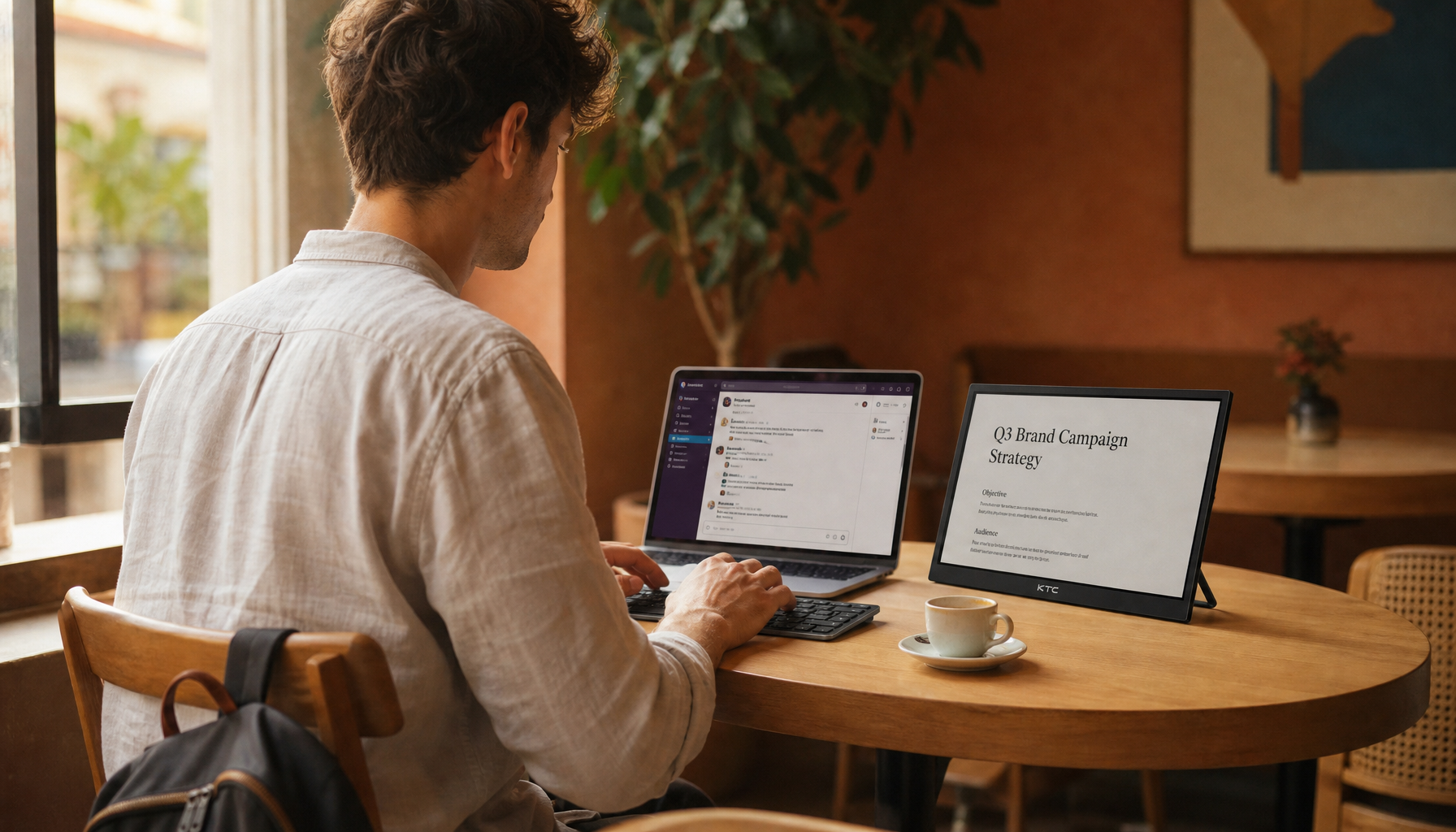
If you are buying a monitor for both gaming and work, 1500R is often the safer compromise. Choose 1000R when you want a wraparound single-player or sim setup, and choose 1800R or flat when you share the screen, work off-angle, use portable monitors, or do layout-heavy tasks.
FAQ
Q: Is 24 inches too close for a curved monitor?
A: For a 27-inch or 32-inch curved monitor, 24 inches may be usable, especially for gaming. For a 49-inch ultrawide, 24 inches is usually too close and can make the edges look exaggerated or uneven.
Q: Will a curved monitor fix eye strain?
A: Not by itself. A curved monitor can reduce edge scanning on wide displays, but eye comfort also depends on distance, height, brightness, text scaling, panel quality, and how long you use the screen without breaks.
Q: Should I choose 1000R or 1800R?
A: Choose 1000R for close, single-user immersion. Choose 1800R for a gentler curve, shared viewing, office work, spreadsheets, or mixed desk setups where flexibility matters more than wraparound effect.
Practical Next Steps
Sit far enough back that the center and edges look equally natural, then tune your setup from there. For most curved gaming monitors, start around 30 to 35 inches; for a 49-inch ultrawide, start around 40 inches. If distortion remains after centering your chair, adjusting height, checking game FOV, and confirming refresh settings, then panel type or monitor size may be the real mismatch for your desk.