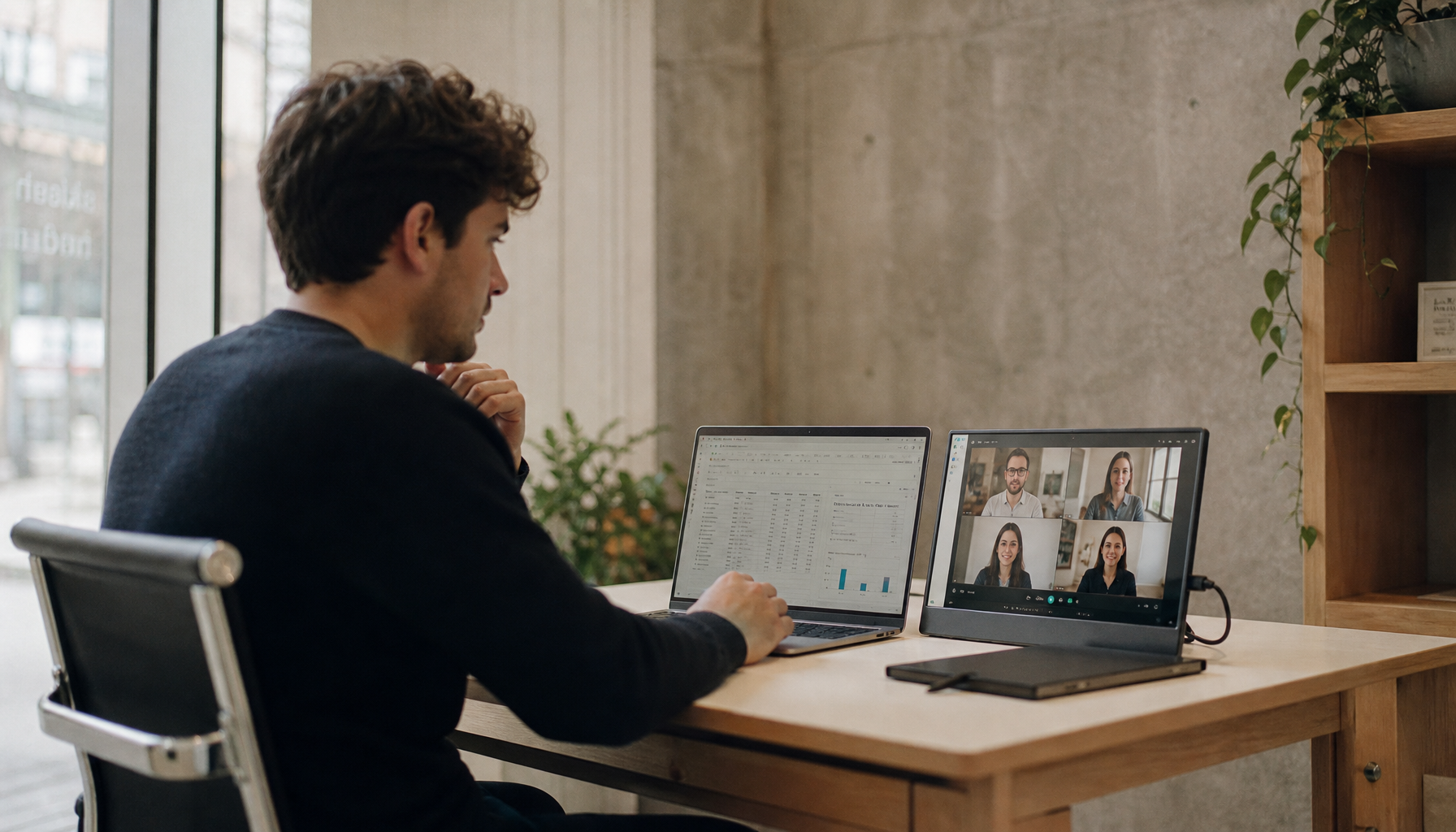
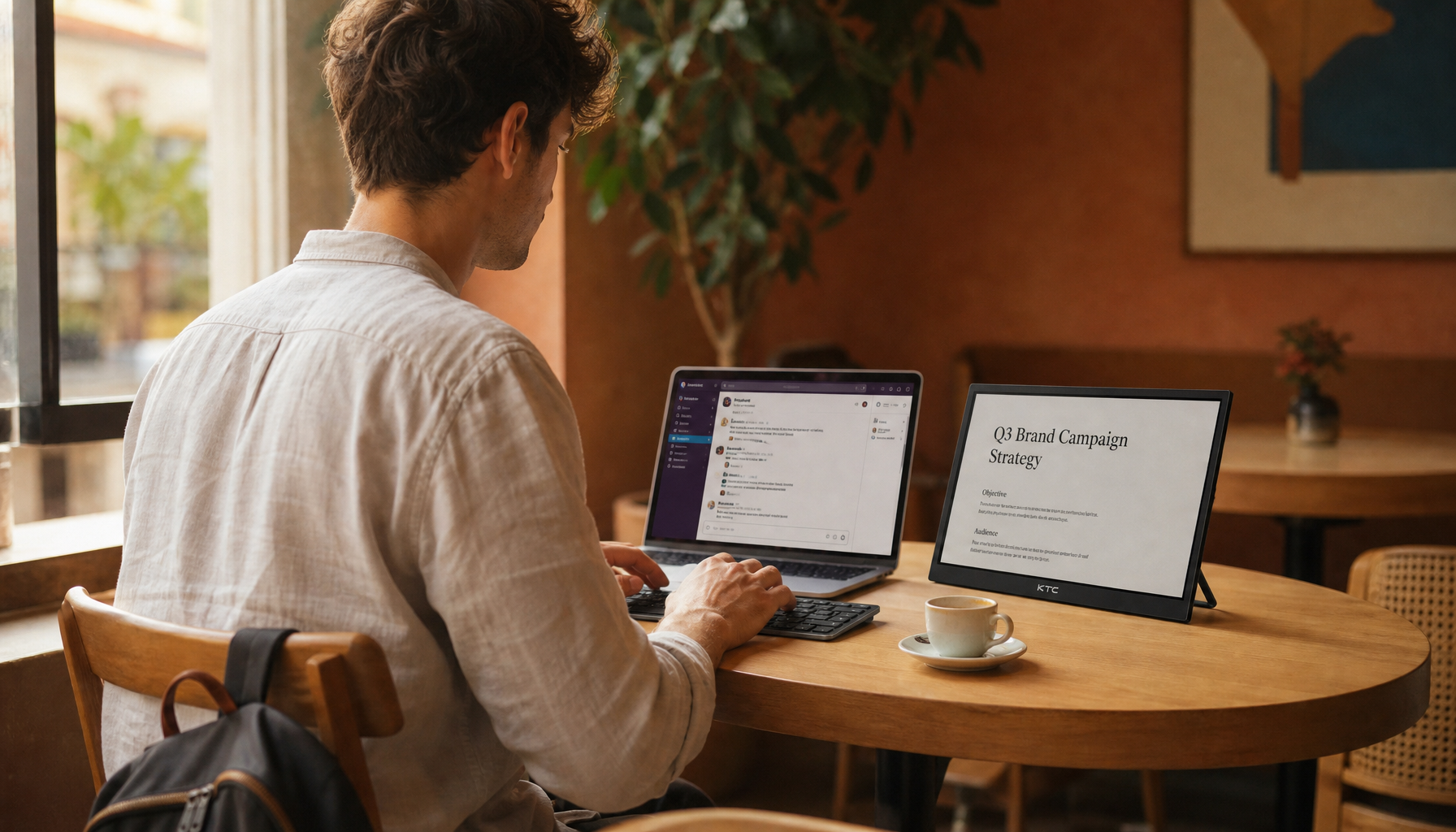
For most eight-hour desk work, place your monitor about 20 to 30 inches from your eyes, then increase the distance for larger screens: about 24 to 36 inches for 27-inch displays, 28 to 42 inches for 32-inch displays, and 36 to 50 inches for 49-inch ultrawides.
Does your neck feel tight by 3:00 PM even though your chair, keyboard, and mouse seem fine? A fast distance-and-height reset can make the whole screen readable without leaning, squinting, or lifting your chin. This guide gives you a practical setup method for single, dual, ultrawide, and portable monitors that keeps work immersive without making your neck support the setup.
The Best Starting Distance for an Eight-Hour Workday
The most reliable baseline is simple: sit back in your chair, relax your shoulders, and place the monitor roughly an arm’s length away. For typical office screens, that usually means 20 to 30 inches from your eyes, a range supported by ergonomic guidance that warns against both close viewing and forward leaning.
That range is not a fixed rule because monitor size changes how much your eyes and neck must travel. A 24-inch office display can feel clean and readable at about 20 to 24 inches, while a 27-inch screen often works better around 24 to 27 inches for productivity layouts with two windows side by side. If the monitor is too close, you scan with your neck and blink less. If it is too far, you lean forward, pull your head ahead of your shoulders, and create the strain you were trying to avoid.
Monitor type | Practical eye-to-screen distance | Best use case |
 |—|—:|—| | 13- to 16-inch portable screen | 20 to 22 inches | Travel desk, secondary reference screen | | 24-inch monitor | 20 to 24 inches | Compact office work, email, writing | | 27-inch monitor | 24 to 36 inches | General productivity, mixed work and gaming | | 32-inch monitor | 28 to 42 inches | Spreadsheets, creative work, immersive gaming | | 34-inch ultrawide | 28 to 38 inches | Multitasking without dual monitors | | 49-inch super-ultrawide | 36 to 50 inches | Wide timelines, data dashboards, cockpit-style immersion |
A real-world check works better than memorizing a chart. If you can see the whole display without moving your head, read body text without leaning forward, and keep your chin level or slightly tucked, the distance is probably close. If your shoulders drift toward the screen after a few minutes, the monitor is too far away, the text is too small, or the display is too low.
Distance Alone Won’t Prevent Neck Strain
Neck strain usually comes from distance, height, and angle acting together. Ergonomic monitor positioning means arranging the display so you can maintain neutral posture, see clearly, and avoid repeated neck, shoulder, and trunk strain; one office ergonomics checklist recommends placing the monitor directly in front, minimizing glare, and keeping the top line at eye level or slightly below ergonomic monitor positioning.
For most users, the top third of the screen should sit at or slightly below eye level. Your eyes should naturally land near the upper part of the display, while the content you read most often sits slightly below a straight-ahead gaze. That matters because many people set large monitors too high, then spend the day lifting the chin to read tabs, menus, or status bars. A display that feels immersive can become punishing if the upper edge is treated like the target.

In workstation tune-ups, the most common pattern is not one dramatic error. It is a screen that is one inch too low, three inches too far away, and slightly off center. Each issue seems minor, but together they pull the head forward, round the upper back, and make the neck stabilize every click. The correction is usually modest: bring the display closer, raise or lower it so the active content sits in the upper-middle zone, and increase OS scaling before moving your face toward the panel.
Match Distance to Screen Size, Resolution, and Workload
Bigger is not automatically better for neck comfort. Larger monitors give you more workspace, but they also require more desk depth and smarter window placement. One monitor-size reference frames viewing distance around field of view, recommending a distance that lets the screen fill about 30 to 45 degrees without excessive eye or neck movement.
Resolution changes the comfort equation because sharp text can remain readable farther away. A 27-inch 4K monitor may allow a cleaner distance than a 27-inch 1080p display, but only if scaling is set correctly. A display-distance reference makes the same broader point for 4K: higher pixel density only matters when the viewer is close enough to perceive the extra detail. For office work, that means you should not solve small text by leaning in. Increase scaling, browser zoom, or application font size first.
For a practical example, a 27-inch monitor used for spreadsheets and writing can start around 28 inches from your eyes. If spreadsheet cells look small, increase scaling or zoom before pulling the monitor to 22 inches. If you use a 32-inch display, start near 32 inches away and keep the most-used window centered rather than stretching active work into the far corners. The corners are useful for passive dashboards, chat, or reference panes, but they are poor locations for repeated neck turns.
Large Gaming Monitors and Ultrawides Need More Space
Large gaming and productivity monitors can reduce window switching, but they punish shallow desks. For 32-inch and larger displays, a monitor placed too close can force excessive eye travel and corner scanning, while a monitor placed too far can make you lean forward. KTC’s large-monitor ergonomics guidance recommends starting around arm’s length, with 32-inch and larger displays often working best around 31 to 39 inches or just beyond fingertip reach.

For 49-inch ultrawides, the working range gets wider. A good starting point is about 40 inches from your eyes, then move closer by a couple of inches if details feel distant or farther back if the screen feels overwhelming. At that size, distance is not only about eye comfort; it determines whether the display feels like a command surface or a wall you have to patrol.
The ergonomic advantage of an ultrawide is that it can replace two separated monitors with one continuous viewing surface. The tradeoff is width. Keep the primary task in the central zone, use the sides for secondary panels, and avoid maximizing every document just because the screen allows it. Immersion should reduce friction, not force your head to sweep left and right all day.
Dual-Monitor Setups: Distance Is Only Half the Fix
Dual monitors can be excellent for productivity, but they increase rotation risk. One dual-screen ergonomics source notes that multiple screens can improve productivity and reduce errors, yet placement must control neck, shoulder, and upper-body strain. If you use one display more than the other, put the primary monitor directly in front of your keyboard and chair. Angle the secondary display inward, keep it at the same height and distance, and use it for reference rather than constant primary work.
If both monitors are used equally, bring their inner edges together and form a shallow V shape. Your nose should point toward the center gap, not toward one screen while the other sits off to the side. The goal is to shift your eyes more than your neck. A small turn is fine; repeated end-range rotation across an eight-hour day is where the setup starts costing you.

Monitor arms help because they let you control distance and angle without surrendering desk space. A fixed stand may place screens too close on a shallow desk or too low behind a laptop. Adjustable arms let you pull the screens into a consistent arc, reduce gaps, and reclaim enough depth for a proper eye-to-screen distance.
Portable Smart Screens and Laptop Workstations
Portable monitors need extra discipline because they are often used in cramped setups. A 15.6-inch portable display can sit around 20 to 22 inches from your eyes, but the bigger issue is usually height. If the portable screen sits flat beside a laptop, your head drops and rotates every time you reference it.
For long sessions, raise the portable display so its top third is near eye level and pair the laptop with an external keyboard and mouse. If the portable monitor is your secondary screen, place it close to the main display and angle it slightly inward. If it is your primary screen during travel, prioritize readable scaling and stable elevation over a minimal desk footprint.
The advantage of a portable screen is flexibility. The downside is that flexibility can become inconsistency. A quick reset at the start of each work block, with the screen centered, raised, and about arm’s length away, prevents a temporary setup from becoming eight hours of compromised posture.
How to Tune Your Monitor in Five Minutes
Start with your body, not the display. Sit back so your lower back is supported, keep your feet planted, relax your shoulders, and set your keyboard and mouse so your elbows stay close to your sides. Once your posture is stable, move the monitor until the screen is directly in front of you and roughly arm’s length away.

Next, adjust height. The top third of the screen should be at or slightly below eye level, and your most-used content should sit in a natural downward gaze. If you wear progressive or bifocal lenses, lower the screen slightly so you do not tip your head back to see through the lower lens area. Then add a slight backward tilt, usually around 10 to 20 degrees, to match your gaze and reduce glare.
Finally, test with real work for several minutes. Open the document, spreadsheet, editor, game, or dashboard you actually use. If you lean forward, increase text size or move the screen slightly closer. If you lift your chin, lower the monitor. If your head turns repeatedly, recenter the main window or reposition the secondary display. Small changes are enough; comfort usually appears inside a narrow band, not at a dramatic new position.
Pros and Cons of Sitting Closer or Farther Away
Sitting closer can make text easier to read and increase gaming immersion, especially on high-resolution displays. The cost is more eye travel, more corner scanning, and greater sensitivity to poor height. On a large screen, close distance can turn every toolbar, minimap, and side panel into a neck movement.
Sitting farther away can reduce visual overwhelm and make large displays easier to take in. The drawback is readability. If the screen moves too far back and text remains small, your body will solve the problem by leaning forward. That is why scaling and font size are ergonomic tools, not just visual preferences.
The best distance is the one that lets your eyes do most of the work while your head stays quiet. For an eight-hour workday, that is more valuable than chasing the most immersive setup possible.
FAQ
Should my monitor be exactly arm’s length away?
Arm’s length is a strong starting point, not a final measurement. A 24-inch monitor may feel right around 22 inches, while a 32-inch display may need more than 30 inches. Your test is whether you can read comfortably without leaning and view the full screen without frequent head movement.
Is it better to move the monitor closer or increase font size?
Increase font size first if your posture is otherwise good. Moving the monitor closer can help, but it may also increase eye travel and make a large display feel crowded. Scaling preserves distance while improving readability.
Can a monitor arm really reduce neck strain?
A monitor arm can help when your desk, factory stand, or dual-screen layout prevents proper placement. The benefit is adjustability: height, distance, tilt, and angle can change with your task instead of forcing your body to adapt to the screen.
Final Screen Distance Rule
Set the monitor close enough to read without leaning and far enough to see the full screen without neck sweeping. For most workdays, that means 20 to 30 inches for standard office monitors, more distance for 32-inch and ultrawide displays, and a height that keeps your main content slightly below eye level. A high-performance screen should expand your focus, not ask your neck to pay for every pixel.