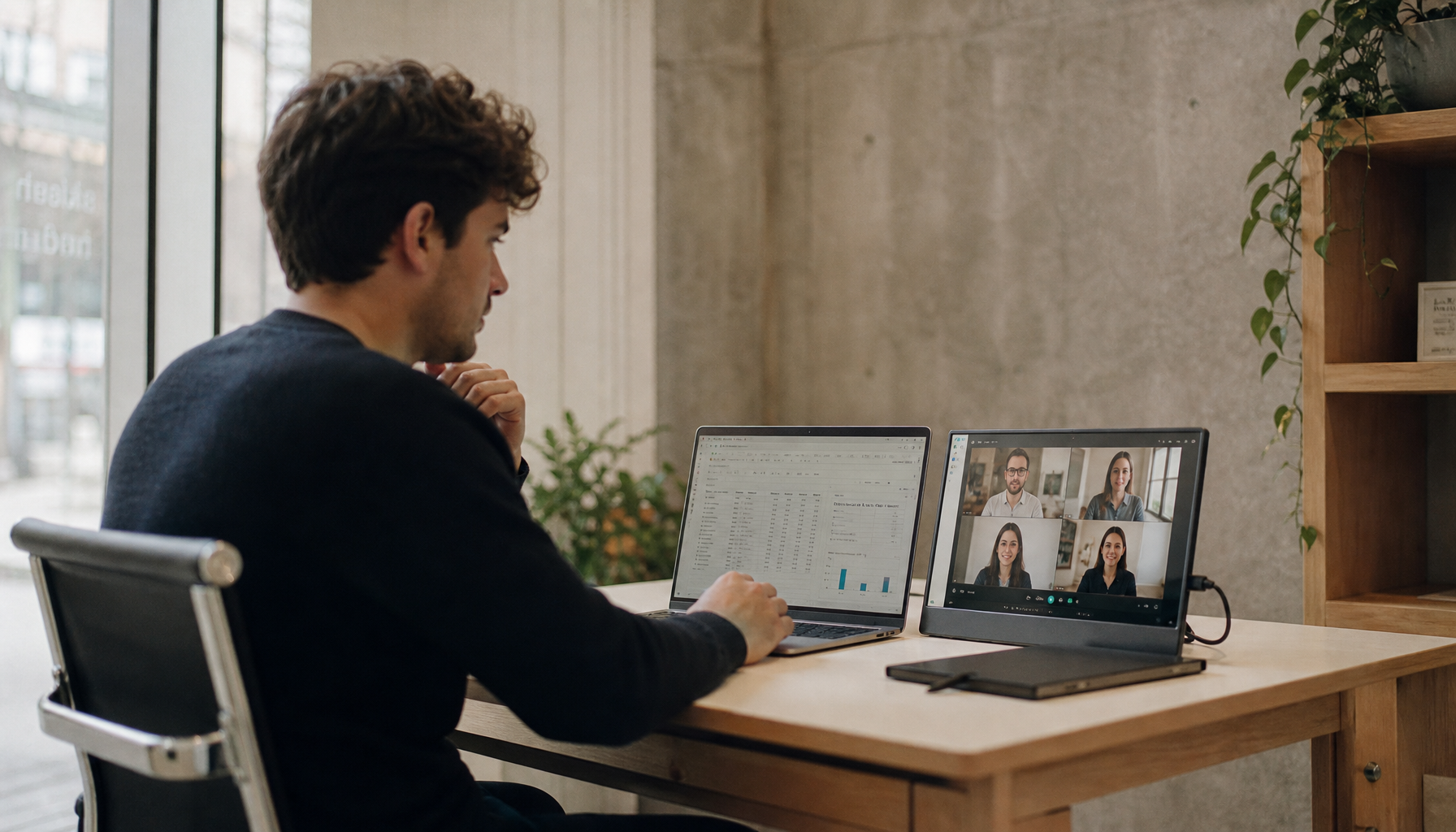
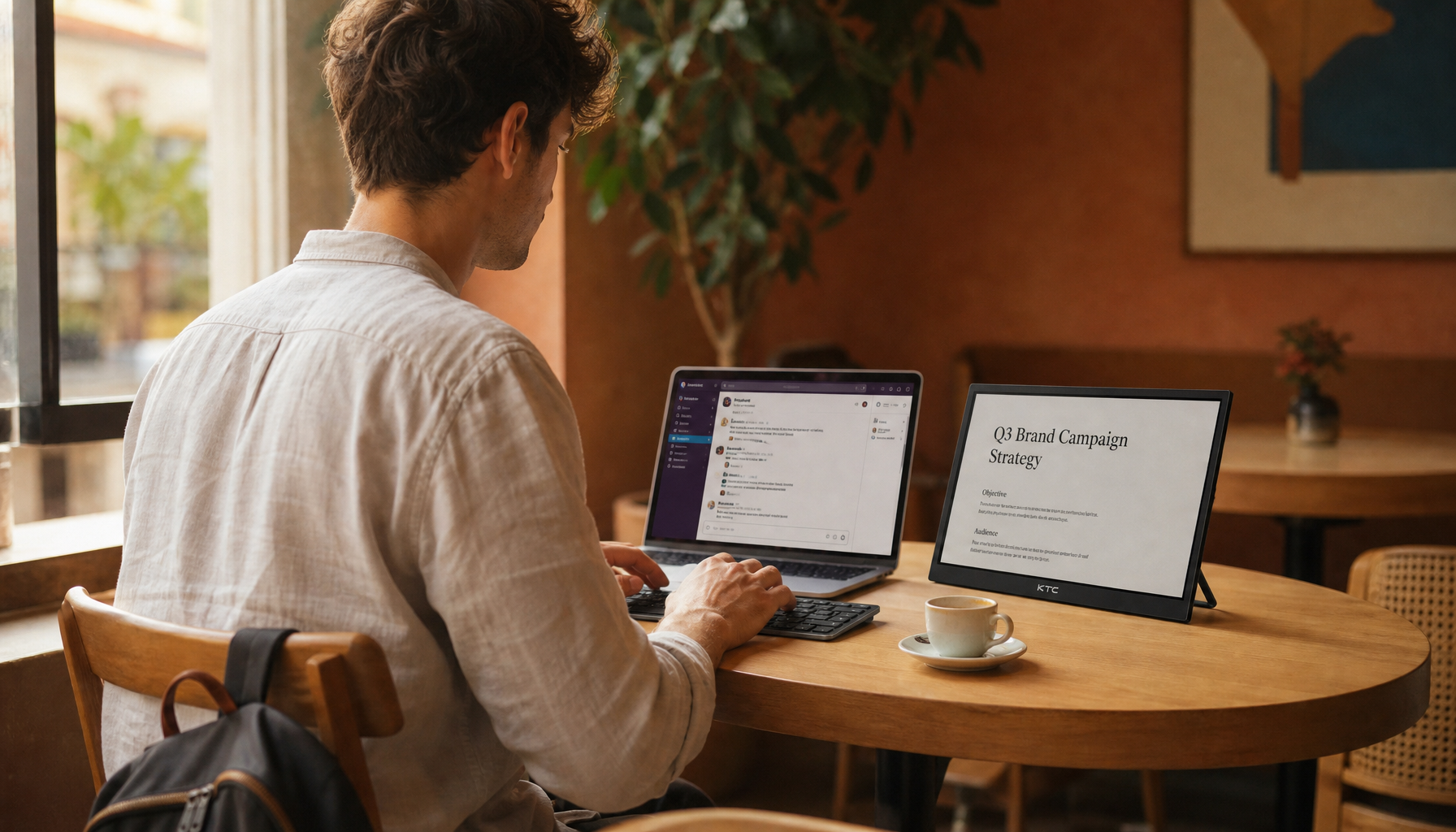
The cleanest setup is to make your operating system’s display map match your physical desk, then give the vertical screen a narrow, repeatable job such as code, chat, documents, or reference material.
Does your mouse hit an invisible wall when you move from your main monitor to the vertical one, or does every app open on the wrong screen? Dual displays have been associated with a 42% productivity increase when configured well, but the gain disappears fast when the layout fights your hands. Here is how to build a mixed portrait-and-landscape setup that feels precise, predictable, and easy to use every day.
Why Vertical Plus Horizontal Works
A horizontal monitor is still the performance center for most work. It gives you room for spreadsheets, timelines, dashboards, games, design canvases, and side-by-side windows. A vertical monitor changes the rhythm. It gives height to long pages, code, documents, chat threads, meeting panels, and reading queues.
That difference matters because the best multi-monitor setup is not just “more screen.” It is a deliberate division of attention. A practical dual-monitor setup can improve productivity by expanding usable workspace for writing, browsing, email, creative work, and gaming support tasks, but poor placement or unoptimized settings can make the extra display feel awkward, as the extra display can become less efficient when positioning and settings are neglected.
In desk builds for developers, analysts, and hybrid office users, the most reliable pattern is a centered landscape monitor for primary work and a portrait monitor just off to the side for persistent context. For example, a 27-inch horizontal display can hold a main document or app, while a 24-inch vertical screen keeps chat, documentation, or a browser preview visible without forcing constant window switching.

Start With the Physical Layout
Place the main horizontal display directly in front of your chair. That is your anchor. If you do most of your typing, reviewing, gaming, editing, or presentation work there, your neck and shoulders should not have to negotiate with the room.
The vertical monitor should sit on the side that matches your natural glance pattern. Right-handed users often prefer the vertical screen on the right because the mouse path feels shorter for secondary tools, but this is preference, not a rule. If your left eye or left-side workspace feels more natural, put it there. The key is consistency.
Top-edge alignment is more important than many people expect. If the vertical monitor is physically taller, align the upper third of the vertical panel near the top edge of the horizontal panel instead of centering both screens by their stands. Common monitor placement guidance recommends side-by-side positioning, comfortable viewing distance, angle adjustment, and eye-level alignment. Matching size and resolution can also reduce visual inconsistency and eye strain.
A simple example helps. If your horizontal monitor is directly ahead and the vertical monitor is on the right, the vertical panel should be slightly angled toward you, not flat against the wall. That angle shortens eye travel and makes the vertical display feel like part of one command surface instead of a separate device parked nearby.
Configure the Display Map So the Cursor Makes Sense
The most common source of layout confusion is not the monitor itself. It is the mismatch between the real desk and the operating system’s monitor map.
Open your display settings and use Identify before moving anything. Your system assigns numbers to screens, but those numbers do not always match the physical order on your desk. The Identify button shows a number on each display so you can match each physical panel to its on-screen rectangle, and the Identify button is the first step that prevents guessing.

After identifying the screens, drag the display rectangles until they mimic the actual desk. If the portrait monitor is on the right, place its rectangle on the right. If its top edge sits slightly higher than the landscape screen, raise the rectangle slightly. Then apply the change and test it by moving your pointer slowly across the seam between screens. This test matters because the operating system uses that virtual edge to decide where the cursor crosses.
Your system may guess monitor positions incorrectly, which can make mouse movement feel illogical, so the virtual arrangement should match the physical layout. If the pointer jumps too high, lower the vertical display rectangle. If it gets trapped near an edge, widen the overlap between the two rectangles.
Set Portrait Orientation Only on the Vertical Display
Select the vertical monitor in display settings and change its orientation to Portrait. Leave the horizontal monitor in Landscape. This sounds obvious, but many layout problems come from changing the wrong numbered display because the user skipped Identify.
Portrait mode is useful because it shows more vertical content at once. In one hands-on test at 1080p resolution and 100% scaling, landscape mode showed 115 words while portrait mode showed 269 words in an AI chat comparison, making portrait mode noticeably stronger for long reading and writing flows.
The drawback is equally real. A vertical screen is not great for wide spreadsheets, video timelines, complex browser tab bars, or photo work that depends on horizontal canvas space. Use it for the work it improves, not as a second primary monitor pretending to be wide.
Choose Extend, Not Duplicate
For productivity, use Extend. Extended mode turns multiple displays into one larger workspace, while Duplicate mirrors the same content on both screens. Duplicate is useful for presentations or shared viewing, but it wastes the value of a vertical side screen.
A good mixed-orientation setup usually assigns each screen a job. The horizontal monitor handles the active task. The vertical monitor handles continuity: documentation, email, chat, terminal logs, meeting participants, calendar, notes, or a long article. Some systems offer a similar choice between extended and mirrored modes, and extended display mode expands the workspace while mirrored mode duplicates the main screen.
This is where the setup becomes immersive instead of merely busy. A competitive gamer can run the game on the horizontal display while keeping chat, stream controls, or a walkthrough on the vertical display. A software developer can keep the IDE centered and stack documentation or logs vertically. A finance or operations user can keep the main dashboard front and center while the vertical screen holds alerts and communications.

Pick a Primary Monitor and Control App Behavior
Your primary monitor should be the screen where you want desktop icons, taskbar focus, and most app launches to begin. In a mixed setup, that is usually the horizontal monitor. Select it in display settings and make it the main display.
This prevents the classic frustration where a full-screen app launches on the portrait panel, or a presentation opens sideways on the screen meant for chat. Display settings let users choose a main display so applications usually prefer that screen, and the main-display control establishes that hierarchy.
After that, train your window layout. Move persistent apps to the vertical monitor and leave them there. Modern operating systems can often remember window placement, but habit still matters. If you always keep chat at the top, email in the middle, and notes at the bottom of the vertical display, your eyes learn the map quickly.
Match Scaling, Resolution, and Brightness
Different monitor sizes and resolutions can make the cursor feel strange even when the layout is technically correct. A 4K horizontal monitor beside a 1080p vertical monitor may create inconsistent window sizes, uneven text sharpness, and odd cursor transitions.
Set each display to its native resolution first. Then adjust scaling so text appears comfortable on both screens. Display scaling controls how large text, windows, and interface elements appear, and display scaling is especially useful when mixing screens with different resolutions such as 4K and 1080p.

Brightness and color also affect comfort. A vertical side monitor that is too bright will constantly pull attention away from the primary screen. A side monitor that is too dim becomes a squinting exercise. Use the monitor’s hardware controls, not only software sliders, to get both displays into the same visual family.
Setting |
Best Starting Point |
Why It Reduces Confusion |
Display mode |
Extend |
Gives each screen its own role |
Main display |
Horizontal center monitor |
Keeps primary apps predictable |
Orientation |
Portrait only on side monitor |
Preserves wide space for main work |
Scaling |
Adjust per display |
Makes text and windows feel consistent |
Physical alignment |
Match the virtual map |
Keeps cursor movement logical |
Pros and Cons of a Vertical Side Monitor
A vertical side monitor gives you more readable height, less scrolling, and a cleaner place for secondary workflows. It is excellent for long pages, code, documentation, email, chat, notes, meeting panels, and portrait-first content. It can also save horizontal desk space because a rotated screen occupies less width.
The tradeoff is reduced horizontal room. Browser tabs feel tighter. Wide tables become awkward. Some apps assume landscape space and waste the portrait layout. For gaming, the vertical display is usually best as a support panel, not as part of a spanned game view, because a two-monitor span can place important action near the bezel.
The value decision is simple: if your second screen mostly holds long vertical content, rotate it. If it mostly holds spreadsheets, timelines, dashboards, or visual editing tools, keep it horizontal.
Troubleshooting Common Confusion Points
If the mouse exits the wrong side, your display rectangles are reversed. Return to display settings, use Identify, and drag the rectangles into the same left-right order as your desk.
If the pointer crosses at the wrong height, your rectangles are vertically misaligned. Raise or lower the portrait display rectangle until the crossing point feels natural. Do not chase perfection by eye alone; test with slow pointer movement across the shared edge.
If one screen is missing, check power, video cables, and input source first. Then use the Detect option in display settings. When a monitor appears unavailable or grayed out, it may be disconnected in settings. Check cables, power, and display mode before assuming hardware failure.
If apps keep opening on the wrong monitor, confirm the main display, move the app to the desired screen, close it there, and reopen it. Many apps remember their last position, especially when the monitor arrangement stays consistent.
A Clean Layout Example
For a high-performance office and gaming hybrid desk, use a 27-inch horizontal monitor centered at eye level and a 24-inch vertical monitor on the right. Set the displays to Extend, make the 27-inch screen the main display, rotate only the 24-inch display to Portrait, and align the top edges in the display map.
Use the main screen for the active workload: game, spreadsheet, edit, presentation, or core app. Use the vertical screen for chat, documentation, email, notes, meeting participants, or a long browser page. Keep the same apps in the same zones every day, and the setup stops feeling like two monitors. It becomes one predictable workspace.
FAQ
Should the Vertical Monitor Be on the Left or Right?
Put it on the side where you glance most comfortably and where your secondary apps make sense. The right side often works well for chat, email, and reference material, but left-side placement can be better if your desk, dominant eye, or workflow favors it.
Is a Vertical Monitor Better for Gaming?
It is better for gaming support, not usually for the game itself. Keep the game on the horizontal monitor and use the vertical screen for chat, stream controls, walkthroughs, hardware monitoring, or notes.
Do Both Monitors Need to Match?
They do not have to match, but similar size, resolution, and brightness make the setup easier to tune. Mixed monitors work well when you use native resolution, adjust scaling, and align the virtual display map carefully.
A vertical monitor beside a horizontal one should reduce friction, not add a new layer of desk management. Anchor your main work on the horizontal display, give the portrait screen a narrow job, and make the software map match the physical setup. Once the cursor path, scaling, and app roles are consistent, the layout becomes fast, immersive, and hard to give up.