

Bright patches or haze appearing on a dark screen can stem from either IPS glow, an inherent trait of the panel technology, or backlight bleed, a potential assembly issue. Distinguishing between the two helps new monitor owners decide whether the unit meets expectations or qualifies for a warranty review.

The 'Panel Lottery' Anxiety: Why Your New Screen Isn't Perfectly Black
New monitor owners often notice uneven brightness when displaying a full black image. This variance arises because individual panels differ even when produced on the same manufacturing line. The outcome depends on both the inherent behavior of IPS technology and how precisely the backlight and bezel were assembled for that specific unit.
IPS Glow vs. Backlight Bleed: Identifying the Visual Differences
IPS glow occurs when light passes through liquid crystals at an angle, creating a hazy wash that shifts or fades as you change your head position. Backlight bleed, by contrast, results from mechanical pressure on the panel layers and remains fixed in place regardless of viewing angle.
The two phenomena produce different visual signatures. IPS glow tends to appear as a broad, soft haze strongest in the corners that moves with your viewpoint. Backlight bleed often shows as sharper streaks or "flashlighting" that stays locked to the same screen location.

The Home Diagnostic: How to Test Your Monitor Properly
Perform the test in a dimly lit room rather than complete darkness, and set brightness between 30 and 50 percent to reflect typical use. Display a full black image or open a dark scene in a game or movie.
Move your head slowly from side to side. If the bright areas change shape or intensity, the behavior matches IPS glow. Gently press near the edge of the bezel; if the pattern shifts or disappears, the issue is more likely mechanical backlight bleed.
When is it a Defect? The RMA Decision Threshold
Minor glow that only appears at maximum brightness in a dark room is common with IPS panels and rarely justifies a return. Leakage that remains clearly visible at normal brightness levels in a typical room, or that stays static when you move your head, crosses into territory where documentation for a warranty claim becomes reasonable.
Camera photos often exaggerate the effect because sensors accumulate light over longer exposures than the human eye. Support teams frequently request photos taken with exposure locked to match what you actually see on screen.
Beyond the Lottery: How to Reduce Visible Glow and Bleed
Lowering brightness to a comfortable 120-150 nits range removes most perceived glow for the majority of users. Adding bias lighting behind the monitor further reduces the contrast between the screen and surrounding wall, making remaining glow less noticeable.
Position the monitor at eye level and maintain a normal viewing distance so extreme corner angles are minimized during regular use. Calibrate Your Gaming Monitor in 5 Steps for a Pro-Level Upgrade and How to Verify Your Display Calibration Is Actually Working provide additional steps for fine-tuning uniformity.
The Hardware Solution: Mini-LED and Local Dimming
Mini-LED panels with full-array local dimming turn off individual backlight zones in dark areas, virtually eliminating both bleed and visible glow at the hardware level. Users who play dark-content games or watch movies in controlled lighting often find this the most satisfying long-term solution.
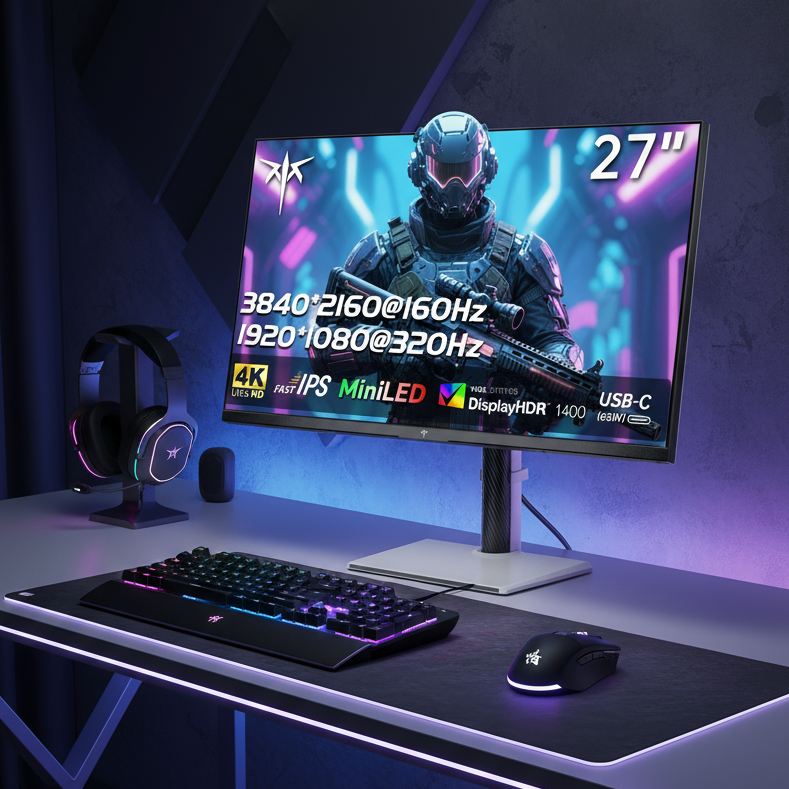
KTC offers several Mini-LED models that deliver this capability while maintaining high refresh rates. M27P6 - 27" 4K 160Hz/320Hz 90W Gaming Monitor, M27T6 - 27" 2K 300Hz/1ms Gaming Vertical Monitor, and the broader All-Mini-LED Monitors collection give buyers concrete options when standard IPS uniformity proves insufficient.
Common Questions About Backlight Bleed and IPS Glow
Does IPS Glow Count as a Manufacturing Defect?
No. IPS glow is a known optical characteristic of the panel technology itself. Manufacturers design around it rather than treat it as a fault, which is why most warranties focus on severe, static leakage instead.
How Bright Should the Test Image Be?
Run the test at 30-50% brightness in a room with some ambient light. Testing at 100% brightness in total darkness exaggerates both glow and bleed beyond what you will experience during normal gaming or viewing.
Will Bias Lighting Eliminate IPS Glow Completely?
Bias lighting reduces perceived intensity by narrowing your pupils and lowering contrast with the wall behind the screen, but it does not remove the underlying light leakage from the panel.
Can I Loosen the Bezel Screws to Fix Backlight Bleed?
No. Opening the monitor housing or adjusting internal components voids the warranty and risks further damage. Contact support with proper documentation instead.
When Should I Contact Support?
Reach out if leakage remains obvious at realistic brightness in normal room lighting, stays fixed in one location, or interferes with dark-scene visibility during regular use. Provide exposure-matched photos and a description of your test conditions.