




Yes, you can often see the difference, especially in dark scenes, HDR highlights, large screens, and bright rooms. Edge-lit designs usually win on thinness and price, while direct-lit designs usually win on brightness uniformity, contrast control, and screen consistency.
Ever notice gray-looking blacks in a night scene, bright corners on a dark loading screen, or a cloudy patch during a full-screen spreadsheet? A quick dark-room movie test and a full-white desktop check can reveal whether the screen’s lighting is helping or hurting your experience. This guide explains how to spot the difference, when it matters, and which backlight type fits gaming, office work, and portable smart screens.

The Core Difference Is Where the Light Comes From
An LCD screen does not create its own light the way OLED does. It needs illumination behind or around the panel so the image becomes visible, and modern LED backlighting uses small light-emitting diodes as that illumination source. The two common layouts are edge-lit and direct-lit.
Edge-lit LED places LEDs along one or more sides of the screen. A light guide plate and optical films then spread that light across the panel. Direct-lit LED places LEDs behind the screen in a grid or array, so the light starts closer to the area it needs to illuminate.
That placement difference sounds simple, but it affects almost everything you notice on a display: thickness, weight, heat, price, black levels, brightness uniformity, and how convincing HDR looks.
Edge-Lit LED: Slim, Efficient, and Cost-Smart
Edge-lit is the design behind many thin monitors, slim office displays, portable screens, and budget-friendly TVs. It uses fewer LEDs, which helps reduce panel depth, power draw, and manufacturing cost. Technical display resources describe edge-lit white LED as a compact and economical layout where LEDs sit along the edge and a diffuser spreads light across the screen.

In real use, edge-lit can look excellent for email, coding, documents, web browsing, dashboards, casual gaming, and bright-room video. If you work mainly in productivity apps, a good edge-lit IPS monitor can feel crisp, lightweight, and practical. For a portable smart screen that travels between a home office, hotel desk, and console setup, the slim chassis can matter more than perfect black uniformity.
The tradeoff appears when the screen has to show deep shadows, subtitles over black backgrounds, or a bright object against darkness. Because the light originates from the sides, some screens show edge glow, clouding, center dimness, or inconsistent brightness. On a 27-inch office display, this may be mildly visible. On a larger screen viewed in a dark room, it becomes harder to ignore.
Direct-Lit LED: More Even Light, More Picture Control
Direct-lit LED spreads the light sources behind the LCD panel. That layout gives the display more physical opportunity to illuminate the screen evenly. Direct-lit backlighting typically improves brightness uniformity and color accuracy, though it usually makes displays thicker and heavier.
For gaming and media, direct-lit becomes especially interesting when it evolves into full-array local dimming. A basic direct-lit display may simply light the screen from behind without individually controlled zones. A full-array design can dim and brighten different regions, which improves contrast and helps highlights stand out. That is why premium gaming TVs and higher-end HDR displays often move beyond simple edge lighting.
For office productivity, direct-lit can also be valuable. A large spreadsheet, design canvas, or white document page exposes uneven lighting quickly. If you stare at a 32-inch or larger screen for hours, better uniformity reduces distraction and makes the panel feel more reliable.
What You Can Actually See With Your Eyes
You do not need lab gear to spot the practical difference. Start with a black screen in a dim room. Edge-lit screens often reveal lighter corners, glowing edges, or cloudy patches. Direct-lit screens usually look more balanced, though cheaper models can still show blotches or gray blacks.
Then open a plain white document or spreadsheet. A weak edge-lit monitor may look brighter near the frame and duller toward the center. A better direct-lit model should hold a more even tone across the panel. This matters for office displays because your eyes track subtle brightness shifts while reading text, editing layouts, or comparing cells.
For gaming, load a dark scene with a small bright object, such as a torch, menu cursor, neon sign, or moonlit doorway. Edge-lit displays can wash the whole scene slightly brighter because the light has less precise control. Direct-lit or full-array screens can preserve darker surroundings while allowing the bright object to pop, assuming the dimming system is well implemented.

LED backlighting by itself does not guarantee better brightness uniformity, because diffuser quality, panel design, and aging also affect results. In other words, a premium edge-lit monitor can beat a poorly built direct-lit one. The backlight type gives you a strong clue, not a final verdict.
Edge-Lit vs Direct-Lit at a Glance
Category |
Edge-Lit LED |
Direct-Lit LED |
LED placement |
Along one or more screen edges |
Behind the panel in a grid or array |
Best strength |
Thin, light, efficient designs |
Better brightness uniformity and image control |
Common advantage |
Lower cost and slimmer chassis |
Stronger dark-scene and large-screen performance |
Common weakness |
Edge glow, clouding, weaker black control |
Thicker body, more heat, often higher cost |
Best fit |
Office monitors, portable screens, slim wall setups |
Gaming, HDR video, large displays, long-use commercial screens |
The fastest decision is to match the backlight to your pain point. If your main problem is desk space, travel weight, or budget, edge-lit is often the rational choice. If your main problem is washed-out dark scenes, visible patchiness, or inconsistent brightness on a large panel, direct-lit deserves priority.
Picture Quality: Contrast, HDR, and Local Dimming
The biggest visible gap appears in contrast. Edge-lit screens can look punchy in bright scenes, but they often struggle to keep dark areas dark while showing bright highlights. Direct-lit screens have a stronger foundation for contrast because the LEDs sit behind the image area.
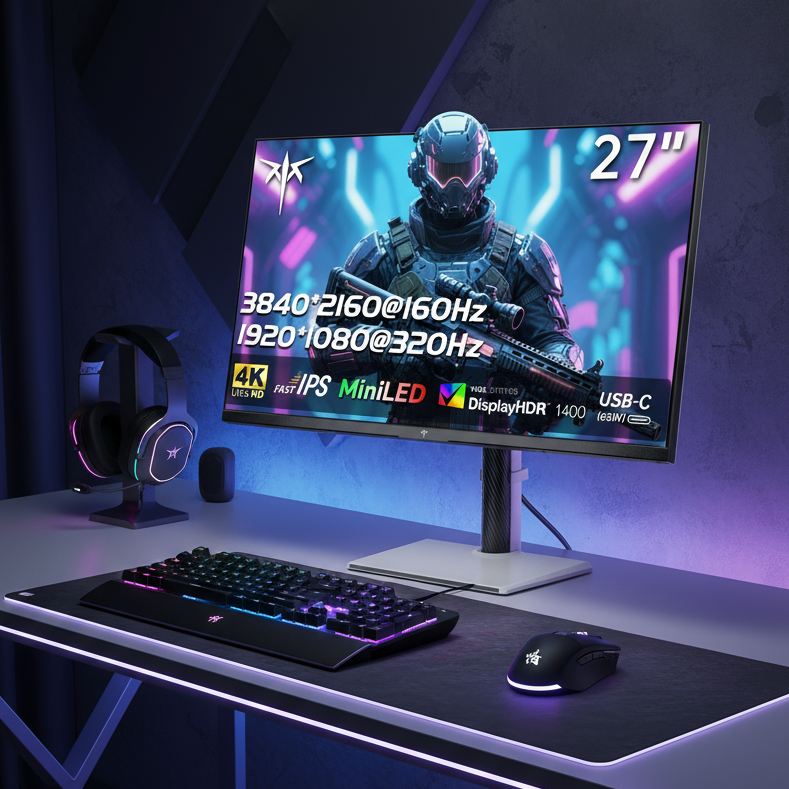
Full-array local dimming is the key upgrade path. A full-array LED design uses more backlight zones and can control them independently, which improves black levels and HDR brightness control compared with simpler backlighting. Mini LED pushes this idea further by using smaller LEDs in denser arrays, allowing finer control, higher brightness potential, and less visible backlight bleed than older full-array layouts. For readers comparing HDR-focused specs, the KTC Mini LED 27” 4K 160Hz HDR1400 Gaming Monitor is a useful 27-inch reference point when weighing 4K, 160Hz, and HDR1400 against simpler backlight designs.
For a competitive gaming monitor, this matters when you move through shadow-heavy maps, scan dark corners, or play HDR titles with bright effects. A weak edge-lit HDR display may accept an HDR signal but fail to deliver meaningful highlight separation. A strong direct-lit or Mini LED display can make explosions, sunlight, and UI highlights feel more dimensional without lifting the whole black floor.
Still, backlight type is not the only performance variable. Static contrast depends heavily on the LCD matrix itself, while many extreme contrast claims are dynamic marketing numbers rather than real all-scene performance. Panel type, firmware, calibration, and dimming behavior all matter.
Office Productivity: Uniformity Beats Drama
For office work, the best display is not always the flashiest one. It is the one that lets you read, compare, edit, and multitask without visual fatigue. A direct-lit display can be preferable on larger screens because even brightness makes white backgrounds, gray UI panels, and split-window layouts look more consistent.

That said, edge-lit monitors remain a strong productivity value. Many office users spend most of the day at moderate brightness, in controlled ambient light, looking at static content rather than dark HDR scenes. LED-backlit LCDs are broadly more efficient, thinner, and longer-lasting than older fluorescent-backlit LCDs, with one industry overview noting that LED-backlit LCDs can be 20% to 30% more energy efficient than CCFL-backlit models.
A simple calculation helps. If a monitor runs eight hours per workday, a lower-power edge-lit model can trim operating cost and heat at the desk. In a dual-monitor office setup, less heat and lower power draw may matter more than cinema-grade black levels.
Portable Smart Screens: Thinness Has Real Value
Portable displays are where edge-lit design often makes the most sense. A screen that fits in a backpack, runs from USB-C, and sets up beside a laptop needs to be thin, light, and efficient. Edge lighting supports that goal because it can use fewer LEDs and a slimmer optical stack.

LED backlight structures often involve a light guide plate, diffusion film, reflection film, and light-control films that spread and shape light for uniform brightness. In a portable screen, that optical engineering is the product. A well-designed light guide can make an edge-lit panel look clean enough for coding, streaming, handheld-console-style gaming, and travel productivity.
Direct-lit portable displays are less common because the deeper backlight cavity can increase thickness and power needs. If a portable screen claims premium HDR or unusually high brightness, look closely at reviews, dimming capability, battery or USB-C power requirements, and heat behavior.
Gaming Monitors: Choose by Genre and Room
For esports, motion clarity, refresh rate, input lag, and pixel response often matter more than backlight layout. A fast edge-lit 240 Hz or 360 Hz monitor can be a better competitive tool than a slower direct-lit display with prettier contrast. If you play shooters, MOBAs, or racing games in a lit room, edge-lit can be perfectly performance-driven.
For cinematic gaming, RPGs, horror, space sims, and HDR console play, direct-lit or full-array backlighting becomes much more compelling. Dark scenes feel deeper, bright effects have more impact, and large screens look more consistent. If you want immersion rather than only speed, the backlight becomes part of the performance stack.
The most balanced buying strategy is to separate signal features from visible performance. HDR support, high refresh rate, and wide color claims do not automatically mean the backlight can deliver strong real-world contrast. Color accuracy depends more on factory calibration, panel technology, and monitor electronics than simply whether the backlight is LED.
Heat, Lifespan, and Reliability
Edge-lit designs use fewer LEDs, so they can run cooler and consume less power in many everyday use cases. Direct-lit systems may spread heat more evenly across the back of the panel, but they can also involve more LEDs and more complex driving circuitry.
Good thermal design matters for both. Heat sinks, airflow, warranties, safety certifications, and regular cleaning are practical selection and maintenance factors for LED systems and thermal design. For a monitor that runs all day, especially in an office, studio, or retail environment, reliability is not just about the LED type; it is about ventilation, brightness settings, build quality, and how hard the backlight is driven.
A practical rule: avoid running any display at maximum brightness all the time unless the room demands it. Lowering brightness in a normal office reduces heat, saves power, and can extend usable life while improving eye comfort.
Which One Should You Buy?
Choose edge-lit if you want a thin, affordable, efficient monitor for productivity, web work, school, trading dashboards, coding, casual gaming, or a portable second screen. It is the value-oriented choice when your content is bright, your room has ambient light, and you do not obsess over dark-scene perfection.
Choose direct-lit if you care about screen uniformity, larger display sizes, darker media, HDR, console gaming, design review, or long sessions where patchy brightness becomes distracting. If the display includes full-array local dimming or Mini LED, the advantage can become much more visible, especially in movies and games with strong contrast.
The strongest move is to test the exact model, not just the category. Open a black image in a dim room, a full-white page in your normal workspace, and a dark game scene with bright highlights. If the screen stays consistent, comfortable, and convincing in those three moments, the backlight is doing its job.
FAQ
Is direct-lit always better than edge-lit?
No. Direct-lit usually has a better foundation for uniformity and contrast, but a cheap direct-lit screen can still perform poorly. A well-engineered edge-lit monitor with good diffusion, calibration, and panel quality can look better than a low-end direct-lit model.
Does edge-lit mean bad for gaming?
Not at all. Many fast gaming monitors are edge-lit and perform very well for competitive play. Edge-lit becomes a bigger limitation when you want deep blacks, convincing HDR, and consistent brightness across a large screen.
Is Mini LED the same as direct-lit?
Mini LED is best understood as an advanced form of backlighting that uses much smaller LEDs in denser arrays. It often builds on the direct-lit or full-array concept, giving the display more precise brightness control and better HDR potential, but usually at a higher price.
Can backlight type affect eye comfort?
Yes, indirectly. Uneven brightness, harsh contrast between the room and screen, and excessive brightness can increase fatigue. A balanced monitor setting plus soft ambient or bias lighting around the screen often matters as much as the backlight layout itself.
The Bottom Line
You can see the difference between edge-lit and direct-lit when the content and room expose it. Edge-lit is the smart choice for slim, efficient, budget-conscious setups; direct-lit is the stronger choice for uniformity, dark-scene depth, HDR impact, and larger immersive screens. Buy the backlight that solves your real viewing problem, not the one with the loudest spec sheet.


