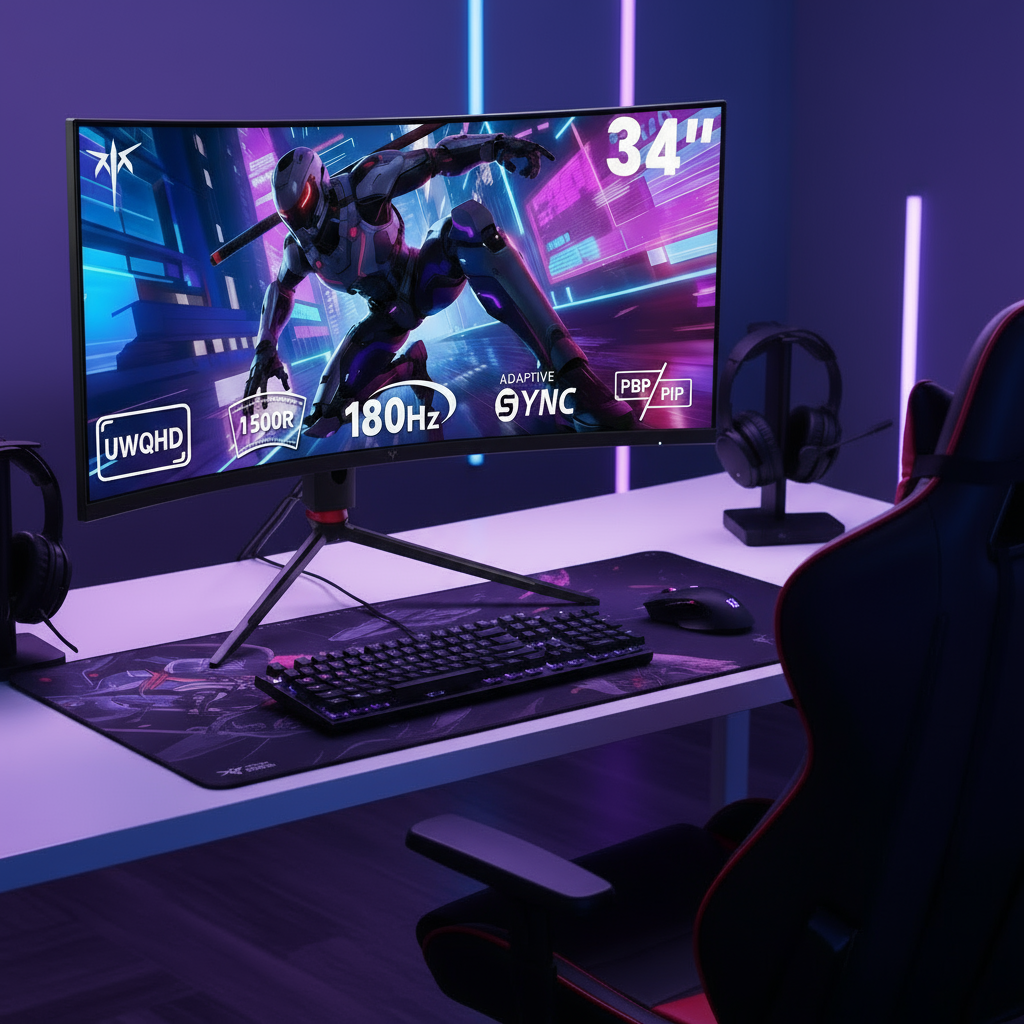


Response time usually matters more when you are choosing a VA panel because slower dark transitions can create visible black smearing. Fast IPS is still worth checking, but modern Fast IPS monitors more often deliver clean motion without sacrificing color consistency.
Do dark corners smear when you flick your aim across a hallway, or does text look fine until a video or game starts moving? At 240Hz, each frame is on screen for only 4.17ms, so slow pixel transitions can visibly trail behind the next frame. You’ll learn when response time should drive your buying decision, when refresh rate matters more, and how to judge Fast IPS versus VA without getting trapped by a “1ms” sticker.
Response Time, GtG, and MPRT in Plain English
Monitor response time is how quickly a pixel changes from one color or shade to another, and lower numbers reduce ghosting, smearing, and motion blur in fast content. For gaming, the most useful advertised metric is often gray-to-gray, because GtG response time describes transitions between gray shades that appear constantly in real game scenes.

MPRT is different. It measures how long a moving image remains visible to your eyes, so it is tied to perceived blur rather than pure pixel transition speed. The MPRT test makes that distinction practical: even a display with instant pixel transitions can still show sample-and-hold blur because each frame remains visible for the duration of a refresh cycle.
That difference matters because manufacturers may advertise low MPRT numbers using strobing or blur-reduction modes. Those modes can sharpen motion, but they may reduce brightness, add flicker, or work best only at certain refresh rates. For buying a gaming monitor, treat GtG as the pixel-speed check and MPRT as the perceived-motion check.
Why VA Panels Are More Sensitive to Response Time
VA panels are popular because they deliver stronger contrast and deeper blacks than most IPS displays. That contrast advantage can make night scenes, movies, and dark-room games look more immersive, and some users even prefer VA for reading because text can appear darker and more ink-like on the page. The tradeoff is motion: VA panels often struggle with dark transitions, which can show up as black smearing behind shadows, dark UI elements, or enemies moving through low-light scenes.

This is why response time matters more for VA in practice. A VA monitor can look excellent in a static screenshot, then lose clarity when dark pixels need to shift quickly. In a tactical shooter, that might look like a shadowy doorway leaving a trail during a quick mouse swipe. In a racing game, it can show as darker trackside objects dragging slightly across the image.
The issue is not that every VA panel is slow. The issue is that VA’s weakest transitions are often the exact ones your eyes notice in dark scenes. A spec sheet that says “1ms” may describe a best-case transition, not the worst dark transitions that create visible smearing.
Why Fast IPS Is Usually the Safer Motion Choice
Fast IPS panels were built to close the old gap between color-focused IPS and speed-focused TN. Modern IPS monitors can combine strong color, wide viewing angles, and fast GtG performance, making them a strong default for competitive gaming, mixed work, and creator-friendly setups. Modern IPS panels have improved enough that they often match VA for refresh-rate support while avoiding VA’s most common black-smearing weakness.

Fast IPS still needs scrutiny. Overdrive settings can push transitions harder, but overly aggressive overdrive can create inverse ghosting, where a bright or colored halo appears instead of a normal trail. Independent motion testing often weighs both response speed and overshoot, because the fastest setting is not always the cleanest setting.
For a real-world example, a 144Hz monitor refreshes every 6.94ms. If its actual pixel transitions land comfortably inside that window with low overshoot, motion looks clean. If a VA panel’s darker transitions take longer than the refresh window, the next frame arrives before the previous shade has settled, and the smear becomes visible.
Fast IPS vs VA: Where Response Time Should Rank
Use case |
Fast IPS priority |
VA priority |
Response-time importance |
Competitive FPS at 240Hz or higher |
Strong choice for cleaner tracking |
Only if reviews confirm dark transitions are controlled |
Very high |
Story games and movies in a dark room |
Good color, weaker blacks |
Strong contrast and immersion |
Medium to high |
Office work and browsing |
Consistent whites and viewing angles |
Strong contrast can make text feel dense |
Low to medium |
Mixed gaming, work, and media |
Best all-around safety pick |
Better if contrast matters more than motion |
Medium |
For competitive play, response time and refresh rate have to work together. A 240Hz monitor is most useful when your PC can feed high frame rates and the panel can transition quickly enough to keep each frame clean. If your game runs at 240fps, the display is updating every 4.17ms; a panel with slow transitions can blur that advantage.
For office productivity, response time is much less decisive. A document, spreadsheet, or browser tab does not punish a 5ms response time the way a fast shooter does. Panel quality, pixel density, screen coating, brightness range, and subpixel layout matter more for long reading sessions, and panel type alone is not a reliable shortcut for text comfort.
The “1ms” Claim Needs Context
A 1ms label is useful only when you know what it measures and how the monitor reaches it. Some monitors hit their lowest claimed numbers only with maximum overdrive, and that can introduce overshoot. KTC’s gaming monitor guidance makes the practical point well: not all 1ms monitors perform equally, especially when cheaper models rely on aggressive overdrive to look fast on paper.
This is especially important for VA. A VA panel may advertise a gaming-friendly response time while still showing slower dark transitions in real use. Fast IPS also benefits from review testing, but its failure mode is more often overshoot tuning than heavy black smear.
A simple buying rule works well: for esports, prioritize tested motion clarity over advertised response time. For immersive single-player games, weigh VA’s contrast against the possibility of smearing. For work-first setups, do not overpay just to chase the lowest response-time number.
Practical Buying Advice
If you play FPS titles, battle royale games, competitive racers, or fast action games, choose Fast IPS unless a specific VA model has strong independent motion testing. Pair it with 144Hz at minimum, or 240Hz if your GPU can sustain the frame rate. Low response time matters most when fast movement would otherwise leave visible trails.

If you play cinematic RPGs, horror games, space games, or watch a lot of movies at your desk, VA can be the better experience. Its contrast can make blacks look deeper and scenes feel more dimensional. Just avoid assuming every high-refresh VA is equally clean in motion; dark-scene response is the number to investigate.
If you need one display for spreadsheets by day and games by night, Fast IPS is the safer all-rounder. It gives you wide viewing angles, color consistency, and motion performance that is easier to trust across different games and refresh rates.
How to Test Your Own Monitor
You can verify your display instead of relying only on the box. Use a Moving Picture Response Time approach to confirm the active refresh mode and compare perceived blur across settings. If 144Hz looks cleaner than 60Hz, that is expected because each frame persists for less time.
Then test your monitor’s overdrive modes. Start with the default or “normal” setting, try the faster mode, and look for bright halos, colored edges, or unnatural outlines around moving objects. The best setting is the one that gives you less smear without obvious overshoot.
Final Verdict
Response time matters more for VA panels because VA’s dark-transition behavior can directly affect motion clarity. Fast IPS still needs good tuning, but it is usually the more reliable choice for high-refresh competitive gaming.
Choose VA when contrast and immersion are worth more than perfect motion. Choose Fast IPS when clean tracking, fast transitions, and all-day versatility matter most.