Home users choosing a secondary screen usually need to decide between an active standalone display like the MegPad and a passive portable monitor that depends on another device. The MegPad suits room-to-room movement without cables or a host device, while portable monitors work best when you already carry a laptop or console and want a lightweight screen extension.

Active vs. Passive: Understanding the Core Difference
A portable monitor is a passive device that requires an external source such as a laptop, phone, or console to function. It lacks its own operating system and storage, so it acts only as a display extension. In contrast, a MegPad is an active standalone smart display with built-in Android, internal storage, and a battery that lets it stream apps and content without any connected host.
This difference creates a clear cable tax for portable monitors. Most setups need at least one video cable and often a power connection, limiting placement and movement around the house. MegPads operate cordlessly in most scenarios, giving users freedom to reposition the screen quickly between rooms.
Mobility vs. Portability: Which Fits Your Home Lifestyle?
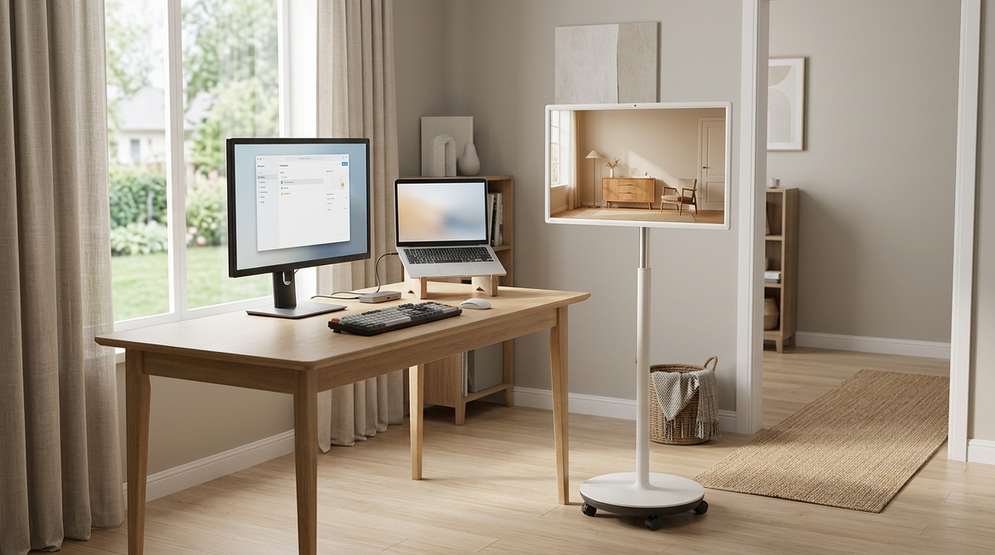
Portable monitors excel at backpack portability. Models such as the 15.6-inch FHD portable travel monitor weigh about 1.4 pounds and slip easily into a bag for travel or cafe use. MegPads prioritize room-to-room mobility instead. The 32-inch 4K mobile touch screen monitor includes a rolling stand that lets users move the screen from kitchen counter to workout area without lifting heavy equipment.

The distinction matters for daily home routines. If your main goal is expanding a laptop screen while staying light for occasional outings, the portable monitor fits. When you need a screen that follows you between household activities, the heavier but wheeled MegPad delivers better practical mobility.
Room-by-Room: Where Each Screen Wins at Home
Different spaces favor different form factors. In the kitchen, a standalone MegPad keeps recipes visible without risking a laptop near spills or flour. In a home gym, the larger rolling screen provides better visibility for form tracking than a small monitor placed on the floor.
Home Scenario Fit: Active vs Passive Screen
This chart highlights which screen type is the more practical fit across common home settings, based on mobility, setup simplicity, and source dependence.
View chart data
| Scenario | Kitchen | Gym | Office | Living Room |
|---|---|---|---|---|
| Active / Standalone MegPad | 3.0 | 3.0 | 2.0 | 3.0 |
| Passive / Dependent Portable Monitor | 1.0 | 1.0 | 3.0 | 2.0 |
In the home office, portable monitors deliver a documented productivity lift when paired with a laptop. In living rooms and bedrooms, the MegPad functions like a cordless TV for streaming and casual touch interaction.
Power and Connectivity: Cables vs. Cordless Freedom
MegPads carry internal batteries rated for up to 11 hours of typical use, removing the need to stay near an outlet. Portable monitors usually draw power from the connected laptop or a wall adapter, which can reduce laptop runtime during extended sessions. MegPads also support Google EDLA certification, which provides secure native access to the Google Play Store and official apps.
When needed, MegPads can still serve as external monitors through USB-C or HDMI connections. This dual capability gives users flexibility without forcing them to choose between standalone and tethered modes.
The Final Decision: MegPad or Portable Monitor?
Choose the MegPad when you want a self-contained screen for cooking, fitness, or family streaming and value cordless movement between rooms. Choose the portable monitor when your primary need is a lightweight laptop companion for work or travel.
Price and capability also factor in. Entry-level portable monitors start near $50, while MegPads with smart features and rolling stands sit in the premium range. Match the device to your main daily job: autonomy and touch for whole-house use, or simple extension when a host device is already present.
Frequently Asked Questions
Does a MegPad Require Any External Device to Work?
No. MegPads run on built-in Android and battery power, so they stream content and apps independently. They can connect to other devices when desired but do not need a host to operate.
Can Portable Monitors Replace a Television in the Living Room?
Portable monitors can display content from a connected device, yet they lack internal apps and speakers suited for primary TV use. A MegPad handles standalone streaming more naturally for casual living-room viewing.
How Does Battery Life Affect Daily Home Workflows?
MegPad batteries typically last several hours at moderate brightness, supporting movement between rooms without recharging. Portable monitors draw power from the host device or an outlet, so users often remain tethered during longer sessions.
Which Option Works Better for Multiple Family Members?
The MegPad’s larger touch screen and rolling stand make it easier for different people to share across activities. Portable monitors remain personal tools best suited to one user at a desk or on the go.