If you are weighing rolling display vs wall tablet for small spaces, the real choice is mobility versus fixed installation. For renters and compact homes, that usually matters more than specs. A wall mount can save floor space, but permanent drilling can create lease or deposit friction, so the better fit depends on room layout, permission, and how often the screen needs to move.

Start With the Space Problem
For most small-space buyers, the first question is not which screen is better. It is whether the room needs something that stays put or something that can move. That is why the rolling display vs wall tablet for small spaces decision should start with daily use, not hardware features.
In a studio, shared living room, or compact apartment, a wall-mounted setup can preserve floor space and keep traffic paths clearer Renter-Friendly Organization Solutions for Small Spaces. But if drilling is not desirable, or if the screen needs to serve more than one area, a mobile setup can avoid that commitment. Renters especially tend to face more friction when a permanent mount means holes, patching, or security-deposit concerns.
What this means is simple: if the screen must stay in one place, fixed placement can be efficient. If the room changes function often, mobility is usually the safer default.
Rolling Display and Wall Tablet: Core Trade-Offs
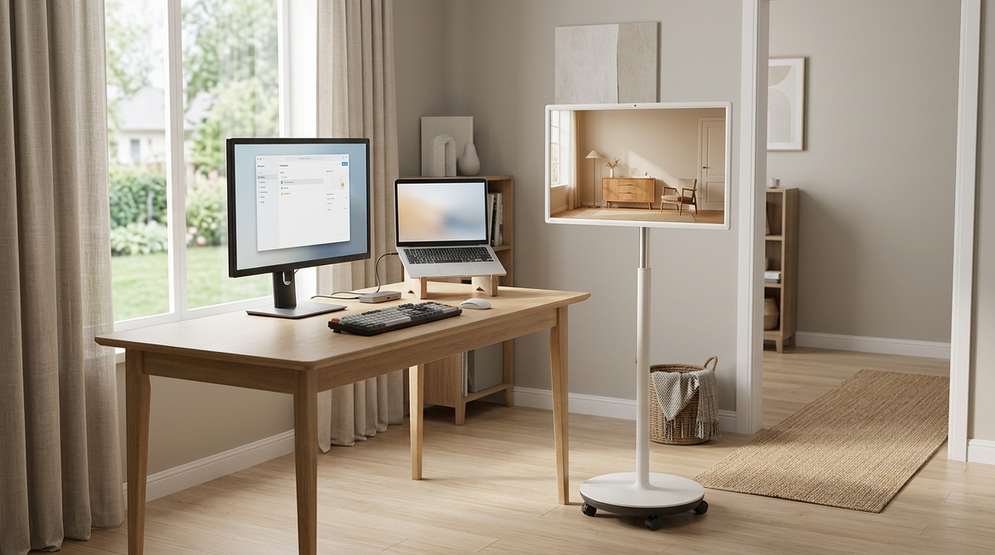
A rolling display is built around movement. A wall tablet is built around permanence. That sounds obvious, but the difference changes how the room feels every day. A mobile setup can move between corners, desks, or shared areas. A fixed setup can look cleaner and keep the floor open, but only if the wall location is practical.
Mobile touch screens are worth browsing when you want a category that supports movement without wall commitment. By contrast, wall-mounted alternatives make the most sense when the screen has one stable job and one stable location.
| Factor | Rolling Display | Wall Tablet |
|---|---|---|
| Mobility | Easy to move between rooms or zones | Stays in one place |
| Installation commitment | Lower wall commitment | Requires mounting permission and planning |
| Floor use | Takes some floor space, but can be repositioned | Frees floor area once mounted |
| Renter fit | Often easier when wall changes are undesirable | Better only when mounting is allowed and practical |
| Visual clutter | More visible hardware | Cleaner when wall routing is planned well |
| Shared-room use | Strong fit for multi-use spaces | Best for one fixed use point |
| Routine change | Adapts well | Less adaptable |

For most buyers, the tradeoff is not "which is better," but "which compromise is more acceptable." Rolling options usually win when flexibility matters more than a tidy footprint. Wall-mounted options usually win when floor space is scarcer than wall access.
A useful rule of thumb: choose movement if the screen serves more than one area; choose a wall install if the screen has a single, predictable job. That decision frame stays closer to real-life use than a spec-only comparison.
When a Rolling Display Makes More Sense
A rolling display makes sense when the room has to do more than one job. In a studio apartment, a shared living room, or a multipurpose family area, the screen may need to shift from work to entertainment to casual browsing. In those cases, mobility can be more valuable than a fixed wall position 12 Renter-Friendly Wall Storage Hacks (No Drilling!).
That flexibility can also help when furniture gets rearranged often. If your desk, couch, or dining area changes position through the week, a mobile display can follow the routine instead of forcing the routine to follow the screen.
A neutral example is the KTC MEGAPAD 32". It can suit buyers who want a room-to-room touch display without committing to a permanent wall install. In small spaces, that kind of setup is more about flexibility than about acting like a traditional monitor.
The catch is that a rolling display still needs clearance. You need space to park it, turn it, and move it without clogging a walkway. So this format is strongest when the screen will be shared, repositioned, or stored in a way that still feels orderly.
If you are comparing formats for a shared home, the article on rolling smart display use cases is a useful follow-up.
Where a Wall Tablet Still Fits
A wall tablet still makes sense when the room is stable and the screen has one main purpose. In very small layouts, wall placement can help keep high-traffic areas clear and make the room feel less crowded. That is often useful in entryways, narrow kitchens, compact dens, and other spots where a stand would interrupt movement.
This option can also feel simpler when the viewing zone is fixed. If everyone naturally approaches the same wall, the screen can stay at a predictable height and location. That is a practical advantage, not just a visual one.
The caution for renters is that "possible" is not the same as "practical." Temporary or adhesive mounting solutions still have weight and adhesion limits, so they need to be treated carefully rather than assumed to solve every wall problem. If you are likely to move soon, or if the wall surface is not a good fit, the fixed route can become a headache instead of a convenience.
So the wall-mounted choice is best when the screen stays in one place, the wall is usable, and the room benefits more from open floor space than from mobility.
Choose by Room and Routine
The easiest way to decide is to walk through the room the way you actually use it.
- Identify the room's main job. Is it for shared entertainment, quick control, work, or one fixed routine?
- Check whether the screen needs to move. If it will shift between zones, the mobile path is stronger.
- Confirm mounting permission and permanence. If wall changes are not ideal, do not treat wall mounting as the default.
- Look at the traffic flow. A screen should not block doors, paths, or furniture rotation.
- Decide whether you need one screen for one spot or one screen for many spots.
If you want a broader browse path after choosing the format, All Monitors is a practical place to compare categories and narrow the fit. The main point is to match the setup to the room, not the other way around.
Final Fit Checklist for Small Spaces
Before you buy, check these basics:
- The screen matches the room's main use.
- The setup will not block walkways or furniture movement.
- You know where power and cables will go.
- You have permission or confidence to mount, if that is the plan.
- You have enough floor clearance for a rolling setup.
- You are choosing permanence only if you truly want it.
- The product details match the format you need, such as the H15F9 if a lighter portable screen fits your use better.
For rolling display vs wall tablet decisions, the safest choice is usually the one that fits how the room already works. If the space changes often, mobility tends to win. If the screen has one fixed job and the wall is workable, a mounted setup can be cleaner.
FAQs
How Do I Know If a Rolling Display Will Fit My Apartment?
Check floor clearance, turning space, and where the display will live when it is not in use. If it can move without blocking a walkway, it is more likely to fit.
What Makes a Wall Tablet Better for Small Spaces?
It is usually better when the screen stays in one place and you want to keep the floor clear. The benefit is strongest in narrow or predictable layouts.
Can Renters Use a Wall-Mounted Tablet Safely?
Often yes, but only if the wall surface, mounting method, and lease terms all line up. If you are unsure, treat mounting as a decision to verify rather than a default choice.
Why Would Someone Choose a Mobile Screen for a Studio?
A studio often needs one screen to serve more than one function. Mobility helps when the same area has to switch between work, entertainment, and shared use.
Can One Display Replace Both a Wall Setup and a Desk Monitor?
Sometimes, if the screen is easy to move and the room has enough flexibility. It works best when one device can cover multiple tasks without creating extra clutter.