




The easiest way to avoid constant reconfiguration is to build your setup around a monitor with separate inputs, single-cable charging, and either built-in KVM or source-specific presets.
Ever finish work, grab a controller or remote, and then lose 10 minutes fixing audio, picture mode, and window layout before anything looks right? The good news is that the right monitor setup can cut that friction down to one input change, especially if you choose the display and cabling around your actual devices instead of treating work and entertainment as separate systems. You’ll leave with a practical setup plan, a buying checklist, and the settings that matter most.
Start With the Right Kind of Display
A monitor usually works better than a TV at desk distance
For a hybrid desk, a monitor is usually the safer base because productivity and computer gaming favor monitor design, especially for text clarity, close viewing, and long work sessions. TVs can be excellent for movies and console use, but once you sit a few feet away for spreadsheets, email, coding, or browser-heavy work, the sharper pixel density and more ergonomic stands on monitors matter more.
Size also changes the experience. A brand’s home office sizing guidance is a good baseline: 24 to 27 inches fits compact desks, 32 to 34 inches is better for multitasking, and 37 inches or larger is best when you want one screen to replace a multi-monitor layout. For most people trying to combine work with streaming or casual TV use, 32 to 34 inches is the sweet spot because it gives enough room for side-by-side windows without pushing the screen so wide that desktop text becomes tiring.
Ultrawide is often the cleanest hybrid option
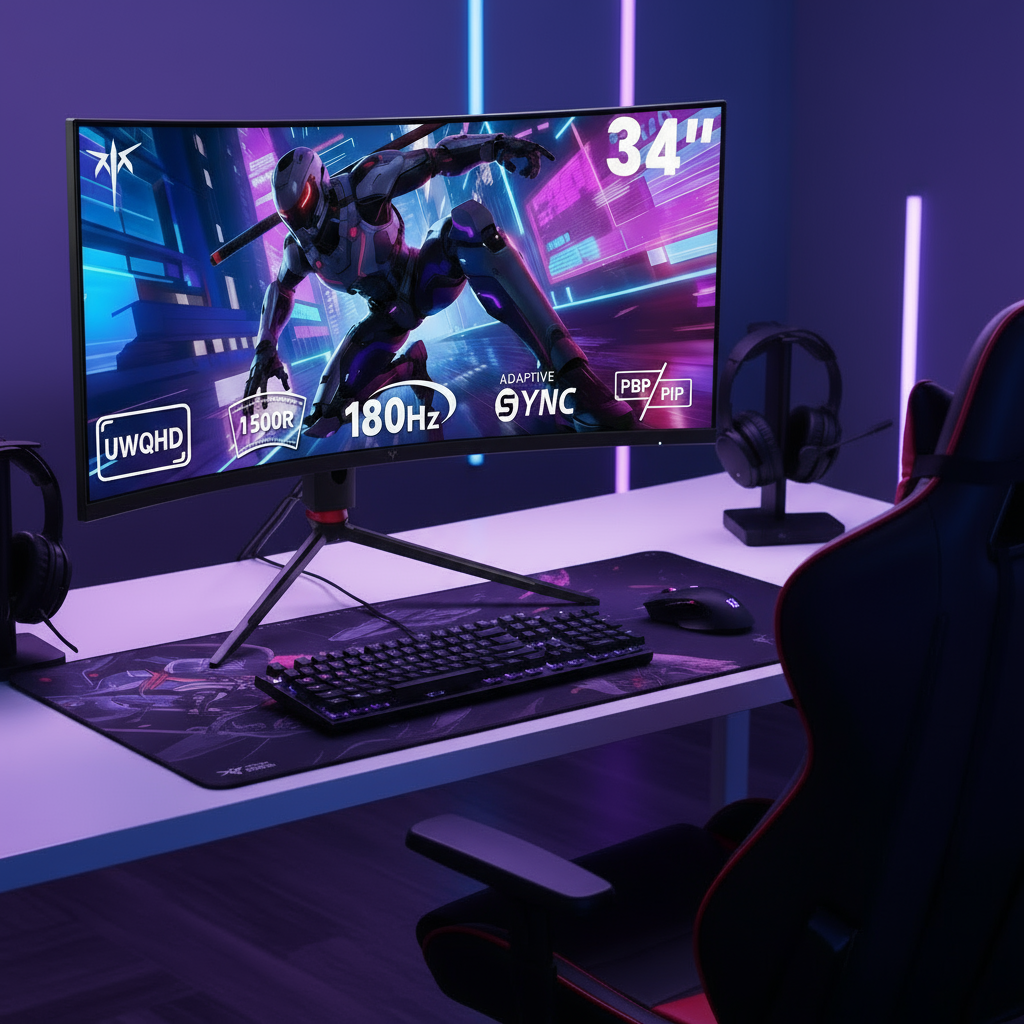
A 21:9 ultrawide format solves two problems at once: it creates more horizontal room for work and gives movies or compatible games a more cinematic presentation with less letterboxing. That makes it easier to stay on one display instead of maintaining a separate office monitor and entertainment screen.

A publication’s ultrawide testing also points to a second benefit: better models now combine high refresh rates, single-cable connectivity, and KVM functions in the same chassis. That matters more than raw panel quality if your real goal is switching modes without rebuilding your desk every evening.
Choose Features That Remove Friction
The best hybrid displays reduce cable changes, not just improve picture quality
If your work laptop connects with one cable and your personal PC or streaming device stays on a second dedicated input, the display becomes much easier to live with. A single-cable monitor setup with KVM can carry video, data, and up to 90 W of charging through one cable for the laptop, while the desktop stays connected over another display input. That means the work machine docks instantly, while your entertainment source remains ready.
Look for these features first: - At least 2 high-bandwidth video inputs - A multi-function video/data port - 65 W to 100 W power delivery if a laptop is involved - Built-in KVM or peripheral upstream switching - Audio-out or speakers if you do not want to re-route sound manually - 120 Hz or higher if gaming matters - 1440p ultrawide or 4K resolution if work clarity matters
Built-in KVM is more valuable than many buyers expect
A built-in KVM feature matters because it lets one keyboard and mouse follow the active source. Without it, the monitor may switch video correctly while your peripherals stay tied to the wrong machine. That is exactly the kind of tiny repeated friction that turns a “simple” hybrid setup into a daily annoyance.
There is also a desk-management benefit. A company notes that a monitor with a single-cable connection and KVM can reduce visible cable runs from 8 or more down to 3 or fewer in some setups, while also avoiding the extra $100 to $150 that an external KVM can add to the bill in many cases. That is a meaningful difference for buyers trying to keep a clean workstation around a gaming monitor or ultrawide display.
Build Separate Work and Entertainment Paths
Use one input for work and one for play
The most reliable layout is simple: connect the work laptop over a full-featured single-cable connection, then connect the personal desktop, console, or streaming box over another display input. A company’s hybrid desk guidance recommends this split because it keeps the laptop on a one-cable path and preserves the higher-bandwidth link for the gaming side when needed.

A real-world example from a tech forum setup shows why this matters. The user had two 27-inch work monitors on different display connections, plus a 32-inch personal monitor on another display connection, and wanted to reuse screens after work without unplugging anything. That is a common hybrid-display problem: the hardware is powerful enough, but the switching path was never designed to remember which source is for work and which is for downtime.
Treat audio as part of the mode switch
Many people focus on video inputs and forget sound. If your monitor has audio-out, a headphone jack, or decent built-in speakers, assign that output to the entertainment source and keep your work calls on the laptop headset or USB dock. That way, switching inputs does not also mean digging through operating system sound settings.
This matters because digital friction builds up through repeated tool changes, not just large technical failures. If changing from work mode to entertainment mode requires input switching, audio switching, USB switching, and app-window cleanup, the system is already too complicated.
Save Presets Instead of Rebuilding Settings
Use source-specific picture settings when your monitor supports them
Some monitors retain different settings per input, and that is one of the most useful hybrid features buyers overlook. Keep your work source on a brighter, color-neutral preset with blue-light reduction if you prefer it, and set your entertainment source to a higher-contrast or HDR-friendly mode. Even when monitors do not expose “work” and “movie” labels, separate input memories often accomplish the same thing.

Smart monitors take this further. A brand notes that smart monitors can switch between work and entertainment apps with a few clicks, which is useful if your “TV mode” is mostly streaming rather than console gaming. In that case, the display itself becomes the entertainment device, and your PC settings stay untouched.
Window layout matters as much as image quality
An ultrawide monitor works best when the desktop layout is predictable. The wide-screen workflow example is not just “more space,” but more usable side-by-side space for documents, browser windows, timelines, and chat. Save that layout with built-in window tools, monitor software, or your preferred tiling tool so the work side always opens the same way.
On the entertainment side, keep it simpler: full-screen video app, game launcher, or streaming input only. The goal is not to make one preset do everything. The goal is to let each source feel finished the moment you switch to it.
Plan Around the Real Bottlenecks
Input switching speed is not always instant
Fast switching is partly a hardware issue, not just a settings issue. Community reports in the discussion thread describe display input changes taking several seconds because the display and source renegotiate a capability handshake, which is how the source learns supported resolution and refresh rate. In some setups, wake-from-sleep behavior makes the delay worse.
That means your target should be “no reconfiguration” more than “zero wait.” A 2-second switch with the correct picture mode, correct USB devices, and correct sound output is far better than an instant switch that still forces you to fix three settings manually.
Cable quality and power delivery can break an otherwise good setup
A company’s single-cable setup notes make an important point: not every multi-function port carries video, and not every cable can handle higher charging power or high-bandwidth display modes reliably. Passive cables longer than about 2.6 ft can become less stable for demanding combinations like high refresh rate and power delivery.
For laptop buyers, power also needs a reality check. A 65 W monitor with a multi-function port is usually fine for mainstream ultrabooks, while 90 W is safer for stronger work machines. If your laptop regularly pulls more than that under sustained load, the setup may still work, but it can slowly drain the battery during heavier sessions.
What to Buy for Each Hybrid Use Case
Setup type |
Best for |
Recommended display traits |
Main tradeoff |
27-inch 1440p monitor |
Small desks, mixed office work, occasional streaming |
1440p, 120 Hz+, single-cable connectivity, multiple inputs, height adjustment |
Less immersive for movie viewing |
32-inch 4K monitor |
Sharp text, office work, console or streaming use |
4K, multiple inputs, single-cable connectivity, audio-out, 60 Hz to 144 Hz |
Larger screen needs more desk depth |
34-inch ultrawide |
Side-by-side work and cinematic entertainment |
3440×1440, 120 Hz+, KVM, power-delivering single-cable connection |
Not all games and apps scale perfectly |
49-inch super ultrawide |
Replacing dual monitors with one panel |
High horizontal resolution, split-screen/KVM, strong stand |
Expensive, large footprint |
Smart monitor |
Light office tasks plus built-in streaming apps |
Built-in app system, remote, multiple inputs, speakers |
Usually weaker for high-refresh gaming |
TV-sized 42-inch class display |
More couch-style entertainment at a desk |
Modern high-bandwidth display input, low-latency mode, strong text handling |
Less ergonomic and less sharp up close |
Action Checklist
- Choose a monitor with at least two active inputs and video support over a multi-function port.
- Put the work laptop on the single-cable connection and the entertainment device on another display input.
- Use built-in KVM or peripheral upstream switching so keyboard and mouse follow the selected source.
- Save one picture preset for work and one for entertainment if the monitor supports per-input memory.
- Route entertainment audio through the monitor’s speakers or audio-out, and keep work-call audio separate.
- Disable any monitor sleep or auto-source features that cause missed wake-ups or wrong-input issues.
- Test every cable at your target resolution and refresh rate before final cable management.
FAQ
Q: Can one monitor really replace both a work display and a TV-style entertainment screen?
A: Yes, if you define the job correctly. A 32-inch 4K monitor or 34-inch ultrawide can handle office work, streaming, and casual gaming well, but the setup works best when the monitor has separate inputs, good audio options, and a simple way to switch USB devices.
Q: Is an ultrawide monitor better than using picture-by-picture mode?
A: Usually, yes. Picture-by-picture support can mimic two screens, but it is not the same as two fully independent displays, and you cannot always disable one side cleanly. A normal input switch plus saved layouts is usually cleaner for daily use.
Q: What is the single most important feature for less reconfiguration?
A: Built-in KVM is the most practical upgrade for a hybrid desk because it keeps your keyboard, mouse, and often USB accessories tied to the active source. Single-cable power delivery is a close second because it turns the work laptop into a one-cable connection.
Practical Next Steps
If you are buying from scratch, prioritize a monitor over a TV for any desk-first setup, then narrow your shortlist to models with single-cable connectivity, multiple high-bandwidth inputs, and built-in KVM. If you already own the display, you can still get most of the benefit by separating work and entertainment onto dedicated inputs, saving per-source presets, and cleaning up audio routing so one switch changes the whole experience instead of only the picture.
For long work sessions, do not ignore ergonomics. A workplace organization’s workstation guidance recommends a separate screen and keyboard, tiltable displays, and a viewing angle roughly 10 to 30 degrees below horizontal, which is a useful reminder that the best hybrid display is not just easy to switch, but comfortable to use for hours.


