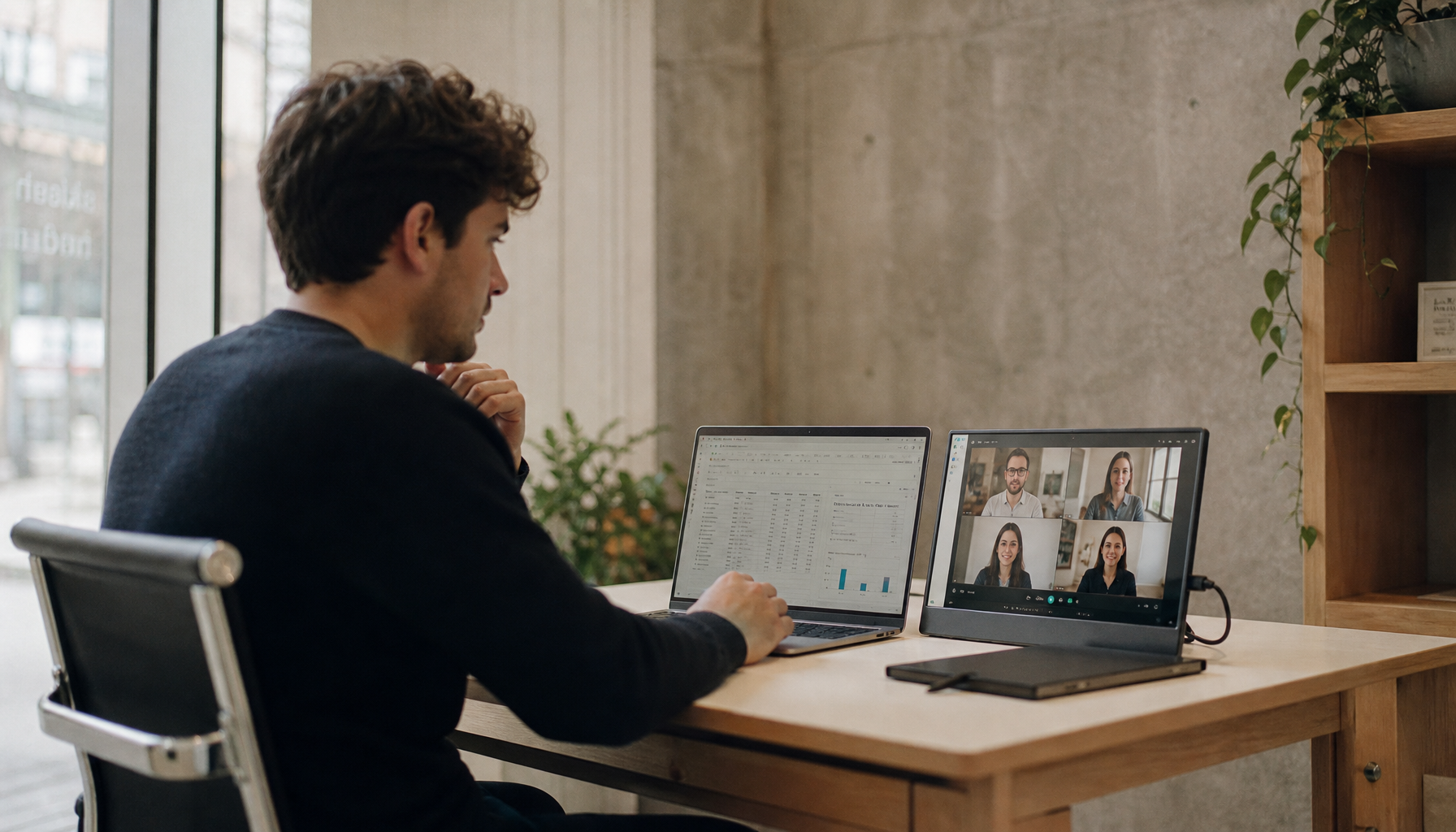
Most standard KVM monitors are built to toggle cleanly between just two laptops, which makes managing three devices feel like a constant game of cable swapping and input juggling. The good news is that a deliberate hybrid architecture—pairing the monitor’s built-in KVM with a smart docking or guest-cable strategy—can deliver a near one-cable hot-desking experience while keeping the desk professional and productive.

Why Managing Three Laptops Is Different Than a Standard KVM Setup
Standard KVM monitors, including many high-end models with integrated switching, are optimized for two active host devices. When you introduce a third laptop, the built-in toggle no longer covers every daily rotation, forcing either manual cable changes or an external switching layer. The practical difference is the “device overflow” that turns simple hot-desking into a deliberate system-design task. The goal shifts from occasional input swaps to a reliable one-cable workflow that preserves productivity across varied laptops and operating systems.
Without that architecture, users often end up with a tangle of HDMI, USB-C, and power adapters that defeats the purpose of a clean shared desk. Recognizing this limit early helps you avoid buying a monitor expecting seamless three-device support only to discover the two-host ceiling on day one.
Does Your Hardware Support a One-Cable Hot-Desking Workflow?
Before buying new gear, verify that your laptops and monitor can actually sustain video, data, and charging over a single connection. Start with USB-C Power Delivery: 65 W is the practical baseline, but 90 W or higher (as seen on many current prosumer monitors) prevents battery drain during intensive video calls or multitasking. This Kensington docking station specification confirms that 90–100 W keeps modern laptops charged while driving a high-resolution display.
Next, confirm DisplayPort Alternate Mode support on the laptop’s USB-C port so video travels alongside power and data. Without it, you will need separate video cables and lose the one-cable benefit. macOS users face an extra constraint: the operating system relies on Single-Stream Transport rather than Multi-Stream Transport, which can complicate wake-from-sleep behavior when multiple devices share the same monitor. Checking these three items—PD wattage, Alt Mode compatibility, and OS-specific limits—before setup saves hours of troubleshooting later.
The table below summarizes safe starting thresholds for common laptop classes.
| Laptop Type | Minimum USB-C PD | Alt Mode Required | macOS Consideration |
|---|---|---|---|
| Ultrabook / M-series Mac | 65 W | Yes | SST only; test wake behavior |
| Workstation / Gaming | 90–100 W | Yes | Usually Windows; MST friendly |
Choosing Between Built-in KVM, Universal Docks, and External Switches
Most integrated KVM monitors handle only two active computers, so the third laptop needs its own path. A hybrid approach often works best for prosumer users: use the monitor’s built-in KVM for your two primary laptops and treat the third as a “guest” that either hijacks the primary USB-C cable or connects through a separate dock. This keeps switching fast for the main machines while limiting cable changes for occasional use.
Universal docking stations, such as those from Kensington, act as a true central hub. You plug all peripherals into the dock once, then move a single USB-C or Thunderbolt cable between laptops. As explained in Kensington’s minimalist desk setup guide, this method delivers the cleanest look but requires physically moving the cable each time. External 3-port KVM switches provide one-button input changes for all three machines, yet they tend to add visible cable runs and can introduce minor signal degradation at higher resolutions.
Choose built-in KVM when your workflow is 80 % two laptops and 20 % guest use. Opt for a universal dock when desk aesthetics matter more than instantaneous switching. Reserve a dedicated external KVM only when every second of input change counts and you can tolerate extra cabling.
The Wiring Blueprint: Connecting Three Laptops to One Monitor
Label your machines clearly: Laptop A stays permanently connected to the monitor’s primary USB-C port, carrying video, up to 90 W power delivery, and upstream data for the integrated USB hub. Laptop B connects via DisplayPort (or a second USB-C if available) to the monitor’s secondary KVM input so the built-in switch can toggle between the two main devices. Laptop C becomes the guest—either by swapping the primary USB-C cable or routing through a small dedicated dock that shares the same upstream path.
Connect your keyboard, mouse, and webcam directly to the monitor’s downstream USB ports. This lets the internal hub route peripherals automatically when you switch hosts. Use high-quality, certified USB-C cables rated for at least 100 W and 4K video to avoid intermittent wake or charging failures. Keep power bricks for each laptop nearby but hidden; only the active machine draws significant power through the monitor.
This blueprint minimizes visible wires while respecting the two-device limit of most integrated KVMs. Test each connection individually before combining them so you can isolate compatibility quirks early.

How to Organize Your Desk for Multi-Device Aesthetics and Airflow
Vertical laptop stands are the most effective way to keep three closed laptops in roughly the footprint of one. Adjustable multi-slot designs let you store devices upright, improving airflow and preventing thermal throttling while dramatically reducing horizontal clutter. Research on ergonomic home-office setups consistently shows that vertical storage maintains better ventilation than stacking machines flat on a desk.
Mount slim cable-management trays or channels under the desktop edge to route power bricks, spare cables, and the monitor’s upstream cord out of sight. This step turns the inevitable “spaghetti” of a three-device station into an organized, professional appearance. Position the monitor on a height-adjustable arm or stand so the screen sits at eye level whether you are seated or standing; the same arm can free up desk real estate that the vertical stands now occupy.
Leave at least two inches of clearance behind each stored laptop for heat exhaust. If your room runs warm, consider a small under-desk fan directed at the vertical rack. These layout choices keep the station looking intentional rather than improvised and protect device longevity during all-day use.
Solving Common Connectivity and Power Delivery Failures
USB-C wake failures on Apple Silicon Macs are a frequent pain point in one-cable setups. Use only cables certified for 100 W delivery and ensure the monitor’s power-saving settings do not cut the USB hub voltage during sleep. Many users find that a brief press of the laptop’s power button after docking resolves the handshake; others add a small USB-C hub with its own power passthrough as a reliable intermediary.
The “toggle tax”—navigating on-screen display menus to change inputs or HDR modes—adds friction during fast context switches. Program OS-level hotkeys or use the monitor’s KVM button (when available) to bypass the menu. Power sag can appear when screen brightness is maxed while charging a demanding laptop; lowering brightness to 60–70 % usually restores stable 90 W delivery.
If a laptop refuses to charge or the display flickers, reseat the cable, cycle the monitor’s power, and confirm the laptop’s USB-C port supports video output. For recurring issues with a specific device, a dedicated universal dock often proves more stable than relying solely on the monitor’s internal circuitry. Document which cable and port combination works for each laptop so morning docking stays under 30 seconds.
What to Check When Your Third Laptop Refuses to Switch or Charge Reliably
When the third device fails to appear or charge consistently, begin with the simplest variable: cable quality and length. Swap in a known-good, 100 W-rated USB-C cable no longer than 6 ft (1.8 m). Next, verify that the monitor’s firmware is current; some 2025–2026 models received updates that improved multi-host wake behavior. Check the laptop’s power settings to ensure it is allowed to charge from a dock or monitor rather than treating the connection as data-only.
If the issue persists only on macOS, test whether the machine wakes when connected directly to the monitor versus through an intermediate dock; the difference often reveals an SST handshake timing problem rather than a hardware fault. Keep a short checklist near the desk—cable seated, monitor awake, correct KVM channel selected—so troubleshooting takes seconds instead of minutes. Addressing these edge cases early prevents the setup from becoming a daily source of frustration and keeps the hot-desking station truly productive.
Can a Standard KVM Monitor Truly Support Three Laptops Without Extra Hardware?
Most integrated KVMs are limited to two active hosts, so a third laptop requires either manual cable swapping or an external dock/switch. A hybrid approach using the monitor’s KVM for two machines and a guest cable for the third is the most common workable path without adding a full external KVM.
How Much Power Delivery Is Needed to Charge a Laptop While Using the Monitor?
Aim for at least 65 W, but 90–100 W is safer for larger or high-performance laptops under load. Lower wattage may result in slow charging or gradual battery drain during video calls and multitasking.
Do Vertical Laptop Stands Actually Improve Airflow and Reduce Overheating?
Yes. Storing laptops upright in a vertical stand allows better passive airflow around the chassis compared with laying them flat, which helps prevent thermal throttling when the lids remain closed for extended periods.
Will macOS Devices Work Seamlessly in a Multi-Laptop USB-C KVM Setup?
macOS is limited to Single-Stream Transport, which can cause wake-from-sleep inconsistencies. Using high-quality cables, keeping the monitor powered on, and occasionally adding a small powered USB-C hub often resolves most handshake issues.
Is an External KVM Switch or Universal Dock Cleaner Than Constant Cable Swapping?
A universal dock usually produces the cleanest desk because peripherals stay connected to the dock and only one cable moves between laptops. An external KVM offers faster input changes but typically adds more visible cabling and potential signal complexity.