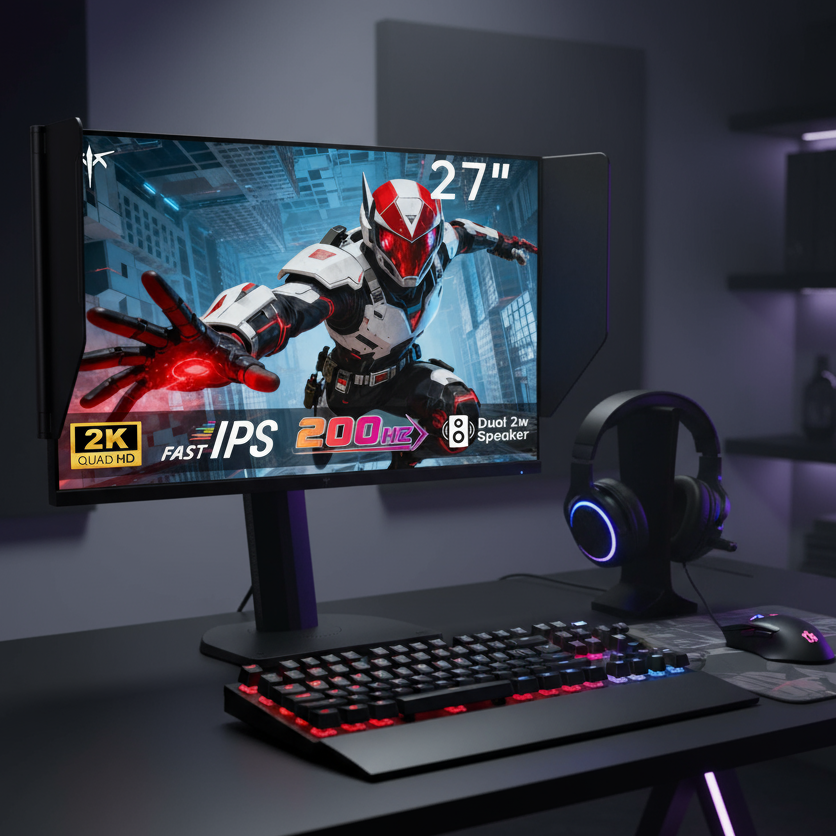


Monitor overclocking lets enthusiasts push a display's refresh rate beyond its factory rating to achieve smoother motion and potentially lower input lag in competitive games. The key is verifying that the higher Hertz is stable with no frame skipping, as an unstable overclock can introduce artifacts or reduce color quality. Always test thoroughly and know when upgrading to a native high-refresh monitor is the safer choice.

What Is Monitor Overclocking and How Does It Work?
Monitor overclocking involves increasing the refresh rate above the panel's official specification by adjusting timings through your GPU control panel or a tool like Custom Resolution Utility (CRU). The monitor's internal scaler and timing controller (TCON) receive a faster signal, which in theory reduces frame persistence—the time each image stays on screen—and can lower perceived input lag for fast-paced titles.
This differs from a factory overclock, where manufacturers like KTC validate and warrant the higher rate. Manual overclocking is user-driven and carries risks such as signal instability. It works best on panels with some design headroom, but results vary due to the "panel lottery" where identical models perform differently. The real goal for competitive players is measurable smoothness, not just a higher number in the display settings.
The Hardware Audit: Cables, Ports, and Bandwidth Limits
Before attempting any overclock, audit your setup to determine if your cable, port, or GPU can support the increased bandwidth. HDMI 2.2 (often called Ultra96) provides up to 96 Gbps and supports uncompressed 4K at 240 Hz with full color depth, according to the official HDMI specification. DisplayPort 2.1 offers even higher payload for extreme rates without compression in many cases.
Safe Refresh Tiers by Resolution and Interface
Shows where 1440p and 4K generally fit as refresh demand rises, and when compression or lower color depth becomes the safer expectation.
View chart data
| Category | HDMI 2.2 uncompressed | HDMI 2.2 with DSC | DP 2.1 uncompressed | DP 2.1 with DSC |
|---|---|---|---|---|
| 1440p | 240.0 | 360.0 | 240.0 | 360.0 |
| 4K | 120.0 | 480.0 | 144.0 | 540.0 |
This chart helps visualize the rough bandwidth thresholds. At higher refresh rates, Display Stream Compression (DSC) often becomes necessary. Chroma subsampling (4:2:2) is a common hidden cost that can blur text and reduce color accuracy, making it unsuitable for productivity work. If your current cable is older than HDMI 2.1 or DP 1.4, replace it first—legacy cables frequently cause black screens or force quality trade-offs that mask any overclock benefit.

For most gamers, checking cable and port version should be the first step. If your hardware cannot sustain the target without heavy compression, overclocking the panel will not deliver the expected gains.
Step-by-Step: How to Overclock Using GPU Control Panels and CRU
Start in your GPU software. In the NVIDIA Control Panel or AMD Software, create a custom resolution and incrementally raise the refresh rate by 1 Hz at a time. Use the VESA Coordinated Video Timings (CVT) Standard, specifically CVT-RBv2 reduced blanking timings, to lower the pixel clock and stay within bandwidth limits. This standard is the industry method for successful higher-rate custom resolutions.
For finer control, download CRU (Custom Resolution Utility). It lets you edit detailed timing parameters directly. Apply the new resolution, restart the driver or PC if needed, and test at each step. Follow the 1 Hz increment rule: small changes reduce the chance of immediate failure and let you isolate the panel's true limit. Many users reach modest gains of 10–30 Hz on mid-range panels, but never bypass driver safety warnings.
The Verification Phase: Testing for Frame Skipping and Stability
A higher number in Windows settings does not guarantee success. Frame skipping—where the monitor drops frames to cope—creates stutter that ruins smoothness. The only reliable check is the TestUFO Frame Skipping Checker. Run the test and take a long-exposure photo (around 1/5 or 1/10 second shutter speed) of the moving square sequence. A solid line of squares without gaps confirms a true overclock; gaps mean frames are being skipped.
Disable hardware acceleration in your browser and disconnect secondary monitors to avoid VSYNC interference or clock drift that can produce false results, per Blur Busters testing guidance. Stress the overclock for at least 30 minutes while monitoring for flicker, heat, or artifacts. If the test passes cleanly, the higher Hertz is likely delivering real benefits.
Identifying the Danger Zone: When to Stop and Revert
Stop immediately if you see flickering, horizontal lines, inverse ghosting, or random black screens. These signs indicate the panel's scaler or power delivery is stressed. Overclocking can reduce panel lifespan in some cases, though exact long-term effects are hard to quantify and depend on usage and cooling.
Remember the panel lottery: two identical monitors may have very different stable limits. Prioritize image quality—do not sacrifice 10-bit color or full chroma (4:4:4) for a few extra Hertz. If artifacts appear or the long-exposure test fails, revert to the factory timing right away. A stable lower refresh rate is always preferable to an unstable higher one.
Native vs. Overclock: Choosing Your Next High-Hz KTC Display
When an overclock becomes unstable or requires too many compromises, upgrading to a natively high-refresh-rate monitor often provides better reliability and full warranty coverage. Native panels are factory-validated, avoiding the risks of sustained manual tuning.
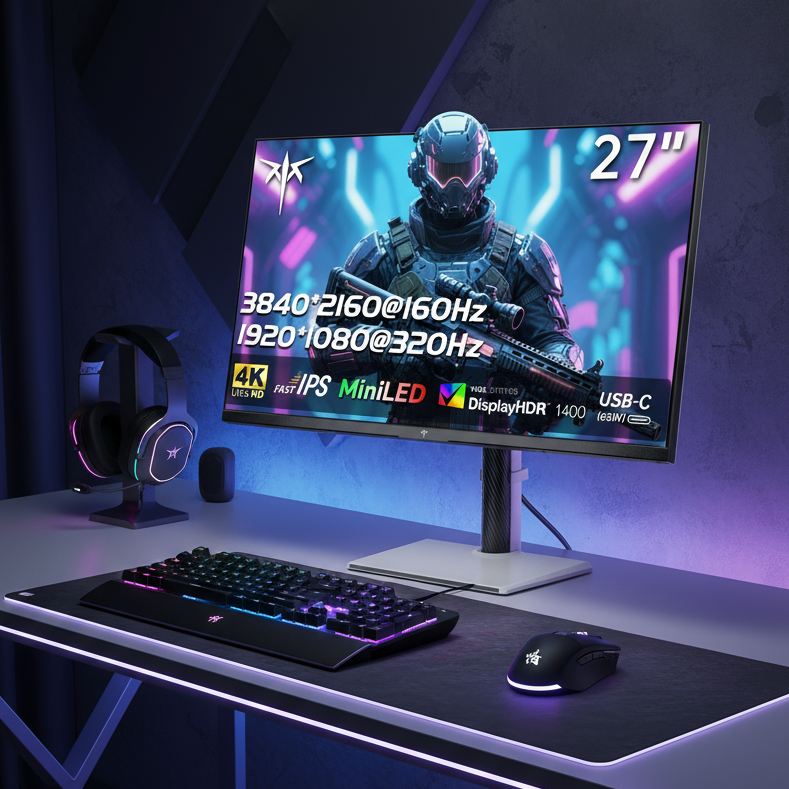
KTC offers strong options in the high-Hz space. The KTC 27" 2K 300Hz/1ms Gaming Vertical Monitor | H27E6 delivers validated 300 Hz performance ideal for esports. For even faster play, consider the KTC 24.5 inch 360Hz/400Hz OC Fast IPS FHD Gaming Monitor HDR 400 | H25X7, which reaches 400 Hz with factory support. Explore the full 240Hz-400Hz Monitors collection to match your resolution and budget needs.
Overclocking can extend the life of an older display, but for serious competitive players chasing maximum Hertz without compromise, a native high-refresh KTC monitor usually proves the lower-risk path to consistent performance.
Is It Safe to Overclock Monitor Hz?
It can be safe in moderation if you stay within the panel's stable limit and verify with proper testing. However, it is not risk-free. Overclocking stresses internal components and may cause artifacts or reduce longevity on some panels. Always use incremental steps, test for frame skipping, and revert at the first sign of instability. Budget or older panels have less headroom, so treat overclocking as a cautious experiment rather than a guaranteed upgrade.
Does Overclocking Reduce Input Lag?
It can lower perceived input lag slightly by reducing frame persistence, but the difference is often small and only noticeable in very high-frame-rate scenarios. Real input lag improvements come more from better synchronization (VRR) and a fast response time than raw Hertz alone. Overclocking alone will not transform a high-latency setup.
How Do I Test for Frame Skipping After Overclocking?
Use the TestUFO frame skipping tool and capture a long-exposure photo of the test pattern. Look for continuous squares with no gaps or breaks. Disable browser hardware acceleration and secondary monitors during the test. A clean result over several minutes confirms stability; any gaps mean the overclock is not truly delivering the higher refresh rate.
When Should I Upgrade Instead of Overclocking?
Upgrade when you need more than 10–20 Hz of stable gain, when image quality suffers (color depth or chroma), or when artifacts appear during testing. If your current panel is already near 240–360 Hz native, the diminishing returns and risks usually make a factory-validated higher-Hz model the better long-term choice for competitive play.
What Cable and Port Do I Need for High Refresh Overclocking?
Use at minimum a certified HDMI 2.1 or DisplayPort 1.4 cable, but HDMI 2.2 or DP 2.1 is strongly preferred for 1440p and 4K at 240 Hz and above. Older cables frequently force compression or subsampling that negates overclock benefits. Check your GPU ports as well—integrated graphics often lack the bandwidth for extreme rates.