

Monitor ghosting appears as a dark trailing shadow behind fast-moving objects on your screen. It is caused by slow pixel transitions on the panel itself. The good news is that you can reliably diagnose whether the blur you see is true ghosting, sample-and-hold persistence, or overdrive overshoot using a free browser test. Once you know the root cause, you can tune your settings or decide whether a different panel type better fits your games.

What Is Monitor Ghosting and Why Does It Happen?
Monitor ghosting is a trailing motion artifact that occurs when pixels cannot change their state quickly enough as an object moves across the screen. The previous image lingers briefly, creating a faint dark shadow that follows the moving object. This differs from inverse ghosting, also called coronas or overshoot, where aggressive voltage causes bright glowing edges instead of dark trails.
VA panels are particularly prone to dark smearing during black-to-dark-gray transitions. This panel trait can make enemies in night-time scenes of games like Escape from Tarkov seem to disappear into black trails. As Blur Busters explains, these artifacts stem from asymmetric pixel response times rather than a universal flaw.
Ghosting is a hardware-level limitation, not a software or cable issue in most cases. Recognizing the visual signature helps you avoid chasing the wrong fix.
Ghosting vs. Motion Blur: Why 1ms GtG Isn’t a Perfect Fix
Even monitors advertised with 1ms GtG (gray-to-gray) response time can still look blurry in motion. GtG measures how fast a pixel can transition between shades, but it does not account for sample-and-hold persistence, or MPRT.
Sample-and-hold blur happens because the image stays lit for the entire refresh cycle while your eyes continue to track motion. This creates uniform blur that no amount of overdrive can fully eliminate. The heuristic many enthusiasts use is that doubling your refresh rate roughly halves persistence blur, because each frame is held for half as long. This is a useful planning guideline, not a laboratory guarantee.
This distinction matters for competitive play. If your UFO test shows uniform blur without a distinct dark tail or bright halo, your limit is likely the refresh rate, not pixel response time. Increasing overdrive in that situation only adds overshoot without solving the core issue.
The TestUFO Diagnostic framework helps you separate these causes in seconds. Our related guide on What Is Sample-and-Hold Blur and Why Higher Refresh Rates Don't Eliminate It? explores this persistence problem in greater depth.
Step-by-Step: How to Test for Monitor Ghosting Using TestUFO
Testing takes less than two minutes and requires no special equipment beyond a browser.
- Go to the TestUFO Ghosting test.
- Set your browser zoom to exactly 100% and verify the green "Sync" indicator is lit. This ensures the test runs at your monitor’s native refresh rate.
- For most monitors, select 960 pixels per second. Choose 1920 pixels per second if you have a 240 Hz or faster panel.
- Sit at normal viewing distance and smoothly track the moving UFO with your eyes (the pursuit camera technique). Do not stare at a fixed point on the screen.
Look for three visual signatures: a dark trailing shadow (ghosting), bright glowing edges (overshoot), or uniform softness across the entire image (persistence). Record your overdrive setting and refresh rate so you can compare results after adjustments.
For more background on response time marketing claims, see our article How Important is 1ms GTG for Your FPS Gaming?.
The Diagnostic Guide: Interpreting Your TestUFO Results
The pattern you see tells you exactly what to adjust.
- Dark shadows or tails that follow the UFO indicate genuine ghosting from slow pixel transitions. Moderate overdrive usually helps.
- Bright halos or coronas around the UFO signal inverse ghosting from excessive overdrive. Lower the response time setting immediately.
- Uniform blur without distinct trails points to persistence blur. This is primarily limited by your refresh rate; further overdrive will not improve it and may introduce other artifacts.
VA panels often show extra smearing only against dark backgrounds. If trails appear mainly in night scenes, this is a panel characteristic rather than a setting you can fully correct.
TestUFO Diagnostic: Identifying the Blur Root Cause
Use these self-check rules before touching your OSD:
- If the UFO is uniformly blurry but lacks a distinct tail or shadow, persistence (refresh rate) is the limit. Overdrive cannot fix it.
- Check for asymmetry: Trails only on dark backgrounds suggest VA-specific dark smearing.
- Bright glowing edges mean your overdrive is too aggressive; reduce it to avoid distracting inverse ghosting.
VESA ClearMR offers a more reliable industry metric than GtG alone. It measures the ratio of clear to blurry pixels while strictly limiting overshoot, giving a clearer picture of real motion performance. Learn more at the official ClearMR site.
How to Reduce Ghosting and Optimize Your Monitor Settings
Start with the middle overdrive setting (often labeled “Medium,” “Normal,” or “Level 2” depending on the model). Increase gradually while re-testing until you see the first hint of bright coronas, then step back one level. This “middle ground” rule prevents both residual ghosting and overshoot.
Backlight strobing (sometimes called MBR or BFI) can further reduce persistence blur but usually introduces flicker and cuts brightness. It also adds input lag, which competitive players often avoid. The trade-off is real: clearer motion at the cost of comfort and responsiveness.
Our in-depth piece on What Is Pixel Overdrive, and When Does It Create Inverse Ghosting? details these tuning trade-offs with additional test examples.
Don’t buy or tune if…
You primarily play dark tactical shooters on a VA panel and expect zero smearing. VA dark-level transitions are a fundamental trait; no OSD setting fully erases them. Consider IPS or OLED instead.
VA vs. IPS vs. OLED: Choosing Your Next Performance Panel
Panel choice determines which motion artifact you will battle most.
VA panels deliver excellent contrast but suffer noticeable dark smearing in low-brightness scenes. They suit cinematic single-player games where motion clarity is secondary to blacks and color volume.
IPS panels offer more consistent gray-to-gray transitions and are less prone to dark smearing. They perform well in bright arena shooters like Valorant or Overwatch where the environment rarely triggers the worst-case transitions.
OLED panels virtually eliminate GtG ghosting because pixels can turn off instantly. They remain subject to persistence blur, but the higher perceived clarity often makes a 240 Hz OLED feel cleaner than a 360 Hz IPS in fast motion. Our KTC OLED 27" 2K 240Hz/0.03ms USB-C Gaming Monitor | G27P6 is an excellent choice for esports players who want both contrast and motion clarity.
Motion Clarity vs. Game Environment Matrix
- Dark tactical maps (Tarkov, DayZ): VA dark smearing can hide enemies. Prefer IPS or OLED.
- Bright competitive shooters (Overwatch, Valorant): IPS performs reliably and offers good color accuracy.
- High-motion esports: A 240 Hz OLED like the G27P6 often delivers higher perceived clarity than higher-Hz IPS panels because it removes GtG decay.
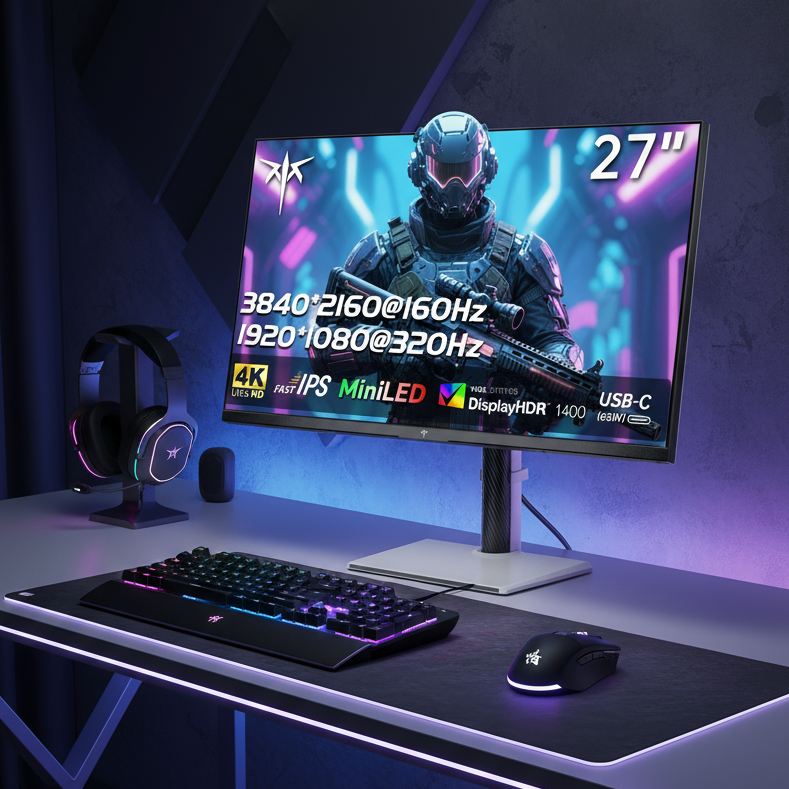
For versatile performance with strong HDR, consider the KTC Mini LED 27" 4K 160Hz HDR1400 Gaming Monitor | M27P6 or the KTC Mini LED 27" 180Hz 2K HDR1400 Gaming Monitor | M27T6 for cinematic contrast. Pure high-refresh competitive players may prefer the KTC 24.5 inch 360Hz/400Hz OC Fast IPS FHD Gaming Monitor HDR 400 | H25X7.
See our panel comparison guide IPS vs VA Panels: Which is Right for Your Playing Style? for deeper analysis.
When Motion Blur Comes from Refresh Rate vs Overdrive
Use this chart to judge whether motion blur is mainly limited by refresh rate (persistence blur) or by pixel-response tuning (ghosting vs overshoot). At lower Hz, persistence blur is usually the bigger constraint; as refresh rate rises, overdrive tuning becomes more important, but pushing it too far can create inverse ghosting.
View chart data
| Category | Persistence blur index | Ghosting pressure | Overshoot risk |
|---|---|---|---|
| 60 Hz | 4.0 | 3.0 | 1.0 |
| 120 Hz | 2.0 | 3.0 | 1.0 |
| 240 Hz | 1.0 | 2.0 | 2.0 |
| 480 Hz | 0.5 | 2.0 | 3.0 |

How Should You Judge Real Improvement After Tuning?
Run the TestUFO test before and after every major change. Take a short video of the moving UFO at the same speed and overdrive level so you can compare side-by-side. In actual games, note whether targets feel easier to track or whether new halos appear during quick turns.
If persistence blur remains dominant even at 240 Hz or higher, the next meaningful upgrade is usually a higher-refresh-rate panel or one with better pixel response characteristics, such as OLED. For most competitive players, a well-tuned 240 Hz or 360 Hz monitor already delivers excellent motion clarity once ghosting and overshoot are controlled.
Explore more high-performance options in our 240Hz-400Hz Monitors or All-OLED Monitor collections.
FAQ
What is the difference between monitor ghosting and motion blur?
Ghosting is a dark trail caused by slow pixel transitions, while motion blur from sample-and-hold persistence affects the entire image uniformly and is mainly limited by refresh rate. Overdrive can reduce ghosting but cannot fix persistence blur.
Does a 1ms GtG monitor eliminate ghosting?
No. A 1ms GtG rating only describes pixel transition speed. Sample-and-hold persistence blur remains and can still be visible, especially at lower refresh rates. Higher Hz and proper overdrive tuning deliver more noticeable real-world improvement.
How do I know if my overdrive setting is too high?
Bright glowing edges or halos (inverse ghosting) around moving objects indicate overshoot. Lower the overdrive one step and retest. The goal is the highest setting that does not produce visible coronas.
Can backlight strobing remove ghosting?
Strobing primarily reduces persistence blur by shortening image hold time, but it often adds flicker, reduces brightness, and increases input lag. Many competitive players prefer higher refresh rates and tuned overdrive instead.
Is VA smearing fixable with settings?
VA dark smearing during black-to-gray transitions is largely a panel characteristic. While moderate overdrive helps, it cannot be completely eliminated. IPS or OLED panels are usually better for dark-scene competitive games.
Which panel type is best for competitive FPS games?
For bright arena-style shooters, a fast IPS panel offers consistent performance. For maximum motion clarity and contrast, OLED panels like the KTC G27P6 often provide the cleanest perceived motion because they eliminate GtG ghosting.
How often should I re-test my monitor settings?
Re-run the TestUFO pursuit test after any driver update, resolution or refresh rate change, or when you switch games with very different brightness levels. A quick check takes under a minute and prevents hidden regression in motion clarity.