Input lag can rise through a monitor USB hub when several devices share one upstream path to the computer. The delay is often small, but it can become noticeable when bandwidth, polling rate, power, or signal stability is strained.
Does your mouse feel crisp when plugged into the PC, then slightly floaty when routed through the monitor’s USB ports? The fastest test is simple: compare the same mouse directly on the computer versus through the monitor hub while keeping refresh rate, game settings, and polling rate unchanged. That gives you a clean way to identify whether the hub is the bottleneck and how to keep your setup responsive.
The Short Answer: The Hub Adds Another Traffic Manager
A monitor USB hub is convenient because it turns your display into a desk command center. One cable can route peripherals, charging, Ethernet, webcam data, and sometimes video-related USB-C traffic. That convenience has a cost: every connected device has to pass through hub electronics before reaching the host computer.
A standard USB hub has one upstream connection to the computer and several downstream ports for devices, so all connected accessories share that upstream link’s capacity and timing behavior. USB hubs expand a PC by adding accessible ports, but expansion is not the same as a direct, isolated connection. For office work, that tradeoff is usually invisible. For competitive shooters, rhythm games, fighting games, or high-refresh cursor work, the extra routing can be enough to feel different.
What Input Lag Means in This Setup
Input lag is the delay between your action and the visible result on screen. Measured display databases often compare display responsiveness in low-lag gaming modes, which matters because a USB hub is only one part of the chain measured display responsiveness.
Your real input path includes the mouse sensor, mouse firmware, USB polling, hub routing, host controller, operating system, game engine, GPU render queue, display processing, panel scanout, and pixel response. A monitor hub can add delay before the game receives the input, while the monitor’s picture mode or refresh behavior can add delay after the frame is rendered. If you change both at once, you may blame the wrong part.
Why Monitor USB Hubs Can Increase Latency
Shared Bandwidth Can Crowd Real-Time Inputs

The most common reason is shared bandwidth. A mouse and keyboard use very little data, but a monitor hub may also be handling a webcam, USB headset, Ethernet adapter, capture device, flash drive, or external SSD. When those devices send bursts of data through the same upstream connection, the hub has to schedule and route packets.
USB-C monitor hubs can feel slow because video, charging, and connected accessories may share one upstream USB-C connection, and a high-resolution display signal can leave less room for fast USB data one upstream USB-C connection. A practical example is a 4K work display running at 60 Hz while a webcam and Ethernet adapter sit on the same monitor hub. Your keyboard will still work, but a high-polling mouse can feel less consistent during file transfers or video calls.
Polling Rate Makes Small Delays Easier to Feel
Gaming mice often poll much faster than basic office mice. Community latency discussions commonly note that a default keyboard or mouse polling rate is often 125 Hz, which means updates arrive about every 8 milliseconds, while many gaming mice can run at 1,000 Hz for roughly 1-millisecond updates mouse polling rate. If a hub or port path behaves like a slower polling bottleneck, your premium mouse may not feel premium anymore.
This is why the same hub can be fine for a keyboard but questionable for a 1,000 Hz or 4,000 Hz mouse. A spreadsheet user may never notice. A player tracking a target at 240 Hz may feel the cursor rhythm change even if the average delay is only a few milliseconds.
Hub Quality and Chipset Efficiency Matter
Not all hubs are equal. A cleanly designed hub with a good controller, solid shielding, and stable firmware can add little perceptible latency. A budget hub with weak power handling or noisy electronics may create inconsistent timing, dropouts, or reduced transfer performance.
The same pattern shows up in real desk use: the amount of added latency depends on the computer, hub quality, USB standard, connected devices, and setup. A quality monitor hub can be excellent for a webcam, keyboard, controller, and headset receiver, while a weak hub can make even simple peripherals feel unreliable under load.
USB Standard and Port Type Can Create Hidden Limits
USB-C is a connector, not a performance guarantee. A monitor may have a USB-C port, but the internal hub could still split lanes in a way that favors display output over data speed. USB 2.0 is often enough for keyboards and basic mice, but it has much less bandwidth than USB 3.x and can become restrictive when several active devices share the path.
USB 3.0 commonly supports up to 5 Gbps, while USB 2.0 tops out at 480 Mbps. Hub latency can rise when too many active devices exceed the available bandwidth on a single upstream port. In plain terms, your mouse does not need 5 Gbps, but it benefits from a clean, uncongested route.
Connection path |
Best use |
Latency risk |
Mouse directly into PC |
Competitive gaming and high polling |
Lowest |
Keyboard through monitor hub |
General gaming and productivity |
Low |
Webcam or headset through monitor hub |
Meetings, streaming, desk cleanup |
Moderate under load |
External SSD through monitor hub |
Light file access |
Higher during transfers |
Capture card through monitor hub |
Usually avoid |
High |

The Display Side Can Be Mistaken for Hub Lag
A USB hub is not always the culprit. Monitor settings can create delay that feels like input lag even when the mouse path is perfect. Low-lag gaming modes matter because they reduce display processing.
Refresh rate also changes feel. At 60 Hz, a new frame appears every 16.67 milliseconds. At 144 Hz, frames arrive about every 6.94 milliseconds. If your monitor accidentally drops from 144 Hz to 60 Hz after a USB-C dock change, the setup can feel dramatically slower even if the USB hub added almost nothing. VSync can add another layer: a university measurement study found that VSync configurations affect input latency while trading off smooth, tear-free visuals VSync configurations. That means the right test keeps VSync, refresh rate, resolution, and game mode fixed before judging the hub.
Pros and Cons of Using Monitor USB Hubs
Monitor hubs are valuable when used with the right expectations. For a clean office or creator desk, they reduce cable clutter, make laptop docking faster, and keep low-bandwidth accessories attached to the display. Hub-equipped displays can be useful productivity tools because they simplify laptops, charging, and desk connectivity desk connectivity.
The downside is control. You may not know whether the monitor hub uses USB 2.0 lanes, USB 3.x lanes, shared USB-C bandwidth, or firmware scheduling that behaves differently under load. You also add one more cable and one more electronics layer between your hand and the game. That does not make monitor hubs bad; it makes them a poor place for the most timing-sensitive device on your desk.
How to Diagnose Hub-Related Input Lag
Start with a direct A/B test. Plug your mouse directly into the PC, launch the same game or aim trainer, and use the same refresh rate, resolution, frame cap, and mouse polling rate. Then move only the mouse to the monitor hub. If the feel changes immediately, the USB path deserves attention. If it does not, add your other devices back one at a time until the issue appears.

Next, test under load. Copy a large file from an external drive through the monitor hub while moving the mouse in-game or across a high-refresh desktop. If tracking becomes inconsistent during the transfer, the hub is probably congested or power-limited. Some testing has found that a strong desktop hub can move external SSD data without speed loss versus a direct connection, which shows why hardware quality matters.
Finally, isolate power. Bus-powered hubs pull power from the computer, while self-powered hubs use an external adapter. For high-power devices such as external drives, scanners, speakers, or multiple charging accessories, a self-powered hub is the stronger choice. For a gaming monitor hub, unstable power can look like lag because it causes brief disconnects, device resets, or inconsistent polling.
Best Setup for Gaming Monitors
For competitive gaming, plug the mouse directly into the PC or into a known low-latency, powered USB hub connected directly to the PC. Put the keyboard, webcam, headset receiver, lighting controller, and desk accessories on the monitor hub. Keep external SSDs, capture cards, and high-resolution webcams off the monitor hub when playing latency-sensitive games.

Use the monitor’s Game, FPS, Instant, or low-lag mode, and confirm the operating system is actually running the advertised refresh rate. A 240 Hz monitor running at 60 Hz because of a cable, dock, or OS setting will feel wrong no matter where the mouse is plugged in. If you use USB-C for one-cable docking, check whether the monitor reduces USB data speed to preserve video bandwidth, especially at 4K and high refresh rates.
Best Setup for Productivity and Portable Smart Screens
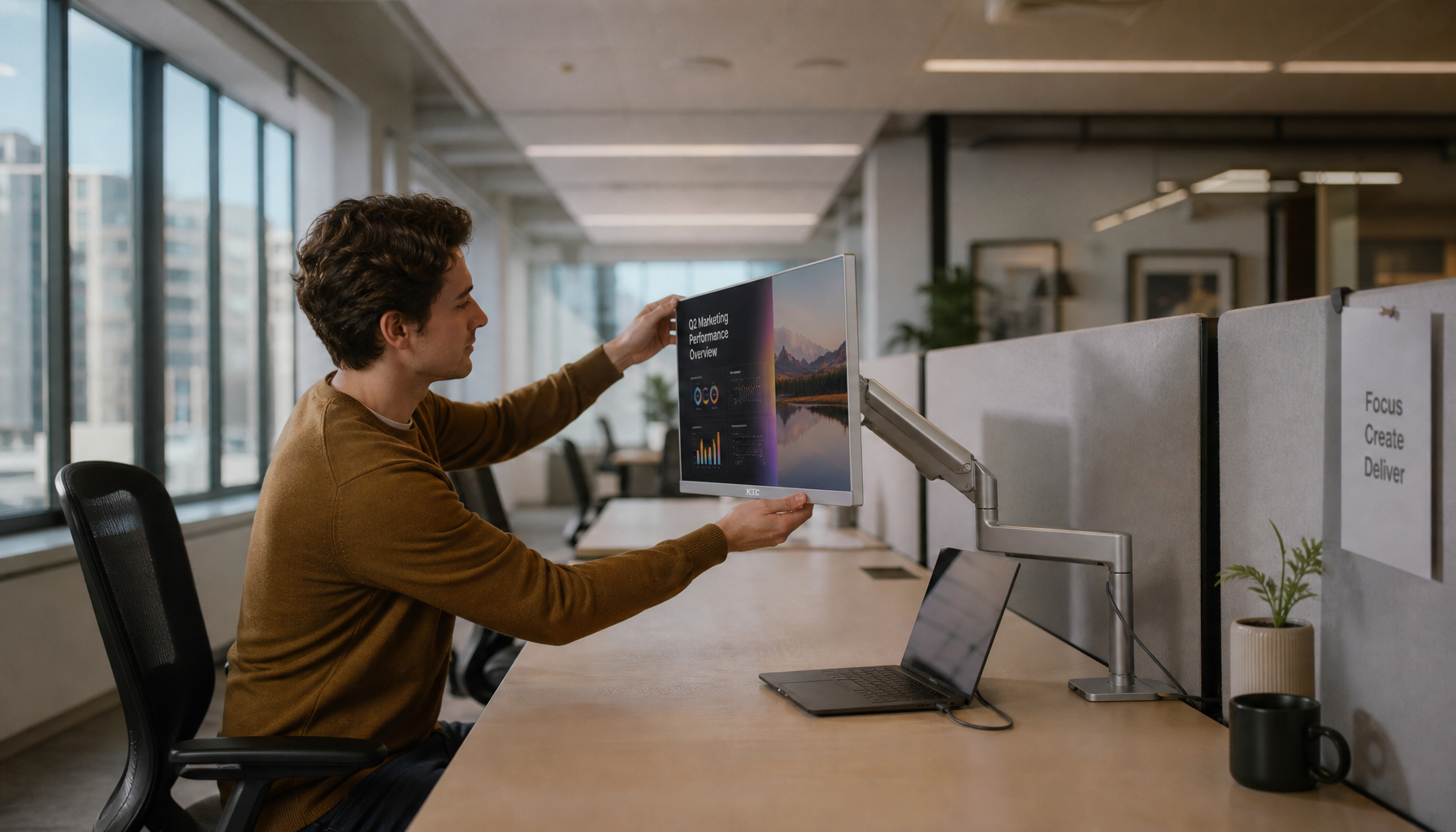
For office productivity, the monitor hub is often the right answer. A keyboard, mouse, webcam, Ethernet adapter, and headset can live on the display so a laptop docks with one cable. The small latency tradeoff is usually outweighed by faster setup, fewer desk cables, and less daily friction.
For portable smart screens, keep expectations tighter. Portable displays often depend on USB-C for video, power, and touch or accessory data. That makes cable quality and host-port capability critical. If touch input feels delayed, test with a shorter certified cable, reduce connected accessories, and confirm the laptop port supports the display mode you are using.
Buying Guidance: What to Look For
Choose a monitor or hub based on the workload, not port count alone. A display with many ports is not automatically better than one with fewer, faster, better-managed ports. For a gaming desk, prioritize measured input lag, stable high-refresh behavior, a direct PC mouse path, and a monitor hub reserved for convenience devices. For a productivity desk, prioritize power delivery, Ethernet stability, webcam performance, and enough USB 3.x bandwidth for the accessories you actually use.
Amazon-like hub listings often emphasize 4K HDMI, 100 W power delivery, and 5 Gbps USB-A ports hub listings. Those specs are useful, but they do not prove low input latency. For performance-driven setups, the better question is whether the hub stays stable when every device you plan to use is active at the same time.
FAQ
Should I plug my gaming mouse into the monitor USB hub?
For casual play, it is usually fine. For competitive games, plug the mouse directly into the PC first. If the monitor hub feels identical in an A/B test, you can use it, but direct connection remains the cleanest baseline.
Does a USB hub always add noticeable lag?
No. A high-quality hub may add so little delay that you cannot feel it. The risk rises with older USB standards, overloaded hubs, long cables, weak power, and high-polling peripherals.
Is USB-C automatically better for latency?
No. USB-C is just the connector shape. The actual performance depends on the USB generation, cable, monitor hub design, host port, power delivery, and whether video and data are sharing the same connection.
Can monitor picture settings feel like USB lag?
Yes. Heavy processing, non-native scaling, lower refresh rates, and VSync behavior can feel like input delay. Test the USB path only after locking down refresh rate, Game Mode, resolution, and frame settings.
A monitor USB hub is a smart desk tool, not a zero-latency extension of your motherboard. Use it for convenience devices, keep the mouse path clean for competitive play, and verify the full chain before replacing hardware.