You blink less on a screen because focused reading narrows your attention, makes your eyes keep refocusing on pixels, and often leads to incomplete blinking. The result is a drier eye surface, more irritation, and faster fatigue during long monitor sessions.
Ever finish a long document, coding session, or gaming chat window and realize your eyes feel dry before the rest of you feels tired? In one controlled reading study, blink rate dropped from a baseline of 19.74 blinks per minute during close reading tasks, and discomfort increased within 15 minutes. This guide explains what is happening and how to choose and set up a monitor that makes long text sessions easier on your eyes.
Why Screen Reading Changes Your Blink Pattern
Blinking is not just an automatic habit. It spreads tear film across the eye surface, clears small irritants, and helps keep vision stable between moments of focus. When you read text closely, especially on a monitor, your visual system tends to hold attention in a more fixed way, so blinks become less frequent and sometimes less complete.
A study of 40 healthy male participants compared 15-minute reading sessions on a 9.7-inch tablet and hard copy. The participants started at a baseline of 19.74 blinks per minute, then dropped to 14.93 blinks per minute after tablet reading and 11.35 blinks per minute after hard-copy reading, while symptoms such as dryness, grittiness, stinging, tiredness, pain, and itching increased during both tasks. The key point is that close visual reading tasks reduce blinking, whether the text is on paper or a screen.

Why Monitors Can Feel Harsher Than Paper
Monitor reading adds display-specific demands. Text is made from pixels, and your eyes must maintain focus on illuminated letter edges while dealing with brightness, contrast, glare, reflections, and viewing distance. If the monitor is too bright for the room, a white document can feel more like a light source than a page.
Digital eye strain is linked with eye irritation, blurred vision, light sensitivity, headaches, and pain behind the eyes. Screen users may blink only three to seven times per minute, which is low enough to let the tear film evaporate faster than it is refreshed. For someone reading spreadsheets, long PDFs, documentation, or text on a platform on a gaming monitor, that low blink rate can turn a sharp display into an uncomfortable one.
The Monitor Factors That Affect Eye Comfort
A more expensive monitor is not automatically easier on your eyes. Comfort depends on how the display handles brightness, text clarity, glare, viewing position, and the type of work you do. A 27-inch monitor used at 24 inches can feel excellent for documents if scaling is right, while a huge ultrawide can feel tiring if you constantly scan from edge to edge.
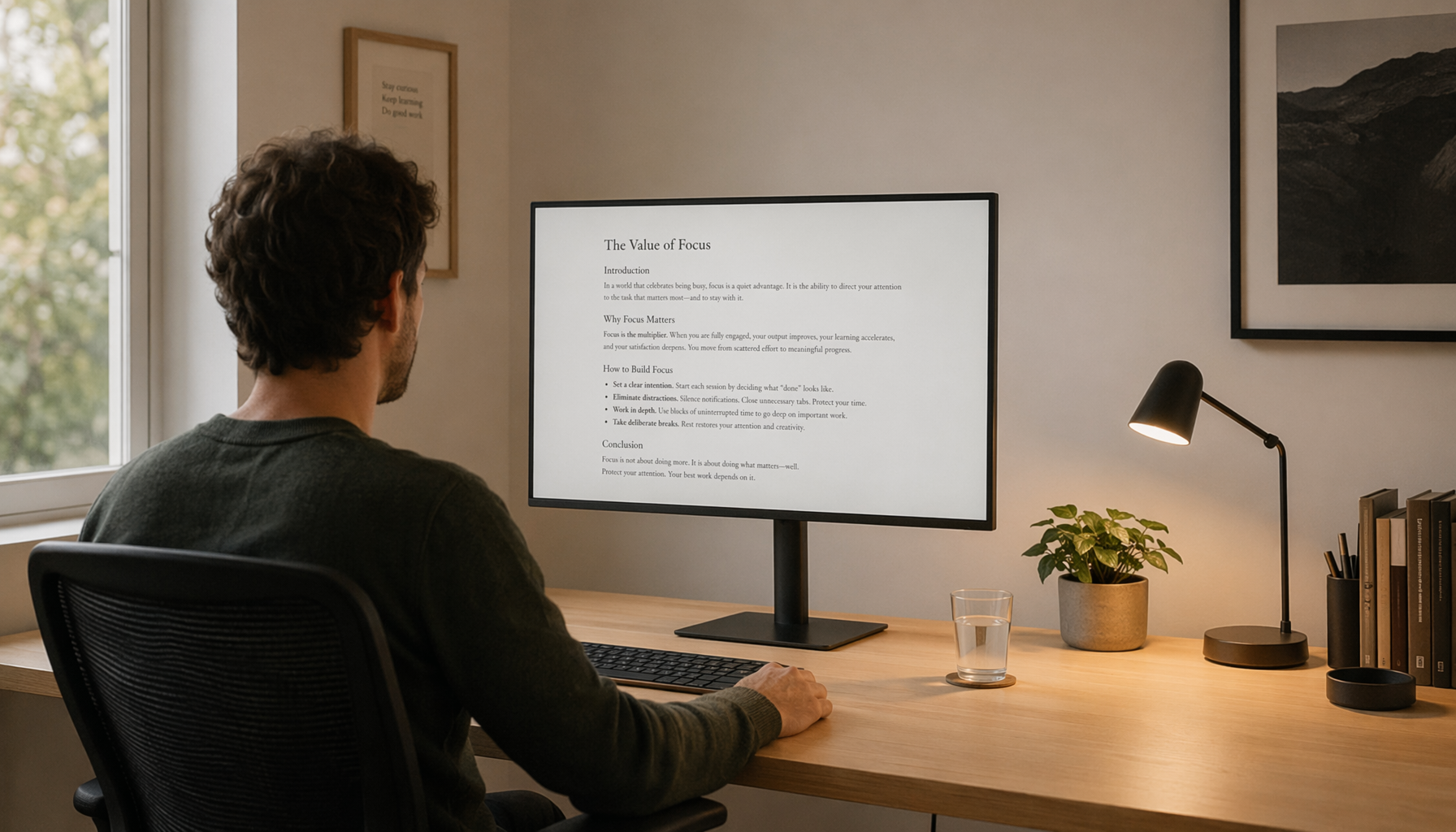
Brightness is the first practical variable to fix. A good starting test is simple: open a white document and compare it to a sheet of paper under the same room light. The screen should look similar to paper, not like a lamp and not like dull gray. Practical monitor guidance recommends matching brightness to room light and using about 60% to 70% contrast as a starting point for readable text without harsh black-white intensity.
Refresh Rate, Size, and Pixel Density
High-refresh-rate monitors can make scrolling, cursor movement, and gaming motion feel smoother, especially at 120 Hz, 144 Hz, 165 Hz, or higher. That can reduce the feeling of visual harshness during motion-heavy use, but it does not directly solve the low-blink problem during static reading. If you are reading a long article, email thread, or documentation page, the display may be barely changing; your blink behavior and setup matter more than maximum refresh rate.
For text-heavy work, prioritize pixel density, clean font rendering, and comfortable scaling. A 24-inch 1080p monitor can be readable but may show rougher text edges than a 27-inch 1440p display or a 32-inch 4K display with scaling. If your eyes feel tired after reading, try 125% to 150% scaling and 12 pt to 14 pt text before assuming you need a new monitor.
How Viewing Distance and Height Change Dryness
Monitor position affects blink comfort because eye opening changes with gaze direction. If the screen is too high, your eyes open wider, exposing more of the eye surface. More exposed surface means tears can evaporate faster, especially in dry indoor air, under ceiling fans, or near HVAC vents.
A medical organization recommends placing the monitor about an arm’s length away, reducing glare, adjusting lighting, and keeping the top of the screen at or just below eye level. These screen-related strain adjustments are basic, but they are often more effective than changing blue-light settings alone.
A Practical Setup Target
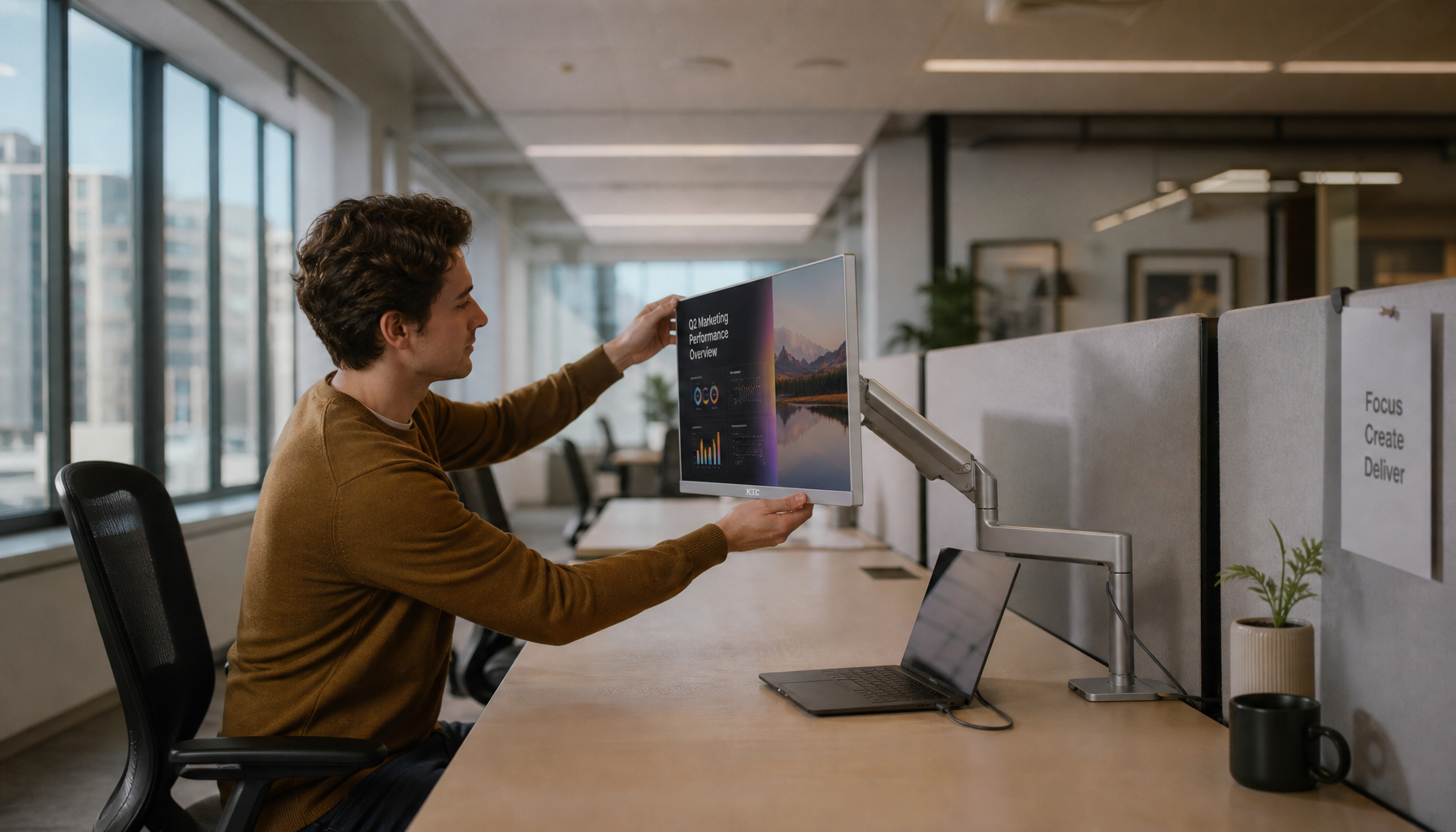
For most desk setups, place the display about 20 to 30 inches from your eyes. The top edge should sit at or slightly below eye level, with the center of the screen roughly 4 to 5 inches below eye level. This supports a slightly downward gaze, which can reduce eye surface exposure.

On an ultrawide monitor, distance matters even more. A 34-inch ultrawide used too close can force repeated head and eye movement across the panel. For reading-heavy work, keep your main document or browser column centered instead of stretching text across the full width. Side areas are better used for reference panels, chat, preview windows, or tool palettes.
Monitor Settings That Help Low-Blink Readers
The best monitor settings for eye comfort are usually moderate, not extreme. Very low brightness can make text muddy, while very high brightness can make the screen feel glaring. Very high contrast may look crisp for a few minutes but can become fatiguing during long reading sessions.
Start with the room first. Avoid placing a monitor directly in front of a bright window or under a reflection-heavy light. Then adjust the screen so a white page resembles paper in that room. If text looks thin or sparkly, increase scaling or font size before raising sharpness; too much artificial sharpness can make letter edges look harsh.
Recommended Starting Settings
Use these as starting points, then adjust by comfort after 20 to 30 minutes of reading:
Parameter |
Practical Starting Point |
Why It Matters for Reading |
Buying or Setup Note |
Viewing distance |
20 to 30 inches |
Reduces excessive focusing demand and helps posture |
Deeper desks help with 27-inch to 32-inch monitors |
Screen height |
Top edge at or slightly below eye level |
Supports a downward gaze and reduces exposed eye surface |
A height-adjustable stand is worth prioritizing |
Screen center |
About 4 to 5 inches below eye level |
Helps keep eyelids more relaxed during reading |
Especially useful for dry-eye-prone users |
Scaling |
125% to 150% |
Makes text easier to resolve without leaning forward |
Important on 1440p, 4K, and portable displays |
Text size |
12 pt to 14 pt |
Reduces squinting and refocusing effort |
Pair with font smoothing where available |
Contrast |
About 60% to 70% |
Keeps text clear without excessive harshness |
Fine-tune by app and room lighting |
20 seconds every 20 minutes |
Restores blink rhythm and relaxes focus |
Look at something about 20 feet away |
A common 20-20-20 rule is still one of the simplest habits for long monitor sessions: every 20 minutes, look at something 20 feet away for at least 20 seconds. The benefit is not just “rest.” It interrupts the locked-in reading state that reduces blinking and gives the tear film a chance to recover.

Choosing a Monitor for Long Reading, Gaming, and Daily Work
If you are buying a monitor and eye comfort is a priority, choose based on your actual mix of use. A competitive gaming display, an ultrawide productivity monitor, and a portable USB-C monitor can all be comfortable, but each has different tradeoffs.
For a main desk monitor, a 27-inch 1440p display is often a strong balance for text, gaming, and general work. It gives more desktop space than 1080p without making interface elements tiny. A 32-inch 4K monitor can be excellent for reading if you use scaling, while a 24-inch 1080p monitor may still work well in tighter spaces or budget setups.
If your priority is crisp text rather than high-refresh gaming specs, a 27-inch 4K IPS office display is another reasonable category to consider; for example, a 27-inch 4K IPS 60Hz low-blue-light home and office monitor is a 27-inch 4K IPS 60Hz model.

Gaming Monitors
For gaming monitors, do not buy only by refresh rate if you also read, work, or study on the same screen. A 144 Hz or 165 Hz panel may feel smooth, but eye comfort also depends on matte coating quality, brightness control, text clarity, and whether the stand lets you set proper height. If the monitor has an aggressive curve, check whether text near the edges remains comfortable for your desk distance.
Look for a display that can run at a comfortable brightness without flicker, has stable text rendering at your preferred resolution, and offers a stand with height, tilt, and ideally swivel adjustment. If you play fast games at night and read during the day, save separate picture modes: one for gaming brightness and one lower-brightness mode for documents.
Ultrawide and Portable Monitors
Ultrawide monitors are useful for dashboards, editing timelines, coding, and side-by-side documents, but they can encourage too much horizontal scanning. For eye comfort, avoid making paragraphs stretch across the full panel. Keep reading columns narrow and centered, then use the side space for secondary tools.
Portable monitors are convenient for travel, dual-screen laptop work, and small desks, but many are 14 to 16 inches. That smaller size can push users to lean forward or accept tiny text. Use scaling aggressively, raise the display closer to laptop eye level when possible, and avoid running it at maximum brightness in dim rooms.
Practical Next Steps
If your eyes get dry or tired when reading on a monitor, treat the problem as a setup issue before treating it as a hardware failure. Better monitor habits, placement, and settings can reduce discomfort even on the display you already own.
Use this checklist during your next long reading session:
- Set the monitor 20 to 30 inches from your eyes.
- Lower the display so the top edge is at or slightly below eye level.
- Match screen brightness to the room; a white page should look like paper.
- Start contrast around 60% to 70%, then adjust for clear but not harsh text.
- Increase scaling to 125% or 150% if you lean forward to read.
- Use 12 pt to 14 pt text for reading-heavy apps when possible.
- Every 20 minutes, look at something about 20 feet away for 20 seconds.
Small changes are easiest to evaluate one at a time. Adjust brightness first, then distance and height, then scaling and text size. If symptoms persist despite a better setup, an eye exam is a sensible next step because uncorrected vision issues, dry eye, or the need for task-specific computer glasses can make screen reading harder.
FAQ
Q: Does a high-refresh-rate monitor make you blink more?
A: Not directly. A high-refresh-rate monitor can make motion and scrolling look smoother, which may feel more comfortable during gaming or fast navigation. But during static reading, the main blink problem comes from sustained concentration, viewing distance, brightness, glare, and text size.
Q: Is an ultrawide monitor worse for dry eyes?
A: Not automatically. An ultrawide monitor can be comfortable if it is positioned correctly and used with centered reading columns. It becomes more tiring when text spans too wide, the screen sits too high, or you constantly scan from one edge to the other.
Q: Should I use dark mode for monitor reading?
A: Use whichever mode gives you clear text without glare in your room. Dark mode can feel better in dim lighting, while light mode may be easier in bright rooms if brightness is matched to the environment. The key is avoiding extreme contrast and making sure text remains large and sharp enough to read without squinting.