A 600-nit monitor can show 1000-nit HDR content well, but it tone-maps the brightest highlights instead of reproducing them at full intensity. Expect solid HDR impact if the display has good contrast, wide color, and local dimming; expect “HDR-lite” if brightness is its only strength.
Is your new HDR game or movie impressive in some scenes, then oddly flat or clipped when sunlight, fire, neon, or reflections hit the screen? With the right setup, a 600-nit display can preserve highlight detail from 1000-nit content instead of simply blowing it out. Here’s how to understand what you are seeing, what settings matter, and when a brighter monitor is worth the upgrade.
The Short Answer: It Depends on Tone Mapping
HDR content mastered at 1000 nits is built with highlight information that can reach up to 1000 nits. A 600-nit monitor cannot physically output those 1000-nit peaks, so it uses tone mapping to fit that brightness range into its own capability. In plain English, the monitor or source device compresses the brightest parts of the image so clouds, sparks, chrome reflections, and explosions remain visible instead of turning into blank white patches.

That process is normal. Tone mapping scales HDR content to match what a display can actually reproduce, and a 600-nit screen showing 1000-nit mastered content is one of the most common real-world cases. If the tone mapping is well handled, you lose some peak intensity but keep useful detail. If it is poorly handled, the image can look dim, washed out, overly bright, or clipped.
The important point is that 600 nits is not automatically bad. Several HDR buying guides treat 600 nits as the beginning of a more convincing HDR experience, especially when paired with wide color and effective local dimming. But 600 nits is still not the same as a true 1000-nit HDR monitor, particularly for small specular highlights and high-impact cinematic scenes.
What “Mastered at 1000 Nits” Actually Means
When HDR content is mastered at 1000 nits, the creator graded the image on a reference display or target workflow where the brightest intended highlights can reach that level. It does not mean every frame is blasting at 1000 nits. HDR is not designed to make the whole picture brighter; it is designed to preserve a wider range between dark shadows, normal midtones, and intense highlight detail.
This is why a night scene with a flashlight, a racing game with sun glints on wet asphalt, or a sci-fi movie with bright control panels can look more dimensional in HDR. The average scene may remain comfortable, while small bright details rise above the rest of the image. The HDR signal carries metadata such as mastering brightness and content light levels, while the display decides how to fit that data into its panel limits.
HDR10, the most common monitor HDR format, uses static metadata for the whole video or game output, while other HDR formats can use dynamic metadata scene by scene. HDR10 support alone does not guarantee strong HDR image quality, because the panel still needs enough brightness, contrast, color depth, and local dimming to make the signal meaningful.
How It Looks on a Good 600-Nit Monitor
On a strong 600-nit monitor, 1000-nit HDR content usually looks punchier than SDR, with more luminous highlights, richer skies, better separation in bright clouds, and a stronger sense of depth in dark scenes. Bright objects should stand apart from normal white UI elements or daylight surfaces. A torch in a cave should glow, not just appear pale yellow. Sunlight on metal should have sparkle without erasing texture.
The best-case experience happens when the monitor combines 600-nit peak brightness with wide color coverage, 10-bit signal support, and local dimming. HDR certification tiers are useful here because higher tiers generally require stronger luminance and color performance than basic “HDR-compatible” labels. DisplayHDR 600 is not the top of the ladder, but it is meaningfully more credible than entry-level HDR claims that only accept an HDR signal.
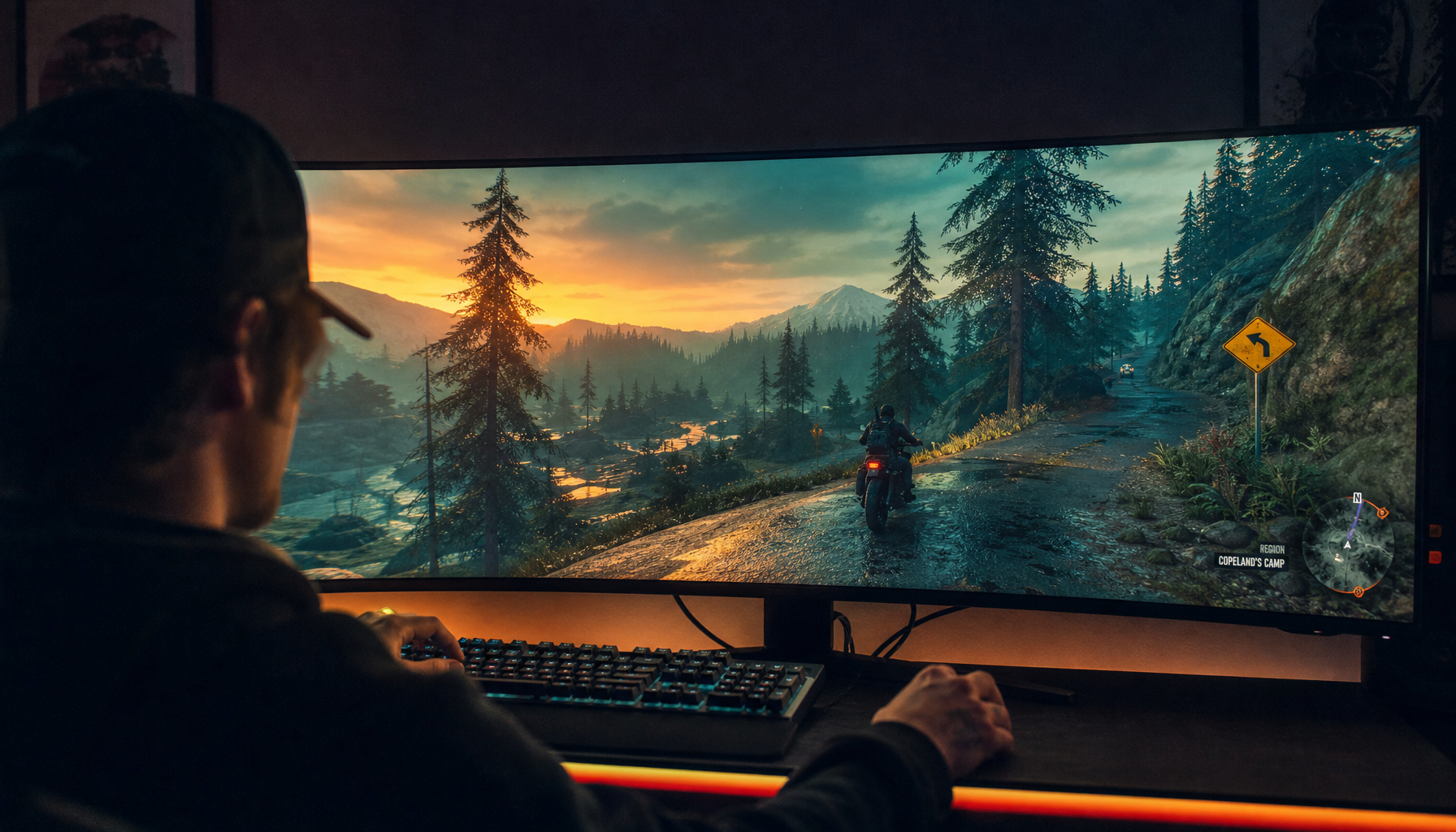
In gaming, a capable 600-nit monitor can feel immersive because HDR improves lighting relationships. Fire, muzzle flashes, headlights, magic effects, neon signs, and sunlit skies gain contrast against darker areas. For office productivity and portable smart screens, the gain is more situational: HDR video playback, photo previews, and creative review benefit more than spreadsheets, email, or browser-based work.

Where a 600-Nit Monitor Falls Short
The most obvious compromise is peak highlight intensity. A 1000-nit display can show a 1000-nit highlight closer to the creator’s target, while a 600-nit display must compress it. That means the brightest sparks, reflections, and sun points may look less intense. They can still look detailed, but they will not have the same “light coming off the screen” effect.
The second compromise is full-screen brightness. Some monitors can hit their peak only in small windows, then dim when a large bright scene appears. This is especially relevant for snowy landscapes, bright skies, white sci-fi interiors, and productivity work with HDR enabled. A monitor’s advertised peak brightness does not always describe how it behaves across a whole screen.
The third compromise is black level. HDR depends on contrast, not brightness alone. A 600-nit LCD with weak local dimming and raised blacks can look less convincing than a lower-brightness OLED in a dark room because the OLED can shut pixels off for true black. Good HDR performance depends on contrast, black levels, brightness, color gamut, and local dimming quality together.
The 600-Nit Versus 1000-Nit Difference in Practice
A simple way to think about it is this: 600 nits can make HDR visible; 1000 nits makes HDR more authoritative. On a 600-nit monitor, the display has to fit a 1000-nit highlight range into 60% of that peak output. With smart tone mapping, it protects detail by rolling off the brightest information. With poor tone mapping, it either clips the top end or darkens the whole image to make room.
Scenario |
600-Nit Monitor With Good Tone Mapping |
1000-Nit Monitor With Good Tone Mapping |
Bright sun glint |
Visible and detailed, less intense |
Brighter, more lifelike highlight punch |
Dark cave with torch |
Strong if blacks and dimming are good |
Stronger highlight separation |
Snowy daytime scene |
May dim or compress highlights |
More room for bright detail |
HDR desktop use |
Can look uneven if SDR brightness is wrong |
Still needs calibration, but has more headroom |
Competitive gaming |
HDR can add immersion, but refresh and response still matter |
Better HDR impact if gaming specs are also strong |
For a real-world desk setup, the practical difference often shows up more in cinematic games and HDR movies than in daily productivity. A 27-inch 4K business display rated around 350 to 400 nits can be excellent for text, USB-C docking, and multitasking, but it will not deliver the same HDR energy as a 600-nit or 1000-nit gaming or creator monitor. Business monitor reviews often prioritize conferencing, ergonomics, resolution, and connectivity because those features matter more for work than peak HDR brightness.
Why Some 600-Nit HDR Looks Washed Out
If your 600-nit monitor looks worse in HDR than SDR, the problem may not be the panel alone. System HDR setup can make SDR desktop content look faded because regular apps, websites, and office windows are being mapped inside an HDR desktop environment. That is a settings issue, not proof that HDR is broken.
HDR must be enabled for the correct display, especially in multi-monitor setups. HDR settings also interact with the monitor’s reported capabilities and the content metadata used for tone mapping. If the wrong display mode is active, or if the monitor is using an inaccurate HDR preset, the image can swing between too dim and blown out.
A practical setup path is to select the monitor’s accurate HDR or game HDR mode, disable extra “HDR effect” enhancements, run the operating system’s HDR calibration app where appropriate, then tune the HDR settings inside each game. Do not assume the correct in-game value is always the monitor’s advertised peak brightness. Some displays tone-map internally, while others clip sharply above a certain level, so the right setting is the one that preserves bright detail in the game’s own calibration pattern.

Should You Leave HDR On All the Time?
For most PC users, no. HDR is best enabled when you are actually watching HDR video, playing an HDR game, or reviewing HDR images. For standard web pages, spreadsheets, email, and most office apps, SDR is still the cleaner and more predictable mode.
That is especially true for productivity displays and portable smart screens. A portable USB-C monitor may be excellent for travel, presentations, and second-screen workflows, but if it has limited brightness and no meaningful local dimming, HDR can become more of a compatibility feature than a visual upgrade. For long work sessions, text clarity, ergonomic placement, stable brightness, and low visual fatigue usually matter more than forcing HDR on the desktop.
For gaming, the better workflow is often to keep desktop HDR off, then enable HDR when a game or video needs it. Ambient light, driver support, display mode and game-level calibration all affect the final result. A dark room can make a 600-nit HDR monitor look more impressive because reflections and room light no longer reduce perceived contrast.
When a 600-Nit Monitor Is Enough
A 600-nit HDR monitor is a smart value point if you want a screen that handles mixed use well. It makes sense for players who want cinematic HDR without paying for top-tier mini-LED or OLED, creators who need a credible preview rather than full mastering accuracy, and office users who occasionally watch HDR content after work.
It is also a reasonable choice when the monitor has other strengths: 4K resolution for sharp text, USB-C power delivery for a clean desk, high refresh rate for smooth gaming, wide color for creative work, and a good ergonomic stand for long sessions. In a real setup, a balanced 600-nit 4K monitor can be more useful than a brighter display with poor ports, weak uniformity, or bad stand adjustment.
However, if HDR is the reason you are buying the monitor, look beyond the brightness number. You want strong contrast, effective local dimming, wide color, accurate HDR modes, and enough bandwidth for your target resolution and refresh rate. Measurable HDR performance matters more than vague HDR-compatible branding.
When You Should Upgrade to 1000 Nits or Better
A 1000-nit monitor is worth considering if you play a lot of HDR games, watch premium HDR movies, edit HDR photos or video, or simply want highlight impact closer to the way the content was mastered. The upgrade is most visible in scenes with small intense highlights, bright skies, reflective surfaces, and high-contrast night lighting.

For creators, 1000 nits also gives more confidence when judging highlight rolloff. Photography-focused HDR recommendations often treat 1000 nits and above as the point where HDR becomes especially compelling, while warning that displays below 600 nits can deliver a limited effect. HDR monitors for photography also show why black level, dimming behavior, and calibration support matter as much as raw peak brightness.
For competitive esports, though, 1000 nits is not automatically the right place to spend money. Refresh rate, response time, input lag, motion clarity, and adaptive sync may matter more. HDR can add spectacle, but it rarely replaces the performance basics that help you track motion and react quickly.
Final Buying Guidance
If you already own a 600-nit monitor, do not write it off. Feed it real HDR content, confirm HDR is enabled correctly, calibrate your system and games, reduce room reflections, and judge scenes with bright highlights and dark shadows. If detail is preserved and the image has depth, the display is doing its job.
If you are buying new, treat 600 nits as the practical floor for serious mainstream HDR and 1000 nits as the stronger target for a premium experience. The most reliable HDR monitor is not the one with the loudest badge; it is the one that combines brightness, contrast, color, tone mapping, and setup controls into an image that stays powerful without losing detail.