Yes, Adaptive Sync can work with console gaming, but the console-facing term is usually VRR. The best results come from a display with HDMI 2.1 VRR support, a 120 Hz refresh rate, and a game that supports variable frame rates.
How Adaptive Sync Helps Consoles Feel Smoother
Adaptive Sync lets a display adjust its refresh timing to match the console’s frame output, which helps reduce tearing, stutter, and uneven motion. That matters most when a game shifts between 60 FPS and 120 FPS, or when a cinematic action scene briefly drops below its target.
The core idea is simple: instead of forcing the console or monitor into a fixed timing mismatch, Adaptive Sync keeps refresh behavior closer to the game’s real frame delivery. The result is cleaner camera pans, steadier racing lines, and fewer distracting frame splits during fast combat.

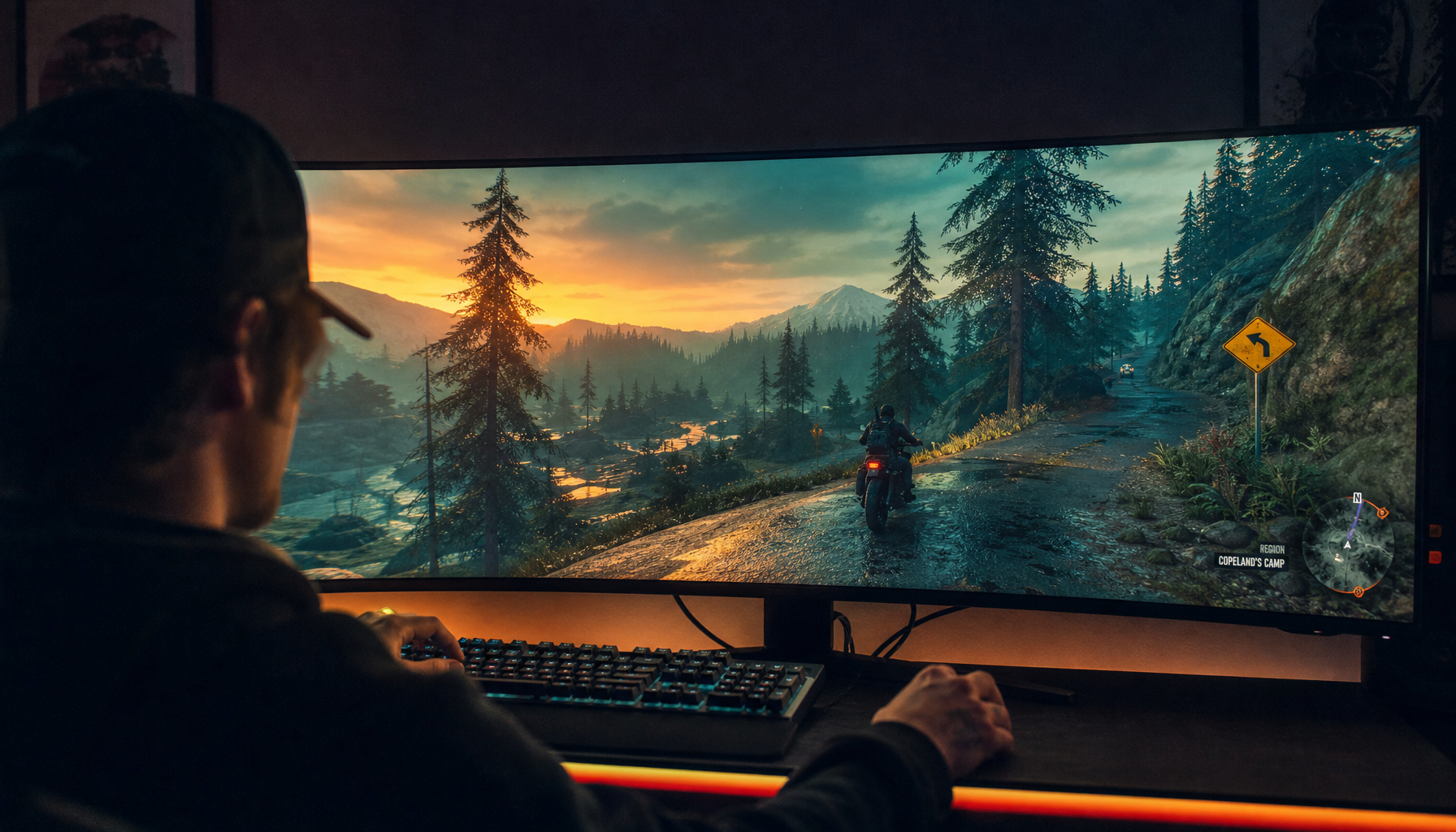
For console players, it is less about competitive tuning and more about preserving immersion. A 4K adventure game that swings between 75 FPS and 110 FPS can feel more stable on a VRR-capable monitor than on a fixed-refresh display.
Console Compatibility
Modern consoles support VRR in different ways, so the display’s HDMI behavior matters as much as its general gaming label. Some consoles work broadly with VRR-capable displays over HDMI, while others depend more heavily on HDMI 2.1 compatibility and game-level implementation.
A display may advertise Adaptive Sync for PC over DisplayPort yet fail to deliver the same behavior from a console over HDMI. For console gaming, prioritize HDMI VRR, HDMI 2.1 bandwidth, and 4K at 120 Hz support over vague “Adaptive Sync” wording. A strong console monitor should clearly support HDMI 2.1 with VRR, 4K at 120 Hz, low input lag in game mode, and meaningful HDR performance rather than HDR branding alone.

Nuance: the Adaptive-Sync standard is mainly a display performance certification framework, while consoles often describe the same experience through HDMI VRR language.
When It Works Best
Adaptive Sync is most valuable when frame rates fluctuate inside the monitor’s VRR range. If a game is locked perfectly at 60 FPS on a 60 Hz display, the benefit may be minor. If a game targets 120 FPS but dips during explosions, weather effects, or open-world traversal, VRR becomes much more noticeable.

It also pairs well with performance modes. Many console games offer quality and performance presets; Adaptive Sync tends to shine in performance mode because frame rates can move more freely above 60 FPS.
For example, a 120 Hz monitor running a game between 80 FPS and 120 FPS can feel more fluid than a 60 Hz screen showing the same action with repeated or torn frames. That is the value: fewer visual interruptions without requiring the console to hold a perfect frame rate every second.
Buying Advice for Console Players
Do not buy a monitor for console gaming based on PC graphics-card sync labels alone. Consoles benefit more from HDMI VRR support than from features designed mainly for desktop gaming setups.
Look for tested gaming monitors with HDMI 2.1, low latency, and real 120 Hz console handling. Current gaming monitor roundups often highlight displays with several sync certifications, but console buyers should still verify the HDMI feature set before paying extra for a premium label.
A good console-first monitor should balance speed, image quality, and value. The sweet spot is usually 27 to 32 inches, 4K, 120 Hz or higher, HDMI 2.1, VRR, and strong game-mode input lag. Premium OLED models can add deeper contrast and faster pixel response, while value IPS models can still deliver excellent smoothness if the VRR implementation is solid.

The Bottom Line
Adaptive Sync works with console gaming when the console, game, cable, and monitor all support the right VRR path. For modern consoles, focus on HDMI 2.1 VRR, 120 Hz support, and proven console compatibility.
If you want smoother motion without overbuying, choose a monitor built for console VRR first, then compare resolution, HDR, panel type, and price. That is the performance-driven way to get a more immersive screen without paying for PC-only features you may never use.