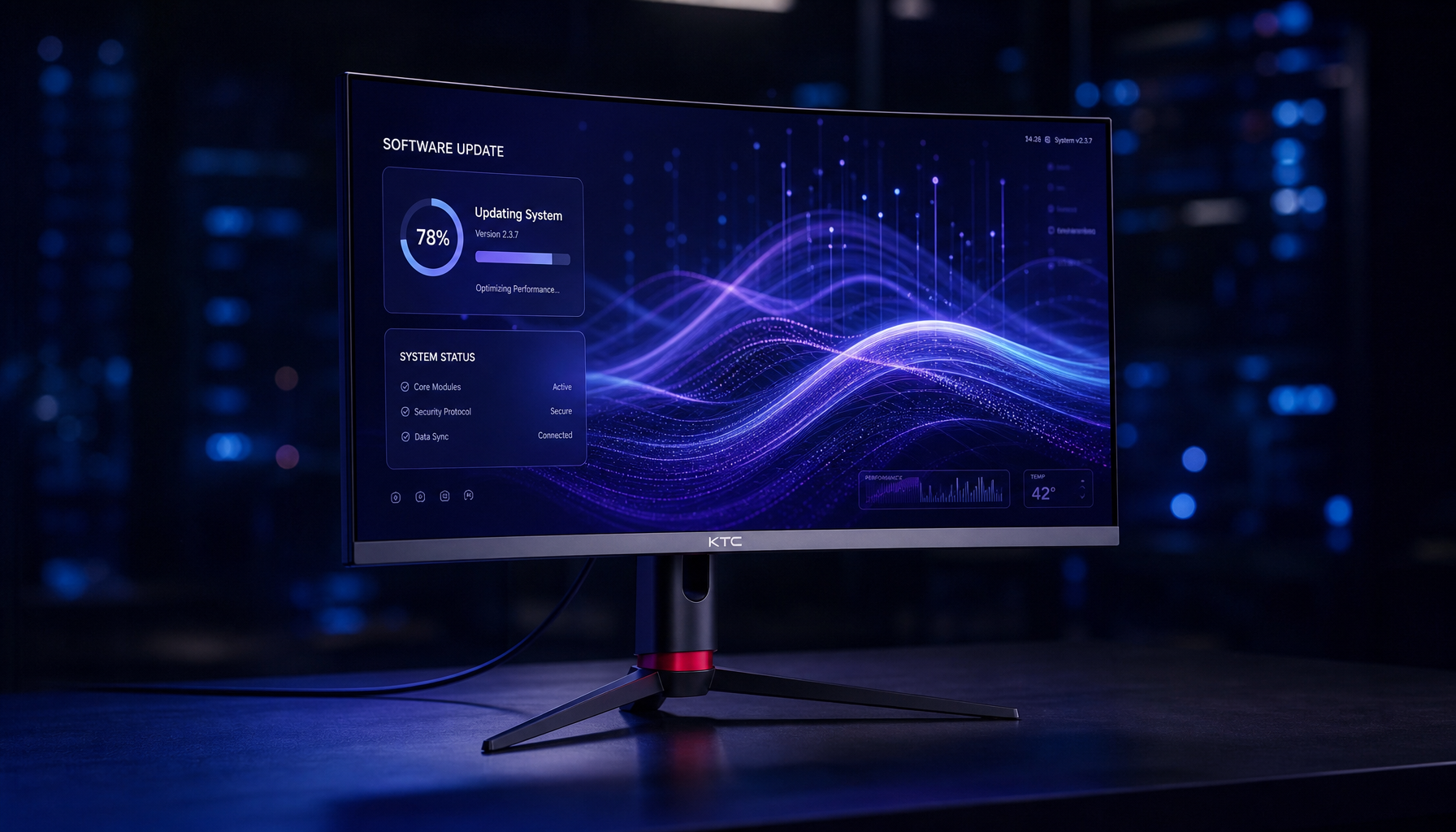
For developers running local LLMs and generative AI agents in 2026, a static monitor often leads to "terminal blackout," where long-running agent tasks and real-time metrics disappear behind active coding windows. A rolling smart display used as a dedicated AI command center solves this by providing persistent, glanceable observability that moves with you between desk, sofa, and lab, keeping token streams, agent logs, and performance data visible without constant context switching.

What is an AI Command Center?
An AI command center serves as a dedicated tactical surface or "mission control" where multiple AI agents report live status, current tasks, and key metrics. Unlike a standard secondary monitor that simply extends your desktop, this setup focuses on passive supervision of autonomous or high-latency processes that don't require constant input.
The core problem it addresses is terminal blackout. When you're deep in active coding on your primary workstation, long-running agent tasks can stall or produce unexpected output without drawing attention. As described in developer discussions around tactical multi-agent workflows, this creates an "out of sight, out of mind" failure mode where compute resources run for hours unnoticed (AI Coding War Room).
Static desktop monitors suit active production work best, while a mobile rolling display excels at passive monitoring. This distinction shifts the justification for a second screen from simply adding real estate to eliminating the risk of missed agent activity. For many AI developers and ML engineers, this setup enables a transitionary workflow: you can monitor a 30-minute code generation task while stepping away from the desk without losing the live token stream.
Why 4K is the Baseline for AI Observability
Real-time LLM monitoring demands high information density. You typically need to track token generation speed (tokens per second), latency percentiles (P50/P95), time to first token (TTFT), cost equivalents, raw terminal output, and agent logs—all visible at once. A 1080p rolling display often falls short here due to text aliasing on small-font logs and metrics, leading to eye fatigue during extended sessions.
For developers monitoring complex logs and code diffs side-by-side, 4K resolution (3840x2160) maintains sharper text and prevents scaling issues that degrade readability, according to comparisons of display performance for coding and data work. This makes 4K a functional requirement rather than a luxury for observability dashboards.
The KTC MEGAPAD 32" 4K Android 13 Google EDLA Smart Touch Monitor with 9500mAh Battery stands out in this role. Its 32-inch 4K canvas supports a practical 2x2 grid of windows—ideal for placing LLM X-Ray metrics next to raw terminal output or performance charts without UI compromises. Lower-resolution options like many 1080p smart displays struggle to deliver glanceable clarity in these dense layouts.
4K vs 1080p for an Observability Dashboard
A decision aid for monitoring-heavy developer setups: 1080p can be workable in simple cases, but 4K becomes the safer choice as text density, side-by-side windows, and long reading sessions increase.
View chart data
| Scenario | 1080p | 4K |
|---|---|---|
| Insufficient | 3.0 | 1.0 |
| Marginal | 1.0 | 3.0 |
| Optimal | 0.0 | 0.0 |
This visualization clarifies the threshold: 1080p often lands in insufficient or marginal territory for dense AI monitoring, while 4K reliably supports optimal information density in typical developer scenarios.

Building the Observability Stack: From PC to Android EDLA
The real power of a rolling AI command center comes from decoupling the display from your primary workstation. Running a local LLM on a powerful PC (such as one with an RTX 4090) while monitoring on a separate Android-based smart display requires a wireless bridge to preserve mobility—no HDMI cables running across the room.
OpenTelemetry-native tracing provides the foundation. It lets you record every LLM call locally, capturing tokens, cost, and latency details without sending data outside your network. This approach ensures privacy, especially important when agents interact with sensitive codebases, as outlined in local-first observability resources (TMA1 — Local-First LLM Agent Observability).
Pair this with frameworks like Monocle for consistent GenAI tracing across executions, model inference, and data retrievals. These community-driven tools, aligned with Linux Foundation AI & Data projects, help standardize your stack (Monocle: A framework for tracing GenAI app code).
In practice, host a local OpenTelemetry collector on your workstation and configure dashboards (such as those inspired by LLMxRay or Jaeger) to listen on your local network IP instead of localhost. The KTC MEGAPAD's Wi-Fi 6 support handles the bandwidth needed for trace-heavy visualizations without stuttering. Pin the dashboard URL as a Progressive Web App (PWA) on the Android 13/Google EDLA interface for instant full-screen access. This architecture keeps everything local-first while fully leveraging the display's mobility.
For related workstation optimization ideas, see our guide on Vertical vs. Horizontal: How to Build the Ultimate Dual Monitor Productivity Setup. Developers experimenting with local AI may also find value in understanding display characteristics for code, as covered in Why Some Monitors Make Syntax Highlighting Look Washed Out or Hard to Tell Apart.
Physical Setup and Safety Guardrails
While a rolling smart display brings welcome flexibility, it comes with real physical constraints that can create regret if overlooked. The primary benefit—mobility—depends heavily on your environment. Models like the KTC MEGAPAD 32" rely on small wheels that perform best on flat, hard surfaces such as hardwood or tile. Thick carpets or high-pile rugs create a topple hazard for the 32-inch panel and heavy base, as noted in reviews of similar rolling stands (LG StanbyME review; Samsung Movingstyle M7 review).
If your workspace lacks suitable flooring, the rolling advantage effectively disappears, turning an expensive mobile unit into a less practical static display. Assess this before purchase: test wheel movement on your actual floors if possible.
Ergonomics also require attention. Some rolling stands lack sufficient height adjustment, which can lead to neck strain when used as a side-car for standing desks or varied seating positions. The A32Q7 Pro (and similar MEGAPAD models) offers a useful 1131–1331 mm height range plus portrait rotation and 360-degree swivel wheels, mitigating this risk better than fixed-height competitors. Still, height adjustment remains essential rather than optional for comfortable long-term use—do not expect universal ergonomic improvement without it.
Check your space against these red lines first: confirm flat hard flooring, verify needed height range for your desk or seating, and avoid setups where children or pets might interact with the moving base. When these conditions align, the rolling display becomes a reliable AI command center; otherwise, a traditional fixed monitor or different mobility solution may prove more suitable.
Optimizing Your AI Command Center for Daily Use
Once set up, treat the rolling display as a living observability hub rather than a set-it-and-forget-it screen. Pin your primary dashboard PWA to the Android home screen for one-tap access. Use the touch interface for quick interactions like zooming into latency charts or dismissing alerts during agent runs.
Common optimizations include configuring multi-window layouts that keep token streams in one quadrant, system metrics in another, and raw logs in a third. Wi-Fi 6 helps maintain smooth updates, but monitor battery draw during extended high-bandwidth sessions—the 9500mAh capacity typically delivers up to 11 hours, though intensive tracing can reduce this.
Many developers also link this setup to broader smart home or office ecosystems. For entertainment breaks between AI runs, the same device doubles as a streaming or presentation screen. Explore the full Mobile Touch Screen collection or the specific KTC MEGAPAD 32" 4K Android 13 Google EDLA Smart Touch Monitor with 9500mAh Battery to see how the hardware supports these hybrid workflows. Additional inspiration for AI-focused display trends appears in reports like KTC at CES 2026: How KTC Brought AI and Display Innovation to Life.
Common Mistakes and When a Rolling Display May Not Fit
Several pitfalls can undermine the AI command center experience. Over-relying on the display for active coding instead of passive monitoring wastes its mobility strengths. Similarly, expecting it to boost your underlying LLM performance misses the point—it improves observability only.
Battery life and network stability represent practical trade-offs. High-bandwidth tracing over Wi-Fi 6 can shorten runtime below the rated 11 hours, and some routers may need manual IP configuration for reliable dashboard access. Test your local network before committing to fully wireless operation.
The biggest mismatch occurs when your physical space doesn't support rolling. As outlined earlier, carpeted floors or a purely static workflow make a traditional monitor or fixed smart display a better, often less expensive choice. If your primary need is maximum pixel density without movement, consider dedicated office models from the Office Monitor or 4K Monitor collections instead.
By addressing these limitations upfront, you avoid the common regret of buying mobility you cannot fully use.
FAQ
Can any rolling smart display work for LLM monitoring?
Not effectively. Many 1080p models suffer from text aliasing that makes dense logs and metrics hard to read for long periods. A 4K panel with at least 32 inches provides the information density needed for side-by-side token streams, latency charts, and terminal output without excessive scaling or fatigue. Verify Wi-Fi 6 support and EDLA/Android compatibility for wireless observability stacks as well.
How does OpenTelemetry help maintain privacy in a local AI command center?
OpenTelemetry allows full tracing of LLM calls, tokens, and latency entirely within your local network. By hosting the collector on your workstation and exposing dashboards via local IP addresses rather than cloud services, no sensitive agent data leaves your environment. This architecture aligns with 2026 best practices for developers working with proprietary codebases.
What flooring is required for safe rolling monitor use?
Hard, flat surfaces like hardwood, tile, or smooth laminate are necessary. The small wheels on most rolling bases, including models like the KTC MEGAPAD, can snag on high-pile carpet, creating a topple risk for the heavy 32-inch panel. Test movement in your actual space before relying on daily mobility.
Does using a rolling display as an AI command center reduce neck strain?
It can, but only if the model offers adequate height adjustment (such as the 200 mm range on the A32Q7 Pro). Fixed-height rolling stands often force awkward viewing angles when paired with standing desks or varied seating. Always prioritize adjustable models and position the screen at eye level for your primary working posture.
Is a dedicated AI command center worth it if I only run short LLM tasks?
Probably not. The strongest value appears in long-running autonomous agent workflows where terminal blackout risk is high. For quick inference or debugging sessions that stay within your main monitor view, a standard secondary display or even well-organized desktop windows may suffice without the added cost and setup of a rolling smart display.
How do I integrate existing tools like Jaeger or Prometheus with the Android display?
Configure your observability stack to serve dashboards over your local network IP. Most tools allow binding to 0.0.0.0 or a specific LAN address instead of localhost. On the Android EDLA device, add the URL as a PWA or bookmark for full-screen viewing. Wi-Fi 6 helps ensure smooth real-time updates for trace visualizations.
What should I check first before buying a rolling display for AI monitoring?
Start with your flooring and available flat surfaces, then confirm 4K resolution and height-adjustable stand features. Next, verify your local network can reliably serve observability data wirelessly. Only after these environmental and technical checks align should you focus on specific models like the KTC MEGAPAD series for their battery life and EDLA certification.