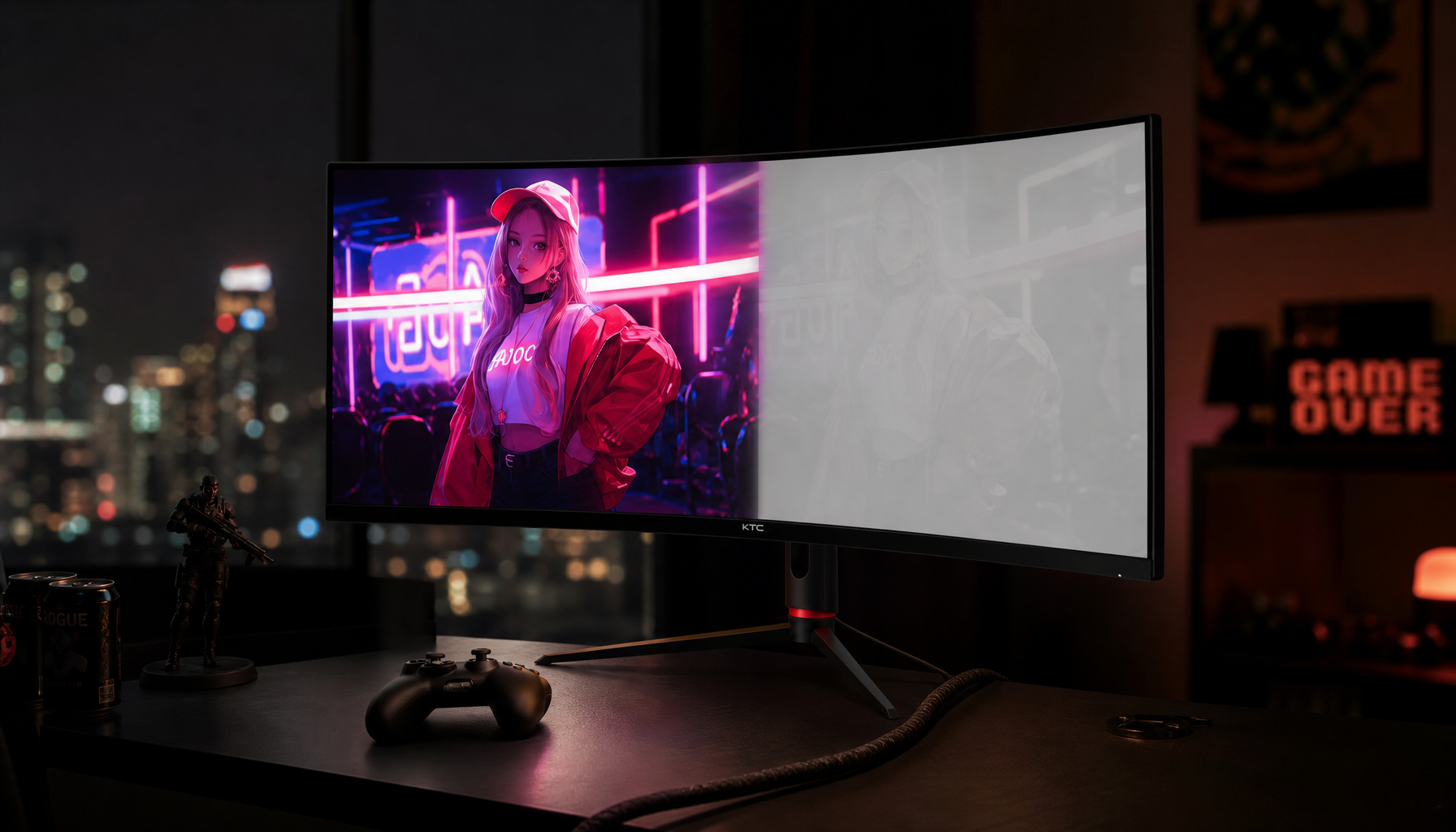
AI-based motion smoothing adds latency because the display chain has to hold, analyze, and generate extra frames before the image reaches the panel. On a fast monitor, that extra work can make motion look smoother while controls feel less immediate.

Ever enabled a smoothing feature and immediately felt your mouse or controller go a little soft? A real 240 Hz a brand case looked much smoother once the system presented at 120 FPS, but the same setup also exposed the usual tradeoff: added input lag and more visible artifacts when the base frame rate dropped too low. You’ll leave with a practical way to judge whether the feature belongs on your gaming monitor, ultrawide display, or portable screen.
What Actually Causes the Latency
The display chain has more work to do
On monitors, extra video processing adds time before the image appears because the signal path is no longer just receiving and drawing the next frame. Once motion smoothing is enabled, the system often has to inspect multiple frames, estimate motion between them, build one or more synthetic frames, and only then send the result to the panel. That processing stage is exactly where latency grows.
Generated frames do not shorten the game loop
At the PC level, frame generation raises displayed FPS without fixing base input latency. If the game itself is still responding on a slower loop, the generated in-between frames can make camera motion look smoother, but your click or stick movement is still waiting on the original game frame to be simulated and presented. That is why a monitor can look fluid while still feeling disconnected.
A real gaming-monitor example shows the tradeoff clearly
One practical case from a 240 Hz a brand setup makes this easy to picture. A player locked at 60 FPS said motion still felt stuttery even after trying a branded variable refresh rate mode, a branded motion-clarity mode, 60 Hz desktop output, and different sync settings. Enabling Smooth Motion plus a low-latency driver mode made the game present at 120 FPS and look much smoother, but the same discussion also flagged the downside: more input lag, plus visible artifacting once the base frame rate fell below roughly 40 to 60 FPS.

Why Higher Refresh Rate Does Not Cancel the Added Delay
Refresh rate lowers the floor, not the processing cost
A higher refresh rate shortens each scanout cycle, but it does not remove the interpolation step. A 240 Hz monitor refreshes every 4.17 ms, while 144 Hz takes 6.94 ms and 60 Hz takes 16.67 ms. That helps the panel show new images sooner, yet any buffering or motion estimation done before scanout still sits on top of those numbers.
Base frame time still dominates how responsive the system feels
The difference between 60 FPS, 120 FPS, and 240 FPS remains fundamental because each base frame arrives 16.6 ms, 8.3 ms, or about 4.1 ms apart. If motion smoothing starts from a 60 FPS game, the display may look closer to 120 Hz or 240 Hz visually, but the underlying control response is still tied to that slower 16.6 ms cadence unless the game loop itself speeds up.
Fast pixel response is helpful, but it is not the same thing as low lag
On gaming monitors, response time and input lag are different measurements. Response time covers how quickly pixels change color, which affects ghosting and blur. Input lag measures how long it takes for your action to become visible on-screen. That is why a monitor advertised at 1 ms gray-to-gray can still feel slow if motion processing, render queues, or frame generation are adding delay upstream.

When Motion Smoothing Is Worth Enabling
Competitive play usually rewards lower latency over smoother interpolation
For esports and reaction-heavy shooters, input-to-photon latency matters more than inflated output FPS. A publication described under 30 ms as excellent, 30 to 45 ms as great, 45 to 60 ms as usable, and anything well above 60 ms as increasingly prone to a rubbery or swimmy feel. That lines up with monitor-focused guidance from a review site and a company, which treats under 15 ms as a strong monitor target and notes that 20 to 30 ms can already become noticeable in faster games.
Single-player games and video are more forgiving
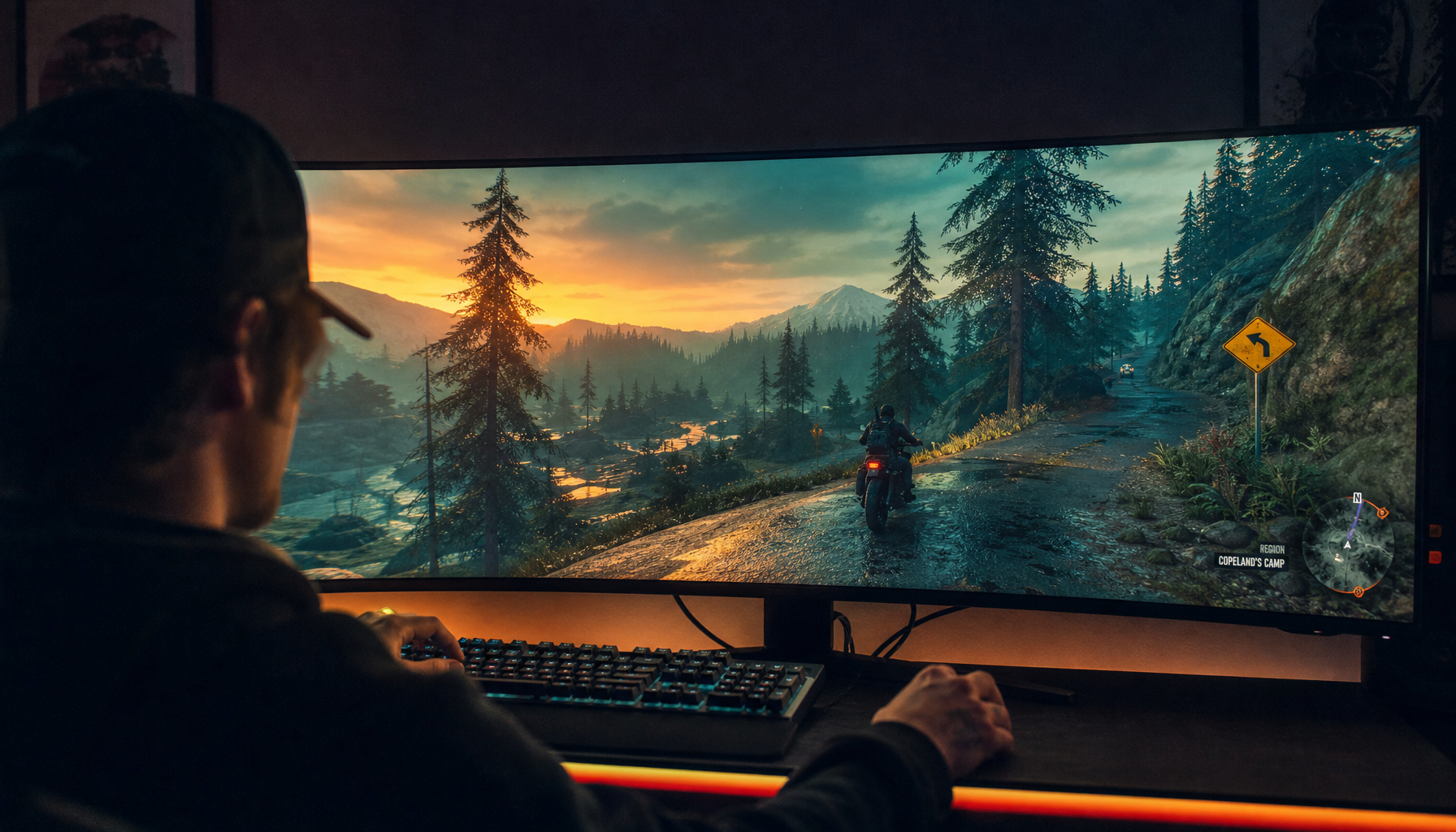
For slower-paced gaming and movie playback, motion interpolation is often easier to tolerate because the priority shifts from instant control response to camera smoothness. That is why some players actively prefer the “smooth motion” look they see on large displays, especially in third-person exploration, racing, or cinematic titles. The tradeoff is that heavy motion can still trigger artifacts, dropped interpolation, or a visible “soap opera” look that some people dislike.
A monitor buyer should match the feature to the job
The best use case for motion smoothing depends on how much lag you can tolerate. If the goal is competitive precision, a high-refresh monitor with low native lag, solid VRR behavior, and stable frame delivery is usually the better purchase. If the goal is making a 60 FPS single-player game feel visually fuller on a 144 Hz or 240 Hz panel, smoothing can be reasonable as long as you accept the control penalty.
Use case |
What you gain |
Main latency risk |
Better default choice |
Competitive FPS on 240 Hz or 360 Hz monitors |
Smoother camera motion |
Softer aim feel and delayed reactions |
Native high FPS, VRR, low-latency mode |
60 FPS single-player game on a 144 Hz or 240 Hz monitor |
More fluid-looking motion |
Higher input lag and possible artifacts |
Try smoothing only if controls still feel acceptable |
4K or ultrawide gaming where native FPS is limited |
Better apparent smoothness |
Base latency can stay high even when displayed FPS rises |
Upscaling plus VRR first, smoothing second |
Video playback on a desktop monitor |
Reduced judder in pans |
Little benefit for interactivity, possible soap-opera effect |
Use only if you prefer the look |
Portable monitor or basic 60 Hz display |
Slightly smoother motion in theory |
Very little latency headroom to spare |
Keep processing minimal |
How the Tradeoff Changes by Monitor Type
Esports monitors benefit more from clean signal paths than added processing
On high-refresh gaming displays, Adaptive Sync reduces tearing without the lag behavior of traditional sync. That matters because most 240 Hz and 360 Hz monitors already have very low scanout intervals, so the remaining “feel” usually comes from render queues, signal processing, and frame stability. In that environment, adding AI motion smoothing often works against the reason you bought the panel in the first place.
Ultrawide and 4K displays make the compromise more tempting
At higher resolutions, smooth output and low latency are separate wins. A publication showed that a graphics card could reach about 190 FPS in one test with multi-frame generation at roughly 60 ms latency, while a different tuning path on another graphics card dropped latency by about 25% to 46 ms and changed output FPS at the same time. For ultrawide and 4K monitor buyers, that is the right mental model: more fluid motion does not automatically mean faster response.
Portable monitors and standard office-class panels have less margin
By the same scanout math a review site uses for monitor lag, lower-refresh displays simply start with less latency headroom. A 60 Hz screen already carries an 8.33 ms center-screen minimum before you add processing, while 120 Hz cuts that to 4.17 ms and 360 Hz to 1.39 ms. Portable monitors also tend to prioritize portability and broad compatibility over aggressive latency tuning, so enabling any smoothing on a 60 Hz or 75 Hz travel display is usually harder to justify than on a well-tuned desktop gaming monitor.
How to Evaluate Motion Smoothing Before You Leave It On
Measure responsiveness and smoothness as two separate outcomes
The cleanest way to judge the feature is to track output frame rate and input-to-photon latency separately. Displayed FPS tells you whether the motion looks fuller. Latency tells you whether the monitor still feels connected. On PC, tools such as a monitoring tool and another monitoring tool are useful precisely because they stop you from confusing visual smoothness with actual responsiveness.
Reduce every other source of delay before blaming the monitor
A practical setup pass still matters because extra processing, outdated firmware, and peripheral choices can all add delay. Use the monitor’s low-latency or gaming mode, update GPU drivers and monitor firmware when available, prefer a wired mouse or controller for testing, and keep the signal path simple over HDMI or DisplayPort. If smoothing still feels slow after that cleanup, the feature itself is likely the main cause.

If you want clearer motion without interpolation delay, use the right tool
For many buyers, backlight strobing and VRR solve a different problem than motion smoothing. Strobing reduces persistence blur, while VRR reduces tearing and stutter from mismatched frame delivery. Neither one creates synthetic in-between frames, which is why they often preserve a cleaner response feel. The catch is that strobing commonly cuts brightness by about 30% to 50% and usually cannot run at the same time as VRR.
FAQ
Q: Does AI motion smoothing always increase input lag on a monitor?
A: In practice, yes, because some amount of frame analysis or buffering has to happen before the new synthetic frame can be shown. The exact penalty varies by implementation, base frame rate, and monitor mode, but the delay does not disappear just because the displayed FPS number rises.
Q: Is motion smoothing worse on a 60 Hz monitor than on a 240 Hz monitor?
A: Usually, yes. A 240 Hz panel starts from a much lower scanout floor, so it has more room before the total latency becomes distracting. A 60 Hz monitor already spends more time per refresh, so added processing is easier to feel.
Q: Should I buy a monitor because it advertises 1 ms response time if I care about smoothing latency?
A: No. Response time helps with ghosting and motion clarity, but it does not tell you how much delay the monitor or GPU pipeline adds before the frame appears. For this feature, low input lag, VRR quality, stable frame delivery, and minimal processing modes matter more.
Final Takeaway
The core buying rule is simple: motion smoothing is most likely to feel wrong when responsiveness is the priority. On a gaming monitor, it adds a processing step that can make motion look cleaner while leaving your inputs tied to a slower underlying loop. Higher refresh rates help the panel itself, but they do not cancel the time needed to analyze and build extra frames.
If you mostly play competitive games, buy for low native lag, strong VRR support, and stable high FPS first. If you mostly play cinematic single-player titles on a high-refresh or ultrawide monitor, try motion smoothing as an optional visual mode, then keep it only if the controls still feel natural.
- Turn on the monitor’s gaming or low-latency mode before testing smoothing.
- Compare the same game scene with smoothing off and on at the same graphics settings.
- Watch both the displayed FPS and the input feel; do not judge by FPS alone.
- Avoid smoothing when the base frame rate regularly falls below about 40 to 60 FPS.
- Prefer VRR, stable frame pacing, and low render-queue settings for everyday gaming.
- Use backlight strobing only for fixed-FPS play if you can accept lower brightness.
References
- How to make 60fps games look smooth on a high refresh monitor?
- How to Reduce Input Lag for Smoother Display Results
- Monitor Response Times and Input Lag: A Comprehensive Guide
- Input latency is the missing piece of framegen-enhanced gaming analysis
- What Makes a Gaming Monitor Feel Fast?
- Motion Blur Reduction vs Adaptive Sync
- 60Hz vs 144Hz vs 240Hz
- Our Monitor Input Tests
- What’s the TV with the best Motion Interpolation?