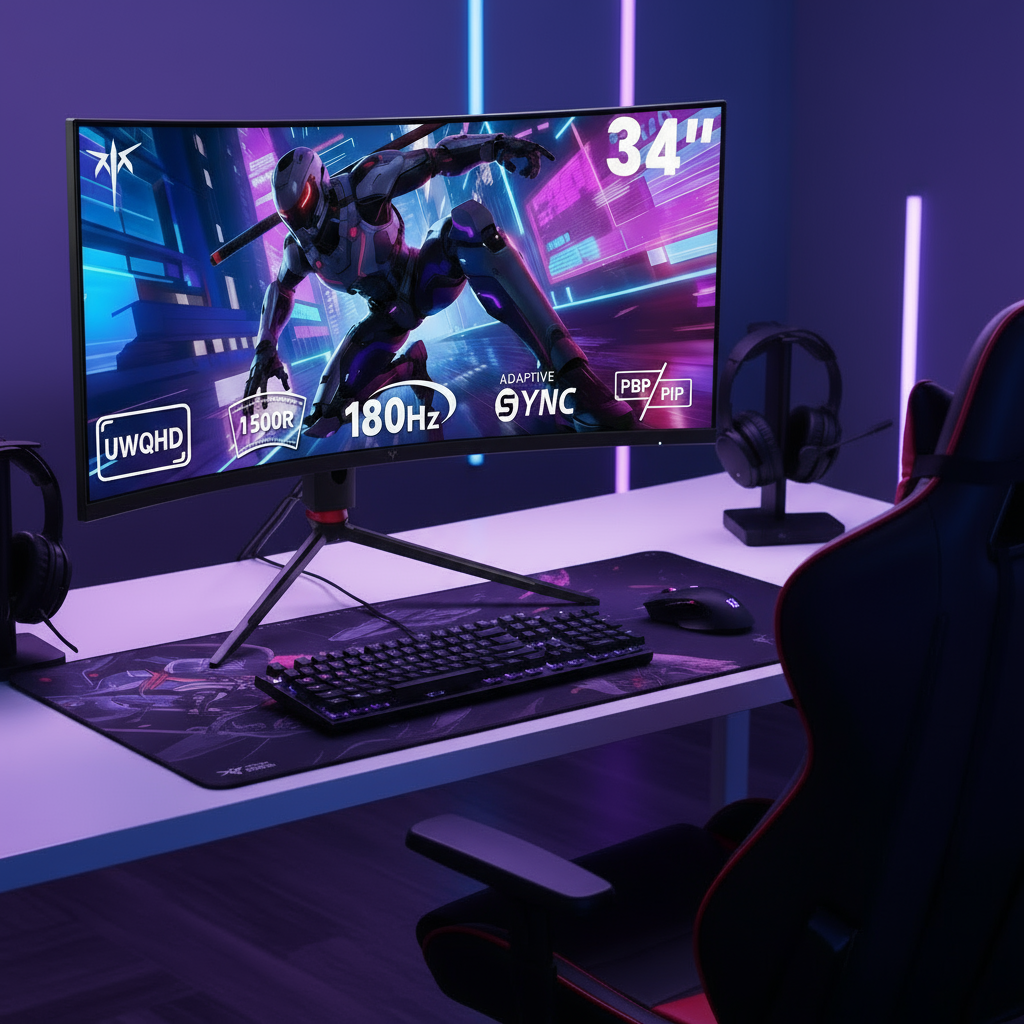




AI posture detection in smart monitors is usually reliable enough to catch obvious slouching, leaning, and sitting-too-close habits, but it is not precise enough to judge full ergonomic form the way a specialist assessment or a well-tuned wearable can.
Ever catch yourself folding toward the screen during a long work session or drifting into a neck-forward posture halfway through a game? Recent posture-tracking research shows these systems work best when the camera has a clear view of your joints, and one wearable posture model reached 95.8% accuracy in controlled testing. What matters here is knowing what a monitor feature can realistically detect, what throws it off, and whether it is worth paying extra for on a gaming, ultrawide, or portable display.
What Smart Monitor Posture Detection Is Actually Measuring
It usually tracks visible body landmarks, not full spinal health
Most camera-based posture systems work by finding body keypoints such as the head, shoulders, elbows, hips, and knees, then estimating angles or movement patterns from video. In smart monitor terms, that usually means the feature is checking whether your head is jutting forward, your shoulders are uneven, or your torso is collapsing toward the desk.

That matters because a monitor’s posture feature is not doing a medical exam. A broad 2024 sitting-posture review found that posture assessment commonly breaks into trunk, head, upper extremity, and lower extremity factors, which is much more detailed than what a built-in webcam can capture from a single front-facing angle at a desk.
Smart monitor alerts are better at behavior change than diagnosis
A 2024 posture-monitoring paper frames posture management as a mix of monitoring, feedback, and user education rather than one-time correction. That lines up with how posture features on smart monitors are most useful in practice: they remind you when you are creeping toward bad habits during long office, coding, or gaming sessions.
This is also why posture reminders should be treated as a support feature, not a replacement for proper display setup. For most buyers, the real value is a nudge that keeps a 27-inch office monitor, 34-inch ultrawide, or secondary portable monitor from encouraging hours of unbroken slouching.
How Accurate These Features Are in Real Desk Use
They are strongest at catching obvious posture drift
Research on real-time pose detection found the system was effective across several postures and perspectives when body joints were not blocked by the desk or limbs. That supports a practical buying takeaway: a smart monitor can usually spot clear forward lean, shoulder hunching, or crossed-leg habits when your upper body stays visible.

A separate computer-vision case study describes systems that evaluate spinal curvature, joint angles, and limb symmetry from standard cameras, but it does not publish benchmark accuracy figures. So the honest reading is that smart monitor posture AI is directionally useful, but not well-supported by universal percentage claims across all products.
Fine distinctions are harder than obvious good-vs-bad posture
The strongest number in the evidence comes from a wearable IMU posture study, where logistic regression reached 95.8% accuracy with a weighted F1 of 0.958. But that same study also showed mild posture was the hardest category to classify, with 88% precision and 88.7% recall, even in a controlled sensor setup.
That is the right lens for smart monitors too. If a dedicated three-sensor wearable struggles more with borderline posture than with clearly bad posture, a monitor-mounted camera should also be expected to do better on obvious slouching than on subtle ergonomic grading. For buyers, that means posture detection is useful for catching drift, not for scoring every sitting position with expert-level precision.
What Affects Accuracy on Gaming, Ultrawide, and Portable Monitors
Camera angle, visibility, and desk layout matter more than spec-sheet marketing
The biggest technical limit in camera-based posture monitoring is occlusion: if the desk edge, your arms, or the monitor itself blocks key joints, accuracy falls. On a deep desk with a tall keyboard stack or a large boom mic in front of the display, even a good smart monitor can lose track of shoulder and torso alignment.

This is especially relevant for ultrawide and gaming setups. A 34-inch or 49-inch panel often encourages side-to-side head turns, reclined seating, and off-center posture, while a high-refresh-rate gaming monitor may be paired with aggressive leaning during competitive play. In those cases, posture AI can confuse normal panel-scanning behavior with poor alignment unless the camera is centered and your full upper body remains visible.
Lighting and seating distance change results in daily use
A workplace ergonomics overview explains that pose-estimation systems depend on continuous posture and movement detection before they can assess risk. In a home office or bedroom setup, that detection gets weaker when you sit too close, backlight your face with a bright window, or use the monitor in a dim room.
Portable monitors are the hardest case. Their smaller size and temporary setups often push the screen too low and too close, and the camera angle is less stable when the display moves between a kitchen table, hotel desk, and office hot-desk. A posture feature on a portable monitor can still remind you to reset, but accuracy will usually be less consistent than on a fixed desktop monitor with a stable viewing position.
Should Posture Detection Influence a Monitor Buying Decision?
It is worth more on work-first smart monitors than on pure gaming displays
The literature review on sitting posture notes that desk workers may sit about 9.5 hours a day and can spend up to 75% of the day sitting. If you use a monitor for long spreadsheets, editing, coding, or remote meetings, posture reminders can have real value because the risk comes from long static sessions, not just short bursts of use.
On a pure gaming monitor, posture detection should usually rank below panel quality, response time, refresh rate, motion handling, and adaptive sync. On a smart monitor used as an all-day productivity display, it deserves more weight because it addresses a real behavior problem during extended stationary use.
Good ergonomics usually beat AI extras in the budget hierarchy
A consumer overview of posture reminder tools makes a useful distinction: reminders help build awareness and muscle memory, but they are separate from the physical setup itself. In monitor-buying terms, that means adjustable height, tilt, swivel, VESA compatibility, and the right screen size for your desk usually matter more than a posture badge on the box.

If the choice is between a cheaper smart monitor with posture alerts and a better stand, better viewing height, and more suitable panel size, the ergonomic hardware usually wins. AI posture detection is best treated as a bonus layer on top of a sound monitor setup, not as a substitute for it.
Comparison Table: Where Posture Detection Helps Most
Monitor type or setup |
Typical posture AI reliability |
Main strength |
Main weakness |
Buying priority |
Smart office monitor with centered webcam |
Moderate to high for obvious slouching |
Good for long desk sessions and reminders |
Can miss subtle alignment issues |
Medium |
Gaming monitor with external webcam |
Moderate |
Can catch leaning in long sessions |
Fast movement and off-center posture reduce consistency |
Low to medium |
34-inch or larger ultrawide |
Moderate |
Useful for general posture drift alerts |
Head turning across a wide panel can confuse posture cues |
Medium |
Portable monitor |
Low to moderate |
Helpful as a reminder in temporary setups |
Unstable angle, low screen height, and close distance hurt accuracy |
Low |
High in controlled classification tasks |
Better direct body sensing |
Less convenient and not built into the display |
Medium to high for posture-focused users |
Practical Next Steps
Use posture detection as a habit tool, not a final verdict
The best-supported takeaway from posture-monitoring research is that feedback and education improve adherence better than passive awareness alone. So if your smart monitor offers posture prompts, use them to interrupt bad habits, then correct the environment that caused them.
For most display buyers, that means thinking in layers: first choose the right monitor size and stand adjustability, then use posture alerts to reinforce good habits. This is a stronger strategy than expecting AI alone to fix a workstation that is too low, too close, or too cramped.
Action checklist
- Put monitor adjustability ahead of posture AI if your budget forces a tradeoff.
- Keep the camera centered above the panel with a clear view of your head, shoulders, and upper torso.
- Sit at a stable viewing distance instead of creeping closer during work or gaming.
- Treat repeated alerts as a setup problem first, not just a behavior problem.
- Use posture detection more seriously on all-day office or hybrid-use monitors than on pure gaming displays.
- Be skeptical of products that promise medical-grade posture accuracy without publishing test conditions.
FAQ
Q: Are smart monitor posture features accurate enough to trust?
A: They are usually accurate enough to flag obvious slouching, leaning, or sitting-too-close behavior, especially when your upper body is clearly visible. The evidence is much weaker for subtle posture grading, so they are better used as reminders than as definitive ergonomic assessments.
Q: Do ultrawide monitors make posture detection less accurate?
A: They can. Wider panels encourage more head turning and off-center sitting, and that can make a camera-based system less consistent than on a standard centered office monitor. A centered webcam and stable seating position help.
Q: Should I pay extra for posture detection on a monitor?
A: Pay extra only after the basics are covered: suitable screen size, good stand adjustment, comfortable viewing height, and the right panel for your work or gaming needs. Posture detection is most valuable for long daily desk use and least important on portable or performance-first gaming displays.
References
- POSTURE MONITORING
- An Intelligent Mobile Application to Monitor and Correct Sitting Posture Using a device and a platform Pose Detection
- The Best Posture Reminder Devices & Apps to Stop Slouching
- Posture Correction Assistant: Wearable System Using 3 Wireless IMU Sensors to Detect Spinal Posture
- How AI is Revolutionizing Workplace Ergonomics
- AI-Powered Ergonomics
- AI-Powered Real-Time Posture Tracking
- Sitting Posture Recognition Systems: Comprehensive Literature Review and Analysis