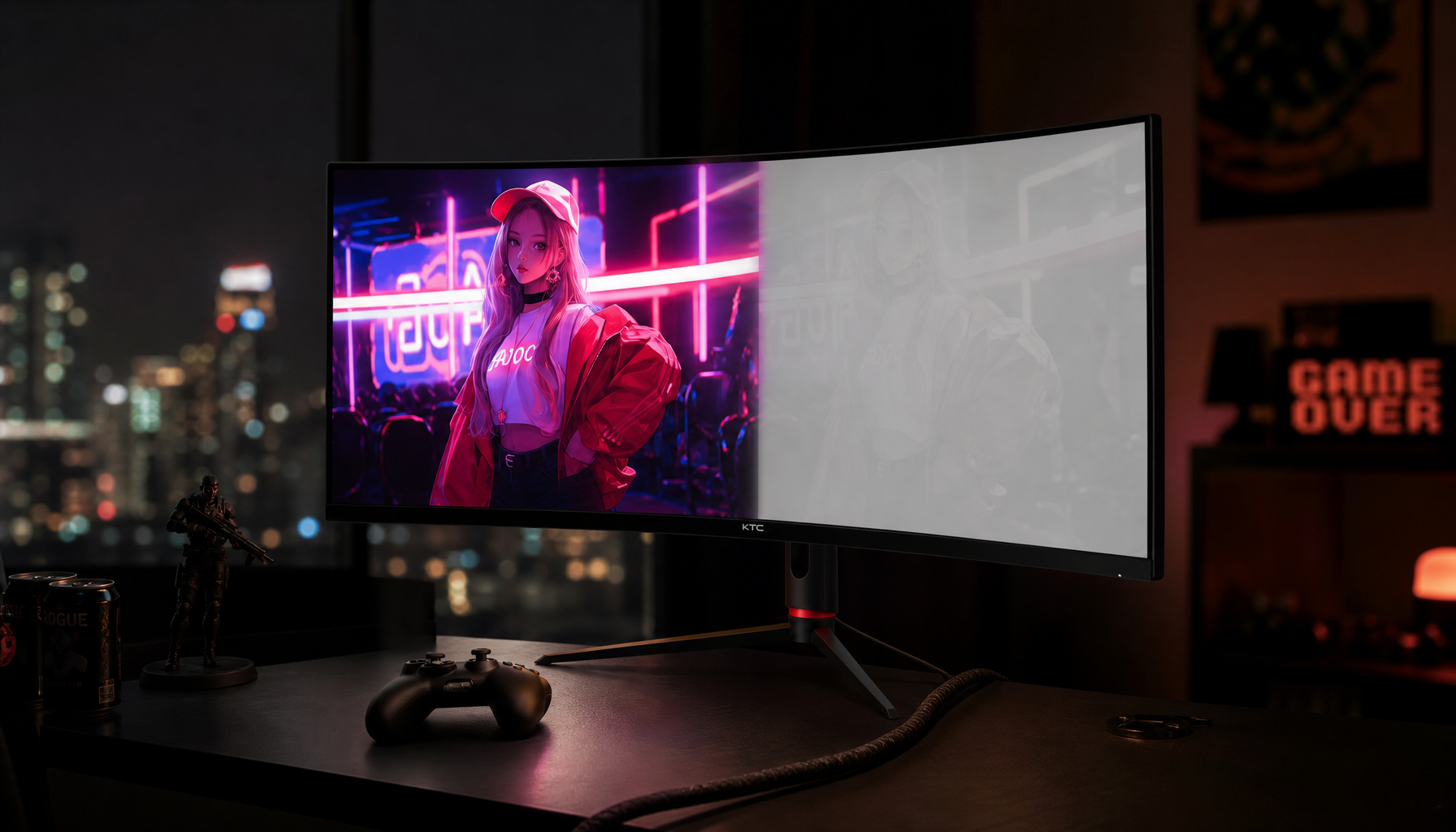
An HDR certification badge guarantees that a monitor passed a defined set of HDR tests for brightness, contrast, color, and signal handling. It does not guarantee that every certified monitor will deliver the same HDR experience in games, movies, or desktop use.
If you have ever switched on HDR on a gaming monitor and wondered why one screen looks dramatic while another barely looks different, the badge alone is only part of the story. Since the standards body’s CTS 1.2 update on May 7, 2024, certified displays have had to clear stricter checks for contrast, color accuracy, and black handling. This guide shows what each level really promises and how to use that badge when comparing gaming, ultrawide, and portable monitors.

What the Certification Actually Tests
HDR performance, not just HDR compatibility
The HDR certification and its True Black variant are open certification standards for monitors and displays, and every certified tier must support HDR10 as a baseline. That matters because HDR10 describes the signal format, while the certification describes how well the monitor can actually reproduce HDR with measurable requirements for luminance, color gamut, black level, and accuracy.
The CTS 1.2 performance criteria make that more concrete. The standards body tests peak white in multiple ways, including an 8% center patch, a full-screen flash, and a longer full-screen pattern, and it now also checks static contrast, black crush, subtitle flicker, HDR-versus-SDR black level, and color accuracy at several brightness levels. For monitor buyers, that means the logo reflects more than a one-time “max nits” burst.

Why the logo matters more than marketing shorthand
Only products that meet all requirements may use the official certification logo, which is why the standards body warns that labels such as HDR-400 or HDR 2000 are not equivalent to certification. On a product page for a gaming monitor, ultrawide, or portable display, that difference is important: one label points to a published test program, while the other may be nothing more than marketing.
A company’s summary of the program explains the practical gap clearly: undefined HDR labels usually do not tell you the test window size, test duration, thermal limits, black level, color gamut, or output accuracy. In buying terms, the badge guarantees a minimum verified floor; a vague HDR label does not.
What Each HDR Tier Guarantees
The minimums rise meaningfully as you move up
The current tier list from the standards body splits LCD-style monitor certifications into Certified HDR 400, 500, 600, 1000, and 1400, while emissive panels such as OLED fall under Certified True Black 400, 500, 600, and 1000. Peak luminance rises with each step, and color requirements also tighten: Certified HDR 400 requires 90% DCI-P3, while higher standard tiers and all listed True Black tiers require 95% DCI-P3.
CTS 1.2 also raises contrast requirements by tier, from 1,300:1 at Certified HDR 400 to 50,000:1 at Certified HDR 1400, while True Black tiers hold black level to 0.0005 cd/m². That is why a higher badge is not just “more brightness”; it usually reflects stronger contrast behavior and better dark-scene performance too.
Quick comparison of what the badge guarantees
Tier |
Panel class |
Minimum peak luminance |
Black/contrast floor |
Color guarantee |
Practical reading |
Certified HDR 400 |
LCD/LED |
400 nits |
1,300:1 static contrast |
99% BT.709, 90% DCI-P3 |
Real entry-level HDR, but modest impact |
Certified HDR 500 |
LCD/LED |
500 nits |
7,000:1 static contrast |
99% BT.709, 95% DCI-P3 |
Clear step up, better HDR structure |
LCD/LED |
600 nits |
8,000:1 static contrast |
99% BT.709, 95% DCI-P3 |
Where HDR starts to look convincing on many gaming monitors |
|
Certified HDR 1000 |
LCD/LED |
1,000 nits |
30,000:1 static contrast |
99% BT.709, 95% DCI-P3 |
Strong specular highlights and more premium HDR |
Certified HDR 1400 |
LCD/LED |
1,400 nits |
50,000:1 static contrast, 0.02 cd/m² black level |
99% BT.709, 95% DCI-P3 |
Flagship LCD HDR |
Certified True Black 400/500/600/1000 |
OLED/emissive |
400 to 1,000 nits by tier |
0.0005 cd/m² max black level |
99% BT.709, 95% DCI-P3 |
Deep blacks first, brightness second |
Buyer-facing guidance from a media outlet adds an important hardware detail: local dimming is not required for Certified HDR 400, edge-lit dimming is required for 500 and 600, and full-array dimming is required for 1000 and 1400, while OLED True Black displays do not need local dimming. That single point explains a large share of the real-world gap between “HDR that looks okay” and “HDR that looks expensive.”
Certified HDR 400 vs. 600 vs. 1000 in Real Monitor Buying
What Certified HDR 400 actually gets you
Certified HDR 400 is the minimum tier, so it is best read as a baseline guarantee that the monitor accepts HDR10 and can hit a verified entry-level HDR target. On a budget gaming monitor or many portable displays, that usually means brighter highlights than SDR and better format compatibility, but not the dramatic shadow depth or punchy specular detail people expect from premium HDR.
A plain-language breakdown from a monitor forum summary captures the buying reality well: HDR400 can be legitimate without requiring local dimming. That means a Certified HDR 400 ultrawide may still look fine for casual HDR gaming, but it is unlikely to resemble the dark-room contrast of an OLED or a strong Mini LED model.
Why Certified HDR 600 is a common sweet spot
Certified HDR 600 adds higher brightness and stronger contrast expectations, and that is where many gaming monitors start to show obviously better HDR separation in explosions, reflections, and bright UI effects. On a fast 1440p or 4K panel, this tier is often the point where HDR stops feeling like a checkbox and starts feeling like a visible upgrade.
Independent buying advice for HDR gaming monitors treats 600 as materially better partly because the tier usually comes with some form of dimming control and a wider color target. For many buyers, especially on midrange gaming monitors, Certified HDR 600 is the first tier worth prioritizing if HDR is part of the reason for the purchase.
When Certified HDR 1000 and True Black become meaningfully different
Certified HDR 1000 and above push much higher luminance and contrast floors, which is why bright HDR highlights on LCD gaming monitors can look more intense and more TV-like at the top tiers. If you play a lot of HDR-heavy single-player titles, this is where sunlight, fire, and neon effects start to feel substantially more believable.
The standards body’s December 30, 2024 update adds another wrinkle: Certified True Black 1000 was introduced so OLED displays could keep their extremely deep black levels while reaching higher luminance. In practice, that means high-end buyers now need to choose between two kinds of premium HDR: brighter LCD-style HDR1000 behavior, or OLED-style True Black performance with near-black strength that can look better in darker scenes.

Why Certified Monitors Can Still Look Very Different
The badge sets a floor, not an identical experience
HDR certification is multi-level and meant to represent visible differences, but it still certifies minimums. Two Certified HDR 600 gaming monitors can both pass while differing in zone count, tone mapping, matte coating, full-screen brightness behavior, and how aggressively they protect against blooming or black crush.
The official criteria also show why OLED and LCD do not behave the same even when both are certified: True Black tiers allow lower full-screen brightness but demand dramatically darker blacks, while standard HDR tiers emphasize higher luminance across LCD-type designs. That is why an OLED ultrawide with a lower headline nit figure can still look better in dark games than a brighter LCD.
Game support and settings still matter
A real-world user example on a QD-OLED ultrawide describes switching between a monitor’s True Black mode and HDR 1000 mode depending on the game. That is a useful first-hand reminder that certification does not decide every preference; some titles look better with stronger highlight pop, while others feel more balanced in a darker, more consistent mode.
Ultrawide monitor buying advice adds another practical limit: game support varies, and 3440 x 1440 ultrawide resolution already asks more of the GPU than 1920 x 1080. So even with a certified HDR ultrawide, you still need the game to support HDR well and the PC to drive the resolution smoothly enough for the effect to be worth using.
How to Use the Badge When Comparing Gaming, Ultrawide, and Portable Monitors
A good buying shortcut for each category
For gaming monitors, recommendations backed by a review outlet and summarized by a testing company point to a simple pattern: OLED and Mini LED models currently deliver the strongest HDR results, while cheaper entry-level HDR monitors are more limited. That makes the badge most useful as a filter, not a final answer: Certified HDR 600 or better is a solid floor for LCD gaming, while True Black tiers are especially attractive if you care about dark-scene quality.
For ultrawide and portable-style buying decisions, the same certification logo should be read in context rather than isolation. A Certified HDR 400 portable monitor may be honestly certified and still feel mild next to a desk-bound Mini LED gaming monitor, because the badge does not normalize for size, panel type, or class of product; it only guarantees the minimum performance of that tier.
The best way to avoid overestimating the logo
The strongest anti-mistake rule is to verify the certification and ignore lookalike labels. If the product page says HDR-600 instead of Certified HDR 600, treat it as unverified until you confirm it on the standards body’s certified-products list.
Older certifications also deserve a quick date check, because products could still qualify under older CTS 1.1 rules through May 2025, and laptops through May 2026, even after the stricter CTS 1.2 rules launched on May 7, 2024. For shoppers in 2026, that means a newer certification claim is usually more meaningful than a badge copied forward from an older product cycle.
FAQ
Q: Is Certified HDR 400 enough for a gaming monitor?
A: Certified HDR 400 guarantees real HDR testing, but with no required local dimming it usually delivers entry-level HDR rather than premium HDR. It is acceptable on budget gaming monitors and many portable displays, but if HDR quality is a priority, Certified HDR 600 or a True Black OLED tier is a safer target.
Q: Is Certified True Black better than Certified HDR 1000?
A: True Black tiers guarantee far darker black levels, while Certified HDR 1000 guarantees higher peak brightness on LCD-class designs. For dark-room gaming and cinematic OLED ultrawides, True Black often looks more impressive; for bright highlights on Mini LED or full-array LCD monitors, Certified HDR 1000 may hit harder.
Q: Do I still need to enable HDR in my operating system and in games?
A: User experience reports from desktop gamers show that you often do. The certification confirms the monitor can do HDR properly; it does not turn on operating-system HDR, Auto HDR, or each game’s internal HDR setting for you.

Final Takeaway
The HDR certification program guarantees that a monitor cleared defined HDR tests instead of relying on vague marketing. For buyers, that means the logo is useful and worth checking, especially because it covers the core variables that matter most on a monitor: brightness, contrast, black level, color gamut, and signal support.
The practical buying rule is simple. Treat Certified HDR 400 as baseline HDR, treat Certified HDR 600 as the point where many gaming monitors become genuinely worthwhile for HDR, treat Certified HDR 1000 and 1400 as premium LCD territory, and treat True Black as the badge that tells you an OLED-class display is built around deep blacks first. Then cross-check panel type, dimming approach, and real product reviews before you spend.
References
- An industry standards body adds new performance levels to motion-clarity and True Black standards
- Certified HDR Program
- HDR Certification Performance Criteria CTS 1.2
- HDR Tiers: A Guide
- What Is Certified HDR 1400
- How to Choose an HDR Gaming Monitor
- What Is HDR For Monitors And Is It Worth It?
- What Is HDR and What Does It Do Exactly?
- A testing company grants the world’s first HDR 1.2 certification to a brand