


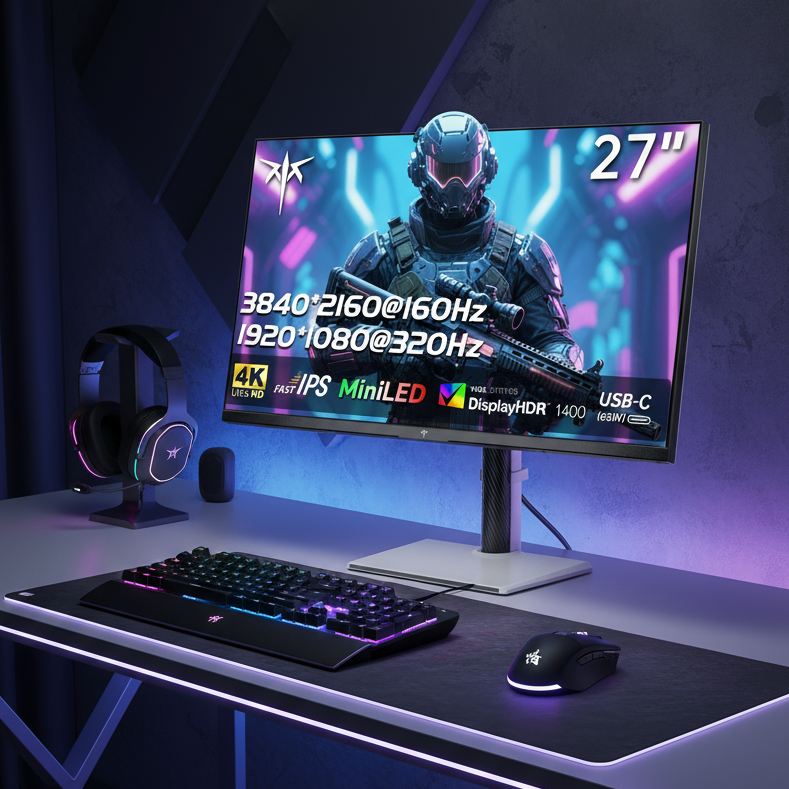


Display bit depth affects visible color accuracy by controlling how finely a screen steps between tones, especially in gradients, shadows, HDR highlights, and color-sensitive work. For most office use and SDR gaming, good 8-bit color is enough; for HDR, video grading, photography, and premium immersive play, 10-bit or strong 8-bit + FRC can make the image look smoother and more reliable.
Ever notice a sunset in a game breaking into stripes, or a gray office background looking slightly blotchy instead of clean? A practical 8-bit monitor can show about 16.7 million colors, while a 10-bit screen can step through about 1.07 billion possible colors, so the real payoff is fewer visible transitions where the image should look seamless. You will learn when bit depth matters, when it does not, and how to choose the right display without paying for specs you cannot use.
What Display Bit Depth Actually Means
Display bit depth, also called color depth, describes how many digital values are available to describe color. In modern monitor language, “8-bit” usually means 8 bits per red, green, and blue channel, not 8 bits total. That gives each channel 256 possible levels, and when red, green, and blue combine, 24-bit color produces 16,777,216 possible colors.
This is why “8-bit,” “24-bit,” and “true color” often appear close together in display conversations. An 8-bit-per-channel monitor is effectively a 24-bit color display for RGB image data. A 10-bit monitor increases each RGB channel from 256 steps to 1,024 steps, producing about 1.07 billion total combinations. The difference is not that every viewer suddenly sees a billion distinct colors. The visible difference is that the screen has more intermediate tones to draw from when it renders smooth skies, fog, shadows, skin tones, game lighting, or HDR highlights.
A useful way to think about it is a ramp from black to dark gray. With fewer steps, the ramp can look like stair blocks. With more steps, the ramp looks more continuous. That is the practical impact of bit depth on visible color accuracy: it reduces quantization error, which is the mismatch between the smooth tone the image calls for and the nearest tone the display can actually produce.

Bit Depth vs. Color Gamut: Precision Is Not Range
Bit depth and color gamut are often confused, but they solve different problems. Color depth controls tonal precision, while gamut controls the range of colors a display can cover. A monitor can have wide DCI-P3 coverage but still show banding if it has limited tonal steps, just as a monitor can have smooth 10-bit gradients while still being limited to a smaller sRGB color range.

For gaming and content work, this distinction matters. A wide-gamut screen can show more saturated reds, greens, and cyans, which helps rich open-world scenes, neon lighting, and modern game art feel more vivid. But if the screen is 8-bit and the content pushes broad gradients across that wider color space, the distance between available steps can become more visible. The result may be intense color that still does not transition smoothly.
The practical buyer’s question is not “Do I need wide gamut or high bit depth?” It is “Does my workflow need both range and precision?” For standard office work, accurate sRGB coverage and clean factory calibration matter more than chasing 10-bit. For HDR games, video grading, and wide-gamut creative work, 10-bit becomes more valuable because the screen is asked to describe more luminance and color variation at once.
Where 8-Bit Still Performs Well
A good 8-bit display remains a strong choice for productivity, coding, spreadsheets, web work, video calls, and most standard SDR gaming. Most web images, many videos, and typical desktop UI elements are still built around 8-bit SDR pipelines, so a higher-bit panel cannot invent true extra tone data from material that was never encoded that way.
For an office productivity display, the larger quality wins usually come from resolution, text clarity, ergonomics, single-cable connectivity, stable brightness, and a usable panel type. A 27-inch QHD IPS-like screen with reliable sRGB behavior can feel dramatically better for daily work than a poorly tuned “10-bit” monitor with weak uniformity or an awkward stand. The eye notices fuzzy text, glare, poor viewing angles, and clipped shadows faster than it notices missing color steps in an email client.
For competitive gaming, bit depth is also not the first performance lever. Refresh rate, response behavior, input lag, adaptive sync, and visibility in dark scenes usually affect play more directly. That said, a good 8-bit gaming monitor should still avoid obvious banding in common SDR content. If dark gradients in menus or skyboxes look heavily striped, the problem may be panel quality, compression, gamma, or a limited signal setting rather than bit depth alone.
Where 10-Bit Becomes Visibly Better
The clearest advantage of 10-bit appears in smooth tonal transitions. 10-bit color gives each RGB channel 1,024 levels instead of 256, which helps reduce banding in skies, smoke, gradients, dim interiors, and bright HDR highlights.
For photo editing, this matters when you are judging subtle color and brightness adjustments. A dusk photo with a blue-to-purple sky can look smooth on a stronger 10-bit workflow but show visible steps on a weaker 8-bit display or compressed file. For video editors, the benefit is even more obvious because color grading often pushes shadows, highlights, and saturation repeatedly. More tonal precision gives edits more room before artifacts become visible.

HDR is another major reason to care. HDR content asks a display to represent brighter highlights, darker shadows, and more nuanced transitions between them. If a monitor claims HDR but uses weak brightness, no meaningful local dimming, and limited bit-depth behavior, the badge may not translate into a premium image. A real HDR experience needs enough luminance control, contrast, and color precision working together.
Display Type |
Channel Steps |
Total RGB Combinations |
Best Fit |
6-bit |
64 per channel |
262,144 |
Budget panels using approximation |
8-bit |
256 per channel |
16.7 million |
Office, SDR gaming, web, general use |
8-bit + FRC |
Simulated extra steps |
Near 10-bit in many scenes |
Value HDR, gaming, mixed use |
10-bit |
1,024 per channel |
1.07 billion |
HDR, photo, video, premium immersion |
Native 10-Bit vs. 8-Bit + FRC
Not every “10-bit” monitor is native 10-bit. Many value-oriented displays use 8-bit + FRC, or Frame Rate Control, which rapidly alternates between neighboring tones to simulate intermediate colors. In motion and normal viewing, this can look very close to native 10-bit for many users, especially in gaming and media playback.
The tradeoff is confidence. Native 10-bit is preferable for professional color work where repeatability matters and where you are grading, retouching, or preparing files for review or print. 8-bit + FRC is a strong middle ground for gamers, streamers, and hybrid workers who want smoother gradients and HDR support without paying workstation-display prices.
The smarter move is to check the full signal chain. A 10-bit panel cannot show a true 10-bit benefit unless the file, graphics output, cable bandwidth, operating system setting, app, and monitor mode all support it. If one link falls back to 8-bit, the monitor may still look good, but it is not delivering the precision you paid for.
How Gamma, Chroma, and Calibration Affect What You See
Bit depth is important, but it is not a standalone guarantee of visible color accuracy. Gamma controls how brightness values are distributed between black and white, so a poorly chosen gamma setting can hide shadow detail or make an image look flat even on a high-bit-depth display. For most SDR desktop work and games, gamma 2.2 is the dependable baseline because it aligns well with common sRGB-style viewing.
Chroma sampling can also affect monitor fidelity, especially with text. A full 4:4:4 signal preserves color detail better than 4:2:2 or 4:2:0, and the difference is most visible around colored text, fine UI edges, and desktop work. This is separate from bit depth. A 10-bit 4:2:0 signal may still look worse for productivity than an 8-bit 4:4:4 signal because the color detail has been reduced spatially.
Calibration closes the loop. A display with more possible colors can still be inaccurate if its grayscale balance, gamut mode, or factory tuning is poor. For creators, Delta E performance, sRGB or DCI-P3 coverage, uniformity, and hardware calibration support can matter as much as bit depth. For gamers, a calibrated picture mode can make dark objects easier to distinguish without washing out the whole scene.
Practical Buying Advice by Use Case
For office productivity, prioritize a clean 8-bit IPS-like display with sharp resolution, good ergonomics, and stable sRGB color. A 24-inch to 27-inch screen works well for most desks, while 27-inch QHD is a particularly efficient balance of text clarity, workspace, and cost. Spending extra on 10-bit makes less sense if your day is built around documents, dashboards, browser tabs, and video meetings.
For immersive gaming, look at the whole visual engine: panel type, contrast, refresh rate, response performance, HDR strength, gamut, and bit depth. Wide color gamut can make modern games look richer, but 10-bit or credible 8-bit + FRC helps those richer tones transition cleanly in skies, shadows, neon, and fog. For competitive play, do not sacrifice refresh rate and response quality just to get a higher bit-depth claim.

For photo, design, and video work, 10-bit support becomes more important. Higher color bit-depth is especially useful when editing gradients, HDR video, and subtle tonal transitions, but it should come with the right color space coverage and calibration behavior. A serious creative display should be evaluated as a system, not as a single spec line.
For portable smart screens, the value calculation is tighter. Battery draw, connection compatibility, brightness, panel quality, and physical durability may outweigh native 10-bit unless you are using the screen for field review, photo culling, or HDR media. A portable 8-bit panel with accurate sRGB and good brightness can be more useful than a dim “10-bit” portable display that is hard to trust outdoors or in a bright room.
Pros and Cons of Higher Bit Depth
Higher bit depth gives smoother gradients, cleaner HDR tone transitions, and more editing headroom. It reduces banding in exactly the places premium displays are meant to shine: cinematic skies, dark game environments, studio backdrops, product photos, skin tones, and subtle UI gradients.
The drawbacks are cost, bandwidth, and workflow dependency. A 10-bit signal can require more display bandwidth, especially at high resolution and high refresh rate, so connection standards matter. Some systems reduce refresh rate, chroma quality, or resolution when bandwidth is tight. Higher bit depth also does not fix low contrast, poor calibration, weak HDR brightness, bad compression, or a narrow color gamut.
The best value choice is therefore not always the highest number. It is the display that matches the content you actually use, the hardware you connect, and the visual problems you are trying to solve.
How to Check Whether Bit Depth Is Your Problem
If you see banding, start with the content. Highly compressed video, low-quality streams, and edited JPEGs can show banding even on excellent screens. Then check your operating system and graphics control panel to confirm the output is RGB or full-quality YCbCr, preferably 4:4:4 for desktop use, and set to the highest bit depth your monitor and cable can sustain at the desired resolution and refresh rate.
Next, reset the monitor to a standard, sRGB, creator, or accurate preset and use a grayscale ramp or gradient test. If banding improves after changing picture mode, gamma, or signal format, the monitor’s bit depth was only part of the issue. If banding remains in high-quality 10-bit test content while the full chain is confirmed, the panel or its processing may be the limit.
For buying decisions, read beyond the headline spec. A trustworthy monitor listing should clarify whether the panel is native 8-bit, 8-bit + FRC, or native 10-bit. It should also provide color coverage, calibration claims, brightness behavior, supported ports, and refresh-rate limits at different signal settings.
Bottom Line
Display bit depth is the precision layer of color accuracy. Choose 8-bit for reliable everyday work and SDR play, choose 8-bit + FRC when you want strong value and smoother visuals, and choose native 10-bit when HDR, grading, photography, or premium immersion is central to the job. The winning display is not the one with the biggest color number; it is the one that keeps the whole image chain honest from content to screen.


