For most SDR gaming, start with a neutral D65-style white point around 6500K, then move warmer for relaxed cinematic play or slightly cooler when visibility matters more than color accuracy.
Does your game ever look technically sharp but emotionally wrong, like a cozy RPG scene feels sterile or a snowy shooter map looks washed in blue? A practical gaming monitor setup can usually be improved in one session by warming up the panel for 20 to 30 minutes, choosing a neutral picture mode, and tuning brightness before chasing extreme color temperature presets. This guide explains how warm, neutral, and cool display settings change mood, atmosphere, and visibility across common game settings.
Why Color Temperature Changes the Feeling of a Game
Display color temperature changes the monitor’s white point, which means every gray, highlight, shadow, skin tone, HUD element, and fog layer is judged against a different “white.” A lower Kelvin setting looks warmer, usually adding amber or reddish warmth, while a higher setting looks cooler, often adding a blue cast that can make whites feel brighter and text look crisper. For general SDR gaming, web use, and sRGB-style content, a neutral target near D65 is commonly treated as the balanced starting point.
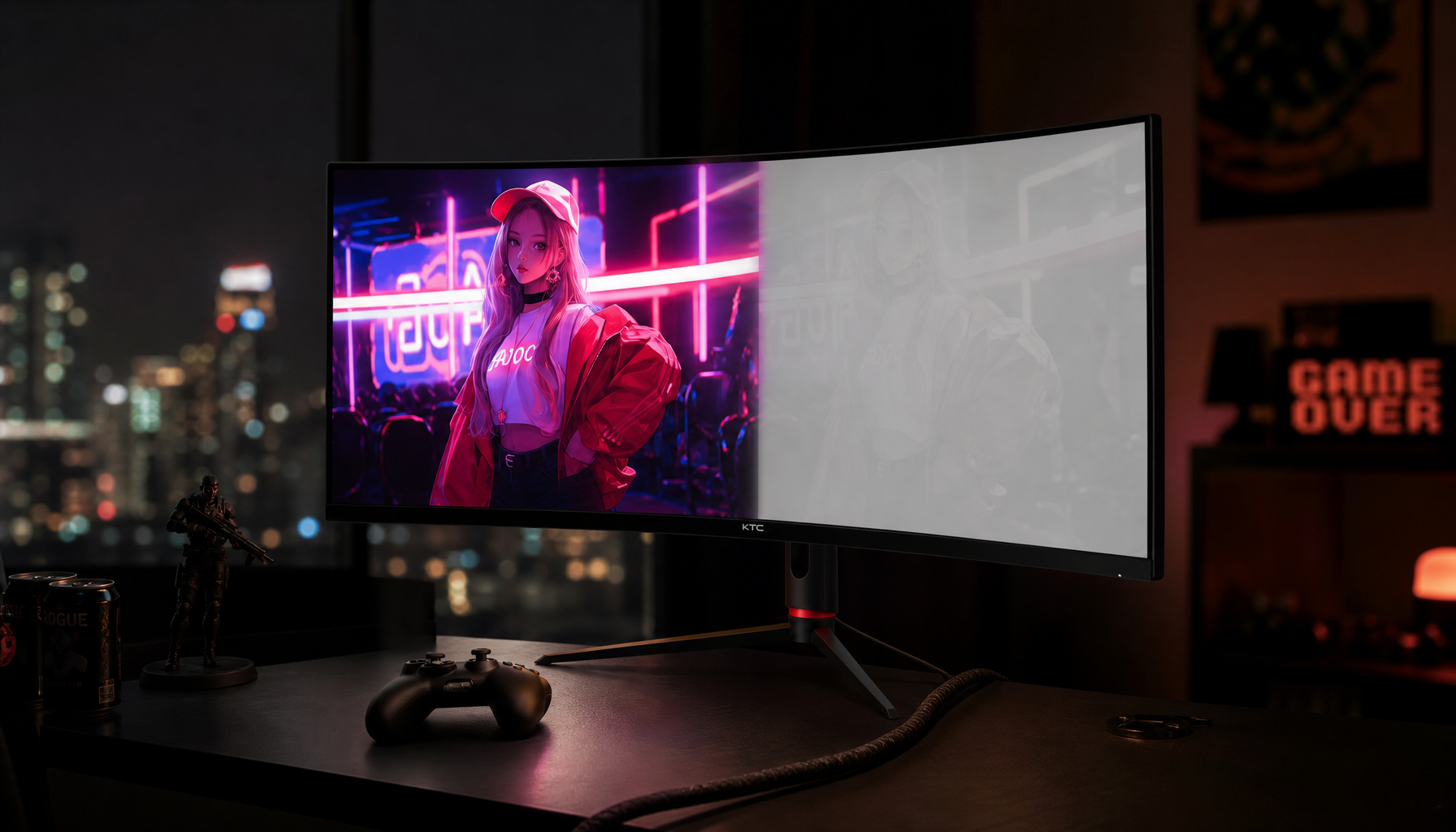
That starting point matters because most games are art-directed around a relatively neutral display. If a gaming monitor ships in a vivid, dynamic, FPS, or showroom-style preset, it may exaggerate blue whites, contrast, and saturation before the player ever touches the settings. The result can be a display that looks punchy on a store shelf but makes a character’s skin look pale, stone walls look icy, or a fantasy sunset lose its intended orange-red weight.
Mood research supports the idea that color temperature and surrounding color interact rather than acting alone. In a controlled study with 33 participants, researchers tested white, red, and blue environments under 3000K warm white and 6500K cool white light for 130-minute sessions; red surroundings were associated with higher tension, anger, depression, and anxiety than white surroundings, while cool white light increased perceived brightness across environments. The same study found that white with warm light and blue with cool light were among the more favorable combinations for mood and visual perception, which maps well to gaming rooms where wall color, bias lighting, and monitor settings all influence the final impression.
Warm, Neutral, and Cool Settings Compared
A warm display setting can make a single-player game feel softer, slower, and more intimate. It tends to flatter candlelit interiors, taverns, character dialogue scenes, desert maps, autumn forests, and film-like cutscenes. The tradeoff is that warm settings can also push white UI elements toward cream, make gray menus look beige, and hide subtle blue or green color cues in health bars, maps, or team indicators.
A cool display setting can increase the impression of alertness and perceived brightness, especially in bright shooters, snow maps, concrete-heavy arenas, and high-contrast esports scenes. That can be useful when the goal is to spot motion quickly on a 144 Hz, 165 Hz, 240 Hz, or faster gaming monitor. The cost is accuracy: a cool white point may make fog, snow, and metal look sharper at first, but it can also push neutral surfaces blue and distort color-coded UI cues.
Neutral is the safest baseline when you want the game to look close to the developer’s intended art direction. On a calibrated or well-tuned gaming monitor, 6500K with gamma near 2.2 usually gives the best all-purpose balance for RPGs, strategy games, cinematic action titles, desktop use, and streaming overlays. From there, use small adjustments by genre instead of treating color temperature as a one-setting-fits-all performance boost.

Display setting |
Typical visual effect |
Best-fit game settings |
Main benefit |
Main tradeoff |
Warm |
Around 3700K–5000K for night modes, or a mild warm preset |
Horror, story games, cozy RPGs, late-night play |
Softer mood and reduced harshness |
Less accurate whites, grays, HUD colors, and skin tones |
Neutral |
Around 6500K / D65 |
General SDR gaming, RPGs, strategy, streaming, content creation |
Balanced color and intended art direction |
May feel less dramatic than genre-specific presets |
Slightly cool |
Above 6500K, used conservatively |
Competitive shooters, bright maps, snow, concrete, racing HUDs |
Higher perceived brightness and crispness |
Blue cast, harsher long sessions, less reliable color judgment |
Extreme vivid/FPS preset |
Often cool, saturated, high contrast |
Short competitive sessions only, if tested |
Fast visual punch |
Can crush shadow detail and misrepresent game atmosphere |
Matching Color Temperature to Game Genre
Horror, Stealth, and Dark Cinematic Games
For horror and stealth, color temperature should support atmosphere without hiding the information you need to play. A mildly warm setting can make lamplight, old wood, skin, and low-light interiors feel more grounded, while a neutral setting often preserves the intended balance between shadows and environmental clues. If the game already uses heavy amber lighting, going too warm can make dark rooms muddy and reduce the difference between objects, enemies, and background textures.

Gamma matters here as much as color temperature. Gaming monitor tuning advice often recommends lower gamma ranges, such as 1.8 to 2.0, for stealth and horror visibility, while 2.2 to 2.4 can feel more cinematic and contrast-rich. The important move is to test both: use a dim scene with a visible doorway, a black jacket or wall texture, and a small HUD element, then adjust until the scene feels tense without making navigation feel like guesswork.
RPGs, Open Worlds, and Story-Driven Games
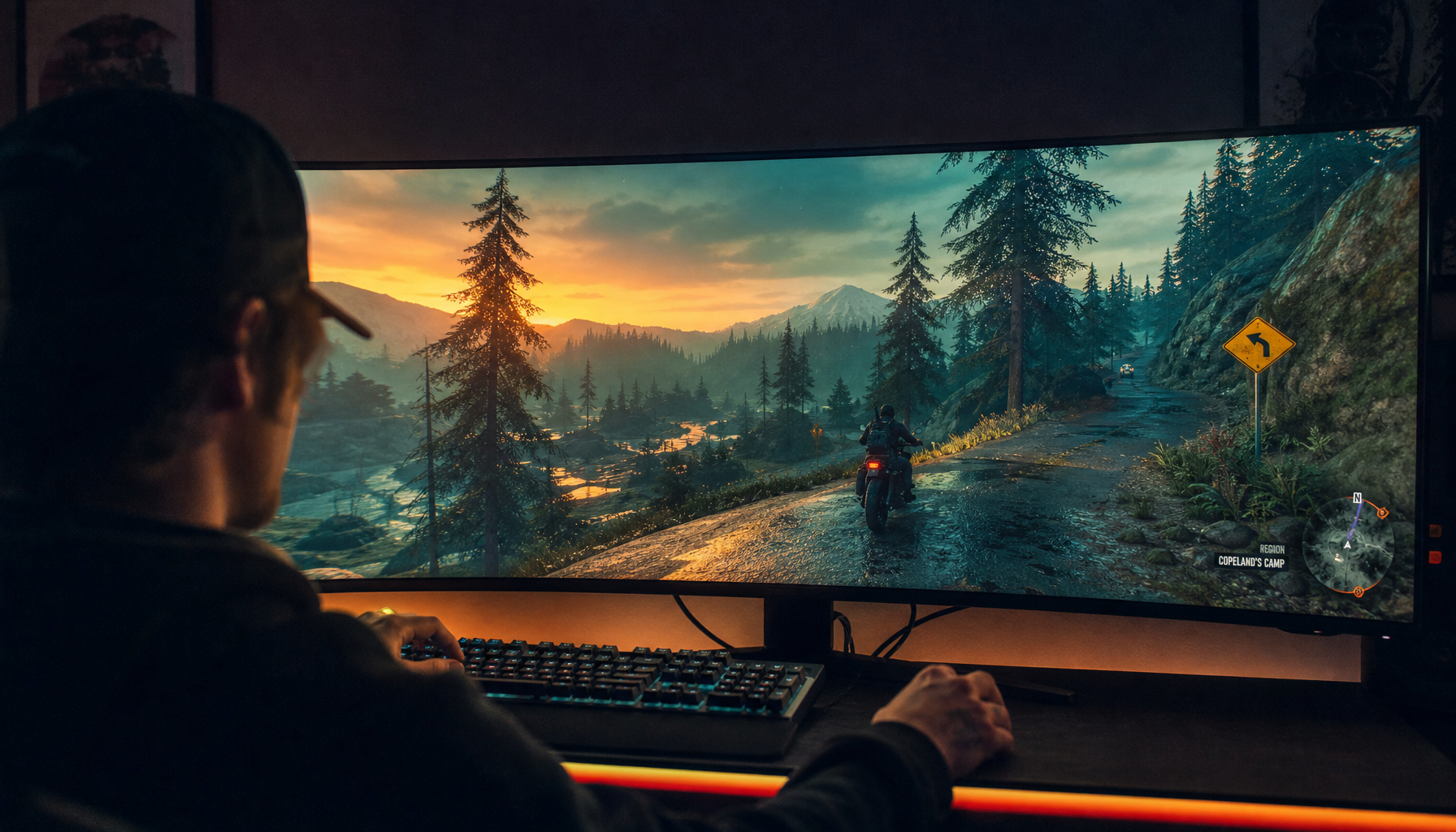
For RPGs and open-world games, neutral usually wins. These games rely on varied environments: snowfields, forests, character faces, magical effects, parchment maps, armor, UI icons, and day-night cycles may all appear in the same session. A D65 white point helps preserve the intended color relationships instead of making every location lean warm or cool.

A useful practical setup is to create two monitor presets if your display allows it: one neutral preset for most play and one warmer preset for late-night story sessions. On a 27-inch or 32-inch gaming monitor, this is often more useful than constantly changing in-game brightness because it separates mood tuning from game calibration. On ultrawide monitors, where the image fills more of your peripheral vision, a mild shift in white point can feel stronger, so smaller adjustments are usually better.
Competitive Shooters and Racing Games
Competitive games are the main case where a cooler look can be defensible, but it should be treated as a visibility tool rather than a universal upgrade. Slightly cooler whites can make bright maps, smoke, concrete, sky glare, and fast-moving silhouettes feel more defined. That effect can pair well with high refresh rates because motion clarity and visual separation both affect how quickly you read the scene.

Still, avoid assuming the coldest preset is the best preset. Many FPS modes raise contrast, cool the white point, oversaturate colors, and lift or crush shadows all at once. If a blue team marker, red damage indicator, or yellow objective icon looks different enough to change your reaction, the preset is no longer just changing atmosphere; it is changing your read of the game’s information design.
Room Lighting, Bias Lighting, and Wall Color Matter
A monitor does not exist in isolation. Ambient light, wall color, and eye adaptation can make the same 6500K display look normal in daylight, cool in a warm lamp-lit room, or dull beside strong RGB lighting. That is why the best gaming setup starts with stable room lighting before monitor tuning.

The workspace study using 500 lux lighting showed that environment color and light temperature together affected comfort, attractiveness, perceived brightness, and calmness. For gaming rooms, the lesson is practical: a red wall, strong red LED strip, or saturated RGB scene behind the monitor can increase tension or visual fatigue even if the monitor itself is set correctly. A neutral wall, low-glare desk lamp, or soft bias light behind the display can make a high-refresh-rate monitor feel easier to view for long sessions.
For late-night play, lower brightness first. A dark-room baseline around 100 nits, or about 120 to 180 nits for a dim indoor room, is often more comfortable than leaving the monitor bright and forcing a very warm color temperature. Warm settings and blue-light filters can help, but night modes reduced blue light more than many built-in monitor modes in one eight-monitor comparison, so OS-level night settings may be the stronger option near bedtime.
What to Look For When Buying a Gaming Monitor
Color temperature control is not the only buying factor, but it should be part of the shortlist. A good gaming monitor should offer a usable sRGB, Standard, Creator, or Custom mode, not just aggressive Movie, Vivid, Eco, and FPS presets. If the monitor lets you adjust RGB gain, gamma, brightness, and color temperature separately, you have a much better chance of building one accurate preset and one gaming-specific preset.
Factory calibration is especially useful if you play cinematic games, edit screenshots, stream, or use the same monitor for work. A monitor can claim 6500K and still lean green or magenta because Kelvin alone does not fully describe white point. That is why reviews with color error measurements, sRGB coverage, gamma tracking, and white point data are more valuable than a spec sheet that only lists “warm,” “normal,” and “cool.”
HDR adds another layer. In HDR mode, many monitors lock or change picture controls, alter local dimming behavior, and use different brightness targets. If you care about atmosphere in HDR games, look for reviews that discuss tone mapping, black levels, peak brightness, and whether color temperature remains adjustable in HDR. For portable monitors, also check whether the display remembers custom settings after disconnecting from a laptop, handheld PC, or console, because repeated setup friction often leads players back to inaccurate defaults.
A Practical Setup Workflow for Gaming Monitors
Start with the monitor warmed up for 20 to 30 minutes, then reset the picture mode and choose sRGB, Standard, Creator, or Custom. Set brightness for the room before changing color temperature; a screen that is too bright often feels harsh even at a correct white point. Then set color temperature near 6500K and gamma near 2.2 for a reliable neutral baseline.
Next, test with three scenes instead of one. Use a bright outdoor scene, a dark indoor scene, and a UI-heavy menu or match screen. If the bright scene looks clean but the dark scene loses detail, adjust gamma or black equalizer carefully before changing color temperature. If the UI colors look wrong, return closer to neutral.
Finally, save genre-specific presets only when the difference helps. A practical preset list might be: Neutral 6500K for general play, Warm/Night around 3700K-5000K for late sessions, and Competitive with slightly cooler whites plus tested shadow settings. Monitor settings can be game-changing when tuned deliberately, and many displays benefit from a reset, custom or sRGB mode, brightness adjustment, contrast check, color temperature tuning, and gamma control rather than relying on defaults optimized for showroom impact.
FAQ
Q: What color temperature is best for most gaming monitors?
A: For most SDR gaming, start near 6500K or D65. It gives the most balanced result for game art, character skin tones, gray UI elements, highlights, shadows, and streaming overlays. Warmer or cooler settings can be useful, but they should be secondary presets rather than your only baseline.
Q: Is a warmer color temperature better for late-night gaming?
A: Often, yes, but brightness should be reduced first. In a dark room, a lower brightness target around 100 nits, or roughly 120 to 180 nits in dim indoor lighting, is usually more important than pushing the monitor into an extremely amber mode. After that, moderate warmth or an OS-level night mode can make late play feel less harsh.
Q: Do competitive players need a cooler color temperature?
A: Not always. A slightly cooler setting may improve perceived brightness and crispness on some bright maps, but extreme cool presets can distort colors, HUD cues, and shadow detail. Competitive players should test cool settings against neutral using real match scenarios, especially where team colors, hit indicators, smoke, fog, and objective markers matter.
Key Takeaways
A neutral 6500K-style setup is the best foundation for most gaming monitors because it protects the game’s intended color balance. Warm settings are useful for late-night comfort, horror, RPGs, and cinematic single-player games, while slightly cool settings can help perceived clarity in competitive or high-brightness scenes. The strongest setup is not one magic preset; it is a controlled baseline plus a small number of purpose-built profiles.
Before buying or tuning a monitor, prioritize adjustable picture modes, usable sRGB or custom controls, stable brightness, good gamma behavior, and documented color accuracy. High refresh rate, ultrawide immersion, HDR performance, and portability all matter, but color temperature determines whether the scene feels natural, tense, cozy, sterile, or harsh once the game is actually on screen.