

A 1000R curved monitor can feel spectacular in the right game, but its aggressive wraparound shape also brings real tradeoffs in comfort, accuracy, flexibility, and value.
Do your eyes feel locked into the center of the screen while the corners seem dramatic in one game and awkward in the next? On a real desk, the same 1000R curve that boosts presence in racing and flight sims can also make HUDs, menus, side-by-side windows, and even your seating position matter more than many buyers expect. You will come away with a clear sense of when 1000R is worth it, when it is not, and how to avoid the most common buying mistakes.
Why 1000R Feels So Good at First
A 1000R curve means the screen follows part of a circle with a 3.3-foot radius, so it is much more aggressively curved than 1500R or 1800R. That stronger bend pulls the edges of the display deeper into your peripheral vision, which is why large 32-inch, 34-inch, and ultrawide gaming monitors can feel more enveloping than flat panels.
That effect is real, and it is not just marketing. Reviewers and manufacturers consistently position 1000R as the most immersion-focused option for racing, flight, and open-world games, especially on larger VA ultrawides, as explained in this curvature comparison and KTC’s 1000R-versus-1500R breakdown. In a cockpit view or a wide scenic game, that wraparound sensation can make a monitor feel larger than its diagonal size suggests.
The Hidden Downsides Start When Your Use Case Is Broader Than Immersion
Straight Lines Can Look Less Trustworthy
A tighter curve is more visually aggressive, and that matters the moment you leave pure gameplay. On a 1000R screen, spreadsheet columns, editing timelines, minimaps, subtitles, and UI bars can look subtly bowed, especially near the sides. You may stop noticing it during a race, but you will usually notice it when aligning windows, reading dense text, or checking precision-heavy overlays.

This is where the advice becomes more nuanced. KTC and other sources tend to favor 1500R or 1800R for mixed productivity because gentler curves preserve straighter perceived geometry. That does not mean 1000R is bad; it means the visual drama that helps immersion can work against accuracy. If you play for three hours and then answer emails, edit clips, or manage inventory systems on the same display, this tradeoff becomes much more obvious.
Off-Center Viewing Gets Worse, Not Better
A curved screen works best when you are centered, and 1000R is less forgiving than milder curves. Lean back in your chair, shift to one side, or let someone watch from beside you, and the image can feel less natural. This matters more than many people expect because gamers rarely sit perfectly still during long sessions.

On a standard desk, even a small seating shift can change how natural the corners feel. If your monitor sits on a shallow desk and you are closer than planned, a 1000R display can feel intense. If your desk is deeper and you sit farther back, the curve can feel less coherent and more like a visible bend than a natural extension of your field of view. That is why viewing distance matters so much in practice.
Multi-Monitor Setups Become Harder to Get Right
A flat monitor is often easier to align in dual- or triple-screen setups, and this is one of the least advertised downsides of 1000R. If you add a second flat display for chat, streaming controls, or work, the transition between panels can feel awkward. If you build a full triple-curved rig, alignment improves for sims, but desk depth, mounting angles, and bezel transitions become much more demanding.

That problem also shows up in enthusiast discussions. A triple 32-inch 1000R setup often comes with an adjustment period many buyers do not anticipate. The curve itself is not the whole issue; the real problem is that a tight curve magnifies every mistake in monitor placement, seat position, and side-panel angle.
Eye Comfort Is Not a Free Win
A clinical eye-strain claim summarized by KTC suggests curved displays may reduce self-reported strain by keeping the screen more uniformly in focus. That is plausible, and many gamers do find large curved screens easier to scan than large flat ones.
But comfort depends on more than curvature. Gaming monitor setup advice still stresses brightness, color temperature, breaks, and overdrive settings because eye fatigue often comes from glare, excessive brightness, poor posture, or motion artifacts, not just screen shape. In other words, 1000R can help some people on large screens, but it will not rescue a bad setup.
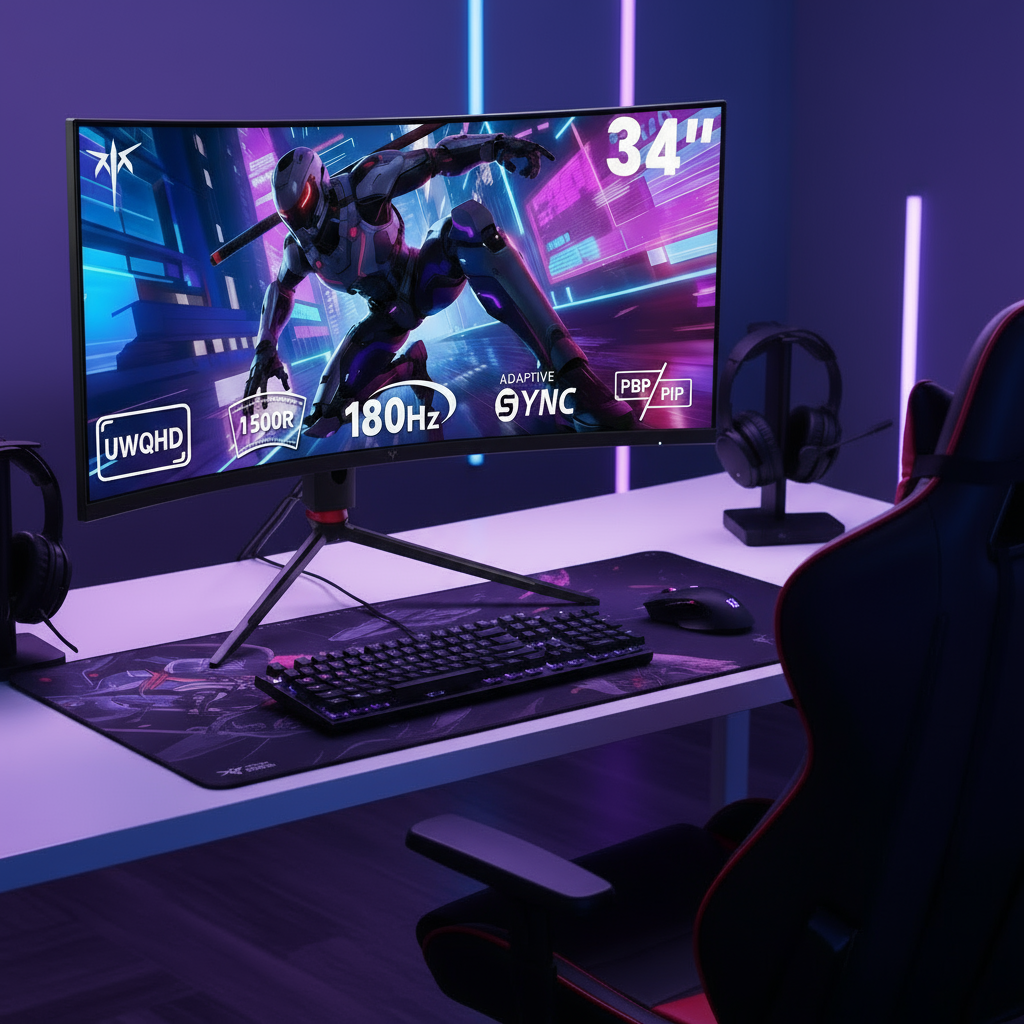
A simple real-world example proves the point. If you play on a 34-inch ultrawide at night with brightness pushed too high, overdrive set too aggressively, and your chair too close to the screen, the aggressive curve may actually make the display feel more imposing rather than more relaxing. The monitor is not failing; the setup is.

Performance Value Can Be Worse Than It Looks
A good 144Hz or 165Hz monitor is often the best value point, and that matters because many 1000R models charge a premium for immersion while giving up elsewhere. You might pay more for the curve yet still end up with a weaker panel, worse brightness, more noticeable ghosting, or fewer ports than a strong flat or lightly curved alternative at the same price.
This is especially important because resolution, refresh rate, and GPU demands already force tradeoffs. A curved 34-inch display may look premium, but many are 3,440 x 1,440 rather than true 4K, and that is not automatically a problem unless you expected 4K sharpness. One common buyer mistake is focusing on size and curvature without checking the actual pixel count.
Panel type adds another layer. VA panels often pair well with 1000R for contrast-heavy gaming, but IPS and OLED options may offer cleaner motion, wider viewing angles, or better color depending on the model. If the curve is the main reason a product looks special, check whether you are quietly compromising on the specs that affect every frame.
Who Should Avoid 1000R
A gentler curve is usually better for hybrid work-and-play use. If your day includes spreadsheets, coding, editing, or frequent window management, 1500R or 1800R is often the safer buy. If you use two or three monitors, a flat panel or a lighter curve is also easier to live with. If you sit far from the screen, the benefit of 1000R shrinks quickly.
On the other hand, if you mostly play sims, open-world games, or cinematic single-player titles from a centered seat at the right distance, 1000R still makes sense. It is simply a specialty tool, not an automatic upgrade.
How to Decide Without Regret
A use-case-first buying approach is the right way to think about 1000R. Ask whether you want immersion above flexibility, whether your desk depth really matches the screen, whether your favorite games support the aspect ratio cleanly, and whether the panel quality is strong enough even without the curve.
The smart move is to treat 1000R as one variable, not the headline feature. If you can answer yes to close seating, centered play, mostly immersive genres, and minimal productivity demands, it can feel brilliant. If any of those answers start to weaken, the hidden downsides become much easier to notice than the initial wow factor.
A 1000R monitor is at its best when the rest of your setup is disciplined enough to support it. If your screen has to be a high-performance all-rounder, a milder curve or a great flat panel is often the more reliable path.