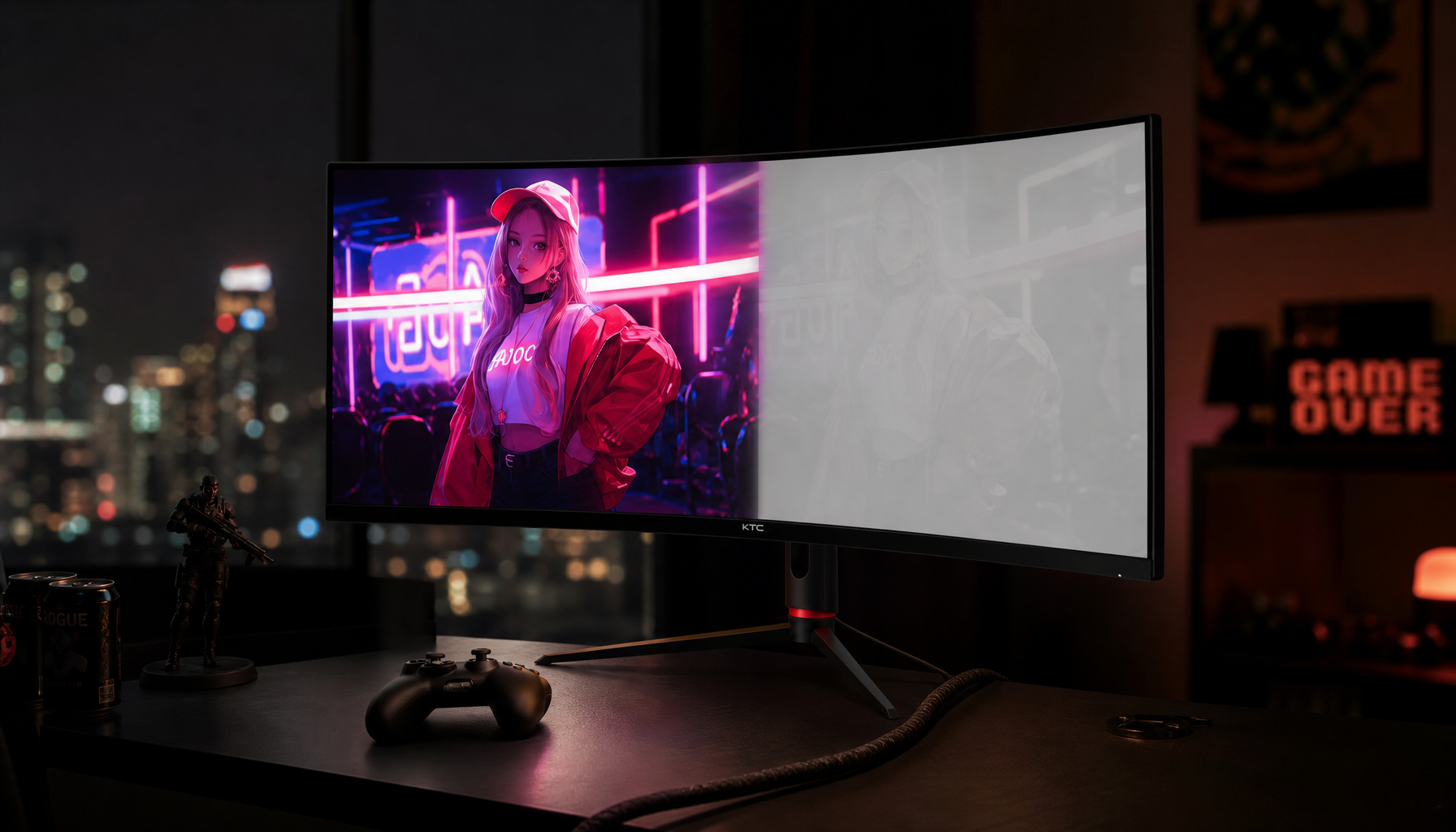
An LCD monitor’s backlight layer supplies the light; the liquid crystal panel, polarizers, and RGB color filters control how much of that light reaches your eyes as an image.
Does your monitor look washed out in a bright room, uneven on a dark game menu, or too harsh after hours of spreadsheet work? A practical backlight check can tell you whether you need a settings change, a better panel design, or a different monitor class entirely. This article explains how the backlight stack works, why it affects brightness and color, and which specs matter when buying or tuning a display.
What the Backlight Layer Actually Does
An LCD is not self-lit. The pixels do not glow on their own; they work more like tiny shutters that manage a separate light source. In a typical monitor, LCD screens rely on a backlight, a liquid crystal layer, and color filters to generate the picture you see.
Think of the backlight layer as the engine behind the image. It creates white light, spreads it across the screen, pushes it through optical films, and sends it into the LCD panel. The liquid crystals and polarizers decide where that light becomes bright, dim, or blocked, while red, green, and blue subpixels turn controlled light into color.
The phrase “LED monitor” can be misleading. Most desktop LED monitors are still LCD monitors; LED describes the backlight, not the pixel technology. OLED is different because each pixel emits its own light, so it does not need the same backlight layer.
The Backlight Stack, Layer by Layer

Behind the glass, a modern LCD monitor is a controlled light path rather than a single flat sheet. A typical backlight stack includes LEDs, a reflector, a light guide or diffuser, brightness enhancement films, polarizers, the liquid crystal cell, color filters, and the front surface.
An optical demonstration from the University of Arizona shows how a diffuser layer spreads light so the screen does not look patchy, while a light-spreading layer and reflective backing help redirect light toward the viewer. In an edge-lit monitor, LEDs sit along one or more edges, and a light guide plate spreads that light across the panel. In a direct-lit monitor, LEDs sit behind the screen and shine forward through diffusion layers.
The liquid crystal layer then acts as a voltage-controlled gate. When the monitor’s electronics apply different voltages, the crystals change orientation and alter how much polarized light can pass through each subpixel. Red, green, and blue filters finish the job by shaping that light into the colors that form windows, games, videos, charts, and text.
Edge-Lit vs. Direct-Lit vs. Mini LED

Backlight placement changes the display’s thickness, uniformity, power behavior, and contrast. Edge-lit designs can be very slim because the LEDs are placed around the border, but they depend heavily on the light guide’s ability to distribute brightness evenly. Direct-lit designs put the light source behind the panel, which can improve uniformity but usually requires more depth.
Direct backlight systems can provide more even illumination because the light source sits behind the display and uses a diffuser to spread output. For a 27-inch productivity monitor, that can mean fewer obvious bright corners on white documents. For a gaming display, it can mean better consistency in dark scenes, though the panel type and dimming system still matter.
Mini LED is an advanced direct-lit approach using many smaller LEDs grouped into dimming zones. It can improve HDR punch and dark-scene control, but it is not magic. If the dimming zones are too large or the algorithm is aggressive, bright HUD elements can create blooming around text or crosshairs. Competitive players should still check response time, input lag, refresh rate, and overdrive behavior instead of buying purely on backlight terminology.

Backlight Design |
Main Strength |
Main Tradeoff |
Best Fit |
Edge-lit LED |
Thin, efficient, cost-effective |
More risk of uneven brightness |
Office, general use, portable screens |
Direct-lit LED |
Better uniformity potential |
Thicker chassis |
Workstations, media displays |
Mini LED |
Stronger local dimming and HDR potential |
Higher cost, possible blooming |
Immersive gaming, HDR video, premium productivity |
Why Backlight Quality Changes Brightness, Contrast, and Color
Brightness starts with the backlight, but visible quality depends on how cleanly the rest of the panel controls that light. A bright backlight with weak optical control can look gray in dark scenes. A strong panel with a poor backlight can look dim, blotchy, or color-limited.
The backlight spectrum defines the monitor’s color potential because the color filters can only shape light that exists in the source. If the backlight has weak red or green energy, the panel cannot fully produce certain saturated colors no matter how polished the menu settings look. This matters for creators, but also for gamers who want vivid worlds without crushed shadow detail or cartoonish oversaturation.
For general SDR office work, high sRGB coverage and stable whites matter more than extreme gamut claims. For cinematic gaming and HDR video, wider DCI-P3 coverage, higher peak brightness, and better local dimming become more relevant. For photo and print workflows, gamut coverage, calibration, uniformity correction, and an accurate sRGB mode are more valuable than a vivid showroom preset.
The Role of Polarizers and Liquid Crystals

The backlight produces light, but the LCD panel controls it through polarization. A rear polarizer organizes the backlight into a specific light orientation. The liquid crystal layer then changes how that light behaves. A front polarizer decides whether the light exits toward the viewer.
Polarizing filters help LCDs turn electrical signals into visible bright and dark areas by controlling which light orientations pass through. In a simple real-world example, a black letter on a white document is not “black ink” inside the screen. It is a group of subpixels where the liquid crystals and polarizers are blocking much of the backlight, while the surrounding white page allows more light through.
This is also why LCD blacks are rarely as deep as OLED blacks. Even when the liquid crystal tries to block light, some leakage usually remains. VA panels often block light better than IPS or TN panels, while IPS usually offers stronger viewing angles and color stability. For esports, TN and fast IPS designs may prioritize motion clarity. For long office sessions, a sharp IPS panel with stable brightness and good ergonomics is often the better value.
Common Backlight Problems You Can Diagnose

A dim screen, uneven glow, flicker, or a faint image under a flashlight can point to different issues. If you can see a very faint desktop image but the screen looks nearly black, the LCD signal path may still be working while the backlight system is not illuminating properly. That can involve the LED strip, backlight driver, power supply, cable, or control signal.
LED backlights affect brightness, power efficiency, contrast, color accuracy, thickness, durability, and overall image quality, so symptoms can overlap. A bright patch near the edge often suggests uneven light guide behavior. Cloudy corners on dark screens can come from backlight bleed, panel pressure, or assembly tolerances. Visible pulsing at low brightness may come from PWM dimming, where the backlight rapidly turns on and off to control perceived brightness.
For buyers, the practical test is simple. Open a full-white page to check uniformity, a dark gray image to spot glow and bleed, a scrolling text page to judge readability, and a familiar game or video to evaluate motion and shadow detail. Manufacturer specs help, but your room lighting and use case reveal the truth quickly.
Backlight Settings for Gaming, Office Work, and Portable Screens
The backlight setting usually controls total light output, not black level or color accuracy by itself. In a bright office, raising backlight improves readability. In a dark room, lowering it reduces glare and eye fatigue. For long spreadsheet sessions, the best setting is usually the lowest level that keeps text crisp without making you squint.
Backlight controls adjust screen light output on LCD displays, and higher settings can help in bright rooms while lower settings often look more natural in dim spaces. On a productivity monitor, pair moderate brightness with a neutral color temperature and native resolution. On a gaming monitor, tune brightness for map visibility, then check that dark areas still show detail without turning blacks into gray fog.
Portable smart screens add another constraint: battery life. A high backlight level can drain power quickly, especially on USB-C portable monitors. If you use a portable screen for travel work, prioritize efficient LED backlighting, a matte finish, readable brightness, and stable power delivery over exaggerated contrast claims.
Pros and Cons of LCD Backlighting
The biggest advantage of LCD backlighting is control over cost, brightness, size, and efficiency. LED-backlit LCDs can be thin, bright, durable, and affordable across a huge range of monitor sizes. They are also strong for productivity because static toolbars, documents, and dashboards do not carry the same burn-in concern associated with emissive technologies.
The tradeoff is that the backlight is shared across many pixels. That shared light source can limit black depth, create glow, expose uniformity flaws, and reduce HDR precision compared with OLED or high-zone Mini LED systems. Local dimming improves this, but it cannot make every pixel independently lit unless the display technology itself is emissive.
How to Choose a Better Backlit LCD Monitor
Start with the job, then read the specs. For office productivity, prioritize native resolution, text clarity, ergonomic adjustment, flicker behavior, brightness range, and sRGB accuracy. A 27-inch 4K IPS monitor is often a strong balance because it delivers dense text, useful workspace, and broad compatibility.
For competitive gaming, backlight quality still matters, but motion performance matters more. Look at refresh rate, response time behavior, input lag, adaptive sync, and dark-scene visibility. For immersive single-player gaming, a Mini LED LCD or strong VA panel can deliver better contrast and HDR impact than a basic edge-lit IPS panel.
For creative work, choose based on your delivery space. Web and UI work need accurate sRGB. Video and HDR workflows may benefit from DCI-P3 support and better dimming. Photo and print users should care about measured coverage, calibration reports, uniformity, and usable color modes rather than raw wide-color marketing.
FAQ
Does the backlight create the image?
No. The backlight creates the light source, while the liquid crystal layer, polarizers, TFT controls, and RGB color filters shape that light into the image.
Is an LED monitor different from an LCD monitor?
For most desktop monitors, “LED monitor” means LED-backlit LCD monitor. The pixels are still liquid crystal pixels; LEDs provide the illumination.
Does a brighter backlight always mean a better monitor?
No. Brightness helps in daylight and HDR scenarios, but poor uniformity, weak contrast, bad color tuning, or harsh dimming can make a bright monitor less comfortable and less accurate.
A backlight layer is the performance foundation of an LCD monitor, but it is only one part of the display system. Choose the backlight design for your room, workload, and content, then validate it with real brightness, uniformity, color, and motion behavior instead of trusting the label on the box.