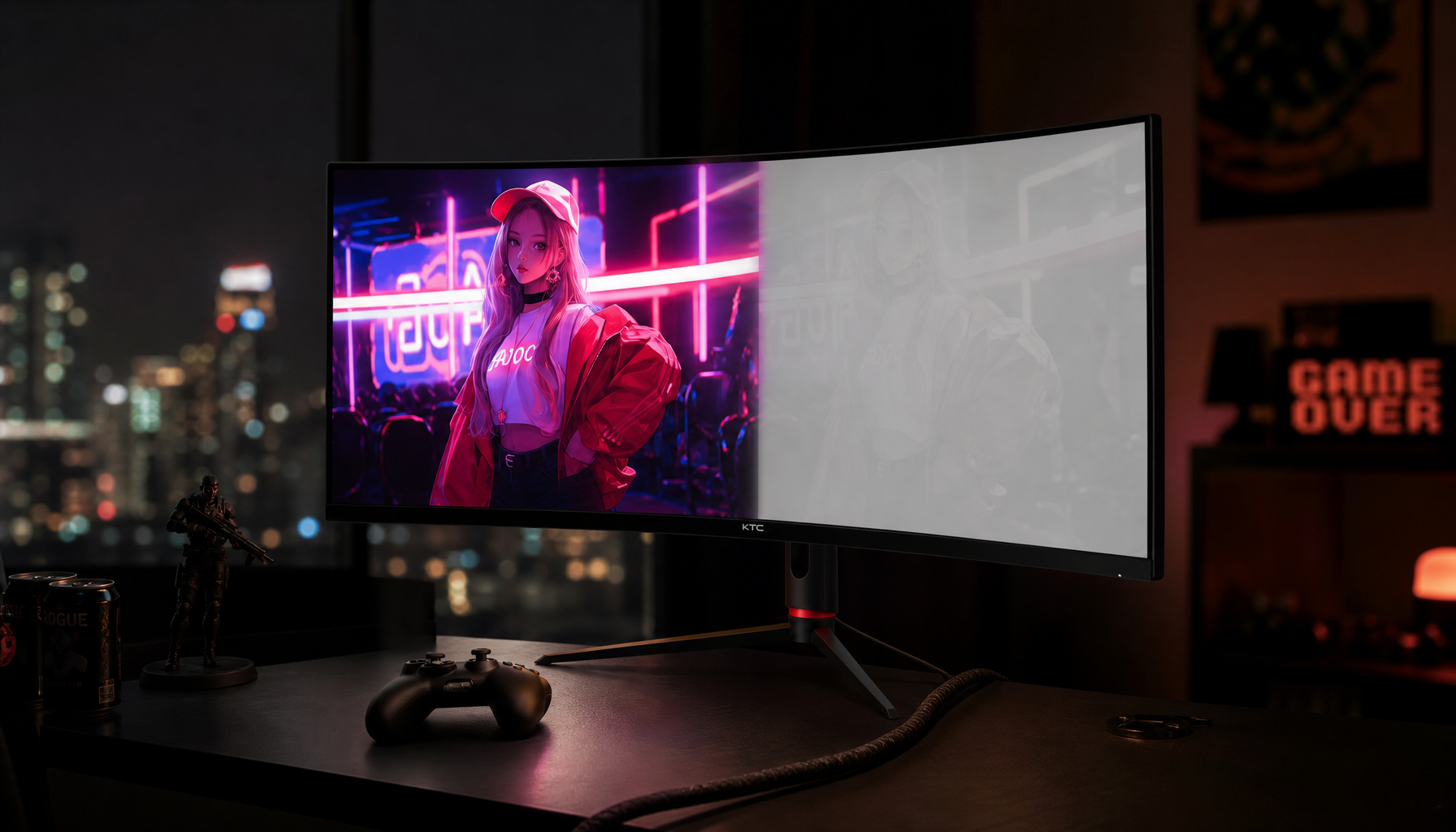
Integer scaling keeps retro game pixels evenly sized by enlarging them in whole-number steps, which usually looks sharper than a monitor’s default fullscreen scaling.
If your favorite 8-bit or 16-bit games look a little soft, uneven, or strangely stretched on a modern gaming monitor, the panel may not be the real problem. On a 1440p display, common retro formats such as 144p, 160p, 240p, and 480p all divide cleanly, which is one reason that resolution is so forgiving for classic games. This guide shows what integer scaling changes, why some monitors handle it better, and which display specs matter before you buy.
What Integer Scaling Actually Does
Whole-number scaling vs. normal monitor scaling
Integer scaling enlarges each source pixel by a whole-number multiple, so a single game pixel becomes a 2x2, 3x3, or 4x4 block instead of being blended across uneven physical pixels. That matters on fixed-pixel LCD and OLED monitors because retro games were drawn for exact pixel grids, not for soft interpolation.

Non-integer scaling adds blur and uneven pixel sizes, especially during scrolling or on high-contrast pixel art. On a gaming monitor, that can show up as softened text, shimmering edges, or scanline effects that no longer line up evenly, even when the panel itself is otherwise excellent for modern games.
Why fixed-pixel displays expose the difference
Modern monitors have one native pixel grid, so every lower-resolution signal has to be resized to fit that grid. A clean 1080p-to-4K jump works well because 1,920x1,080 scales exactly to 3,840x2,160 at 2x, but a 1440p source on a 4K panel does not divide evenly and usually looks softer.
Black bars are often the correct result when you ask a monitor, GPU, or scaler to preserve exact pixel math. That can feel wasteful on a large ultrawide monitor or a 16-inch portable monitor, but it is usually preferable to filling the panel with stretched pixels that no longer match the original artwork.

Why Retro Games Often Look Bad on Modern Displays
Low-resolution console output meets a high-resolution panel
Retro consoles commonly output very low resolutions such as 240p or 480i, while a 4K display has 8,294,400 pixels to fill. A 240p image has only 76,800 pixels, so the monitor or TV has to invent a lot of extra picture information during scaling, and that is where muddiness starts.
Many displays also misread 240p as 480i, which can trigger deinterlacing on a signal that was never interlaced in the first place. The result can be extra flicker, stutter, or strange motion artifacts that have nothing to do with the game and everything to do with the display pipeline.
Signal quality and sampling still matter
Analog retro video does not always carry explicit horizontal pixel boundaries, so modern displays have to sample the signal and guess where each pixel begins and ends. If sampling timing is off, you can get softness, moire, dropped pixels, or black borders even before any scaling choice is applied.
Connection quality and scaler quality can matter as much as resolution. Composite video is usually the weakest starting point, while S-Video, RGB, and SCART preserve cleaner detail, and an external scaler often does a better job than the internal scaler in a typical TV or budget monitor.
Which Monitor Resolutions Work Best for Integer Scaling
1080p, 1440p, and 4K behave very differently
1440p is one of the best overall resolutions for retro integer scaling because it gives roughly 93% to 100% screen fill across common retro vertical resolutions, while 1080p never hits 100% for that same group. In practical buying terms, a good 27-inch 1440p gaming monitor is often the safest single-display choice if your setup mixes classic consoles, arcade boards, handheld emulation, and PC use, and a 24-inch QHD model such as the a monitor is a concrete example of that 1440p middle ground in a smaller format.
4K is especially strong for 240p and lower content, and it also gives you a perfect 2x path for modern 1080p content. That makes 4K attractive if you want one monitor for retro games and current PC titles, but for mixed retro libraries, 1440p often wastes less space and needs fewer compromises than 1080p or an ultrawide panel.
Real examples of clean fits
On 1440p, vertical resolutions like 144, 160, 240, and 480 divide cleanly, which is why users of an FPGA platform often prefer that resolution. One practical example is a 256x224 game scaled to 1,792x1,344, giving 7x horizontal and 6x vertical scaling while staying close to a proper 4:3 image.
A 1,280x720 source fits perfectly at 2x on 1440p and 3x on 4K, which is useful if you also play modern pixel-art indies or retro-styled PC games. That is one reason 1440p and 4K monitors feel more flexible than 1080p when you care about both old console content and crisp low-resolution PC output.
Monitor resolution |
Integer-scaling behavior for retro games |
Main advantage |
Main tradeoff |
Best fit |
1080p |
Works, but often leaves awkward cropping or less efficient fill for 224p/240p content |
Lower cost and wide availability |
Less flexible for pixel-perfect retro scaling |
Budget gaming monitors and secondary displays |
1440p |
Clean fit for many common retro vertical resolutions |
Best overall balance for mixed retro libraries |
Not a perfect match for every source and aspect ratio |
27-inch gaming monitors, many desktop setups |
4K |
Excellent for 240p and lower, plus perfect 1080p 2x scaling |
Strong for mixed retro and modern use |
1440p content is fractional on 4K |
Premium gaming monitors and high-PPI panels |
Can still use integer scaling, usually with large side bars |
Great for multitasking and modern games |
Retro content rarely fills the screen cleanly |
Users who accept black bars for classic games |
|
Convenient for travel and compact setups |
Small size can hide some scaling flaws |
1080p is less forgiving for many retro sources |
An FPGA platform or handheld-friendly mobile setups |
Why Aspect Ratio Matters as Much as Sharpness
Pixel-perfect does not automatically mean geometry-perfect
Correct aspect ratio prevents stretching and squashing, and that matters just as much as sharpness on a monitor. A classic console is a good example: even if pixels are scaled cleanly, forcing it to a mismatched fullscreen shape can make circles look wide and characters look slightly compressed or inflated.
Some FPGA platform cores have used a 64:49 default instead of true 4:3, which can create uneven pixel widths even when vertical integer scaling is enabled. That is a useful reminder for monitor buyers: a panel with a great refresh rate and fast response time still needs solid aspect-ratio controls, or the image can be mathematically sharp but visually wrong.
Cropping and black bars are sometimes the right tradeoff
Perfect 4:3 usually involves compromise on a fixed-pixel display. On a 1080p screen, a 5x vertical scale for a 240p console reaches 1,200 pixels, so about 120 pixels total are cropped, or 24 lines, which is roughly 10% of the image and close to CRT overscan behavior.
Exact scaling often leaves unused space, but that is usually a better outcome than fractional stretching. On an ultrawide gaming monitor, this means retro content will often sit centered with large side bars; on a portable monitor, it may leave more visible empty space than you expect. That is not a flaw in integer scaling so much as a sign that the monitor’s shape was optimized for modern widescreen content, not classic 4:3 systems.
What to Look for When Buying a Monitor for Retro Gaming
Start with panel resolution and scaling options
A 1440p monitor is often the best all-around retro choice if your priority is sharp emulation, FPGA platform output, or digital-video-fed classic content. It handles a wide spread of retro vertical resolutions efficiently, and a standard 16:9 1440p gaming monitor is easier to recommend for classic games than a 1080p ultrawide or a basic 1080p portable screen.
GPU-side integer scaling is available on modern hardware, which means you do not always need a monitor with special built-in retro features. If you use a PC, monitor shopping should include checking whether your graphics setup exposes integer scaling controls, whether scaling happens on the GPU, and whether the display correctly centers non-native content without adding blur.
Refresh rate helps, but it is not the main retro feature
Dual-mode monitors can switch from a 4K 160Hz mode to 1080p 320Hz, using grouped pixels and separate EDID profiles so the PC sees each mode as a proper display target. That is useful if one monitor has to cover both esports and retro play, but it matters more for mixed-use buyers than for someone building a dedicated classic gaming station.
A graphics company’s integer scaling setup has been exposed through GPU scaling controls, which is another reason to treat scaling support as part of the buying checklist, not just a software afterthought. A monitor can have excellent refresh specs, but if your retro image is always being fractionally stretched by the panel, those headline numbers will not solve the core problem.
Original hardware may need an external scaler
External video scalers can deinterlace 480i, reduce latency, and convert legacy inputs to cleaner digital video output. If you plan to connect original consoles rather than only emulators, the display decision should include the full chain: console output type, cable quality, scaler, and finally the monitor’s own processing.

Products like an external scaler at $325 and another external scaler at $750 can make more difference than upgrading from one average monitor to another. For many buyers, the best value is a low-lag 1440p or 4K monitor paired with a competent external scaler, rather than relying on whatever scaling logic the monitor vendor included for general video playback.
FAQ
Q: Is 1440p better than 4K for retro gaming?
A: 1440p is often the better all-around choice for mixed retro libraries because common retro vertical resolutions fit it efficiently, but 4K is excellent if you also want perfect 1080p 2x scaling and stronger support for both retro and modern PC gaming on one premium monitor.
Q: Do I need a monitor with built-in integer scaling?
A: You can often use GPU-side integer scaling instead, so built-in monitor support is helpful but not mandatory. What matters more is that your display cleanly accepts centered non-native resolutions and does not force soft fullscreen interpolation.
Q: Why do black bars appear when integer scaling is on?
A: Black bars appear because the image is being centered on an exact pixel grid, and the scaled result does not fully fill the monitor’s native resolution. In retro gaming, that is usually the correct tradeoff for keeping pixel sizes even.
Final Takeaway
If retro gaming image quality matters more to you than filling every inch of the panel, buy for scaling math first and refresh rate second. A 1440p gaming monitor is the safest recommendation for most retro-focused setups, a 4K monitor makes sense if you also want modern 1080p and high-PPI desktop use, and ultrawide or portable displays are best only if you already accept that classic games will usually run with black bars.
Before buying, check four things: panel resolution, aspect-ratio controls, GPU or monitor integer-scaling support, and whether your setup includes original hardware that needs an external scaler. Those details do more for retro image quality than marketing terms alone.
References
- Aspect ratio and integer scaling - a forum
- How to get perfect video scaling and list of recommended resolutions - a website
- How a dual-mode gaming monitor works - a publication
- How do retro systems look bad on HDTV? - a platform
- Retro Console Emulation and Integer Scaling - a website
- Is a graphics company’s Integer Scaling really able to render 1080p/1440p games with excellent sharpness on 4K monitors? - a forum
- Retro Consoles Look Bad on Modern TVs, Here’s Why and How to Fix It - a website
- This is why retro games always look better on retro monitors - a publication
- How to get pixel perfect graphics - a platform
- How to Correctly Set Retro Game Resolution - a website