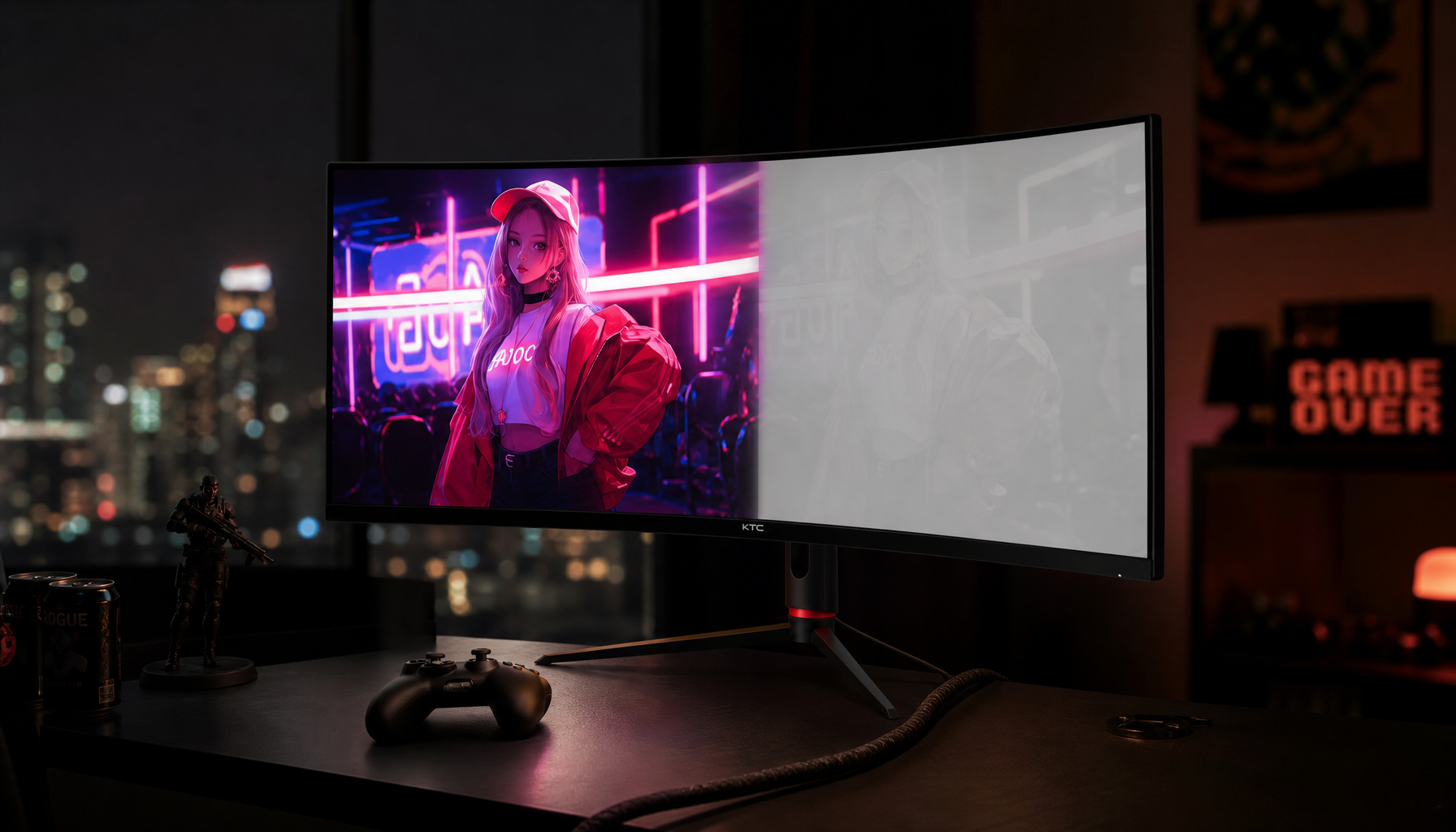
Matte and glossy screen finishes do change ideal brightness settings, but indirectly. The finish changes how reflections, glare, and perceived contrast behave, while the room lighting still matters more than the coating alone.
Ever raise your gaming monitor to 90% brightness and still feel like a window reflection is winning? In practical desk setups, a matte screen can sometimes stay readable around 45% where a glossy display might feel like it needs 80% because of glare, but a glossy panel can look richer at lower brightness in a controlled room. Here is how to set brightness for matte, glossy, and semi-glossy monitors without sacrificing eye comfort, contrast, or gaming visibility.
Screen Finish Changes Perceived Brightness, Not the Backlight Itself
A matte, glossy, or semi-glossy finish does not usually change the monitor’s actual backlight output or OLED pixel capability. What changes is how much room light competes with the image before it reaches your eyes. That is why two monitors with the same brightness percentage can feel very different on the same desk.
Glossy monitors use a smoother outer surface that lets image light travel more directly, which can make colors look more saturated and blacks look deeper in a controlled room. The tradeoff is that glossy screens reflect windows, overhead lights, desk lamps, and nearby objects more clearly, especially in dark scenes. On a glossy OLED gaming monitor, a black loading screen can show your room almost like a dark mirror if a lamp or window is behind you.

Matte monitors use a textured anti-glare surface that breaks up sharp reflections. That diffusion can make a bright window less distracting, but it can also spread light across the screen as a mild haze. In a bright office or apartment with uncontrolled daylight, that haze is often easier to tolerate than a sharp reflection, but it may make blacks look a little grayer and fine text slightly softer.
Matte vs. Glossy Brightness Settings by Room Type
The simplest rule is this: match brightness to ambient light first, then adjust for screen finish. Many monitors ship too bright because retail display modes use high brightness, boosted contrast, and vivid color settings; for home office use, 30% to 50% brightness is often a more comfortable starting range.

For a dark gaming room, a glossy monitor may need less brightness than expected because the finish preserves perceived contrast well. In a room with controlled lighting, glossy OLED screens can show deep blacks and crisp highlights without pushing brightness aggressively. If your desk is lit only by soft bias lighting behind the monitor, start around 25% to 40% SDR brightness and raise it only if dark game areas become hard to read.
For a bright room, matte often lets you use a more stable brightness setting because it turns sharp glare into a softer glow. However, matte does not make sunlight disappear. If a window reflection crosses the screen, changing the monitor angle, moving the lamp, closing blinds, or placing the window to the side usually helps more than increasing brightness from 60% to 100%.
Setup |
Best Finish Tendency |
Practical Brightness Starting Point |
What to Adjust First |
Main Tradeoff |
Dark gaming room |
Glossy or semi-glossy |
25% to 40% SDR |
Add soft bias lighting if the screen feels harsh |
Glossy reflections are minimal, but bright UI can feel intense |
Mixed-light home office |
Semi-glossy or matte |
35% to 55% SDR |
Match screen white to paper or room brightness |
Matte is steadier; semi-glossy looks crisper |
Bright desk near windows |
Matte |
50% to 75% SDR |
Move the display away from direct reflections |
Contrast may look flatter in daylight |
Matte |
45% to 70% SDR |
Remove glare from lamps and windows |
Less color “pop,” better distraction control |
|
Portable monitor in changing locations |
Matte or semi-glossy |
45% to 80% SDR |
Reposition before maxing brightness |
Glossy looks better indoors but struggles outdoors |
Glossy OLED media setup |
Glossy |
20% to 45% SDR, HDR as needed |
Control room lights and reflections |
Excellent blacks when lighting is managed |
When Matte Screens Need More or Less Brightness
A matte monitor does not automatically need higher brightness than a glossy one. In many real setups, it can use less brightness because the coating reduces the sharp glare that causes you to overcompensate. For example, if a desk lamp creates a hard reflection on a glossy 27-inch gaming monitor, you may keep raising brightness and still feel distracted; a matte finish can make the same lamp less visible, allowing a lower setting.
There is a catch: matte coatings scatter both incoming room light and some light from the display. That is why matte finishes can add haze, softness, grain, or reduced perceived contrast compared with glossy screens. On a high-refresh-rate IPS or OLED monitor, this can make dark game scenes look less punchy in daylight even when the brightness slider is high.
A practical way to decide is to separate readability from image quality. If text, HUD elements, and white web pages are readable at 40% to 50%, do not raise brightness just to make black levels look deeper on a matte screen. Instead, reduce room light hitting the panel. Brightness can improve visibility, but it cannot fully restore perceived contrast once ambient light is washing across the surface.
Use the Paper Test for SDR Brightness
For work, browsing, coding, spreadsheets, and standard dynamic range gaming, the paper test is a useful baseline. Open a mostly white page on the monitor, place a sheet of white paper beside the screen, and lower brightness until the screen is not dramatically brighter than the paper.

This works especially well for matte monitors in home offices because it prevents the common mistake of running the screen like a showroom display. If the white page looks like a light source, eye fatigue often shows up after an hour or two, especially on ultrawide monitors where a large bright area fills more of your vision.
Raise Text Scaling Before Raising Brightness
If a matte 4K monitor makes text feel slightly soft, increasing brightness is not always the right fix. A small increase in operating system scaling, browser zoom, or app font size often improves readability without making the whole panel harsher. That matters on dense displays such as 27-inch 4K monitors, where fine subpixel edges can look cleaner on glossy or semi-glossy surfaces than on heavier matte coatings.
When Glossy Screens Look Brighter at Lower Settings
Glossy monitors often appear brighter and more vivid at the same numerical setting because less surface scattering interferes with the image. In a controlled room, glossy OLED coatings preserve deeper blacks, richer color, and sharper clarity compared with heavier anti-glare surfaces. This is one reason glossy OLED gaming monitors can look impressive for single-player games, movies, and HDR content.

The problem appears when the room is brighter than the image. A glossy display may look excellent at 35% brightness at night, then feel unusable at 65% in the afternoon because the reflection of a window is still stronger than the dark parts of the game. In that case, brightness is treating the symptom, not the cause.
For glossy monitors, your first “brightness setting” is really room control. Move the monitor so windows are to the side, avoid lamps behind your chair, turn off overhead lights that reflect directly, and use soft rear bias lighting in dark rooms. Once reflections are controlled, glossy panels can often run at a lower brightness than matte displays while still looking more contrasty.
Glossy OLED and HDR Brightness
HDR is a special case because peak brightness is content-driven. A glossy OLED can show specular highlights very cleanly in a dark room, but the same glossy surface can reflect your keyboard, hands, or window during dark HDR scenes. If HDR games look washed out during the day, do not assume the monitor’s HDR mode is wrong; the room may be lifting perceived black levels.
For daytime HDR on a glossy display, reduce direct reflections first, then adjust the game’s HDR calibration screens. On matte OLED monitors, HDR highlights may be easier to see in a bright room because reflections are less defined, but perceived black depth can be slightly reduced by ambient light scattered across the coating.
Semi-Glossy Screens Are the Middle Ground
Semi-glossy monitors are useful because they reduce more glare than glossy screens while preserving more perceived sharpness than heavy matte coatings. They are not a separate panel technology; they are a surface treatment. Some semi-glossy finishes are described around 13% to 18% haze, while regular matte coatings may be closer to about 25% haze.

That middle-ground behavior matters for mixed-use desks. A semi-glossy 34-inch ultrawide can feel clearer than a heavy matte display for text, creative work, and RPGs, while still being less mirror-like than a fully glossy screen. If your room has blinds, side lighting, and no direct lamp behind your chair, semi-glossy is often easier to tune than either extreme.
Brightness settings for semi-glossy displays usually sit close to matte in bright rooms and close to glossy in controlled rooms. Start around 35% to 50% for office work, then adjust based on reflection visibility rather than the brightness number alone. The screen-off reflection check helps: if you can clearly see objects like a mirror, treat it more like glossy; if reflections look soft and blurred, tune it more like matte.
Brightness Guidance for Gaming, Ultrawide, and Portable Monitors
Gaming monitors add another layer because visibility, response, refresh rate, and contrast all matter. A competitive player on a 240 Hz or 360 Hz display usually benefits from predictable visibility more than maximum color depth, which is why matte finishes remain common for esports-style monitors. If a lamp reflection covers a dark corner in a shooter, glossy vividness does not help.
For ultrawide monitors, brightness mistakes are amplified because the screen occupies more horizontal vision. A 34-inch or 49-inch display at 70% brightness in a dim room can feel comfortable for ten minutes and tiring after a long work session. Keep large matte ultrawides closer to the room’s ambient level, and use bias lighting behind the display instead of pushing the panel brighter at night.
Portable monitors are the hardest to generalize because the lighting changes constantly. A glossy portable display may look excellent in a hotel room or at a controlled desk, but it can struggle in airports, coffee shops, or near large windows. Matte or semi-glossy portable monitors are usually more forgiving because matte coatings scatter incoming light instead of reflecting one sharp glare patch.
Practical Brightness Ranges by Use Case
For productivity, start lower than you think: 30% to 50% is often enough in a typical home office. If you use two monitors, match their brightness and color temperature closely, even if one is matte and one is glossy. Mismatched screens force your eyes to adapt repeatedly as you move between them.
For gaming, tune SDR brightness separately from HDR. In SDR, set brightness so shadow detail is visible without turning black areas gray. In HDR, use the monitor’s HDR mode and in-game calibration, then control reflections aggressively, especially on glossy OLED panels.
For night use, reduce brightness and consider warmer color temperature. A matte monitor at 45% may feel comfortable under room lighting but too bright in a dark room at 11:00 PM. Rear bias lighting can make a lower brightness setting feel clearer without making the display look dull.
Common Mistakes That Lead to Bad Brightness Settings
The first mistake is leaving the monitor at factory brightness. Many monitors ship with vivid presets intended to stand out, not to support a full workday or long gaming session. If whites look painfully bright on desktop apps, reduce brightness before changing contrast, saturation, or sharpness.
The second mistake is using brightness to fight direct glare. If sunlight or a lamp is visible on the panel, changing lighting placement is usually more effective than raising the brightness slider. Move the monitor, shift the lamp, close blinds, use sheer curtains, or place the window to the side of the desk.
The third mistake is treating matte as automatically easier on the eyes and glossy as automatically worse. Matte helps with glare, but heavy matte coatings can soften text and reduce perceived contrast. Glossy can be comfortable in a controlled room because it preserves edge contrast, but it becomes fatiguing when it reflects bright objects for hours.
FAQ
Q: Does a matte monitor need higher brightness than a glossy monitor?
A: Not always. A matte monitor may need slightly more brightness to overcome coating haze in some rooms, but it may also need less brightness because it reduces sharp reflections. In a bright room, matte usually wins by making the image more consistently readable; in a dark controlled room, glossy may look brighter and richer at a lower setting.
Q: Is glossy better for OLED gaming monitors?
A: Glossy is often better for OLED image quality when lighting is controlled because it preserves deeper perceived blacks, sharper edges, and stronger color. For daytime gaming, shared rooms, or desks near windows, matte or semi-glossy OLED coatings may be easier to live with because glare control becomes more important than maximum contrast.
Q: What brightness should I use for a dual-monitor setup with one matte and one glossy screen?
A: Match perceived brightness, not the percentage number. A glossy monitor at 35% may visually match a matte monitor at 45% or 50%, depending on the coating and room light. Use a white document on both screens, align color temperature, and adjust until moving your eyes between displays does not feel like jumping between dim and bright surfaces.
Key Takeaways
Matte vs. glossy finish changes ideal brightness because it changes glare, perceived contrast, and how much ambient light competes with the image. It does not replace basic calibration: the best setting still depends on your room, desk position, panel type, and whether you are working in SDR or gaming in HDR.
For a controlled gaming room, glossy or semi-glossy can look vivid at lower brightness. For bright rooms, desks near windows, competitive gaming setups, and portable monitors, matte is usually easier to tune because it controls reflections before they become a visibility problem. Start with 30% to 50% brightness for regular desktop use, raise it only when the room demands it, and fix direct glare with lighting changes before pushing the monitor toward 100%.
References
- KTC, Right Monitor Brightness for Home Office: Reduce Eye Strain
- KTC, Glossy vs Matte OLED Monitors: Which Coating Wins?
- KTC, Matte vs. Glossy Screens: Which Is Best for Eye Comfort?
- KTC, Semi-Glossy Monitor: Matte vs. Glossy Finish Compared
- KTC, Semi-Glossy Monitor: Matte vs. Glossy Finish Compared
- KTC, Matte vs Glossy Monitor: Which Coating Is Best for You?