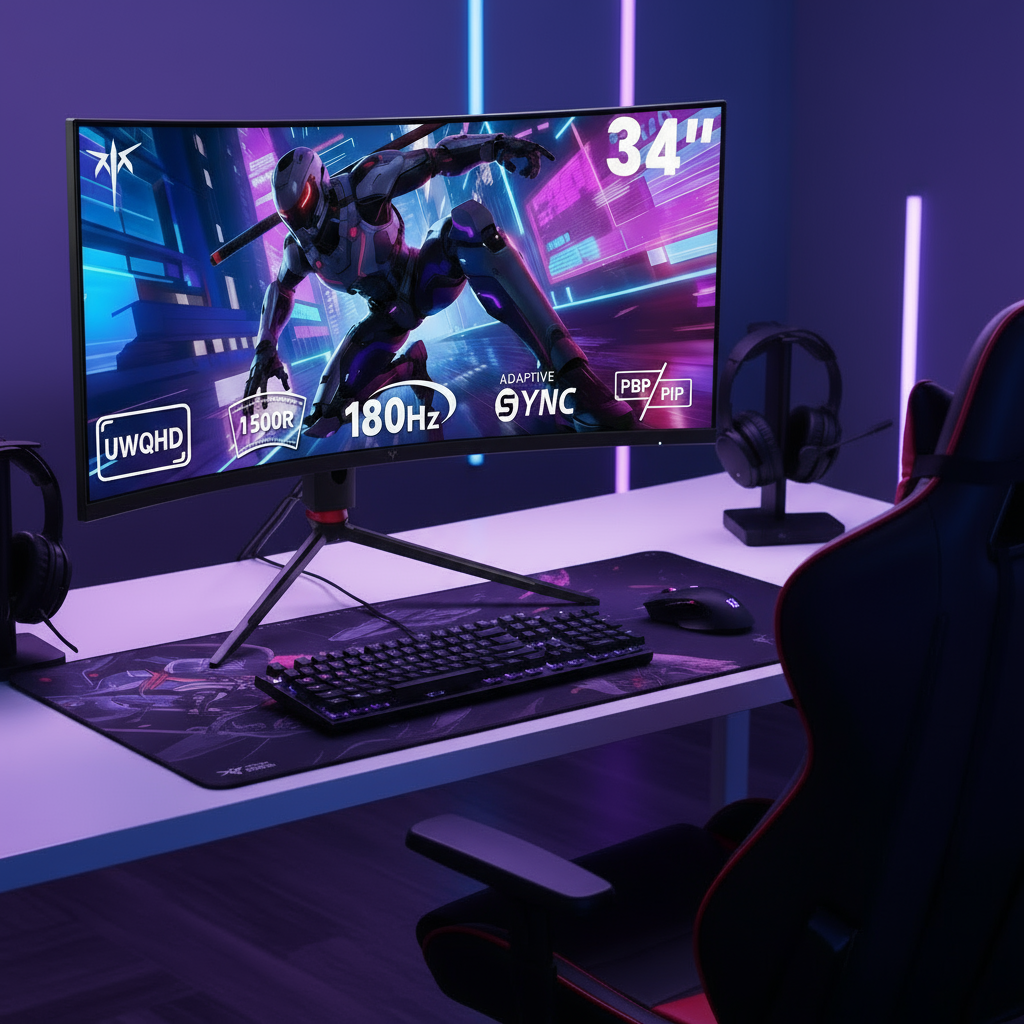


Mini-LED monitors often use more standby power because they keep more support electronics awake, even when the panel looks off.
You close your game, the screen goes dark, and the monitor’s LED changes color, so it feels like power use should be almost zero. In practice, some monitors sit well under 0.5 W in standby, while others can stay far higher because of backlight control hardware, wake features, and signal handshakes. This breakdown shows why that happens, which monitor types are most likely to do it, and what to check before you buy.
Standby Does Not Mean Every Monitor Is Sleeping the Same Way
The power light can hide very different internal states
Modern monitors do not all treat standby the same way. One widely cited breakdown describes four states, from fully on to standby, sleep, and off, and notes that standby can keep more electronics active while sleep may leave only a small signal-detection circuit running standby power ranges. That matters for buyers comparing a basic office LCD with a high-end gaming monitor, because the same “screen is black” result can come from very different internal behavior.
For many conventional LCD monitors, published sleep or standby figures are low enough to look trivial on a spec sheet. Examples in the same discussion include modern displays rated below 0.5 W, with some around 0.3 W to 0.45 W. That is the baseline most buyers expect from a traditional edge-lit LCD: minimal always-on circuitry, modest wake logic, and no large lighting system that needs complex zone management.
Mini-LED adds control layers, not just brighter HDR
A Mini-LED monitor is still an LCD, but its backlight uses many more, much smaller LEDs with local dimming control. That design improves HDR highlights, black levels, and contrast, especially in gaming monitors and premium ultrawides, but it also means more driver circuits, more control logic, and more power-management states to coordinate.

The key point is simple: when a monitor is designed to manage hundreds or thousands of backlight elements during active use, it often has a more complex electronics stack even when idle. Standby power is not about the liquid-crystal layer itself. It is about how much of the monitor’s power board, scaler, input detection, a port-based feature set, and backlight-control system remains partially active so the display can wake quickly and preserve convenience features.
Why Mini-LED Designs Tend To Start From a Higher Power Baseline
Backlights and control boards are the main reason
In LCD systems, backlight power usually dominates overall display consumption, while the panel-driving portion is comparatively small. That principle comes from embedded LCD design, but it maps cleanly to desktop monitors: once you add a more capable backlight, power behavior depends less on the liquid crystal itself and more on the hardware controlling light output.
Mini-LED monitors also target much higher brightness than standard office displays. A high-brightness monitor can use two to three times the power of a standard monitor in active use, and the relationship between brightness and power is non-linear. Even though standby shuts the visible image off, the same product class usually carries beefier power stages, thermal management, and smarter controllers, all of which can raise the idle floor if the monitor is designed for fast wake and feature retention.
Premium monitor features keep more subsystems alive
A Mini-LED gaming monitor typically combines several power-hungry traits at once: high refresh rates, high peak brightness, 4K resolution, and local dimming. One review noted that models with these specs can have very high active draw, including a model from a brand rated at 139 W average and other premium displays listed even higher. That does not prove the same numbers in standby, but it does show these displays are built around larger power budgets and more elaborate internal hardware than a basic LCD.
That complexity matters because standby is rarely a pure “nothing is running” state on enthusiast monitors. If the monitor keeps its scaler ready for fast signal lock, preserves charging functions, supports input-switching features, or monitors a display interface path for wake events, power use can sit well above what buyers expect from a simple LCD that only has to blank the screen and wait.
Why Some Gaming and Ultrawide Monitors Stay Surprisingly High in Standby
Real-world cases show standby can go far above the spec sheet
The clearest cautionary example is a monitor standby case, where one owner measured about 23 W after an operating system put the monitor to sleep. The same user reported that turning the monitor fully off and back on dropped standby to about 2 W or under 1 W, and support staff from a company suggested the display might still be maintaining a display interface handshake. A later replacement unit improved the behavior to about 3 W in operating-system-initiated soft standby.

That example is not a Mini-LED monitor, but it proves an important buying lesson: standby power can be driven as much by signal management and firmware behavior as by panel type. For high-end gaming monitors, ultrawide monitors, and creator displays with more ports and more always-on features, the monitor may remain semi-active to maintain convenience. When users say a monitor “uses power while off,” this is often what they mean.
High refresh mode can also raise the surrounding idle cost
On high-refresh displays, the monitor is only part of the picture. One high-refresh power analysis found that raising refresh rate increased the monitor’s own power by only about 1 W in one lab test, but total system idle rose by roughly 57 W because the graphics card left low idle clocks. For buyers, that means the “hidden cost” of a premium display can come from the monitor and the connected PC together.
This is especially relevant for 240 Hz, 360 Hz, and 500 Hz gaming monitors. Even if your Mini-LED display has acceptable standby behavior, leaving the desktop in a high-refresh mode can still raise whole-system idle use. The practical takeaway is that premium displays often come with stacked power behaviors: higher active brightness, more complex standby electronics, and PC-side idle penalties from aggressive desktop settings.
How Traditional LCDs Usually Compare
Simpler edge-lit designs often sleep more efficiently
A traditional LCD versus LED-backlit LCD comparison highlights that the main difference is the backlight system. Older CCFL-lit LCDs were bulkier and less efficient, while LED-backlit designs improved power use significantly. Within today’s monitor market, the simplest edge-lit LED LCDs still tend to have the easiest job in standby: they have fewer lighting components, lower peak brightness targets, and less need for advanced dimming control.
That is why many standard office monitors, mainstream 24-inch to 27-inch displays, and basic portable monitors can hit very low standby numbers. A 27-inch LED monitor in power-saving mode is commonly described at about 0.5 W to 1 W in standby, which is more than a 95% reduction versus active use. That is the benchmark many shoppers assume applies to every monitor, but it is more typical of simpler displays than of feature-heavy HDR gaming models.
The size of the annual cost depends on how bad standby actually is
When standby stays around 0.45 W, the annual savings from switching a monitor fully off instead of leaving it in standby can be small. One example estimate put that at roughly 3.1 kWh per year, or about $0.40 annually at $0.13 per kWh. That is not enough to drive a buying decision by itself.
The math changes quickly when a monitor behaves more like a soft-idle device than a true low-power sleeper. A workplace standby example using 5 W per monitor shows how fleets of screens can exceed 2,000 kWh per year. For an individual buyer, that means a difference between 0.5 W and 5 W is not cosmetic. Over nights, weekends, and travel days, it becomes meaningful, especially if you run multiple monitors.
What To Check Before Buying a Mini-LED Gaming Monitor or Ultrawide
Compare more than the active power number
Manufacturer monitor power figures are often inconsistent, and power ratings can be cryptic. Some brands publish average numbers, some publish maximum numbers, and some appear to quote eco-mode figures without making the test settings obvious. For Mini-LED buyers, that makes standby behavior even harder to predict from the product page alone.
If you are shopping for a gaming monitor, ultrawide monitor, or portable monitor dock setup, check four things: the published standby or active-off rating, whether charging stays on while the screen sleeps, whether the display includes a built-in hub or input-switching feature, and whether reviews mention wake quirks over a display interface or a multifunction port. Those support features are useful, but they are also the most likely reason a dark screen still draws more power than expected.
Use this quick buying framework
Monitor type |
Typical standby expectation |
Why standby may rise |
Best use case |
Basic edge-lit LCD |
About 0.3 W to 1 W |
Simple signal detection only |
Office work, secondary displays |
High-refresh LCD gaming monitor |
Often low, but can vary |
Fast wake, scaler readiness, graphics-related desktop settings |
Competitive gaming |
Mini-LED gaming monitor |
Often higher risk of elevated standby |
Local dimming control, brighter power system, charging or switching features |
HDR gaming, mixed work and play |
Ultrawide premium monitor |
Often varies widely by firmware and ports |
More inputs, hub features, signal handshakes |
Multitasking, sim racing, creator setups |
Portable monitor with multifunction power/video input |
Usually low, but depends on pass-through features |
Power delivery, always-on charging, dock behavior |
Travel, laptop dual-screen setups |
Treat the table as a screening tool, not a guarantee. If standby efficiency matters to you, a simple monitor with fewer extras is still the safest bet. If HDR impact matters more, Mini-LED can be worth it, but you should assume more standby variability and verify the actual behavior after setup.
How To Cut Standby Power Without Giving Up Monitor Performance
Start with settings, then test with a plug-in meter
A plug-in power meter measurement approach is still the fastest way to separate marketing from reality. Measure the monitor when it is on, when the PC puts it to sleep, and when the monitor’s own power button is used. If those numbers are far apart, the issue is usually not “Mini-LED is bad” in the abstract. It is that your current standby path leaves too many subsystems awake.

Useful adjustments are consistent across monitor categories. A power-saving mode guide recommends short screen-off timers, and the high-refresh tuning advice suggests lowering brightness, using an energy-saving mode when suitable, enabling adaptive sync, and checking wall-power at different refresh rates. On premium monitors, also look for settings that disable always-on charging, fast startup, or deep sleep restrictions.
Full off still wins for long idle periods
A standby-avoidance recommendation makes sense when you will be away overnight, over a weekend, or during travel: switch the monitor fully off instead of leaving it in standby. That is especially true for dual-monitor and triple-monitor gaming desks, where even small standby differences add up across multiple displays.
For everyday use, the best compromise is usually this: let the monitor enter sleep during short breaks, but power it fully off when you are done for the day. That preserves convenience when you need it and avoids paying for hours of unnecessary standby on hardware designed for bright HDR peaks, high refresh rates, and lots of attached-device features.
FAQ
Q: Do Mini-LED monitors always use more standby power than traditional LCDs?
A: No. Some can still achieve very low standby figures, but Mini-LED models are more likely to vary because they often include more backlight control hardware, higher-power boards, and more always-on features than a simple edge-lit LCD.
Q: Is high standby power caused by Mini-LED itself or by gaming features?
A: Usually both can contribute. Mini-LED adds backlight-control complexity, while gaming-oriented extras like 240 Hz or 360 Hz modes, hubs, switching functions, and fast wake behavior can keep more electronics partially active.
Q: Should I avoid Mini-LED if I care about energy use?
A: Not necessarily. If you want stronger HDR, higher brightness, and better contrast than a standard LCD, Mini-LED can still be a smart buy. The better move is to verify standby behavior, disable unnecessary always-on features, and fully power the monitor off during long idle periods.
Final Takeaway
Mini-LED monitors tend to use more standby power than traditional LCDs because they are built around more complex lighting and support electronics, not because the dark screen itself needs energy. For buyers, the practical rule is straightforward: the more your monitor promises in HDR brightness, local dimming, refresh rate, port convenience, and instant wake behavior, the more carefully you should verify what “standby” really means on that model.
References
- a platform: monitor standby power discussion
- a brand: high-refresh-rate monitor power consumption
- a company community: monitor standby draw case
- a company blog: stop using standby for monitors
- a brand: monitor power-saving mode
- a company: LCD power consumption fundamentals
- a company: energy efficiency in high-brightness monitors
- a company: monitor power consumption and buying context
- a company: LCD vs. LED monitor differences
- a brand: Mini-LED monitor overview