Overdrive can make motion look sharper by forcing pixels to change faster, but pushing it too hard causes inverse ghosting: bright, dark, or colored halos around moving objects. The best setting is usually the fastest mode that stays visually clean at your actual refresh rate and frame rate.
Is your crosshair sharp when you flick, but enemy outlines leave a pale glow behind them? A quick pass through low, medium, and high response-time modes can reveal whether your monitor is truly getting faster or just trading blur for artifacts. You’ll leave with a practical tuning method for gaming monitors, office displays, and portable screens.
What Overdrive Actually Changes
Overdrive is a monitor setting designed to reduce pixel response time, which is the time it takes a pixel to move from one color or brightness state to another. On LCD monitors, that usually means the display applies a stronger voltage push to help liquid crystals transition faster.
The benefit is straightforward: if pixels finish their transition before the next refresh arrives, moving objects look cleaner. A 60Hz monitor refreshes about every 16.67 ms, while a 144Hz monitor refreshes about every 6.94 ms, so faster screens demand faster pixel behavior. Response time overdrive exists because a high refresh rate alone cannot fully fix slow pixel transitions.
In real use, this is why a 144Hz office monitor can feel smooth on the desktop but still smear dark text while scrolling, or why a 240Hz esports display can look crisp in one mode and strangely outlined in another. Refresh rate controls how often the screen updates; overdrive controls how cleanly each pixel gets there.
Response Time vs. Ghosting vs. Inverse Ghosting
Ghosting refers to visible trails left behind moving objects when pixels change too slowly. It often appears as soft blur, dark smearing, or a shadow-like trail behind a player model, mouse cursor, scrolling text, or fast camera pan.
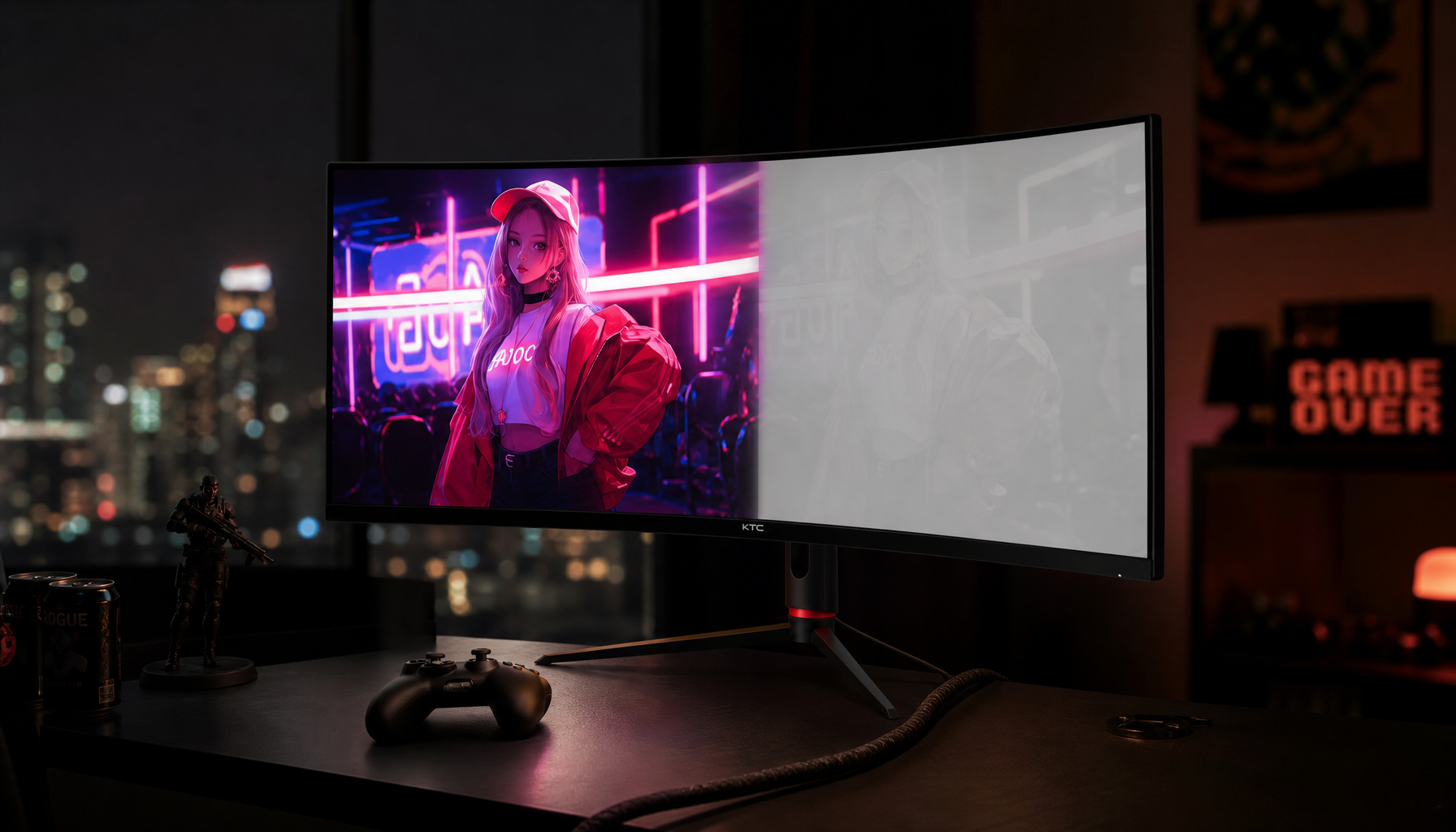
Inverse ghosting is the opposite failure mode. Instead of lagging behind the target shade, the pixel overshoots it and then settles back. That overshoot can create pale halos, dark outlines, purple fringes, or a “corona” around motion. The image may technically measure faster, but it looks worse because the monitor is pushing transitions too aggressively.
That distinction matters when you’re tuning a display. If a moving test object has a soft tail behind it, overdrive may be too weak. If the object has a bright or colored edge ahead of or around it, overdrive is probably too strong. For a competitive FPS player, the second problem is often more distracting because it can make targets look artificially outlined or doubled during quick turns.


Why the Highest Overdrive Mode Often Looks Worse
Monitor makers often label overdrive with friendly names rather than technical values. Depending on the display, it may appear under terms such as response time, overdrive, or motion acceleration. The trap is that “Fastest,” “Extreme,” “Premium,” or “Super Fast” does not always mean best.
Too much overdrive can cause overshoot because the pixel is driven past the intended shade. On a spec sheet, the most aggressive mode may help produce a lower advertised gray-to-gray number, but real viewing quality depends on both speed and accuracy. A monitor that hits a claimed fast transition with obvious halos is not giving you cleaner motion.
A practical example is scrolling white text on a dark gray background. With overdrive off, the text may smear softly. With medium overdrive, it may become easier to read. With extreme overdrive, the text may gain purple, green, or white fringes. In that case, medium is the performance setting, even though extreme sounds more powerful.
Setting Style |
Likely Motion Result |
Common Risk |
Best Use |
Off or Low |
Less overshoot, more blur |
Ghosting and smearing |
Reading, office work, slower games |
Medium or Normal |
Balanced clarity |
Minor artifacts on some panels |
Most gaming and mixed use |
High or Fast |
Sharper motion at high refresh |
Visible inverse ghosting |
Competitive play if clean |
Extreme or Fastest |
Lowest advertised response |
Halos, coronas, colored trails |
Only when testing proves it clean |
How Refresh Rate and Frame Rate Change the Right Setting
Overdrive is not a one-time universal switch. The cleanest setting at 240Hz may not be clean at 60Hz, and the best mode for a steady esports title may not work as well in a cinematic game where frame rate swings constantly.
Adaptive sync and VRR can make this more complicated because the display refresh rate follows the GPU frame output. When the frame rate drops, aggressive overdrive may become more visible because pixels have a different timing window. This is why a monitor can look great at a locked 165 FPS but show halos when a game dips to 80 FPS.
Variable overdrive is the premium solution. Instead of applying one fixed push at every refresh rate, the monitor adjusts overdrive behavior dynamically. If your monitor has true variable overdrive, you can usually run a stronger setting with fewer compromises. If it only has fixed overdrive, tune for the frame-rate range you actually use, not the maximum number printed on the box.
For example, a portable 144Hz screen used with a laptop GPU may spend most demanding games between 70 and 110 FPS. In that case, the cleanest “Normal” or “Fast” mode at those frame rates is more valuable than an “Extreme” mode that only looks acceptable near 144 FPS.
Panel Type Matters More Than Marketing Names
IPS, VA, TN, and OLED displays do not respond the same way. IPS gaming monitors often have a usable middle overdrive mode and sometimes a clean faster mode at high refresh rates. TN panels can be quick, though they are not immune to overshoot. VA panels can deliver excellent contrast, but dark transitions are often harder to control, which can show up as black smearing or overdrive artifacts.
VA panel ghosting is especially noticeable during fast motion because dark shades may transition more slowly than brighter ones. That is why a VA screen can look rich and immersive in a single-player RPG but show dark trails in a competitive shooter or while scrolling high-contrast text.
OLED is different. Many OLED monitors do not expose traditional LCD-style overdrive because their pixel response behavior is already extremely fast. On OLED, motion tuning usually shifts toward refresh rate, VRR behavior, black frame insertion, brightness, and burn-in care settings rather than an LCD overdrive slider.
How to Tune Overdrive Without Guessing
Start with the monitor’s default or middle response-time setting. Then test motion that resembles what you actually do: a fast shooter, a racing game, a sports broadcast, a scrolling spreadsheet, or a browser page with dark text and mixed backgrounds. The goal is not to find the most aggressive mode; it is to find the highest clean mode.

Ghosting tests are useful because they make trails, coronas, and text clarity easier to compare while settings change. Keep the same refresh rate, brightness, and game frame-rate cap during comparison so you are judging overdrive rather than several variables at once.
If you see soft trails, raise overdrive one step. If you see glowing edges, colored outlines, or a hard duplicate image, lower it one step. If both blur and inverse ghosting are visible, your panel may simply have a narrow sweet spot; choose the mode with fewer distracting artifacts for your main use.
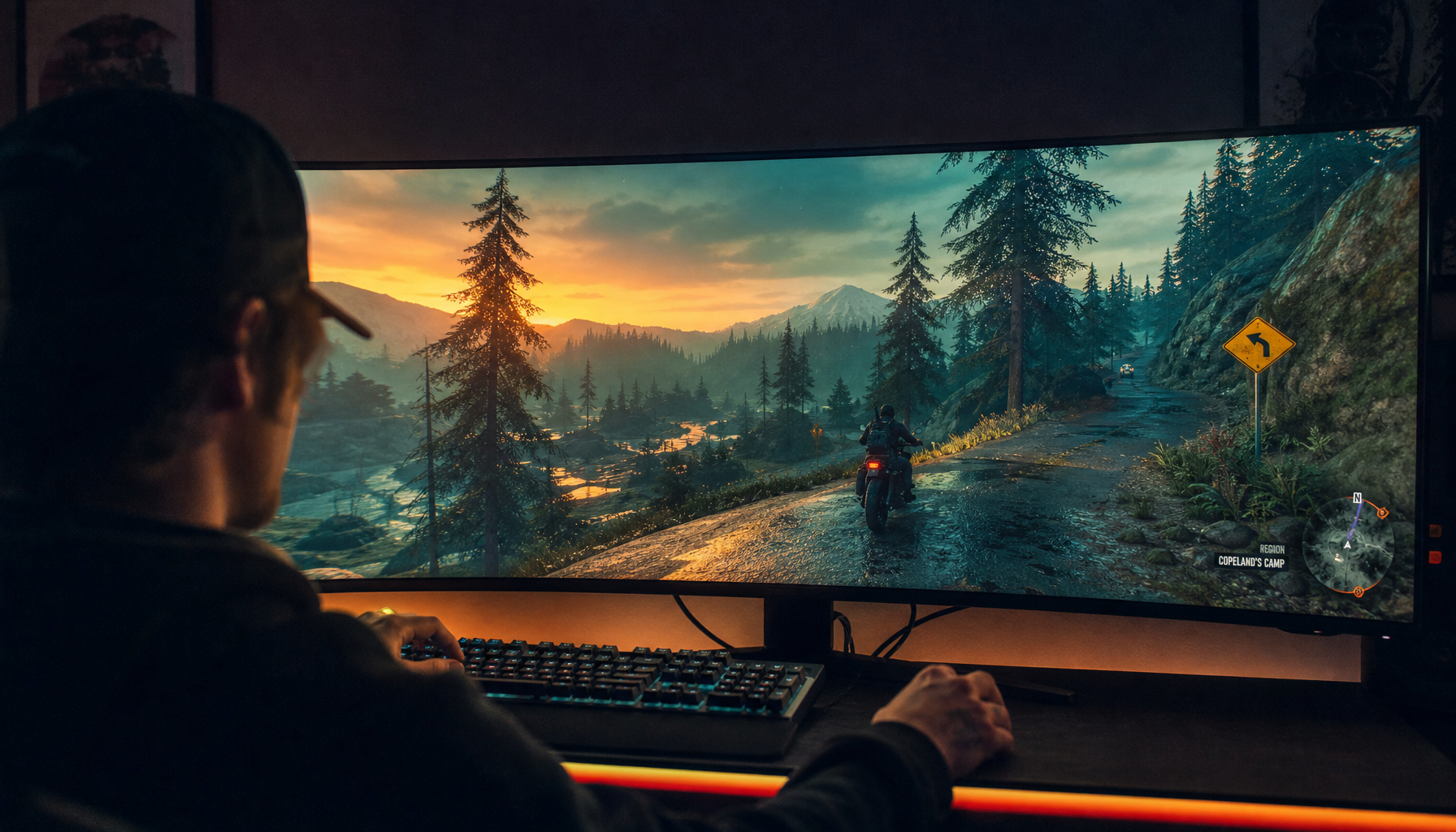
For gaming, test at your real frame rate. If you cap competitive shooters near 240 FPS, tune there. If your story games run between 70 and 100 FPS with VRR, tune there. For office productivity, drag a window over text, scroll a document, and move the mouse across light and dark backgrounds. A setting that looks great in a benchmark but makes spreadsheet text shimmer is not a reliable daily mode.

When Lowering Contrast Can Help
There is one advanced tuning nuance worth knowing for blur-reduction and strobing users. Forum testing describes reducing the digital color range through GPU brightness and contrast controls to avoid the brightest output extremes, where some overdrive artifacts are most visible. This can reduce coronas or crosstalk on certain displays, especially when using strobing or blur-reduction modes.
The tradeoff is image quality. Lowering digital contrast can flatten the picture, reduce color accuracy, and make the display less satisfying for desktop work, photo editing, and HDR content. This is a specialist move for motion clarity, not a universal setup step.
A practical way to approach it is to first choose the least-bad overdrive mode, then only experiment with GPU-side brightness and contrast if strobe crosstalk or coronas remain unacceptable. For most users, especially on office displays and portable monitors, staying with a moderate overdrive preset is cleaner and more predictable.
Pros and Cons of Using Overdrive
Overdrive’s biggest advantage is sharper motion. In fast games, it can make strafing enemies, road edges, puck movement, or scrolling maps easier to follow. It can also make a lower-cost monitor feel more responsive when the default pixel tuning is conservative.
The downside is that overdrive has a narrow performance window. Too little leaves traditional ghosting; too much creates inverse ghosting. It can also behave differently at 60Hz, 120Hz, 144Hz, 240Hz, or under VRR. Portable monitors and laptop-connected displays may show a small power impact, but the main concern is visual quality, not lifespan.
The reliable rule is simple: use overdrive when motion clarity matters, but do not worship the fastest label. For general office work, reading, coding, writing, and static dashboards, Off, Low, or Normal may be more comfortable. For gaming, Normal or Fast is usually the first serious test point, while Extreme needs proof before it earns a place.
Recommended Settings by Use Case
Use Case |
Starting Point |
What to Watch For |
Competitive FPS at high FPS |
Fast or Medium |
Halos around targets during flicks |
Racing and sports games |
Medium or Fast |
Trails behind high-contrast objects |
Console gaming at 60Hz or 120Hz |
Normal or Low |
Overshoot in darker scenes |
Office work and scrolling text |
Off, Low, or Normal |
Colored fringes around letters |
Portable smart screen use |
Normal |
Battery impact and text clarity |
VA gaming monitor |
Normal first |
Black smearing or purple trails |
VRR gaming with frame-rate swings |
Medium unless variable overdrive is strong |
Artifacts during FPS drops |
FAQ
Should overdrive be on or off?
For gaming and fast video, overdrive should usually be on at a moderate level. For office work, reading, or any display that shows colored trails with overdrive enabled, Off or Low may look cleaner.
Does overdrive reduce input lag?
Overdrive primarily affects pixel transition speed, not the full input-to-image chain. It can make motion look clearer, which may help you visually track action, but it is not the same as reducing controller, mouse, GPU, or processing latency.
Is inverse ghosting harmful to the monitor?
Inverse ghosting is a visual artifact, not a sign that the panel is being damaged in normal use. The practical fix is to lower the overdrive setting until the halos disappear or become less distracting than the original blur.
Why does my monitor advertise 1 ms but still ghosts?
The advertised response time may apply only to a specific transition, test method, or aggressive overdrive mode. Real motion quality depends on many transitions across dark, midtone, and bright shades, plus overshoot behavior at your refresh rate.
Final Calibration Mindset
Treat overdrive as a precision control, not a speed badge. The winning setting is the one that keeps motion readable without halos at the frame rates you actually use, whether that is a 240Hz esports monitor, a color-rich office display, or a portable smart screen connected to a laptop.