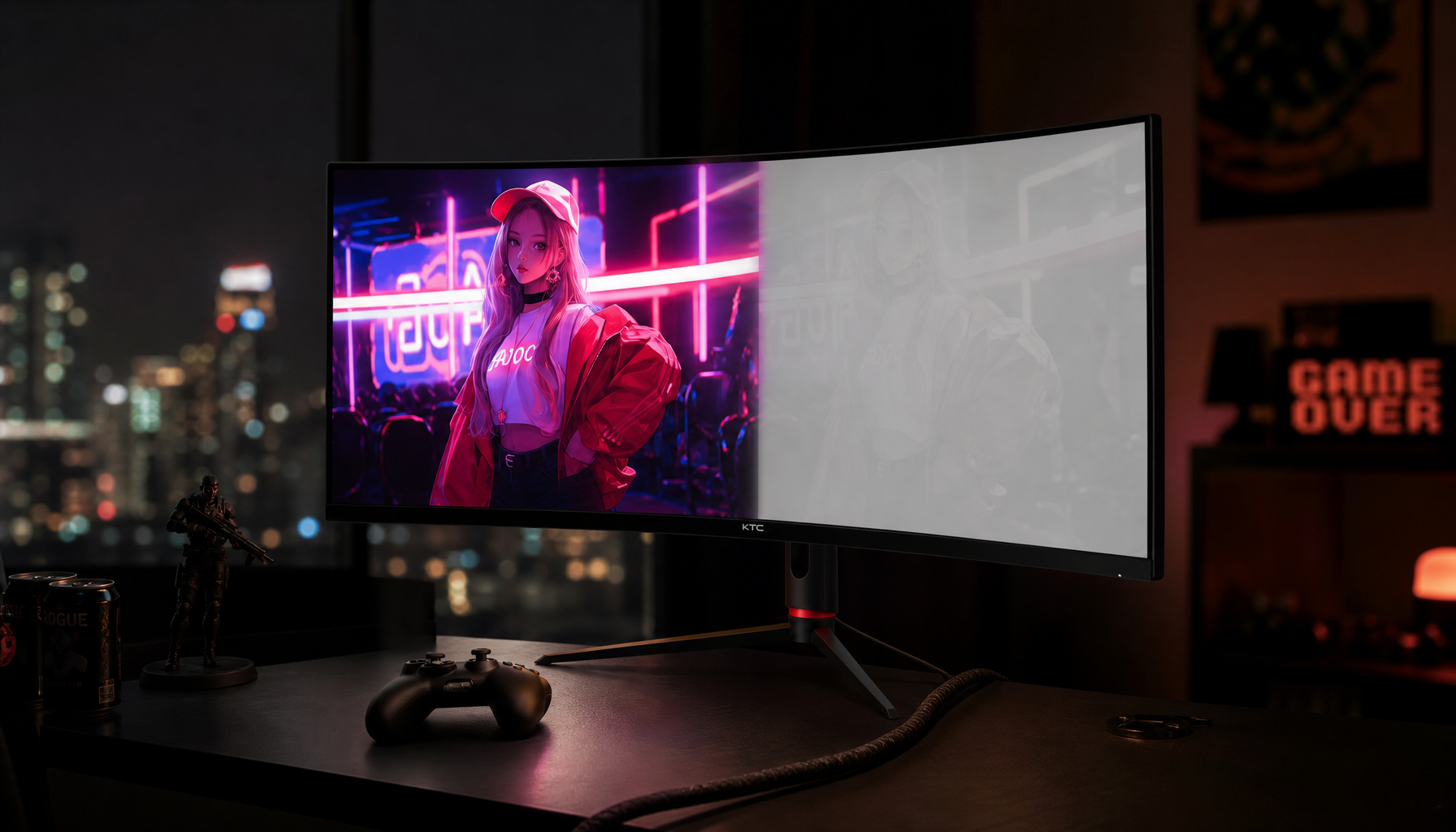
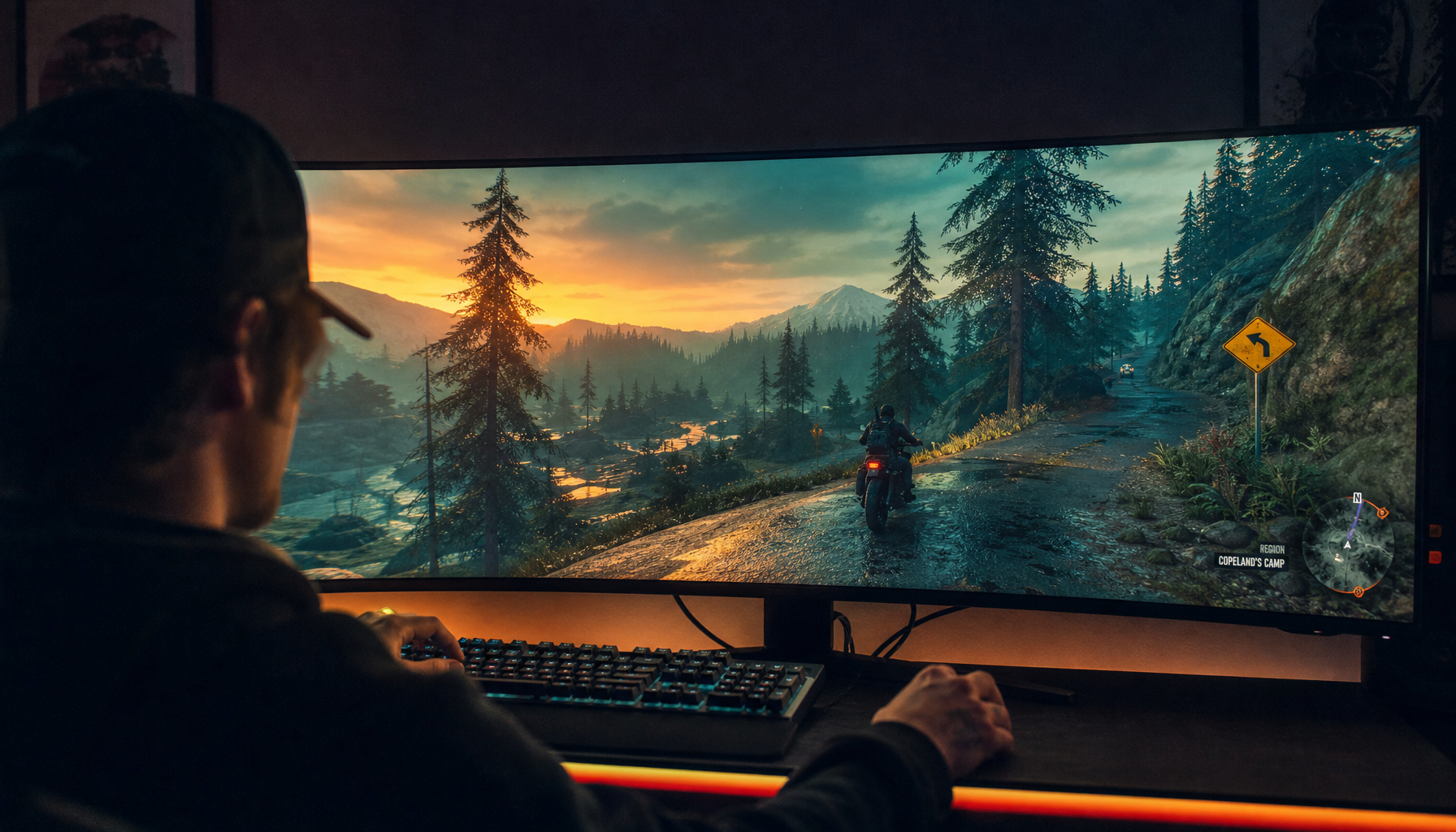
Viewing angle changes how deep blacks look and how much contrast your eyes perceive, even when the monitor’s settings have not changed. The farther you sit off-center, the more panel type, screen size, glare, and room lighting determine whether dark scenes stay rich or turn gray.
Does the corner of your ultrawide look washed out while the center still looks punchy? A simple 45-degree side check, paired with a centered seating adjustment, can quickly reveal whether the issue is panel behavior, room reflections, or desk distance. You’ll learn how viewing angle affects black levels, which panel types handle it best, and how to set up a display for more consistent gaming, editing, and office work.
Why Viewing Angle Changes Black Level and Contrast
Viewing angle is not just about whether you can still read the screen from the side. For LCD and OLED displays, it describes how well brightness, color, and contrast hold up as your eyes move away from the screen’s center line. A common LCD claim such as 178-degree viewing angle sounds generous, but viewing angle often means the image remains barely acceptable by a contrast threshold, not that blacks and colors look identical from every seat.
Black level is the brightness of a screen when it is supposed to show black. Contrast is the relationship between dark and bright parts of the image. When you sit off-axis, light leakage, crystal alignment, polarizers, reflections, and panel coating can change the amount of unwanted light reaching your eyes. The result is familiar: a black game loading screen becomes charcoal gray, a movie’s letterbox bars look uneven, or spreadsheet gridlines lose separation near the edges.
In practical use, contrast perception matters more than the number printed on the box. A monitor can advertise strong native contrast yet still look weaker from a side chair or at the far edges of a 49-inch screen. That is why a front-facing spec should never be treated as a full-room guarantee.
Panel Type: IPS, VA, TN, and OLED Behave Differently
Panel technology is the biggest predictor of off-angle black consistency. IPS usually keeps color and brightness more stable across wide angles, which is why it remains a strong choice for office productivity, creative review, shared screens, and multi-monitor layouts. The tradeoff is that many IPS panels have moderate native contrast, often around the 1,000:1 class, so blacks may look less deep than VA or OLED in a dark room.
VA panels usually deliver stronger front-facing contrast and deeper blacks than IPS, making them attractive for cinematic games, movies, and value-focused large monitors. The weakness is that VA can lose contrast and shadow separation more visibly from the side. If you sit centered, VA can look bold and immersive; if you share the screen with someone sitting off to the side, the same dark image may look flatter.
TN panels are fast and inexpensive, but they are the weakest fit when black-level consistency matters. Panel comparisons often note that IPS LCD panels preserve contrast and color far better off-axis than TN, where vertical shifts can cause obvious dark-to-light inversion. That makes TN difficult to recommend for large displays, vertical monitors, shared workstations, or visual judgment.
OLED is the black-level champion because each pixel can turn off independently. That creates effectively perfect black in a controlled room, with excellent perceived contrast. However, OLED is not immune to real-world viewing problems. Reflections, glossy coatings, room light, automatic brightness behavior, and static UI burn-in risk can affect the ownership experience, especially for office dashboards and long editing sessions.
Panel Type |
Black Level Strength |
Off-Angle Consistency |
Best Fit |
Main Tradeoff |
IPS |
Moderate |
Strong |
Office work, design, shared viewing |
Blacks can look gray in dark rooms |
VA |
Strong |
Moderate |
Movies, immersive gaming, value ultrawides |
Side-angle contrast loss |
TN |
Weak to moderate |
Weak |
Budget or niche speed-first use |
Color and contrast shift quickly |
OLED |
Excellent |
Strong |
HDR, dark games, cinema, premium media |
Cost, reflections, burn-in risk |
Why Large and Ultrawide Screens Expose the Problem Faster
Viewing angle issues are not only caused by sitting off to the side. On a large flat monitor, your eyes naturally view the left and right edges at an angle even when your chair is centered. This is why a 32-inch or 49-inch display can show darker or lighter edges than the middle, especially with VA or TN panels.
A 49-inch ultrawide is often equivalent to two 27-inch QHD monitors side by side, so the outer edges sit far from your center line. For that format, a 49-inch monitor is best treated as a wide workspace that needs proper desk depth and viewing distance, not just a bigger screen. If you sit too close, the edges become more off-axis, and contrast inconsistency becomes easier to see.

Curvature helps here. A curved ultrawide brings the sides of the panel closer to a consistent viewing angle, which can improve perceived uniformity and immersion. For productivity-heavy work, a gentler curve can feel more natural for spreadsheets and timelines. For racing, flight sims, and wide game worlds, a stronger curve can help the scene wrap into your field of view without forcing your eyes to fight the edges.
Black Level Consistency Is Also a Room Problem
A monitor’s black level is physical, but your perception of black is environmental. Bright overhead lights, windows, glossy desks, and pale walls can raise perceived black level by adding reflections and glare. In a bright office, even an OLED black can look less dramatic if the panel reflects the room.
A monitor hood is one practical fix for editing and color-sensitive work because ambient light can interfere with perceived color, brightness, and contrast. The same logic applies to gaming and office setups. If a dark scene looks washed out during the day but improves at night, the display may not be the core problem. The room is lifting the blacks your eyes perceive.
For a quick test, open a dark image or black screen, then turn off nearby lamps and move any bright window reflection away from the panel. If the black level immediately improves, prioritize light control before replacing the monitor. Matte coatings, blinds, bias lighting behind the screen, and a more neutral desk setup can all make contrast feel more stable.
The 45-Degree Test: A Simple Way to Judge a Monitor
A practical field test is to view the monitor from straight on, then move about 45 degrees to the side while keeping the same image on screen. Use a dark movie scene, a black desktop background with white text, or a game menu with shadow detail. If the blacks brighten heavily, colors wash out, or shadow detail collapses, the panel is not holding contrast well off-axis.

This test is especially useful before buying a monitor in person. The best target zone is not the extreme angle printed on the spec sheet. It is the real zone where you sit, lean, share the screen, or look at the edges during daily work. For meeting rooms and interactive displays, IPS panels are often favored because they maintain more stable brightness and contrast across common seating positions.
For home and desk use, repeat the test vertically. Lower your head slightly, then raise it above the screen. TN panels often reveal problems quickly here, while IPS and OLED tend to remain steadier. VA usually performs better than TN but can still show gamma and black-level shifts depending on the specific panel.
Choosing the Right Display for Your Use Case
For competitive gaming, prioritize fast response, refresh rate, and centered seating first. A high-refresh IPS monitor can be a balanced pick because it combines speed with strong viewing-angle stability. VA can be excellent for story-driven games and cinematic contrast, but check dark-level smearing and side-angle behavior before committing. OLED is the premium route when deep blacks, HDR punch, and motion clarity matter most.
For office productivity, the best display is often the one that keeps text and contrast stable across your normal posture changes. Monitor buying guidance consistently points out that panel type affects color, contrast, viewing angles, and motion behavior. If you use spreadsheets, dashboards, documents, and video calls for hours, IPS is usually the reliable value choice. VA can work well if you sit centered and want deeper blacks for after-hours media.
For creators, the decision is more nuanced. IPS is still the safer reference choice for predictable calibration, print work, and long static editing sessions. OLED gives superior blacks and contrast for HDR video, dark-scene grading, and client preview, but it can make shadows look richer than they will appear on typical office displays. A disciplined workflow uses calibration, stable lighting, and sometimes a second reference screen.
Portable monitors need extra caution because their viewing environment changes constantly. A slim travel display can be productive, and portable monitor designs are built around easy transport with a laptop, but hotel lamps, cafe windows, and cramped desk angles can make black levels feel inconsistent. For portable work, prioritize matte finish, brightness flexibility, and IPS-like viewing stability over dramatic contrast claims.

Setup Adjustments That Improve Perceived Contrast
Start by centering your chair with the screen. Your eyes should land near the center of the panel, with the top of the display around eye level or slightly below. If you use a large monitor, move back enough that you can see the full screen without turning your head. For many desk setups, that means roughly 2 ft to 2.5 ft for larger displays, and more for 49-inch ultrawides.
Next, reduce direct reflections. A window behind you can do more damage to black perception than a modest contrast-ratio difference between two panels. Angle the monitor away from light sources, use blinds during bright hours, and avoid glossy objects near the screen. If you work in dim rooms, soft bias lighting behind the monitor can reduce eye strain and make blacks feel more comfortable without crushing shadow detail.
Finally, use the correct picture mode. Vivid, FPS, racing, and movie modes often raise brightness, alter gamma, or boost contrast aggressively. That can make games pop, but it can also hide whether the panel is truly consistent. For judging black levels, start with sRGB, standard, creator, or a calibrated custom mode. Then tune brightness for your room instead of chasing maximum luminance.
Pros and Cons of Wide Viewing Angle Displays
Wide viewing angle displays are valuable because they keep the image usable and more consistent as you move. For shared work, presentations, creative review, and large screens, that stability reduces posture changes and makes the display feel more trustworthy. Industrial and professional display makers emphasize that wide viewing angle displays help preserve clarity, contrast, brightness, and color accuracy from multiple positions.
The downside is that wide viewing angle alone does not guarantee deep blacks. IPS may stay consistent but still look less rich in a dark room than VA or OLED. OLED may deliver unmatched blacks but cost more and require care with static content. VA may look superb head-on but less consistent from the side. The right choice is not the widest number; it is the best match between panel behavior, room lighting, screen size, and how you actually sit.
FAQ
Does a 178-degree viewing angle mean blacks stay perfect from the side?
No. It usually means the screen remains viewable under a defined contrast threshold. It does not mean black level, gamma, color, and brightness remain identical at extreme angles.
Why do my monitor edges look lighter than the center?
On large flat screens, the edges are naturally viewed off-axis. IPS glow, VA gamma shift, backlight uniformity, and room reflections can all make edges look lighter, especially on dark content.
Is OLED always better for black levels?
For pixel-level black, yes. OLED can turn pixels off completely. In real rooms, reflections, brightness behavior, and burn-in considerations still matter, so OLED is best when your use case justifies the cost and care.
Should I choose VA or IPS for contrast?
Choose VA if you sit centered and want deeper blacks for movies or immersive games. Choose IPS if you need more consistent contrast and color across angles, shared viewing, productivity, or creative work.
Black-level consistency is not a single spec; it is the combined result of panel type, viewing angle, screen size, room light, and setup discipline. Sit centered, control reflections, test from real positions, and choose the panel whose weaknesses you can live with every day.