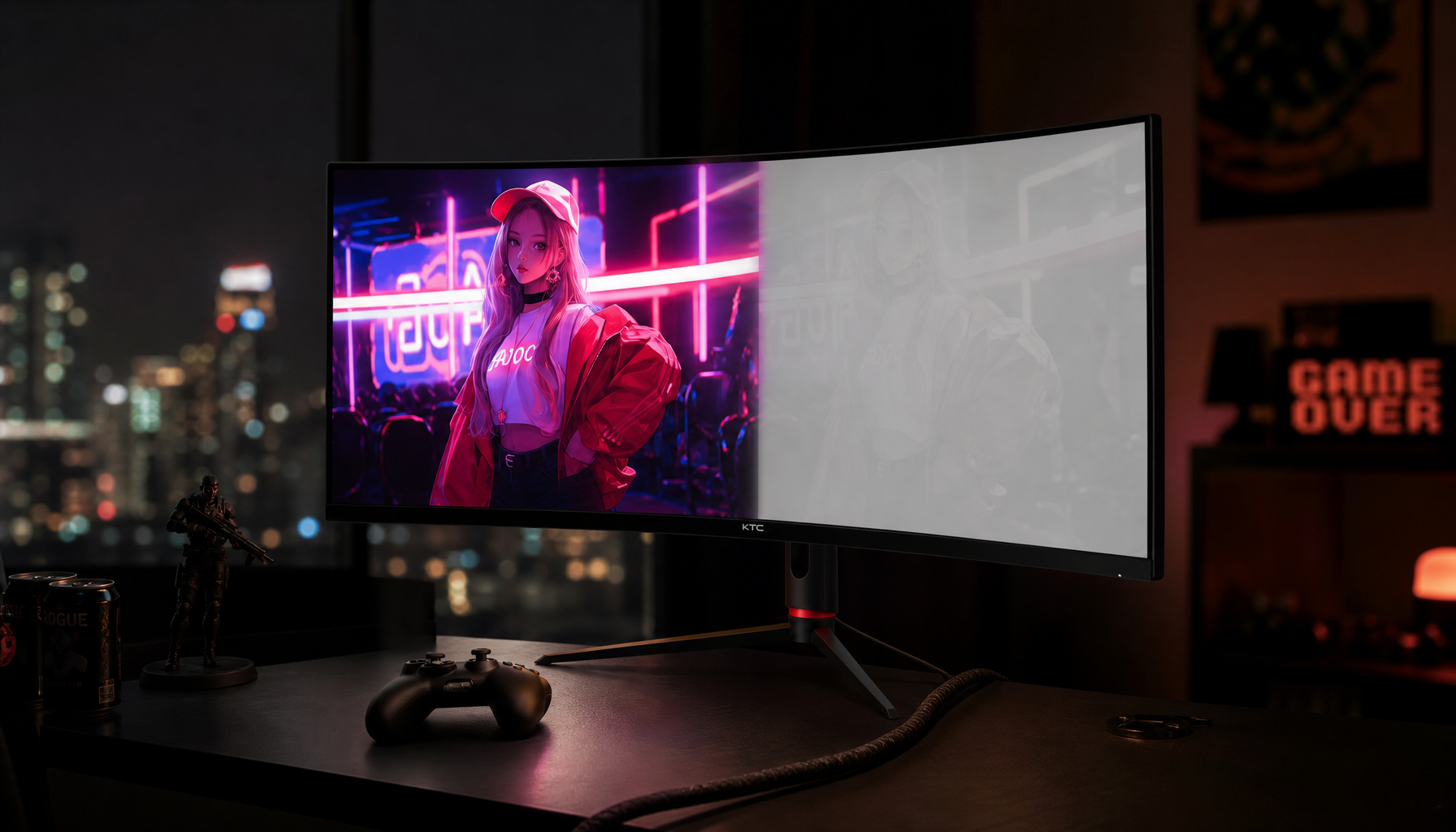
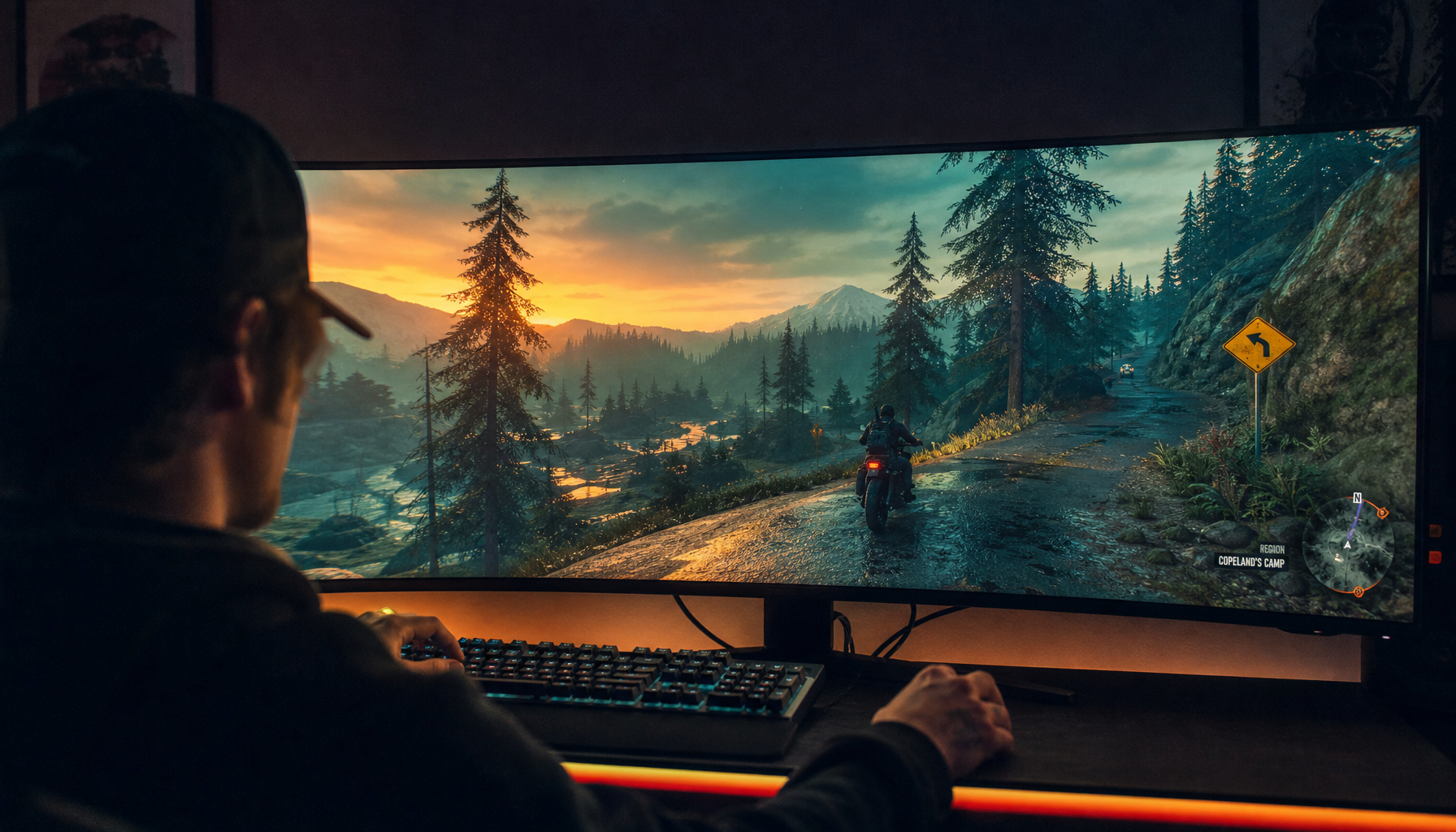
Gamma does not make a weak panel physically blacker, but it strongly changes how dark tones step away from black. Set too high, shadows look deep but can hide detail; set too low, dark areas separate more clearly but blacks can turn gray and flat.
Is your game cave, movie night scene, or dark spreadsheet theme turning into either a black blob or a milky gray haze? A practical gamma check can reveal whether the issue is your tone curve, your black-level setting, or the monitor’s native contrast limit before you spend money on a new display. You’ll leave with a reliable way to choose gamma for gaming, office work, portable screens, and cinematic viewing.
Gamma, Black Level, and Shadow Separation Are Related but Not the Same
Gamma is the curve that controls how digital values between black and white become visible brightness on screen; in simple terms, it shapes the middle and dark steps rather than only the endpoints. The relationship between pixel values and brightness is why a 50% gray signal is not expected to look like half of peak white on a properly tuned monitor.
Black level is the darkest luminance your display can produce. On OLED, each pixel can effectively shut off, so black can be extremely deep. On LCD monitors, including IPS, VA, mini-LED, and many portable displays, a backlight is always involved, so “black” still emits some light. Gamma then decides how quickly the tones just above that black floor rise into visible dark gray.
Shadow separation is the ability to distinguish near-black steps, such as RGB 3, 5, 8, 12, and 16, instead of seeing one merged patch. A monitor can have impressive black depth but poor shadow separation if the curve crushes the first few steps. It can also show every dark step but look weak if gamma or black level is lifted too far.

What Higher Gamma Does to Blacks and Shadows
A higher gamma setting, such as 2.4 instead of 2.2, darkens midtones and shadows. That often increases perceived depth because dark scenes sit lower and contrast feels stronger. For a dim-room movie or story-driven game, gamma 2.4 can make a night skyline, cave wall, or space scene feel more anchored and less like a backlit poster.
The tradeoff is visibility. Higher gamma can make dark tones cluster too close together, especially on monitors with modest contrast or in a bright room. In practical use, higher gamma darkens shadow areas and can make details harder to see in dark parts of an image.
That does not mean 2.4 is wrong. It means the room and use case matter. On a 27-inch QHD IPS productivity monitor in daylight, 2.4 can make dark UI panels and game interiors feel heavy. On a VA or OLED display in a controlled room, it can deliver a more cinematic SDR image because the panel has enough black depth to support the darker curve.

What Lower Gamma Does to Shadow Detail
A lower gamma setting, such as 2.0 or 1.8, raises dark and middle tones. In games, that can make opponents, doorways, and terrain details easier to see. For a portable screen used in a bright office, it can also keep dark interface elements readable when ambient light is washing across the panel.
The cost is image solidity. Calibration guidance notes that lower gamma brightens the image, while higher gamma darkens it with stronger contrast. In practice, too-low gamma turns black suits, dark stone, night skies, and shadowed faces into gray surfaces with less depth. Competitive players may accept that visibility advantage, but creators and immersive gamers usually should not make it their default.
This is why monitor “black equalizer” or shadow boost controls should be treated as tactical tools. They can be useful in a ranked FPS match, but they are not the same as accurate gamma. If you edit product photos, watch films, or review video, a lifted shadow curve can cause you to underexpose or overcorrect content that was already fine.
The Physical Limit: Gamma Cannot Beat Native Contrast
The most important reality is that gamma cannot create deeper black than the panel can produce. Calibration discussions about finite contrast point out that non-OLED displays cannot follow a perfect power-law curve all the way down to absolute black because their black floor is not zero.
A simple example makes this concrete. If a monitor is set to 120 nits peak white and has a 3,000:1 contrast ratio, its black level is about 0.04 nits. If another monitor at the same brightness has a 900:1 contrast ratio, its black level is about 0.13 nits. Gamma adjustment can reshape the ramp above those values, but the 900:1 display will still glow more in a dark room.
This is why IPS, VA, OLED, and mini-LED screens respond differently to the same setting. A typical IPS monitor may have excellent color and viewing angles but less convincing dark-room black. VA often gives deeper LCD blacks but can have slower dark transitions. OLED offers the cleanest black depth and shadow contrast, though buyers should consider cost, brightness behavior, and burn-in risk for static desktop use.
Gamma Setting |
Visual Effect |
Best Fit |
Main Risk |
1.8 to 2.0 |
Brighter shadows and midtones |
Bright rooms, visibility-first gaming, dim portable screens |
Washed-out blacks and flatter depth |
2.2 |
Balanced SDR tone response |
Office work, web, SDR gaming, mixed use |
May feel slightly light for movie viewing in a dark room |
2.4 |
Darker shadows and stronger perceived contrast |
Dim-room video and cinematic SDR games |
Crushed shadow detail on weaker panels or in bright rooms |
The Best Default for Most Monitors
For most desktop, web, office, and SDR gaming workflows, gamma 2.2 is the best starting point. Image-correction guidance explains that most standard image files, including sRGB-style workflows, are built around approximately 1/2.2 encoding, which pairs with a display response near 2.2 for expected brightness and contrast.
That matters for productivity as much as gaming. Text antialiasing, gray UI panels, dark-mode borders, chart fills, and spreadsheet gridlines all sit in the tonal middle where gamma errors are obvious. A too-high gamma makes low-contrast interface details disappear. A too-low gamma makes the whole desktop look lifted, reducing the sense of hierarchy between panels, toolbars, and content.
For a practical buying context, a 27-inch QHD IPS monitor with strong sRGB coverage and factory calibration remains a strong all-around choice for mixed work and gaming, especially when paired with 100 Hz or higher refresh. A computer monitor decision should still follow the workflow: office users need ergonomic readability, gamers need stable motion and low lag, and creators need verified grayscale and color behavior.
How to Set Gamma Without Making Blacks Worse
Start with the monitor’s most neutral picture mode, usually Standard, Custom, User, sRGB, Creator, or a calibrated mode. Avoid Vivid as a baseline because it often raises saturation and contrast in ways that hide what gamma is really doing.
Then set brightness for your room before judging gamma. Calibration guidance is useful here because brightness adjustment affects black-level visibility and dark-gray detail, while contrast affects bright-gray and near-white detail. If the backlight is too high in a dark room, blacks will look gray no matter what gamma you choose. If it is too low in daylight, shadow separation may vanish because your eyes are fighting ambient glare.
After brightness, keep contrast near the factory default unless a white-level pattern shows clipping. Then test gamma with a grayscale ramp, black-level pattern, or familiar content. In a good setup, the first few near-black steps should be barely visible, not glowing, and not merged into one block. A dark jacket should still show fabric folds, while a black letterbox bar should remain visually deeper than dark gray content.
For gaming, leave the GPU gamma control at default first and use the game’s internal brightness or gamma screen after the monitor is stable. Some games, especially in fullscreen modes, may not respect ICC profiles or GPU lookup-table corrections consistently, so monitor-level settings and in-game calibration are often more reliable for play.
When Black Gamma, Black Level, and Tone Mapping Enter the Picture
Some displays and cameras expose separate controls for black level, black gamma, shadow boost, dark stabilizer, or HDR tone mapping. These are related to gamma but not identical. Picture-profile controls describe black gamma as a subtler adjustment to gradation in dark image areas, while black level shifts the overall black point more directly.
That distinction matters. If black level is raised, the whole floor comes up and blacks weaken. If black gamma is adjusted carefully, the curve near black can be opened or tightened while leaving more of the image alone. On a gaming monitor, a shadow-control feature may behave more like black gamma than global gamma, which is why it can reveal dark corners without changing the entire desktop as dramatically.
HDR adds another layer because tone mapping decides how content mastered for a wider brightness range is adapted to your display. A tone mapping algorithm can preserve shadows, protect highlights, or shift the mood, but it cannot create black depth, peak brightness, or local dimming performance the hardware lacks. For daily office use, SDR often remains more predictable than always-on HDR because whites, grays, and dark UI tones stay more stable.
Calibration, Certification, and Real-World Confidence
A colorimeter and calibration software can improve grayscale tracking, gamma accuracy, and consistency across applications that use color management. They cannot turn a low-contrast panel into an OLED, but they can stop a good monitor from wasting its potential with a poor factory curve.
For creative and review work, factory validation matters. An explanation of factory validation notes that certification evaluates color temperature, gamma curve, and Delta E, which is exactly the zone where shadow neutrality and grayscale confidence live. That does not replace your own calibration under your room lighting, but it gives you a stronger starting point.
For most users, the reliable workflow is simple: use gamma 2.2 as the baseline, set brightness for the room, verify near-black bars, and only move toward 2.4 for dim-room cinematic use or toward a lower effective gamma for visibility-first gaming. If the image still lacks depth after that, the limitation is probably native contrast, backlight behavior, or panel type rather than the gamma menu.
FAQ
Does gamma change true black level?
Gamma changes how tones above black are distributed, but it does not lower the physical black floor of the display. If an LCD panel leaks light at black, gamma can hide or reveal detail near that floor, but it cannot make the backlight disappear.
Is gamma 2.2 always best for gaming?
Gamma 2.2 is the best default for SDR gaming because it preserves the intended balance of depth and visibility. Competitive players may use a lower effective gamma or shadow boost for dark-map visibility, while cinematic players in dim rooms may prefer 2.4 if their monitor has enough contrast.
Why do shadows look washed out after I raise black detail?
You likely lifted the near-black curve too much. That improves separation, but it also makes dark pixels brighter, so blacks lose weight. Reduce shadow boost, return gamma closer to 2.2, and lower room glare before blaming the panel.
A high-performance display should let you see what matters without breaking the image’s intent. Treat gamma as a precision tone tool: 2.2 for balanced SDR accuracy, 2.4 for controlled cinematic depth, and lower settings only when visibility is worth the loss in black-level authority.