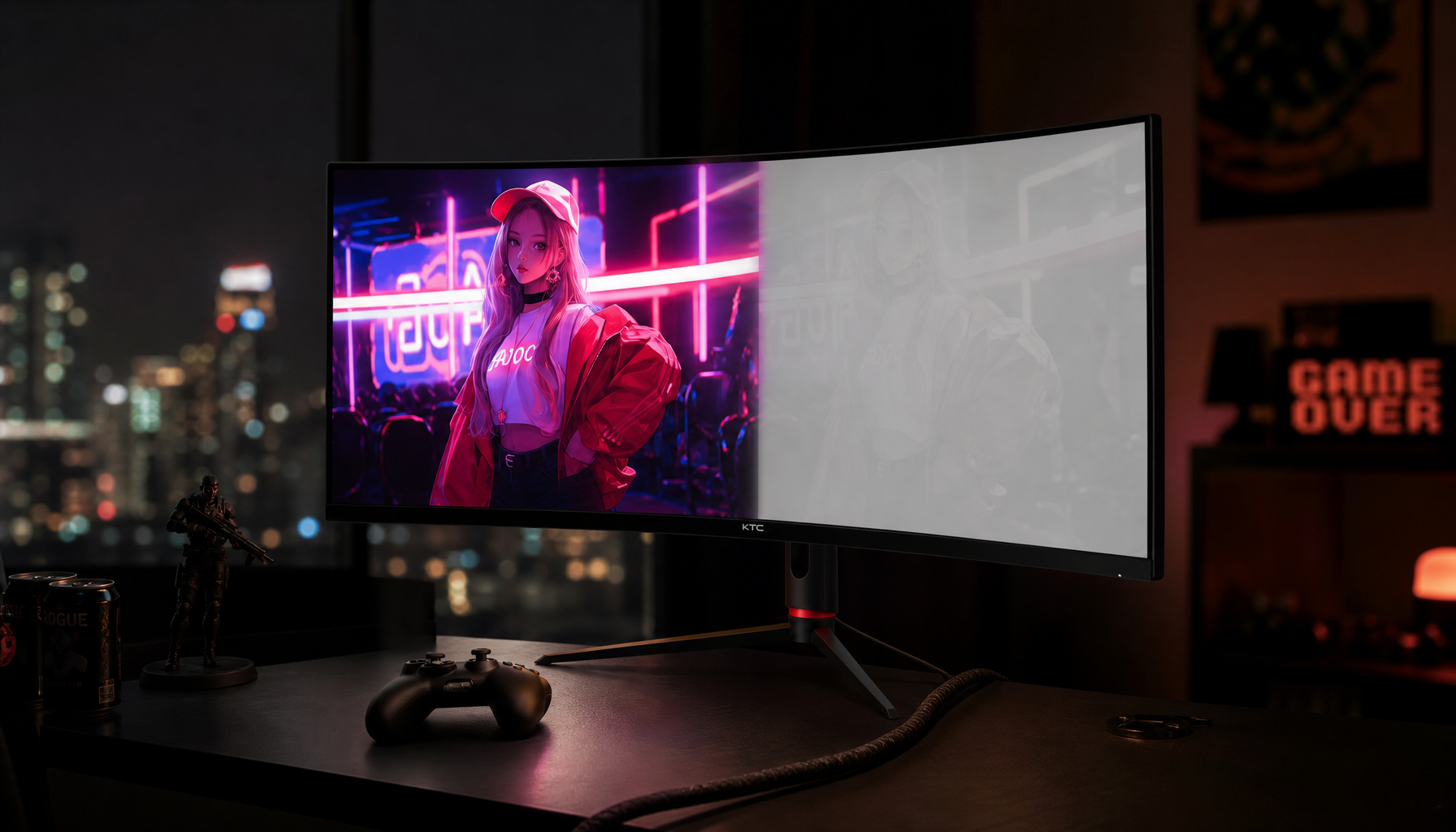
Native contrast ratio tells you how much brighter a monitor’s white can be than its black at the same time, without dynamic dimming tricks. It is one of the fastest ways to predict black depth, shadow detail, and image punch in real use.
Does your “1,000,000:1” monitor still make night scenes look gray, or does white text glow against black backgrounds in a distracting way? With one white-level reading and one black-level reading, you can separate a trustworthy panel spec from a marketing number before you buy. You will know what native contrast means, when it matters, and how to choose the right screen for gaming, work, and portable setups.
Native Contrast Ratio, Plainly Defined
A monitor’s native contrast ratio is the relationship between its brightest white and darkest black under the same picture condition. If a display produces 300 nits of white and 0.3 nits of black, its native contrast is 1,000:1. If the black level drops to 0.1 nits while white stays at 300 nits, contrast becomes 3,000:1, and dark scenes should look noticeably deeper.

A static contrast ratio is often treated as the same practical idea as native contrast: the display shows bright and dark information without changing backlight behavior between separate moments. That matters because games, spreadsheets, movies, and design tools often place bright UI elements beside dark content at the same time.
The key phrase is “at the same time.” A native contrast spec is not asking how bright the monitor can get in one scene and how dark it can get in another. It is asking how well the panel separates white from black in a single stable state.
Why Native Beats Dynamic on a Spec Sheet
Dynamic contrast ratio is the number that creates confusion. It can compare a bright measurement from one moment with a dark measurement from another, often helped by backlight dimming or processing. That is why a basic LCD can advertise a huge contrast figure while still looking washed out in a dark game lobby or dim movie scene.

A dynamic contrast ratio is influenced by algorithms and brightness changes, while static contrast is closer to the hardware’s real capability. In practice, dynamic contrast can help full-screen dark scenes look moodier, but it can also cause brightness pumping, crushed shadow detail, or inconsistent image tone during mixed scenes.
Native contrast is the number to trust first. Dynamic contrast is a feature to test with your own eyes after that.
Spec Label |
What It Usually Means |
Buying Value |
Native or static contrast |
White and black performance under the same stable condition |
High, especially for gaming, editing, and dark UI work |
Dynamic contrast |
Brightest and darkest states measured across changing scenes |
Limited, because processing can inflate the number |
Ambient contrast |
How contrast survives room light and reflections |
Important for portable screens, offices, and bright rooms |
The Simple Math Behind the Ratio
Contrast is division, not magic. A measured 100-nit white and 0.15-nit black works out to about 667:1. If that same monitor is set to 100 nits white but black measures 0.2 nits, the practical contrast is 500:1.
That example also explains why calibration does not erase a panel’s native advantage. When you dim many LCD monitors from 300 nits to 120 nits, the black level usually drops too, so a stronger native-contrast panel tends to keep its lead. For an office monitor calibrated to 120 nits, a 1,000:1 panel would land around 0.12 nits black, while a 3,000:1 panel would land around 0.04 nits black. The second screen should look deeper in dark mode, video calls with black backgrounds, and shadow-heavy content.
There is one important exception: if you intentionally set two monitors to the same white and same black level for matching, the resulting contrast can become the same. That is useful in controlled multi-monitor workflows, but it also means you may be leaving a better panel’s black-level capability unused.
What Good Native Contrast Looks Like by Use Case
For everyday productivity, native contrast around the typical LCD range is often enough. One monitor overview notes that many LCD monitors sit around 1,000:1 to 3,000:1, which is workable for email, browser tabs, spreadsheets, and coding in normal office light. Text clarity depends more on resolution, scaling, coating quality, and brightness comfort than on chasing theater-grade black levels.
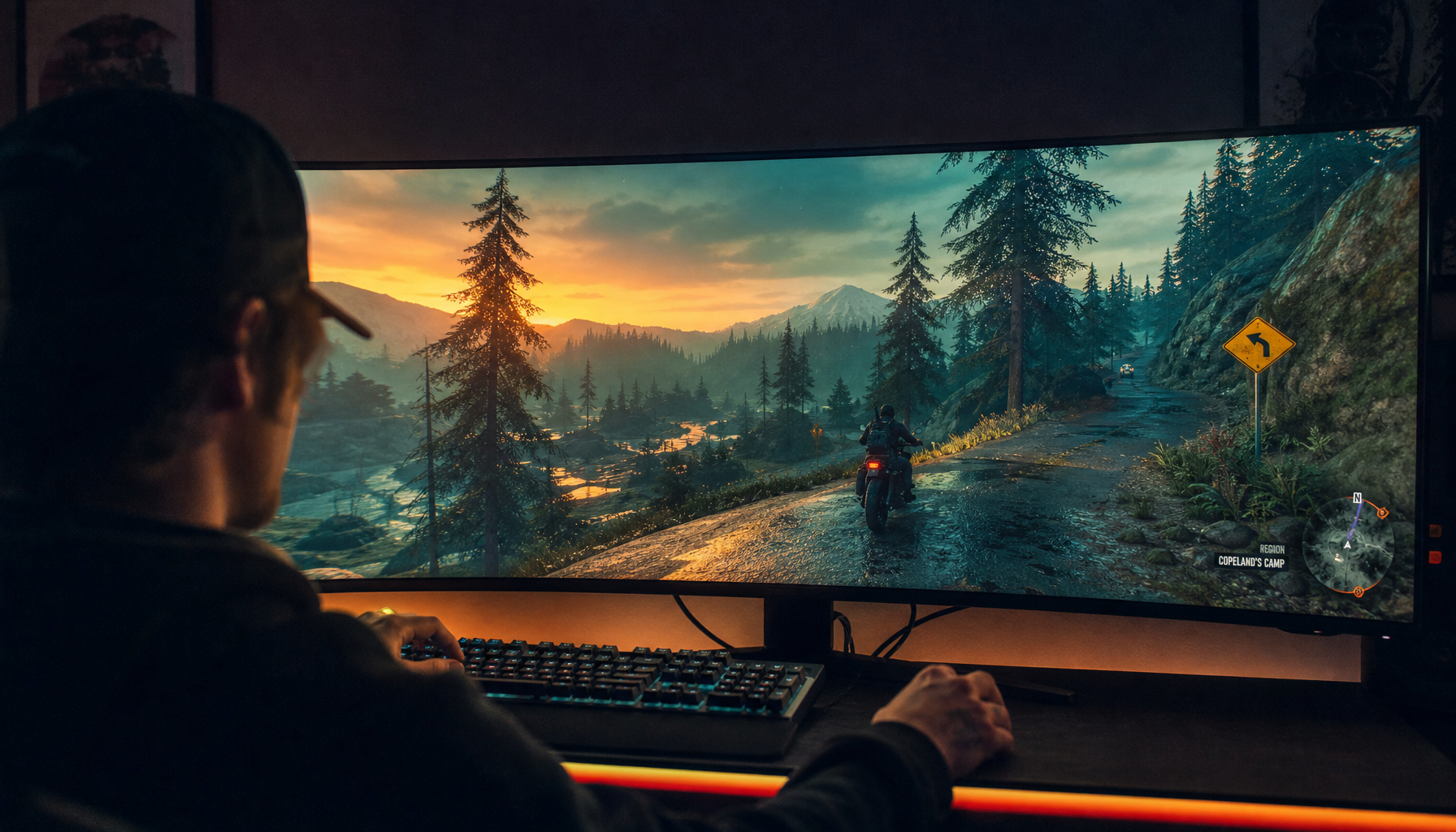
For gaming, cinematic play, and media, contrast becomes much more valuable. A 1,000:1 IPS monitor can feel fast and clean, but dark scenes may look gray in a dim room. A high-contrast VA or OLED screen can make caves, night races, space scenes, and horror games feel more dimensional because blacks sit lower and highlights stand out more strongly.

A 2025 monitor overview describes IPS panels typically around 1,200:1, high-end VA panels much higher, and OLED as near-infinite because pixels can turn off. Treat those as category expectations, not guarantees. A great IPS gaming monitor may still be the better competitive choice because of motion handling, response tuning, and viewing angles. A VA monitor may deliver richer blacks but needs good overdrive to avoid dark smearing. OLED is elite for black depth, but buyers should weigh brightness behavior, cost, and long-term image retention risk.
For portable smart screens, native contrast matters, but ambient light often matters more. A portable display used beside a laptop near a window can lose perceived contrast because reflections lift the apparent black floor. In that situation, a brighter panel, matte coating, and good angle control may beat a spec-sheet contrast upgrade.
Brightness and Contrast Are Partners, Not Substitutes
Brightness tells you how visible the screen can stay in real light. Contrast tells you how far apart black and white can appear. A monitor with high brightness but weak black levels may look punchy in a store and flat at night. A monitor with deep blacks but limited brightness may look excellent in a dim room and underwhelming beside a sunny window.
For indoor screens, 300 to 500 nits is commonly described as a practical brightness range, while brighter environments may need more output. That does not mean every office worker needs a 1,000-nit monitor. It means you should match brightness to the room, then use native contrast to judge depth and shadow separation.
A practical buying test is simple: picture where the monitor will live. In a bright open office, prioritize brightness, anti-glare behavior, and text comfort alongside decent native contrast. In a dark gaming room, prioritize native contrast, black uniformity, local dimming quality, or OLED-level pixel control. For a travel display, check brightness and coating first, then contrast.

Native Contrast, Panel Tech, and Real Tradeoffs
LCD monitors use a backlight, so black usually means “blocked light,” not “no light.” That is why black can look like dark gray, especially on lower-contrast IPS panels or screens with backlight bleed. VA panels usually block light more effectively, which is why they often deliver stronger native contrast. OLED pixels emit their own light and can switch off individually, so black depth is fundamentally stronger.
A display’s ambient light can still change what you see, even when the panel technology is excellent. This is the nuance spec sheets rarely make obvious: a high native contrast number measured in a dark test setup may not translate cleanly to a desk with overhead lighting, glossy reflections, and daylight on the screen.
The best purchase is not always the highest contrast number. It is the screen whose contrast, brightness, coating, panel speed, and resolution fit the job. For esports, motion clarity may outrank black depth. For photo review and video grading, native contrast and grayscale behavior matter more. For office productivity, reliable text rendering and comfortable brightness may be the better value.
How to Read the Spec Before You Buy
When a spec sheet says “native contrast ratio,” treat it as a useful baseline. When it only says “contrast ratio” and the number is enormous, assume it may be dynamic until the manufacturer proves otherwise. If the same listing shows 1,000:1 typical and 1,000,000:1 dynamic, the 1,000:1 figure is the one that better predicts normal mixed-content performance.
Look for “typical,” “static,” or “native” near the contrast value. Then compare within the same panel class and price band. A 1,200:1 IPS monitor may be strong for that category. A 3,000:1 VA monitor may be normal rather than exceptional. An OLED’s contrast spec may be less useful than its brightness limits, image retention protections, and warranty language.
For serious buying, rely on measured reviews when available. The most useful reviews report white luminance, black luminance, native contrast, black uniformity, local dimming behavior, and whether dynamic contrast was disabled during testing.
FAQ
Is 1,000:1 native contrast bad?
No. It is common for many office and IPS monitors, and it can be perfectly usable for productivity, browsing, and competitive gaming. It becomes less satisfying if you play dark games, watch movies in a dim room, or work heavily in dark interfaces.
Is OLED contrast really infinite?
In theory, OLED can reach extremely high or “infinite” contrast because black pixels can turn off. In real rooms, reflections and ambient light still affect perceived black depth, so the experience depends on the environment as well as the panel.
Should I turn on dynamic contrast?
Use it only if you like the look. For games, movies, and casual viewing, it may add punch. For editing, color-critical work, or stable desktop use, it can make brightness and shadow detail less predictable.
Final Word
Native contrast ratio is the spec-sheet number that tells you how much real depth a monitor can produce before processing gets involved. For a sharper buy, read native contrast first, dynamic contrast last, and always judge the number against your room, your content, and the way you actually use the screen.