Pixel pitch is the physical spacing between pixels, and it matters because it determines how close you can sit or stand before the image starts looking blocky. Smaller pitch supports closer viewing and sharper detail, but it also raises cost, processing demand, and sometimes complexity.
Ever lean toward a screen during a match, spreadsheet review, or client presentation and suddenly notice a faint grid instead of a clean image? A simple viewing-distance check can explain why a 24-inch 1080p monitor feels fine from about 3 ft away, while a fine-pitch LED wall may need a much larger budget to look equally refined up close. You’ll leave with a practical way to match pitch, screen size, resolution, and viewing distance before you buy.

Pixel Pitch, Defined Clearly
Pixel pitch is the distance from the center of one pixel to the center of the next pixel. In direct-view LED walls, the industry often uses labels like P1.2, P2.5, or P10; a smaller P-number means tighter spacing, more pixels in the same area, and finer image detail. Display guidance describes pixel pitch as the center-to-center spacing between adjacent LED pixels, which is why it directly shapes perceived sharpness.
For desktop monitors, office displays, and portable smart screens, you will more often see PPI, or pixels per inch. Pixel pitch and PPI describe the same core idea from opposite directions: pitch measures spacing, while PPI measures density. A tighter pitch means a higher PPI, but the buying context differs. LED wall buyers talk about P1.5 or P2.5 because panels are modular and physically large; monitor buyers talk about 110 PPI, 140 PPI, or 160 PPI because the screen size and resolution are fixed consumer specs.
Why Viewing Distance Changes Everything
A screen does not need infinite pixel density to look sharp. It needs enough density for the distance where people actually use it. Pixel density becomes less visibly important once your eyes can no longer separate individual pixels from your seat.
That is why a 27-inch 1440p gaming monitor can feel crisp at a desk, while a 27-inch 1080p display may look soft for productivity. A 27-inch 1080p monitor is about 82 PPI, while a 27-inch 1440p monitor is about 109 PPI. From normal desk distance, that jump is easy to notice in text edges, map labels, inventory UI, and small HUD elements.
For LED video walls, the stakes get larger because viewers may stand 6 ft away in a conference room or 100 ft away in an arena. Smaller pixel pitch improves clarity at close range, but the extra density can become wasted cost when the audience is farther away.
Pixel Pitch vs. Resolution vs. PPI
Resolution tells you the total number of pixels. Pixel pitch tells you how tightly those pixels are packed. PPI tells you how dense the final screen appears per inch.
A 32-inch 4K monitor and a 55-inch 4K display both contain the same number of pixels, but the 32-inch screen packs them into a smaller surface, so it looks sharper up close. That is why monitor shoppers should never evaluate resolution alone. A 4K badge is powerful on a 27-inch or 32-inch desk display, but it becomes less dense as the screen grows.
Direct-view LED walls work differently. LED wall custom resolutions depend on the wall’s physical dimensions and pixel pitch. A larger wall with a tight pitch can deliver a high pixel count, but it also needs more LED clusters, more driving hardware, and a budget that matches the ambition.
Practical Viewing Distance Benchmarks
The useful question is not “What is the smallest pitch I can buy?” The better question is “How close will the closest important viewer be?”
Display guidance separates visual acuity distance from average comfortable viewing distance. Visual acuity distance is stricter: it estimates where a person with 20/20 vision stops seeing individual pixels. Comfortable viewing distance is more forgiving and closer to what many real installations can tolerate, especially for video or large graphics.
LED Pitch Label |
Approx. Pixel Spacing |
Visual Acuity Distance |
Comfortable Viewing Distance |
P0.75 |
0.030 in |
8 ft 6 in |
4 ft 3 in |
P1.0 |
0.039 in |
11 ft 3 in |
5 ft 8 in |
P1.5 |
0.059 in |
16 ft 11 in |
8 ft 6 in |
P2.0 |
0.079 in |
22 ft 7 in |
11 ft 3 in |
P3.0 |
0.118 in |
33 ft 10 in |
16 ft 11 in |
P5.0 |
0.197 in |
56 ft 5 in |
28 ft 3 in |
P10.0 |
0.394 in |
112 ft 10 in |
56 ft 5 in |
Here is the real-world read: if the first row in a boardroom is 6 ft from the screen and people read dashboards or small text, P2.0 is too coarse for a premium experience. P1.0 or P1.25 makes more sense for presentation detail, while an LCD or high-PPI monitor may still be the cleaner choice for dense spreadsheets. If the display is a lobby wall viewed from 15 ft to 25 ft, P2.0 or P3.0 can be a much better value.
How Pixel Pitch Affects Gaming Monitors
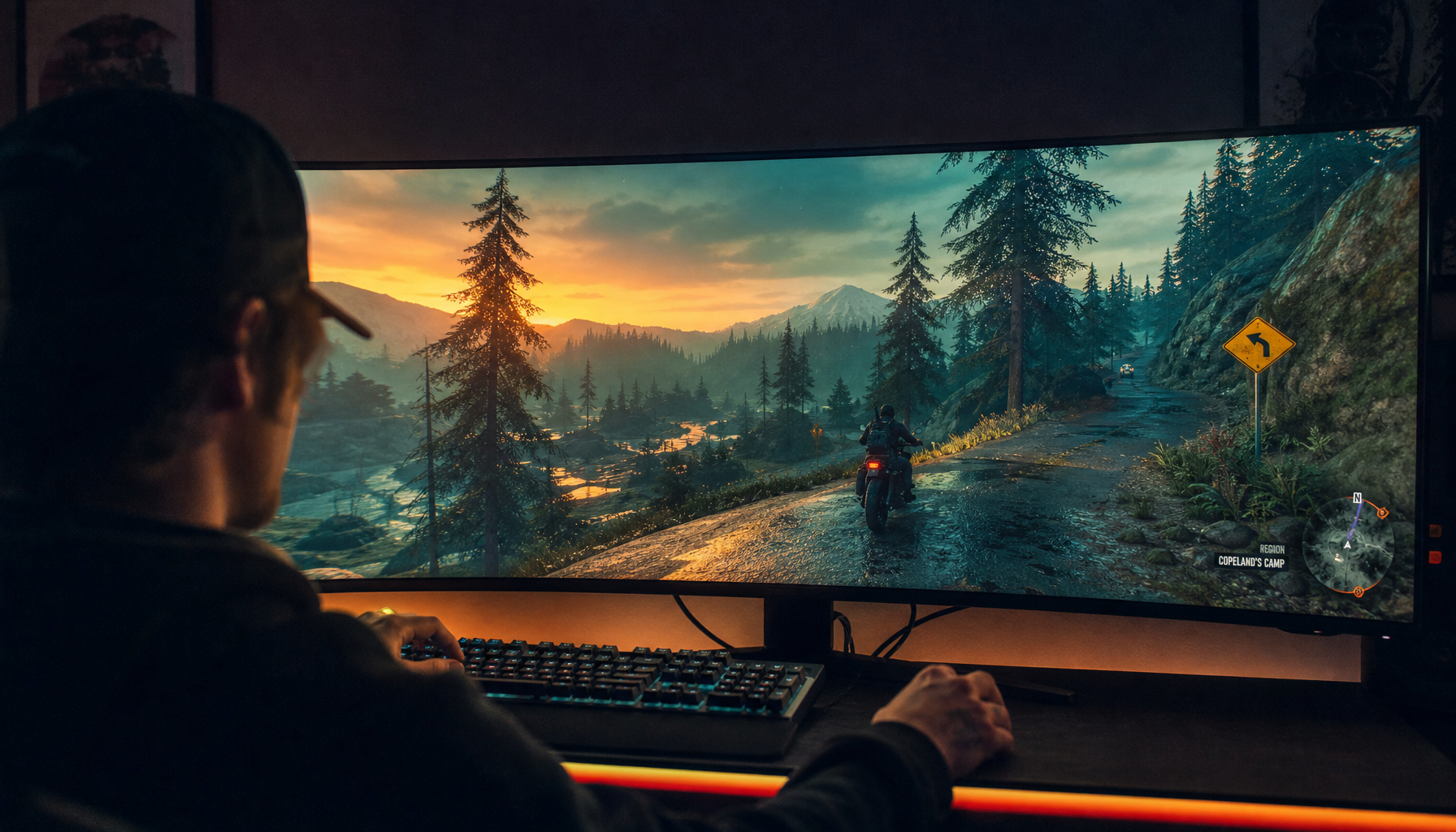
For gaming monitors, pixel pitch shows up as sharpness, GPU load, and interface scale. Higher PPI makes distant enemies, fine textures, and UI edges cleaner, but it often requires a higher resolution, which can reduce frame rate if the graphics card cannot keep up. High pixel density can require higher processing power and may affect frame rate, which matters more in competitive play than in static office work.
A strong performance-first sweet spot is still 27-inch 1440p for many esports and mixed-use gamers because it balances clarity, refresh rate, and GPU demand. A 32-inch 4K display gives sharper visuals for cinematic play, sim racing, and creator-gamer setups, but it asks more from the system. If you play fast shooters at high refresh rates, do not chase pitch so aggressively that you sacrifice motion performance.
How Pixel Pitch Affects Office Productivity Displays
Office work is brutal on weak pixel density because text exposes every flaw. Low PPI makes letters look fuzzy, spreadsheet gridlines shimmer, and long reading sessions feel less precise. For productivity, the display should make text calm and stable, not just big.

A 24-inch 1080p office monitor is usable, but it is not luxurious for dense work. A 27-inch 1440p monitor is a better all-around productivity baseline, while 32-inch 4K is excellent when you want more workspace with sharper text. Above roughly 140 PPI on desktop monitors, scaling may become necessary, which is not a problem in modern operating systems but can still affect older apps or niche enterprise software.
How Pixel Pitch Affects Portable Smart Screens
Portable displays add a different constraint: you sit close, the screen is smaller, and power matters. A 15-inch or 16-inch 1080p portable screen can look reasonably sharp because the pixels are packed tighter than on a large 1080p monitor. A 2.5K or 4K portable screen can look beautiful for design review, coding, and travel work, but it may cost more, draw more power, and require scaling to keep text readable.

For portable smart screens, prioritize balance. If the screen is used for email, dashboards, console monitoring, or hotel-desk productivity, strong brightness, USB-C reliability, and stable scaling may matter as much as raw pixel density. If it is used for photo review, UI design, or premium media, a higher-PPI panel earns its keep.
The Pros and Cons of Smaller Pixel Pitch
Smaller pixel pitch gives you sharper text, smoother curves, closer viewing, and a more premium image. It is the right move for control rooms, broadcast sets, high-end retail displays, boardrooms, design monitors, and premium gaming setups where the viewer is close enough to appreciate the extra detail.
The tradeoff is cost and system demand. Reducing pixel pitch raises manufacturing complexity because more LEDs are packed into the same area. In practical terms, finer pitch can mean higher panel cost, more processing hardware, more heat considerations, and a sharper need for high-quality content. A low-resolution video feed on a premium fine-pitch wall still looks like a low-resolution video feed.
How to Choose the Right Pixel Pitch
Start with the closest viewer, not the screen spec. If someone will sit 2 ft from a desktop monitor, prioritize PPI and text rendering. If someone will stand 6 ft from an LED wall, use fine pitch or consider whether a commercial LCD display is the better tool. If the audience is 30 ft away, a coarser LED pitch can deliver strong impact without wasting budget.
Then match the content. Fast gaming and video tolerate slightly lower pixel density better than small text, CAD lines, financial dashboards, or code. A scoreboard, brand loop, or menu board can use larger pitch than a command center wall where every tiny label matters.
Finally, check the whole system. Screen size, resolution, refresh rate, brightness, scaling behavior, GPU performance, content quality, and installation distance all work together. Pixel pitch is not the only spec that matters, but it is the spec that tells you whether the image will hold together at the distance where people actually look.
FAQ
Is smaller pixel pitch always better?
Smaller pixel pitch is visually better at close distances, but it is not always the better buy. If viewers are far enough away, they may not see the extra detail, so the added cost brings little practical return.
What pixel pitch is best for a conference room LED wall?
For a room where viewers may sit within 6 ft to 10 ft, fine pitch is usually required. P1.0 to P1.5 is more appropriate for close presentation detail, while P2.0 can work when the closest viewers are farther back or the content is mostly video and large graphics.
What PPI is good for a desktop monitor?
For most office and gaming desks, roughly 110 to 140 PPI is a strong practical range because it improves sharpness without forcing heavy scaling. Higher PPI can be excellent for design and premium productivity, but check software scaling and GPU performance before buying.
Does pixel pitch affect eye comfort?
Yes, indirectly. If pitch is too coarse for the viewing distance, your eyes work harder to resolve fuzzy text, jagged edges, or visible pixel structure. Good ergonomics still require proper brightness, contrast, refresh behavior, and viewing height, but pixel density is part of the comfort equation.
The Bottom Line
Pixel pitch is the distance reality check behind every sharp screen. Match it to the closest viewer, the content detail, and the performance budget, and you get a display that feels immersive, readable, and worth the money instead of merely impressive on a spec sheet.