Programmers often feel less fatigue when a monitor is sharp enough for clean text without making code tiny or scaling awkward. For most desktop coding setups, that usually means roughly 110–140 PPI.
Pixel Density Changes How Code Feels
Pixel density, or PPI, describes how many pixels fit into each inch of a display. Higher density usually makes text edges cleaner, and sharper text matters when your day is built around brackets, punctuation, indentation, and small UI labels.

More density is not always better. A very high-PPI screen can make menus, terminals, and editor sidebars too small at native scale, while a low-PPI screen can make text look soft. Both problems force your eyes to work harder.
That is why programmers do not just need more pixels. They need pixels arranged at a density that keeps code crisp and comfortably sized at a normal desk distance.
The Comfort Range: About 110–140 PPI
For many developers, the sweet spot starts around 110 PPI. A 27-inch 1440p display sits near 109 PPI, which explains why it remains such a reliable coding choice: text is noticeably sharper than 24-inch 1080p, but still readable without heavy scaling.

A 24-inch 1440p monitor rises to about 122 PPI. That can look excellent for code, though some users may prefer slightly larger fonts. A 27-inch 4K monitor reaches about 163 PPI, delivering premium sharpness but often requiring display scaling.
The fatigue difference is practical: fewer fuzzy glyphs, less squinting, and less constant font adjustment. In developer discussions, users repeatedly point out that resolution and usable workspace matter more than physical size alone.
Why Too Low or Too High Can Tire You Out
Low pixel density can make code look smeared, especially on larger 1080p panels. A 27-inch 1080p monitor is about 82 PPI, which can make small text and icons feel coarse compared with a sharper display.
High density has the opposite problem. At 4K on a 27-inch screen, the image is beautifully crisp, but native UI elements may be too small. Once you scale to 150%, the workspace becomes closer to 1440p, which is comfortable but reduces the raw space advantage.

For comparison, a 24-inch 1080p monitor is budget-friendly at about 92 PPI, but it is not ideal for premium text clarity. A 27-inch 1440p monitor is the balanced option at about 109 PPI, while a 24-inch 1440p monitor is sharper at about 122 PPI and may need font tuning. A 27-inch 4K monitor is ultra-sharp at about 163 PPI and usually works best with scaling.
High PPI reduces visible pixel structure, but scaling quality depends on the operating system and apps, so older tools may not look equally clean everywhere.
The Best Pixel Density Depends on Workflow
If you code mostly in terminals, IDEs, browser docs, and dashboards, a 27-inch 1440p monitor is the value-oriented performance pick. It gives more workspace than 1080p while keeping text comfortably sized.
If you review dense logs, write all day, or use strong display scaling, 27-inch 4K can feel more immersive and polished. A modern 4K resolution panel can make fonts look refined, especially when paired with good brightness control and an ergonomic stand.
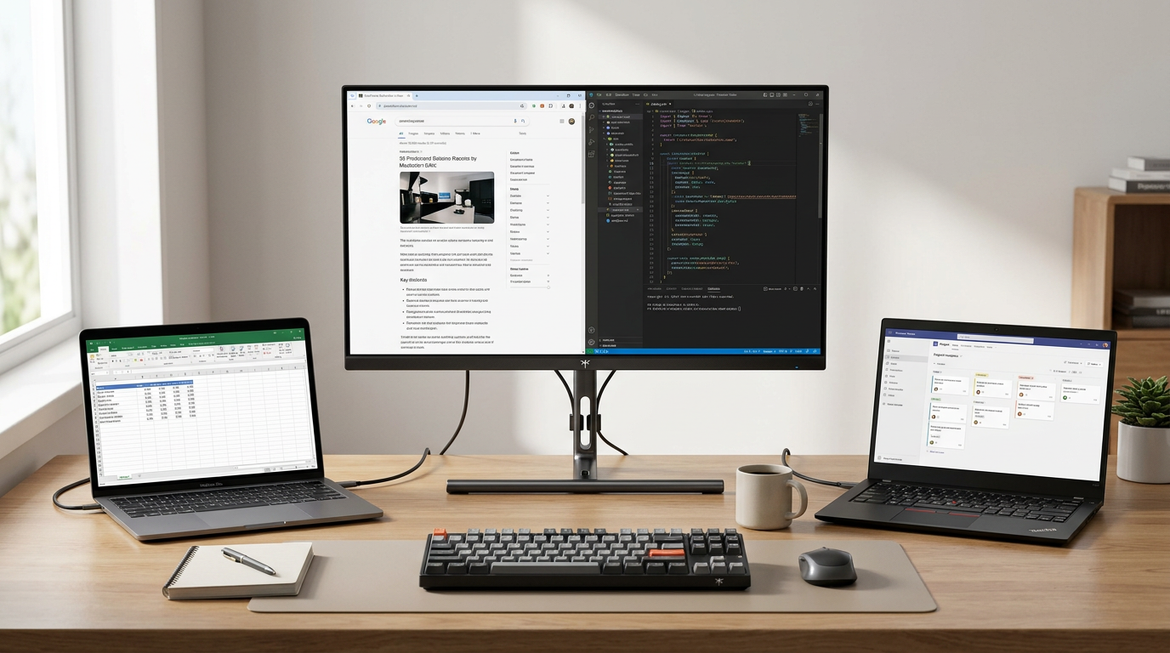
For dual-screen setups, consistency matters. Mixing a low-PPI side monitor with a high-PPI main display can make your eyes constantly adapt as windows move between screens.

Practical Buying Guidance
Choose the monitor around your actual coding distance, scaling tolerance, and workspace needs. Pixel density is not a spec-sheet trophy; it is a comfort tool.
For most programmers, start with 27-inch 1440p for maximum value and low-friction readability, or choose 27-inch 4K if you prioritize sharper text and are comfortable using scaling. Avoid large 1080p displays for serious text work unless budget is the main constraint.
The less your eyes fight the screen, the longer your focus lasts. That is the real performance gain.