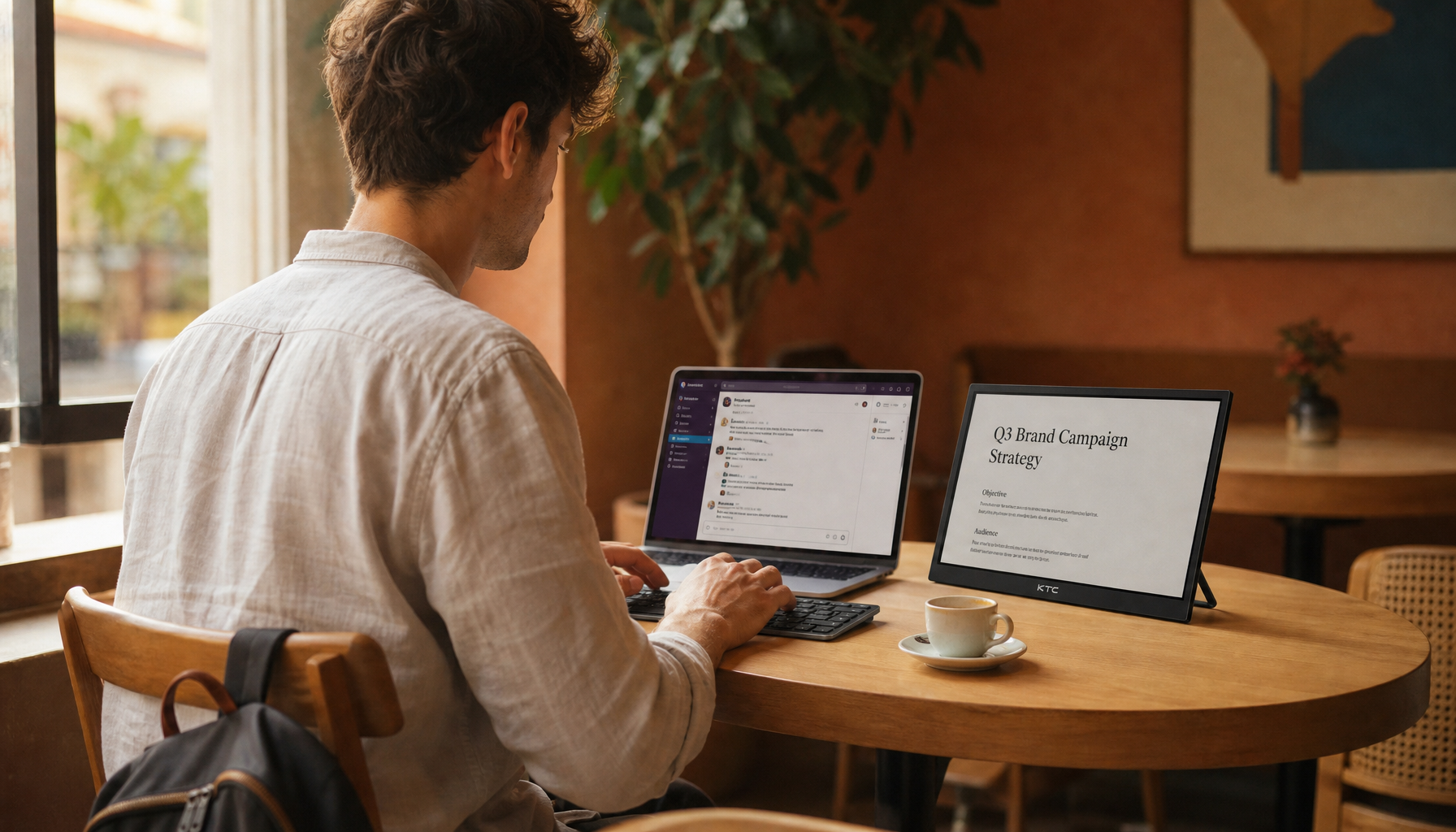
Hybrid workers are buying matching monitor pairs because identical displays make home and office setups feel more predictable: the same size, resolution, height, ports, refresh rate, and screen behavior reduce daily friction.
Ever drag a window from one screen to another and watch the text change size, the color shift, or the mouse suddenly feel different? A well-matched dual-monitor setup can preserve your desk habits across email, documents, dashboards, spreadsheets, video calls, coding tools, and even after-hours gaming. Here is how to decide whether two matching monitors are worth it, when mixed displays are still practical, and what specs matter most before you buy.
Hybrid Work Turned Monitors Into a System, Not a Single Upgrade
Before hybrid work became normal, many people bought one “better” monitor and treated the laptop screen as a backup. Now the desk itself has to work in two places: an office station, a home office, or sometimes a shared apartment desk that gets packed down at night. That shift has pushed more buyers toward coordinated monitor pairs instead of mixing whatever display happens to be available.
The main reason is repeatability. A matched setup lets your left screen and right screen behave the same way every day, which helps preserve window placement habits for chat, email, browser tabs, documents, dashboards, coding panes, design tools, and spreadsheets. Matching home and office displays can reduce daily adjustment friction by aligning size, resolution, refresh rate, ports, and ergonomics across desks, which is why matching monitor pairs have become a more practical buying category for hybrid workers.

There is also a productivity case. Dual-screen workplace comparisons cited in monitor buying research reported faster task completion, productivity gains of up to 40%, and about a two-minute improvement on a data-finding task. That does not mean every person becomes 40% faster by buying two displays, but it does show the practical value of reducing window switching when the work involves reference material, communication apps, and production tools at the same time.
The New Buying Question
The old question was simple: “What is the best monitor I can afford?” The hybrid-work question is more specific: “Can I create the same visual workspace in more than one location?”
That is why a pair of 27-inch QHD monitors often makes more sense than one premium display beside an older 1080p screen. With two similar panels, the cursor travels predictably, windows keep a familiar scale, and your eyes do not keep adapting to different brightness, sharpness, and color temperature from one side of the desk to the other.
Why Matching Pairs Feel Better Than Mixed Displays
Mixed-brand monitors can work, but they often create small mismatches that add up over an eight-hour workday. The most common problems are different pixel density, different color temperature, uneven brightness, inconsistent refresh rate, mismatched stand height, and different input behavior through a dock or hub.
Size and resolution are the first specs to match. A 27-inch display is a common balance point because it fits many desks, offers comfortable visibility, and pairs well with QHD resolution. At 27 to 32 inches, QHD gives more workspace than 1080p without the scaling and graphics demands that can come with 4K, especially on laptops that also handle video calls, browsers, and productivity apps.
Color, Brightness, and Pixel Density
Two displays do not need professional color accuracy for every job, but they should feel visually consistent. If one screen is warmer, dimmer, glossier, or visibly less sharp, your eyes keep making tiny adjustments. That is especially noticeable when a document, spreadsheet, browser window, or design review moves from one screen to the other.
For office work, try to match screen size, resolution, panel type, brightness range, and color controls. For creative work, match calibration options more carefully. If you edit photos, review product images, or compare brand colors, mixed panels can make the same image look different across screens, which can lead to unnecessary second-guessing.
Refresh Rate and Pointer Feel
Refresh rate matters even if you are not gaming. A mismatched 60 Hz and 165 Hz setup can make scrolling, pointer movement, and window dragging feel uneven. For hybrid workers who split time between productivity and gaming, 120 Hz to 144 Hz is a useful range because it improves motion smoothness without making the display choice too narrow.
This is also where matching gaming monitors can be more practical than buying one gaming display and keeping an old office monitor beside it. During the workday, the cursor and scrolling feel consistent; after work, both screens can support high-refresh-rate use, smoother game launchers, streaming tools, chat apps, and browser guides without a jarring side display.
Ergonomics Are Easier When the Screens Match
Monitor comfort is not only about the chair or desk height. Screen position has a direct impact on posture. Poor monitor placement can force upward chin tilt, forward bending, and sideways head or body positions, and these habits may contribute to neck and shoulder discomfort, headaches, and eyestrain symptoms. Good monitor setup depends mainly on viewing angle and viewing distance.

Matching monitors make ergonomic alignment easier because both screens have the same height, bezel position, stand range, and viewing area. You can place them with their top edges aligned, keep the same tilt, and avoid the awkward “one screen high, one screen low” arrangement that often happens when mixing an older monitor with a newer one.
Practical Desk Placement
For a dual-monitor desk where both screens are used equally, place the two screens in front of you with the inner edges touching or nearly touching, forming a shallow semi-circle. If one screen is primary, center that monitor with your keyboard and chair, then angle the secondary display toward you.
A practical starting point is to keep the displays about an arm’s length away, then adjust until text is easy to read without leaning forward. For many desks, 24-inch monitors work well from about 2 to 3 ft away, while 27-inch and 32-inch displays usually sit a bit farther back. For side monitors, an inward angle of about 15 to 20 degrees often feels natural, and many dual-display setups land around 20 to 30 inches from the face.
Height and Viewing Angle
A common ergonomic target is to place the screen center slightly below eye level, with the monitor about 15 degrees below the horizontal eye-level line. Looking upward for long stretches tends to be more tiring than looking slightly downward, which is why monitor arms or height-adjustable stands are useful when building a matched pair.
This is another reason matching pairs are popular: identical stands make height and tilt alignment faster. If the built-in stands are limited, choose monitors with standard mount support so both panels can sit on the same dual-monitor arm.
Matching Pair, Mixed Brands, Ultrawide, or Portable Monitor?
A matching pair is not the only good answer. Some workers are better served by an ultrawide monitor, a laptop plus portable monitor, or a mixed setup built around one primary screen. The right choice depends on desk space, task type, travel needs, and whether you need identical visual behavior across displays.

Horizontal dual monitors align well with wider human vision and are useful for spreadsheets, timelines, browser-heavy work, and side-by-side research. A vertical side monitor can be better for documents, chat feeds, coding, and long web pages; one vertical coding monitor can show roughly 80 to 120 lines of code compared with about 40 lines on a standard horizontal screen, which makes a horizontal and vertical setup especially useful for text-heavy work.
Setup Option |
Best For |
Main Advantage |
Main Tradeoff |
Buying Guidance |
Matching 27-inch QHD pair |
Hybrid office work, spreadsheets, dashboards, coding, mixed work and gaming |
Consistent size, sharpness, cursor travel, height, and refresh behavior |
Needs enough desk width |
Choose the same model, or at least match size, resolution, panel type, refresh rate, and stand range |
Mixed-brand dual monitors |
Budget upgrades, reusing an existing display |
Lowest upfront cost if you already own one monitor |
Possible mismatch in brightness, color, height, scaling, and refresh rate |
Use the better monitor as primary and manually calibrate brightness, color temperature, and scaling |
Timelines, wide spreadsheets, finance dashboards, clean single-cable desks |
No center bezel and simpler cabling |
Less flexible than two separate screens for full-screen apps and screen sharing |
Consider 34-inch ultrawide models if you want width without managing two displays |
|
Laptop plus portable monitor |
Travel, hot desks, small apartments, temporary workstations |
Compact, easy to pack, useful away from the main desk |
Smaller screen, limited ergonomics, often lower brightness |
Pick a portable monitor with single-cable power and video support, plus a stand that raises it closer to eye level |
Matching pair with one vertical screen |
Coding, writing, research, chat, documents |
Keeps visual consistency while adding vertical workspace |
Requires at least one rotating stand or monitor arm |
Buy matching monitors with pivot support, or mount both on an adjustable arm |
For many hybrid workers, the strongest default is a matching 27-inch QHD pair. It gives enough workspace for serious multitasking, fits more desks than two 32-inch displays, and avoids the performance and scaling complications that sometimes come with dual 4K monitors on work laptops.
What to Match Before You Buy
The most important specs to match are size, resolution, refresh rate, panel type, port layout, stand adjustability, and mounting support. Matching the brand is helpful because menus, color modes, stands, bezels, and firmware behavior are more likely to align, but the real goal is matching the experience at the desk.
A platform can handle different monitors, but every difference adds another setting to check. After connecting external displays, a platform lets users adjust each screen separately, identify numbered displays, detect a missing monitor, drag display icons to match the physical layout, and choose display modes such as Duplicate or Extend through a platform’s display settings. That flexibility is useful, but a matching pair means fewer corrections after docking, unplugging, or moving between work locations.
Action Checklist for a Better Hybrid Monitor Setup
- Match the screen size first: choose two 24-inch, 27-inch, or 32-inch monitors instead of mixing sizes unless you have a clear primary-secondary plan.
- Match resolution next: pair 27-inch QHD with 27-inch QHD, or 24-inch 1080p with 24-inch 1080p, to keep text scale consistent; for example, two 27-inch 2K 100Hz/120Hz home and office monitor displays would keep a hybrid desk aligned around the same 27-inch QHD size and 100Hz/120Hz refresh-rate behavior.

- Choose a refresh rate intentionally: use at least 120 Hz to 144 Hz if you want one setup for both work and gaming.
- Check ports before buying: confirm single-cable display support, digital video inputs, docking station support, and laptop output limits.
- Verify stand adjustability: look for height, tilt, swivel, and pivot if one monitor may rotate vertically.
- Align the monitors after setup: use the platform’s display identification and detection tools, then drag the display layout to match the real desk.
- Calibrate by eye or with tools: match brightness, color temperature, and scaling before deciding the setup is finished.
Ports and Docking Matter More Than Buyers Expect
Many hybrid workers discover the real pain point after purchase: the laptop, dock, or cable cannot drive both screens at the preferred resolution and refresh rate. Before buying, check whether your laptop supports two external displays, whether your dock can output the target resolution and refresh rate, and whether you need single-cable display support, digital video inputs, or a combination.
For example, a laptop may handle one 27-inch QHD monitor at 144 Hz but drop to a lower refresh rate when a second display is connected through a limited dock. That does not make the monitor pair a bad choice; it means the whole chain needs to support the same target.
When Mixing Brands Still Makes Sense
Mixing brands is not automatically wrong. It can be the right move when you already own a good monitor, have a limited budget, need one specialized display, or want a compact secondary screen for a narrow task. A designer might pair a color-accurate main display with a cheaper chat monitor; a developer might use a high-refresh-rate main display with a vertical 24-inch side screen; a traveler might use a portable monitor beside a laptop.
The key is to decide which screen is primary. Center the main display in front of your keyboard and chair, then place the secondary monitor to the side. If the secondary display is used mostly for email, chat, music, documentation, or calendar windows, a small mismatch is less disruptive than it would be in a setup where both screens are used equally all day.
How to Make a Mixed Setup Less Annoying
Start by matching the easiest settings: brightness, color temperature, scaling, and refresh rate where possible. Then align the top edges of the screens, not just the stand bases. If the two monitors have different stand heights, a monitor arm or riser can solve more comfort problems than another round of software adjustments.
Avoid the most disruptive combinations when you can: one glossy screen beside one matte screen, one 4K display beside one 1080p display at the same size, one 60 Hz screen beside one 165 Hz screen, or one monitor that sits several inches higher than the other. Those mismatches are noticeable because they affect how your eyes, neck, and mouse movement behave throughout the day.
FAQ
Q: Is it better to buy two identical monitors for a hybrid work setup?
A: Yes, for most hybrid workers who use both screens heavily. Identical monitors reduce differences in size, resolution, color, brightness, refresh rate, stand height, ports, and menu settings. That makes the desk easier to recreate at home and in the office, especially if you use the same apps in the same screen positions every day.
Q: What monitor size is best for a matching pair?
A: A 27-inch QHD pair is the most balanced choice for many home office desks. It gives more workspace than 24-inch 1080p without taking as much room as two 32-inch monitors. If your desk is shallow or narrow, two 24-inch displays may be easier to position; if you work with large timelines, maps, or dashboards, 32-inch displays or an ultrawide may be worth considering.
Q: Should I choose two monitors or one ultrawide?
A: Choose two monitors if you want clear task separation, easier full-screen app use, flexible portrait orientation, or separate screen sharing. Choose an ultrawide if you want one continuous workspace with no center bezel and simpler cable management. For many hybrid workers, two matching 27-inch QHD monitors are more flexible, while a 34-inch ultrawide can feel cleaner on a smaller desk.
Key Takeaways
Matching monitor pairs are gaining ground because hybrid work rewards consistency. When two displays share the same size, resolution, refresh rate, color behavior, stand adjustability, and port setup, the workspace feels easier to trust. You spend less time fixing window positions, less energy adapting to visual differences, and less effort rebuilding the same desk experience in different places.
The most practical buying path is straightforward: start with two matching 27-inch QHD monitors if your desk allows it, choose 120 Hz to 144 Hz if you also game or care about smooth motion, confirm your laptop and dock can support both screens, and set the monitors at a comfortable height and distance. Mixing brands can still work, but it should be a deliberate choice, not the accidental result of buying one good monitor and leaving an old display to fill the gap.
References
- KTC, Matching Home & Office Monitor Setups for Hybrid Work
- Microsoft Support, How to use multiple monitors in Windows
- Canadian Centre for Occupational Health and Safety, Office Ergonomics - Positioning the Monitor
- KTC, Dual Monitor Setup: How to Build for Productivity