









In 2026, data scientists and AI developers running local large language models (LLMs) need more than a single large screen. They must simultaneously view Jupyter notebooks with dense dataframes and plots, IDE code with syntax highlighting, real-time terminal logs, VRAM usage metrics, and inference performance dashboards. A single monitor forces constant window switching that breaks focus and increases errors, while a poorly planned multi-monitor setup creates neck strain or blurry text that worsens eye fatigue during long sessions. The right data science monitor setup therefore prioritizes dedicated screen roles, high pixel density for sharp code, and ergonomic placement that matches your actual desk depth.

The 2026 AI Workflow: Why Single Monitors Fail Data Scientists
Local LLM tools like Ollama or LM Studio in 2026 require continuous observability. You need to watch token-per-second rates, memory consumption, and serving logs while simultaneously editing code and inspecting model outputs. On a single monitor this creates friction: you alt-tab between a wide Jupyter notebook, your IDE, and scrolling terminal output, losing context each time. The cognitive cost adds up quickly during debugging or hyperparameter tuning.
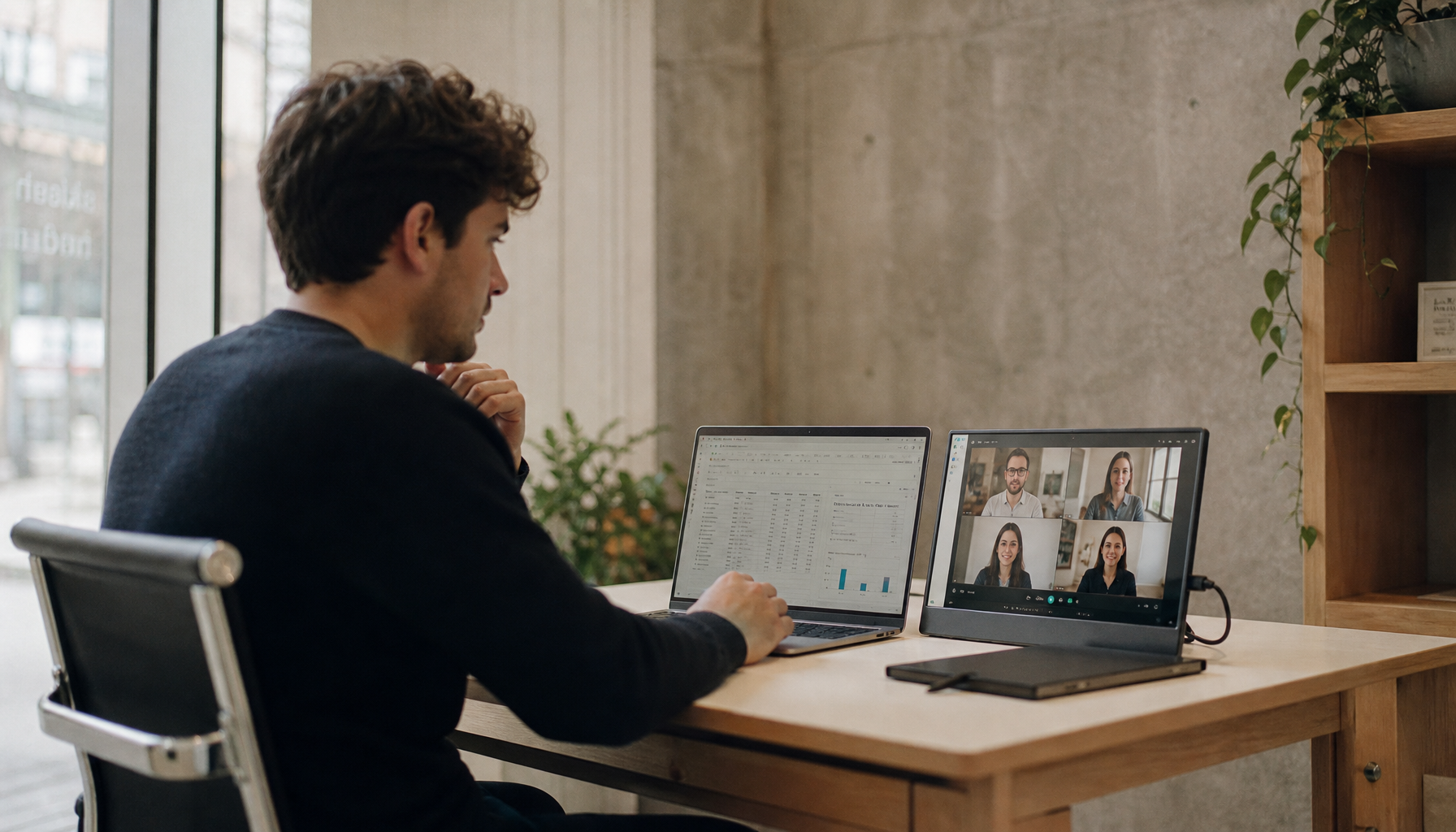
A multi-monitor setup for data science solves this by creating distinct cognitive zones. One screen becomes your primary “creation canvas” for notebooks and code. A second becomes the “observability pillar” for logs and metrics that you glance at without disrupting flow. This separation reduces context switching and supports the parallel attention demands of modern AI development workflows. This 2026 guide to running local LLMs underscores how real-time hardware telemetry has become central to stable local inference.
The Resolution Standard: Why PPI Matters for AI Developers
Text clarity directly affects how long you can code without fatigue. Pixel density, measured in pixels per inch (PPI), determines how sharp small characters and syntax highlighting appear. A 27-inch 4K monitor delivers roughly 163 PPI, while a 27-inch 5K panel reaches about 218 PPI, matching Apple’s Retina standard for print-like sharpness.
On macOS, 5K enables clean integer scaling at 2560×1440 logical resolution, eliminating the fractional scaling blur that can make code jagged or slightly fuzzy. Jupyter notebooks with zoomed-out dataframes and complex plots stay readable at 80–90 % scale. Windows and Linux users often tolerate 4K better thanks to stronger subpixel font rendering, but the eye-strain difference remains noticeable in 8–10 hour sessions. Lower PPI forces the ciliary muscles in your eyes to work harder to resolve edges, contributing to the digital eye strain many developers report.
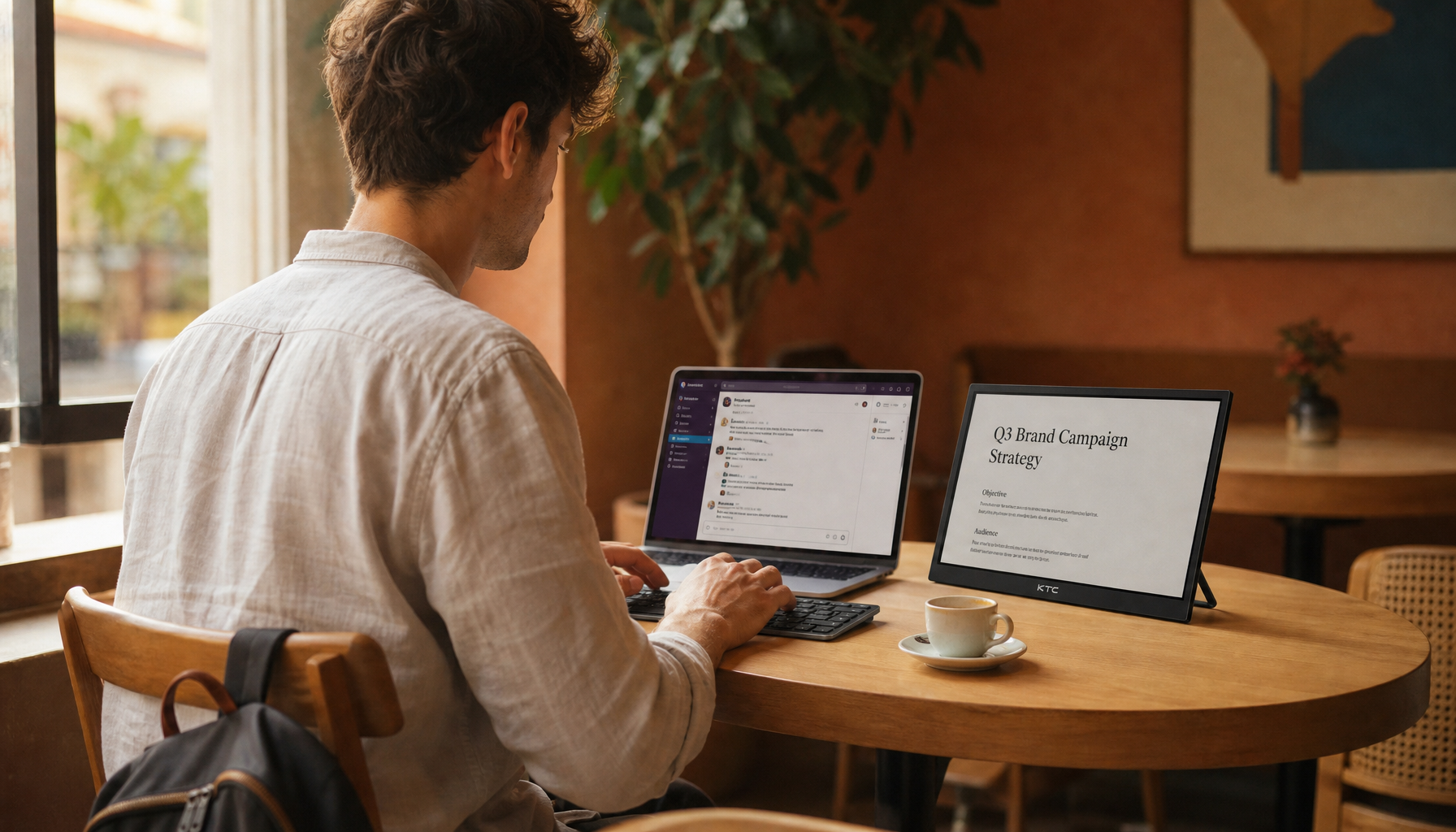
For most AI coding workflows the practical threshold sits near 200 PPI. The KTC H27P3 27-inch 5K monitor meets this standard with 99 % DCI-P3 coverage and accurate color, making it a strong choice when text sharpness is paramount. The more affordable KTC H27P27 27-inch 4K model remains highly capable for Windows users who prioritize screen real estate over absolute Retina-level clarity. As one analysis of programming displays notes, higher PPI reduces long-term fatigue when reading dense code and documentation for hours.
The chart below helps visualize how resolution and operating system interact with typical developer needs.
Desk Depth vs. Safe Monitor Size
Use this as a practical fit guide: deeper desks can support larger monitors more comfortably, while shallower desks usually need smaller screens or a monitor arm to preserve viewing distance.
View chart data
| Scenario | 24 in | 27 in | 32 in | 34+ in |
|---|---|---|---|---|
| <24 in desk depth | 1.0 | 0.0 | 0.0 | 0.0 |
| 24-27 in desk depth | 2.0 | 1.0 | 0.0 | 0.0 |
| 28-31 in desk depth | 2.0 | 2.0 | 1.0 | 0.0 |
| 32+ in desk depth | 3.0 | 2.0 | 2.0 | 1.0 |
Mapping the Workspace: Task-Specific Screen Roles
The most effective data science monitor setup in 2026 pairs one landscape primary display with one vertical secondary display. The landscape screen serves as the creation canvas: Jupyter notebooks, multi-pane IDEs such as VS Code or Cursor, side-by-side documentation, and wide data visualizations all benefit from horizontal real estate.
The vertical screen becomes the observability pillar. Terminal logs, Python stack traces, NVIDIA-SMI output, token-per-second history, and dense API references scroll naturally in portrait orientation, letting you see entire error blocks or long training histories without constant scrolling. This layout reduces the “stack trace frustration” common in local LLM debugging.
Choose a monitor with 90° pivot capability for the vertical role. Models such as the KTC H25Y7 or those using the BCS1-27 stand make rotation simple and maintain height alignment. Many developers report that once they adopt a landscape-plus-vertical configuration, reverting to dual landscape feels inefficient. Our guide on vertical vs horizontal dual monitor setups explores these orientation trade-offs in more detail.
Physical Constraints: Desk Depth and Viewing Distance
Desk depth is the constraint most AI developers overlook when scaling up monitors. A standard 24-inch deep desk can comfortably support dual 27-inch displays but quickly feels cramped with dual 32-inch panels. Shallower desks force monitors too close, shrinking your effective viewing distance and pushing outer edges into uncomfortable neck-rotation zones.
Official guidance recommends 24–30 inches of depth for 27–32 inch monitors to maintain a comfortable focal length of roughly 20–30 inches from your eyes. The Canadian Centre for Occupational Health and Safety and OSHA both emphasize that the primary monitor should sit centered directly in front of you. When two monitors receive equal attention they should form a gentle “V” angled toward your midline, avoiding prolonged head turning that leads to “developer’s neck.”
The chart above translates these principles into a practical fit guide. If your desk is under 24 inches deep, favor 24–27 inch monitors or plan on a monitor arm to reclaim a few inches. For 28–31 inch desks, dual 27-inch or a single 32-inch ultrawide usually works best. Only 32+ inch depth reliably supports larger 32–34 inch combinations without ergonomic compromise. Monitor arms can help by removing stand footprints, but they cannot change the actual focal distance your eyes require.
Our home office ergonomic monitor guide provides additional measurements and self-check steps for long coding sessions.
Implementation: Wiring Your 2026 AI Workstation
High-resolution multi-monitor setups demand sufficient bandwidth. A single USB-C cable that carries video, 90 W power delivery, and USB data simplifies cabling for MacBook or modern Windows laptops. Monitors offering 90 W PD let you charge while driving 5K or dual 4K output, reducing desk clutter.
For mixed 5K and 4K configurations, verify your GPU or laptop’s display output capabilities. Many 2026 laptops handle one 5K at 60 Hz plus one 4K at 60 Hz over Thunderbolt or USB4, but older hardware may require an active DisplayPort splitter or reduced refresh rates. The KTC H27P3 5K model includes DisplayPort 1.4 that supports its native resolution while also offering a 2560×1440@120 Hz mode useful for lighter tasks.
VESA-compatible monitor arms are almost essential for precise alignment in a landscape-plus-vertical layout. They let you match heights exactly, angle the vertical screen optimally for logs, and free up desk depth for notebooks or large mouse pads. Our article on how USB-C monitors streamline workspaces covers single-cable benefits and compatibility checks.
When selecting hardware, match the monitor’s strengths to its role. The H27P3 excels as a primary 5K canvas for macOS users who need maximum text clarity. The H27P27 or similar 4K IPS models work well as cost-effective secondary or Windows-primary displays. For the vertical observability pillar, any model with reliable pivot—such as the H25Y7—keeps logs readable without forcing awkward neck angles.
Common Setup Questions for Data Science Workstations
Is a Dual-Monitor Setup Enough for Local LLM Development?
Yes for most developers. A landscape primary plus vertical secondary provides dedicated space for code and real-time metrics without the added complexity and desk space of three or four screens. Only users running multiple simultaneous training runs or large-scale visualization dashboards typically need a third display. Start with two well-chosen monitors and add a third only after measuring actual workflow bottlenecks.
Should I Choose 4K or 5K for AI Coding and Notebooks?
Choose 5K if you work primarily on macOS or need the sharpest possible text and dataframe rendering at non-integer scales. The extra PPI noticeably reduces eye strain during 8+ hour sessions with dense Jupyter output. On Windows, a high-quality 27-inch 4K monitor often delivers sufficient clarity at a lower price, letting you invest the savings in a better vertical monitor or ergonomic arm. Test fractional scaling in your specific IDE before deciding.
Does Vertical Orientation Really Help With Logs and Stack Traces?
It does for the majority of Python and LLM workflows. A vertical monitor lets you view complete error traces, long training logs, and token-rate histories without horizontal truncation or constant scrolling. Developers who adopt this layout often report faster debugging because the information stream stays visible at a glance. Make sure the monitor you select for this role has a stable 90° pivot stand or easy VESA mounting.
How Deep Should My Desk Be for a Comfortable Dual-Monitor Setup?
Aim for at least 24 inches of depth for dual 27-inch monitors and 28–30 inches if you want to use 32-inch or larger panels. Shallower desks force monitors too close, shrinking your viewing distance and increasing neck rotation. If your current desk is under 24 inches, prioritize smaller monitors or a monitor arm that lets you pull screens forward while preserving focal comfort.
Can a Single Ultrawide Replace a Dual-Monitor Setup for Data Science?
Sometimes, but not always. A 34-inch or 49-inch ultrawide can mimic dual landscape screens through virtual partitioning software, but it cannot replicate the natural vertical scrolling advantage of a true portrait monitor for logs. Many AI engineers find the hybrid landscape-plus-vertical combination more productive than a single wide canvas, especially when monitoring live inference metrics alongside code.
What Monitor Features Matter Most for Reducing Eye Strain in Long Sessions?
High PPI for sharp text, flicker-free backlighting, and accurate low-blue-light hardware filters matter more than refresh rate for productivity work. Full ergonomic adjustment (height, tilt, swivel, pivot) lets you maintain neutral neck posture. Position the top of your primary screen at or slightly below eye level and keep it centered to avoid the “developer’s neck” that comes from constant off-axis viewing.


%20need%20more%20than%20a%20single%20large%20screen.%20They%20must%20simultaneously%20view%20Jupyter%20notebooks%20with%20dense%20dataframes%20and...
)