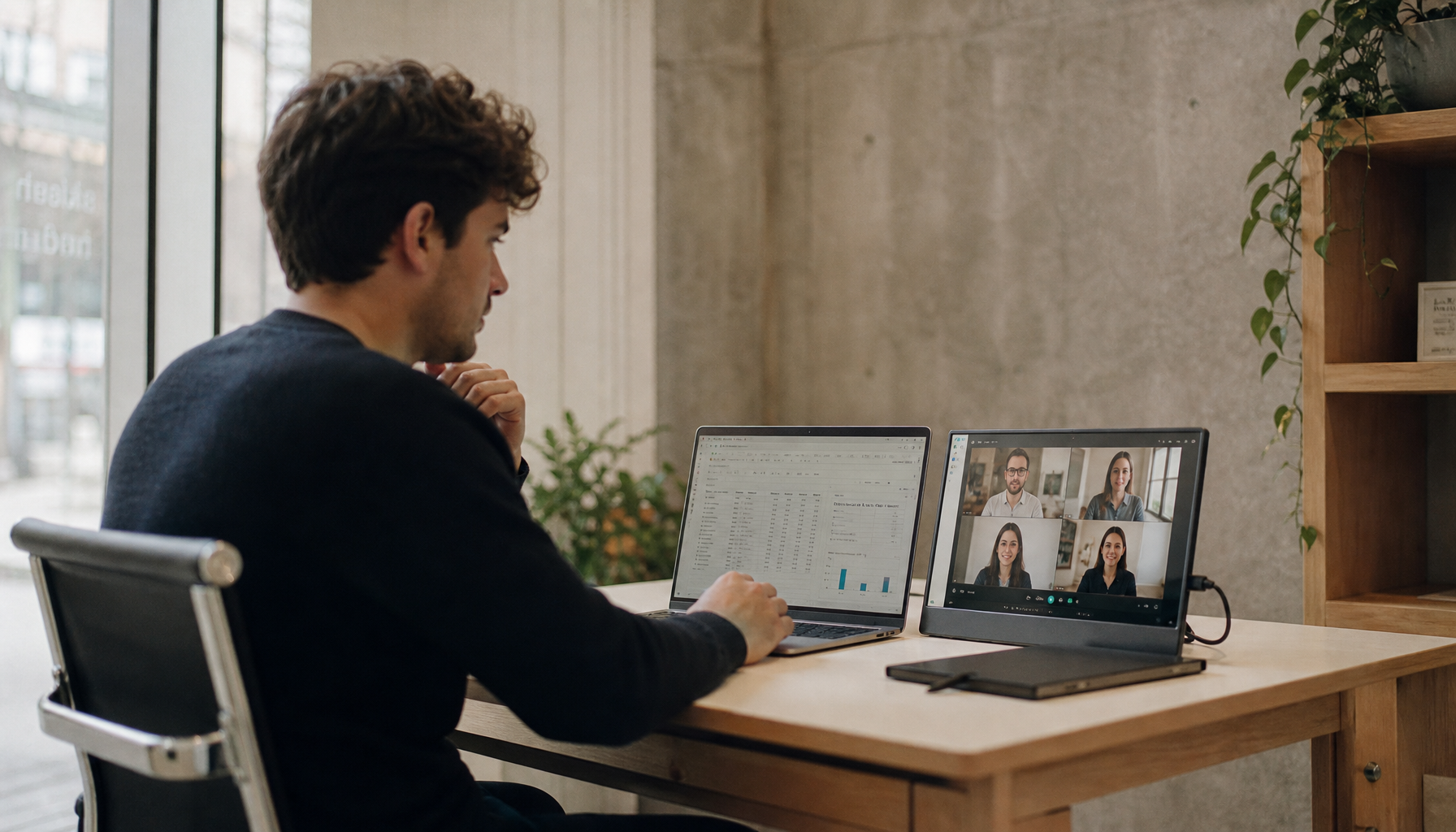
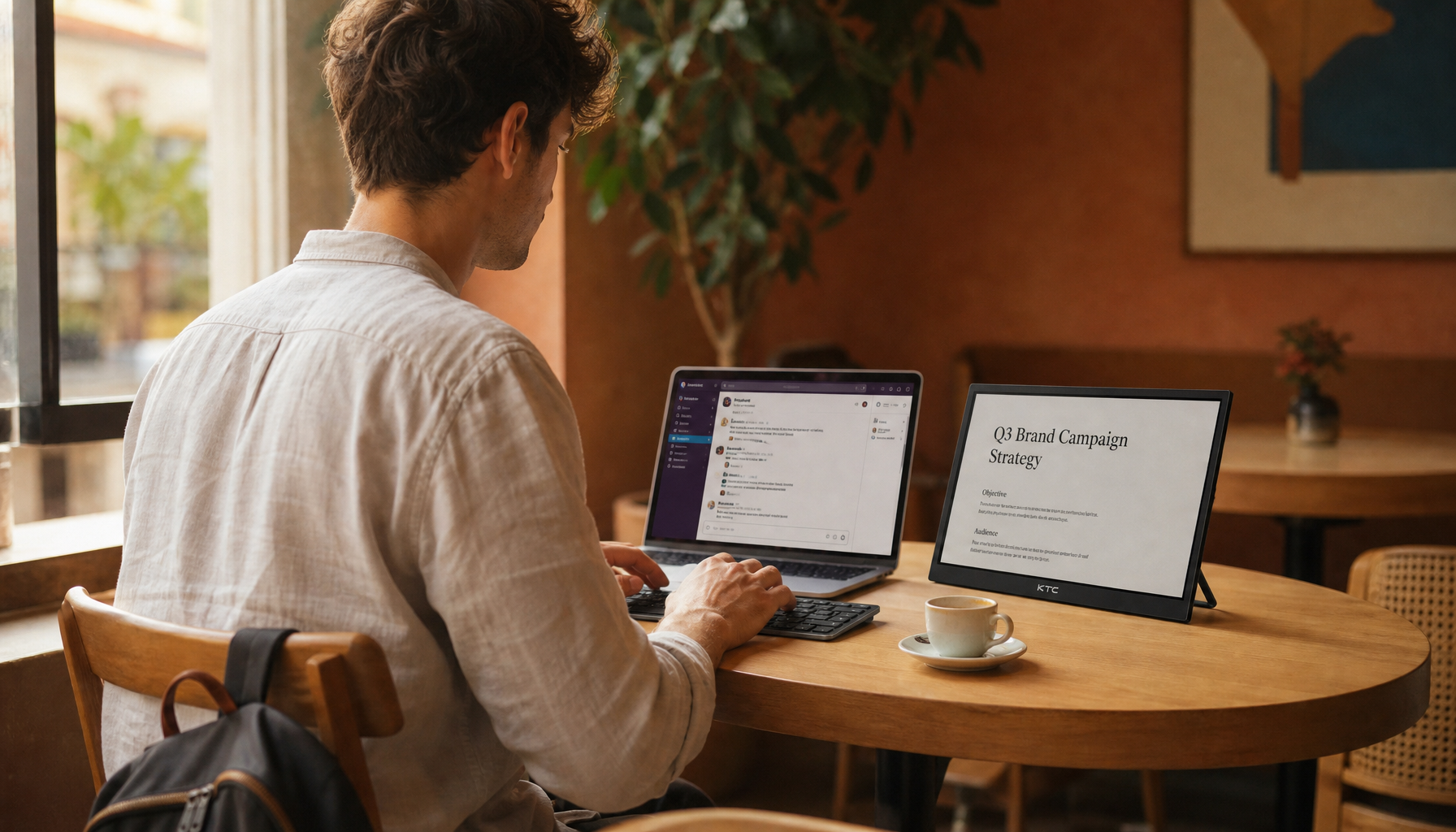
Place your monitor perpendicular to the window, then fine-tune height, distance, tilt, and brightness so the screen works with the room instead of fighting it. If the window cannot move, control the angle of light before adding filters or buying new gear.
Start With the 90-Degree Rule
The strongest baseline is simple: keep the window to your side, not directly in front of you or behind you. A monitor placed at a right angle to windows reduces both direct glare and mirror-like reflections, which is why ergonomic sources consistently recommend positioning screens at right angles to bright light sources.
Avoid facing the window because your eyes must constantly adapt between a bright background and a darker screen. Avoid putting the window behind you because sunlight can bounce straight off the display.
If your desk must stay near the window, rotate the monitor first. Even a 20- to 30-degree swivel can move the reflection away from your eyes without disrupting your posture.

Set Height and Distance Before You Chase Brightness
Glare often makes people lean forward, raise their chin, or tilt their head to see around reflections. That is the real productivity cost: the screen is no longer just hard to read; it is pulling your body out of position.
Keep the top of the screen at or slightly below eye level, with the monitor about an arm’s length away. For most desks, that means roughly 20 to 30 inches from your eyes, adjusted for display size and text scaling; arm’s length is a practical starting point.
For larger monitors, especially 32-inch or ultrawide displays, sit farther back so your eyes can scan the full panel without constant neck movement. Increase font size before moving the screen too close.

Quick setup check:
- Top edge: at or slightly below eye level
- Distance: about 20 to 30 inches for most users
- Primary screen: centered with your keyboard and chair
- Tilt: slight downward angle only if it reduces reflection
- Text: large enough to read without leaning
Use Tilt, Shades, and Bias Light in That Order
Tilt is useful, but it is not a complete fix. If you tilt the screen downward to avoid a reflection, raise the monitor slightly so your neck position stays neutral.
Next, control the window. Blinds, shades, curtains, or solar film reduce the brightness gap between the display and the room. That matters because glare is not only reflection; it is excessive contrast in your field of view.
A small bias light behind the monitor can also help in late afternoon or evening. The goal is a softer visual environment where the screen is not the only bright object.
Anti-glare filters can help with stubborn reflections, but they may soften image clarity. Color-critical creators should try positioning and light control first.
Multi-Monitor and Laptop Setups Need a Primary Screen
If you use two monitors equally, place them side by side with their inner edges meeting in front of you, then angle both slightly inward. This creates a wide view without forcing your neck to rotate all day.
If one display does 80% of the work, center that monitor. Put the secondary screen to the side and angle it toward you, matching height and distance as closely as possible; ergonomic advice for dual displays favors keeping the primary screen directly in front.
For laptop-plus-monitor setups, do not let the laptop sit flat as your second screen. Raise it on a stand and use an external keyboard and mouse, so both displays support upright posture instead of dragging your eyes downward.

When Gear Actually Helps
A monitor arm is the highest-value upgrade when window glare changes throughout the day. It lets you adjust height, depth, swivel, and tilt in seconds, which is more reliable than stacking books under a fixed stand and hoping the sun cooperates.
A matte monitor or anti-glare protector is worth considering for bright rooms, portable screens, or office work where readability beats perfect contrast. Glossy panels can look richer in controlled lighting, but matte finishes are usually more reliable when daylight is unavoidable.
For the cleanest result, combine smart placement with adjustable hardware: side-facing window, centered screen, arm’s-length distance, slight tilt, managed daylight, and brightness matched to the room. That setup keeps text readable and lets your monitor perform like a tool instead of a mirror.