









Monitor curvature changes ideal viewing distance by bringing the screen edges closer to your eyes, so stronger curves generally make more sense at closer seating positions, especially on wide monitors. Still, screen size, aspect ratio, resolution, desk depth, and comfort matter more than the curve rating by itself.
Ever push a curved gaming monitor back and forth on your desk because the center looks right but the corners feel too close, too distant, or oddly stretched? For a 32-inch 4K display, a practical comfort target is about 25 inches, while a 32-inch QHD screen may feel better closer to 37 inches. The goal is to help you choose a viewing distance that fits your monitor, desk, games, and daily work without relying on guesswork.
What Monitor Curvature Actually Changes
A monitor curvature rating describes the radius of the circle that matches the screen’s curve: a lower number means a tighter curve, so 1000R is stronger than 1500R, and 1500R is stronger than 1800R. In practical viewing terms, curvature ratings roughly map to intended distances of about 3.3 ft for 1000R, 4.9 ft for 1500R, and 5.9 ft for 1800R.

That does not mean you must sit exactly 3.3 ft from a 1000R monitor. It means the curve is designed around that radius, while your actual comfort zone may be much closer on a normal desk. Many gaming setups land around 27-32 inches from the screen, while productivity setups often feel better around 30-35 inches because text, toolbars, and multiple windows need room to breathe.
The main effect is not that the monitor becomes physically larger. Curvature does not add panel area, resolution, pixel density, sharpness, or text clarity; it changes how the screen wraps into your field of view. That is why a curved 34-inch ultrawide can feel more immersive than a flat one, while a 24-inch curved 16:9 monitor may feel only mildly different.
The Simple Rule
Stronger curvature usually supports closer viewing, but only when the screen is wide enough for the curve to matter. On a 16:9 monitor, curvature is often a comfort preference. On 21:9 and 32:9 ultrawide gaming monitors, curvature can meaningfully reduce how far your eyes need to sweep from the center to the edges.
Why Screen Width Matters More Than the Curve Label
Curvature has its biggest impact when the screen edges would otherwise sit far from your central view. That is why wider formats such as 21:9 ultrawide and 32:9 super-ultrawide monitors show a stronger field-of-view effect than typical 16:9 displays.
For example, a 27-inch 16:9 monitor can work well as a flat display because the left and right edges are not very far away from your direct line of sight. A 49-inch super-ultrawide is different: if it were flat and placed at the same desk distance, the far edges would sit much farther from your eyes and require more head movement. Curvature brings those edges inward, making the screen feel more continuous.

A useful way to think about it: curvature is an amplifier, not the main ingredient. Screen width, seating distance, and aspect ratio create the viewing experience first; the curve then changes how natural that experience feels. If the monitor is not very wide, the curve has less room to help.
Flat vs. Curved Viewing Distance
Monitor type |
Typical best use |
Practical viewing distance |
Curvature impact |
24-inch flat 16:9 |
Esports, compact desks, portable-like setups |
20-28 inches |
Low; flat is usually fine |
27-inch flat or mild curve 16:9 |
Gaming and everyday work |
24-32 inches |
Mild; mostly preference |
32-inch 16:9 curved |
Mixed gaming, productivity, single large display |
24-30 inches |
Moderate; helps edges feel closer |
34-inch 21:9 curved ultrawide |
Immersive gaming, timelines, multitasking |
28-36 inches |
High; curve improves edge comfort |
49-inch 32:9 curved super-ultrawide |
Sim racing, flight sims, multi-window workflows |
32-45 inches |
Very high; flat can feel too wide up close |
Portable monitor |
Travel, laptop extension, shared work |
18-28 inches |
Low; flat is usually better |
Matching Curvature to Desk Depth and Posture
Desk depth often decides whether a curved monitor feels comfortable before the spec sheet does. A 32-inch monitor is generally most comfortable at a 24-30 inch viewing distance for mixed use, with broader ergonomic guidance placing preferred monitor viewing distances between about 20 and 40 inches.
This is where a curved 32-inch gaming monitor can be easier to live with than a flat one on a shallower desk. A 1000R or 1500R panel pulls the left and right edges slightly toward your natural field of view, which can reduce side-to-side eye scanning. If your desk does not let you push the monitor far back, that curvature can make 24-27 inches feel more workable.
Posture still matters. The top of the screen should sit at or slightly below eye level, and your chair, monitor arm, or stand should let you keep your neck neutral. If the display feels overwhelming, causes you to lean back, or makes you turn your head repeatedly, moving the screen farther away will usually help more than buying a different curve.

A Practical Desk Test
Sit normally, open a full-screen document or game menu, and look at the center of the monitor. If the left and right edges feel easy to read without leaning, the distance is close. If the center feels sharp but the edges demand effort, move the monitor back 2-3 inches or reduce window width for productivity tasks.
For a 32-inch 4K monitor, about 25 inches is a strong starting point because the pixel density supports close viewing. For a 32-inch QHD monitor, text and fine UI details may look more comfortable farther back, closer to 37 inches, depending on scaling and eyesight.
Curved Gaming Monitors: Immersion vs. Control
For gaming, the ideal viewing distance depends on whether you value maximum immersion, fast visual scanning, or long-session comfort. Competitive players often sit closer to smaller high-refresh-rate displays because they want the action centered and easy to track. Sim racing, flight simulation, and open-world games benefit more from curved ultrawide displays because the extra width fills more peripheral vision.
A curved single-monitor field-of-view setup is not always a single fixed number. A curved monitor FOV calculator can estimate a range, with the higher field-of-view value treating the curved monitor as an arc and measuring distance to the straight chord between the screen ends. That distinction matters because curved screens do not behave exactly like flat panels when you translate physical width into in-game FOV.
Start with the higher FOV estimate if you are tuning a racing or simulation game, then adjust downward if the image feels stretched or if speed perception feels unnatural. For shooters and action games, comfort often beats mathematical precision: if you are constantly moving your head to check UI elements, the screen is probably too close or too wide for that game.
Gaming Distance Examples
A 27-inch 16:9 high-refresh-rate gaming monitor often feels natural around 24-30 inches. A 32-inch curved 16:9 display commonly works around 24-30 inches, especially if it is 4K or if you use moderate UI scaling. A 34-inch curved ultrawide usually benefits from a bit more space, around 28-36 inches, while a 49-inch super-ultrawide may need 32 inches or more unless the curve is aggressive and the game supports a well-tuned FOV.
For a concrete desk-depth check, a 34-inch 1500R model such as a 34-inch 2K 180Hz/1ms 1500R curved gaming monitor from a brand fits the ultrawide example above: measure whether your setup lets your eyes sit roughly 28-36 inches from the center before judging the curve by the spec label alone.

Productivity, Text, and Shared Viewing
Curvature is not always an upgrade for work. For spreadsheets, layout work, shared viewing, and frequent collaboration, flat or mildly curved screens are often easier because straight lines stay visually predictable and off-angle viewing is more forgiving. A strong curve can make a large spreadsheet feel enveloping, but it may also make edge alignment or design review less natural.
For everyday productivity, resolution and pixel density strongly affect viewing distance. A 32-inch 4K screen has enough pixel density to sit closer without individual pixels becoming distracting, while a 32-inch QHD panel may feel better farther away or with careful scaling. That is why two monitors with the same size and curve can need different seating distances.
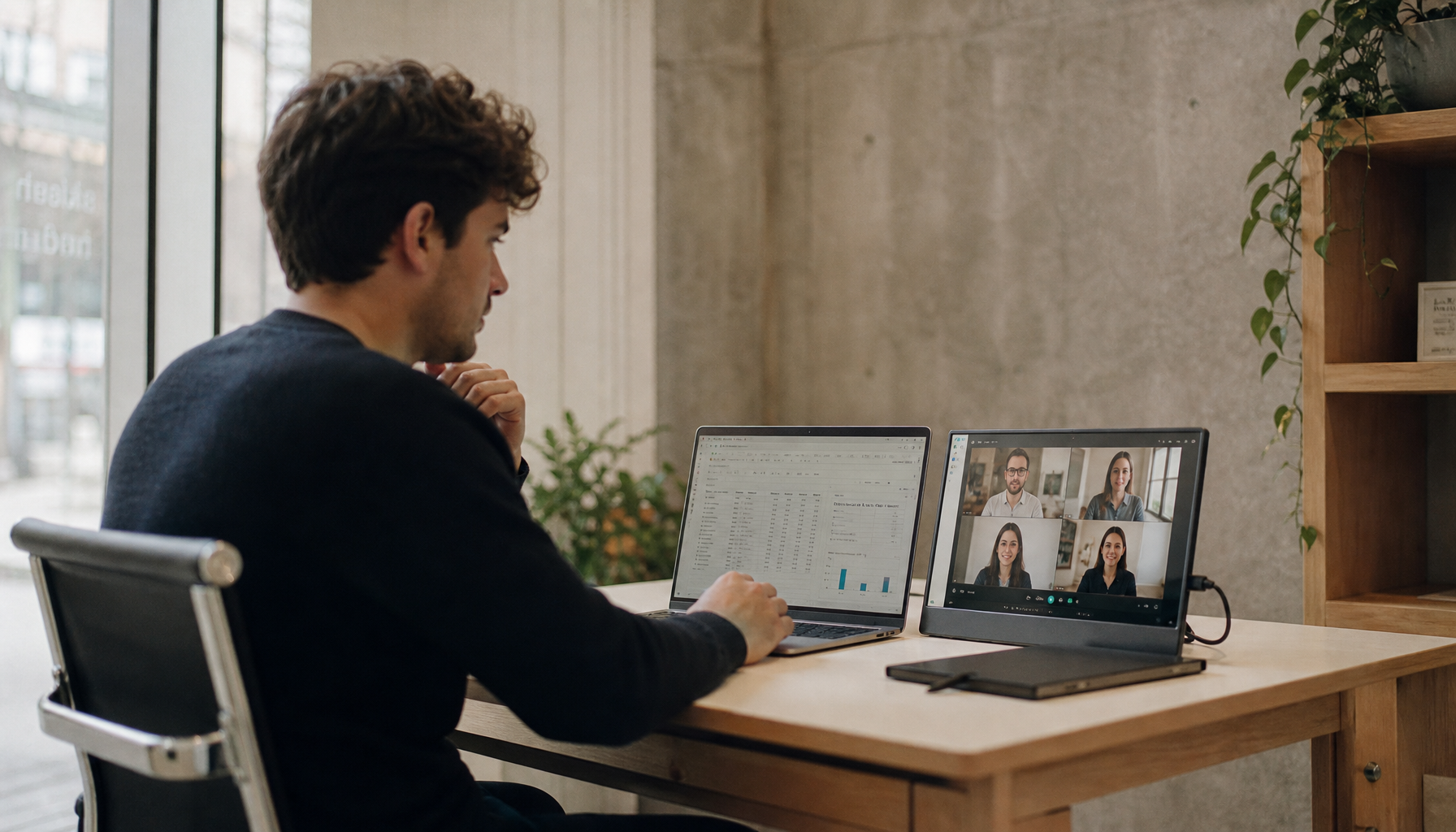
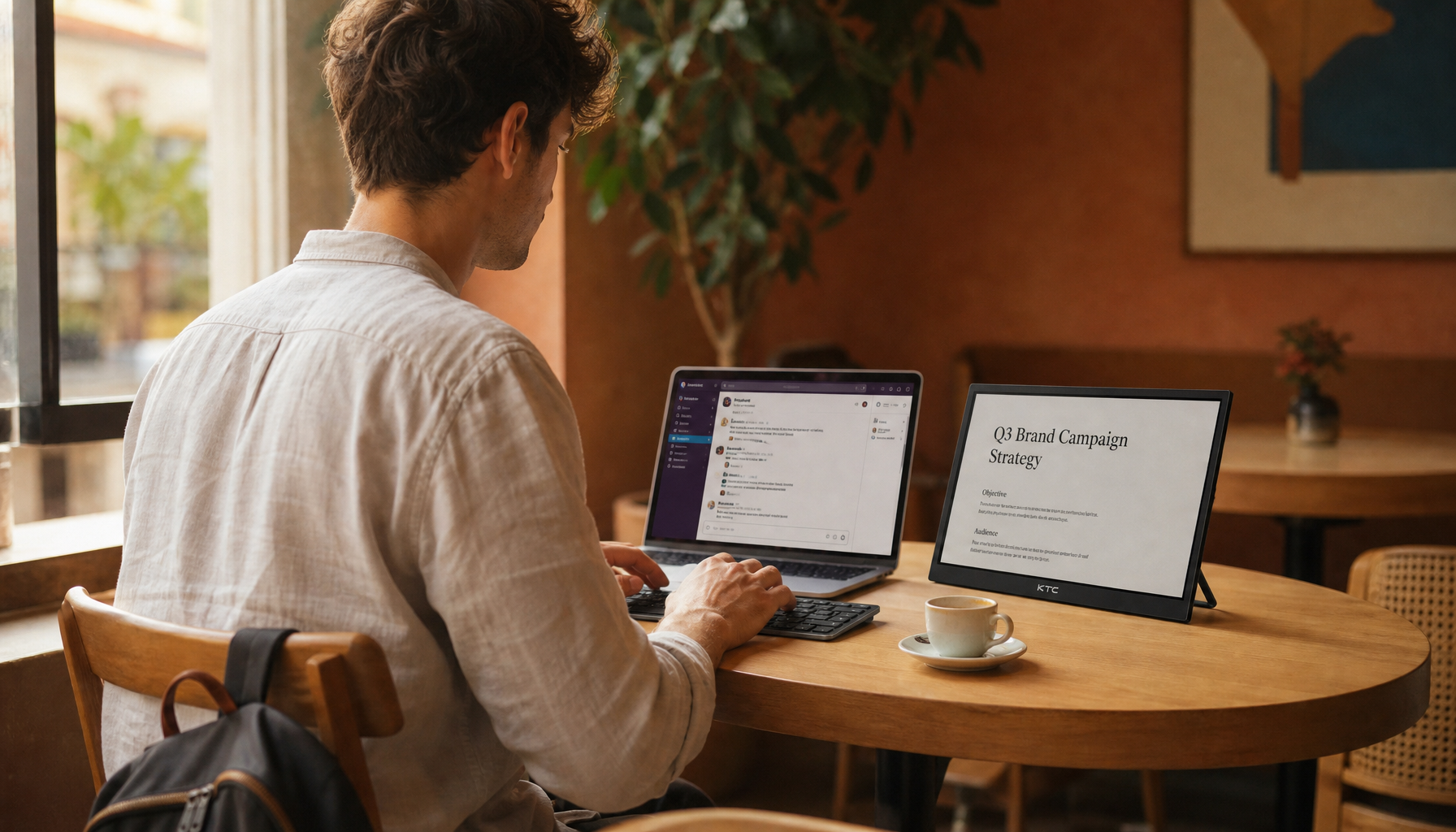
Portable monitors are a separate case. Because they are usually smaller, often shared beside a laptop, and frequently viewed from changing angles, curvature usually adds less value. A flat portable display is easier to position, pack, and use as a second screen in tight spaces such as a hotel desk, conference table, or apartment workspace.
When to Choose Flat or Mild Curvature
Choose flat or mild curvature if you often share the screen, work with grids and layouts, use a portable monitor, or sit far enough back that a stronger curve no longer adds comfort. Choose stronger curvature if you use a wide gaming monitor alone, sit centered, and want the left and right edges to feel more evenly positioned.
How to Set Your Ideal Viewing Distance
Start with the monitor’s size and use case, then adjust by feel. If you are using a 32-inch display for mixed work and gaming, begin around 27 inches. Move closer if text is too small or the game feels detached; move farther back if the edges feel too intense, your eyes sweep constantly, or you find yourself leaning away.
For curved ultrawides, center alignment is critical. Your eyes should line up with the middle of the panel, not one side, because the curve assumes a centered viewer. If the monitor is off-center, one side becomes visually dominant and the benefits of curvature drop quickly.
Use this checklist when setting up a curved gaming monitor, ultrawide display, or large everyday screen:
- Measure from your eyes to the center of the screen, not from the desk edge.
- Start around 24-30 inches for a 32-inch monitor, then adjust in 2-inch steps.
- For 21:9 ultrawide monitors, start around 28-36 inches.
- For 32:9 super-ultrawide monitors, start around 32-45 inches.
- Keep the screen top at or slightly below eye level.
- Sit centered on the curve, especially with 1000R and 1500R monitors.
- If the image feels overwhelming, move the monitor back before changing FOV or scaling.
FAQ
Q: Does a stronger curve mean I should always sit closer?
A: Not always. A stronger curve is generally intended for closer, centered viewing, but the right distance still depends on screen size, aspect ratio, resolution, and your desk. A 1000R ultrawide may feel natural closer than an 1800R ultrawide, but a very large screen can still feel overwhelming if it is too close.
Q: What is the ideal viewing distance for a curved ultrawide gaming monitor?
A: For a 34-inch 21:9 curved ultrawide, start around 28-36 inches and adjust based on game type and comfort. For a 49-inch 32:9 super-ultrawide, start around 32-45 inches. Sim racing and flight games may benefit from closer, more immersive placement, while shooters and productivity work often need more distance.
Q: Is a curved monitor better for eye comfort?
A: It can be, especially on larger and wider screens, because the edges sit closer to your natural field of view. However, curvature will not fix poor posture, low resolution, bad scaling, glare, or sitting too close. If your eyes feel tired, adjust distance, height, brightness, and text scaling before assuming the curve is the problem.
Practical Next Steps
The best viewing distance is the point where the center looks sharp, the edges feel easy to scan, and your posture stays relaxed. Treat curvature as one part of the setup rather than the whole answer: a 1000R, 1500R, or 1800R label gives a useful clue, but size, width, pixel density, desk depth, and how you use the monitor decide the final position.
For most buyers, the practical recommendation is simple. Use flat or mild curvature for smaller 16:9 monitors, shared work, portable displays, and layout-heavy tasks. Choose stronger curvature for large 32-inch gaming monitors, 34-inch ultrawides, and 49-inch super-ultrawides where edge comfort and immersion matter most.


%20suit%20closer%20seating,%20especially%20on%20ultrawide%20gaming%20monitors.%20Set%20the%20perfect%20distance%20...
)