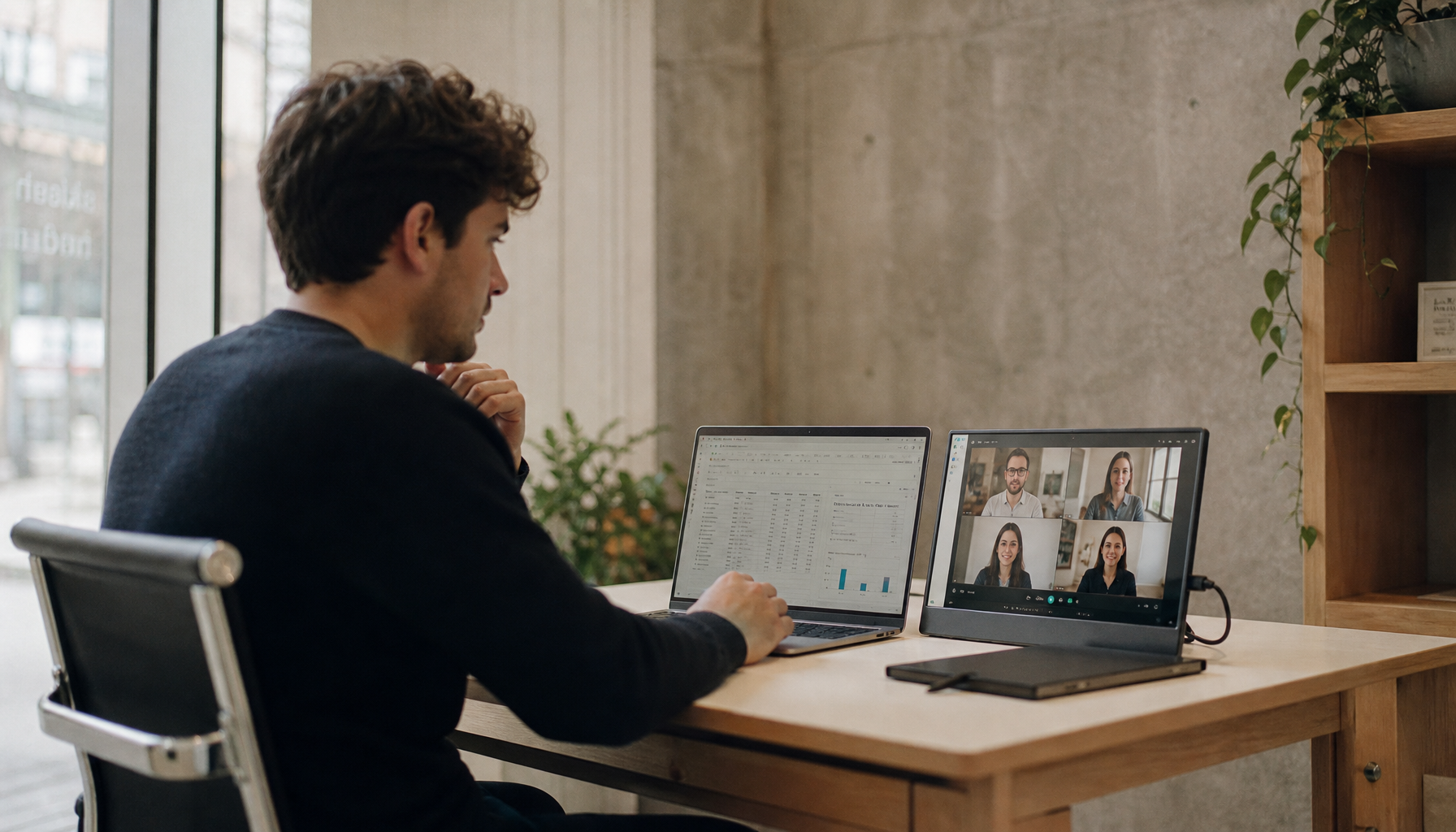
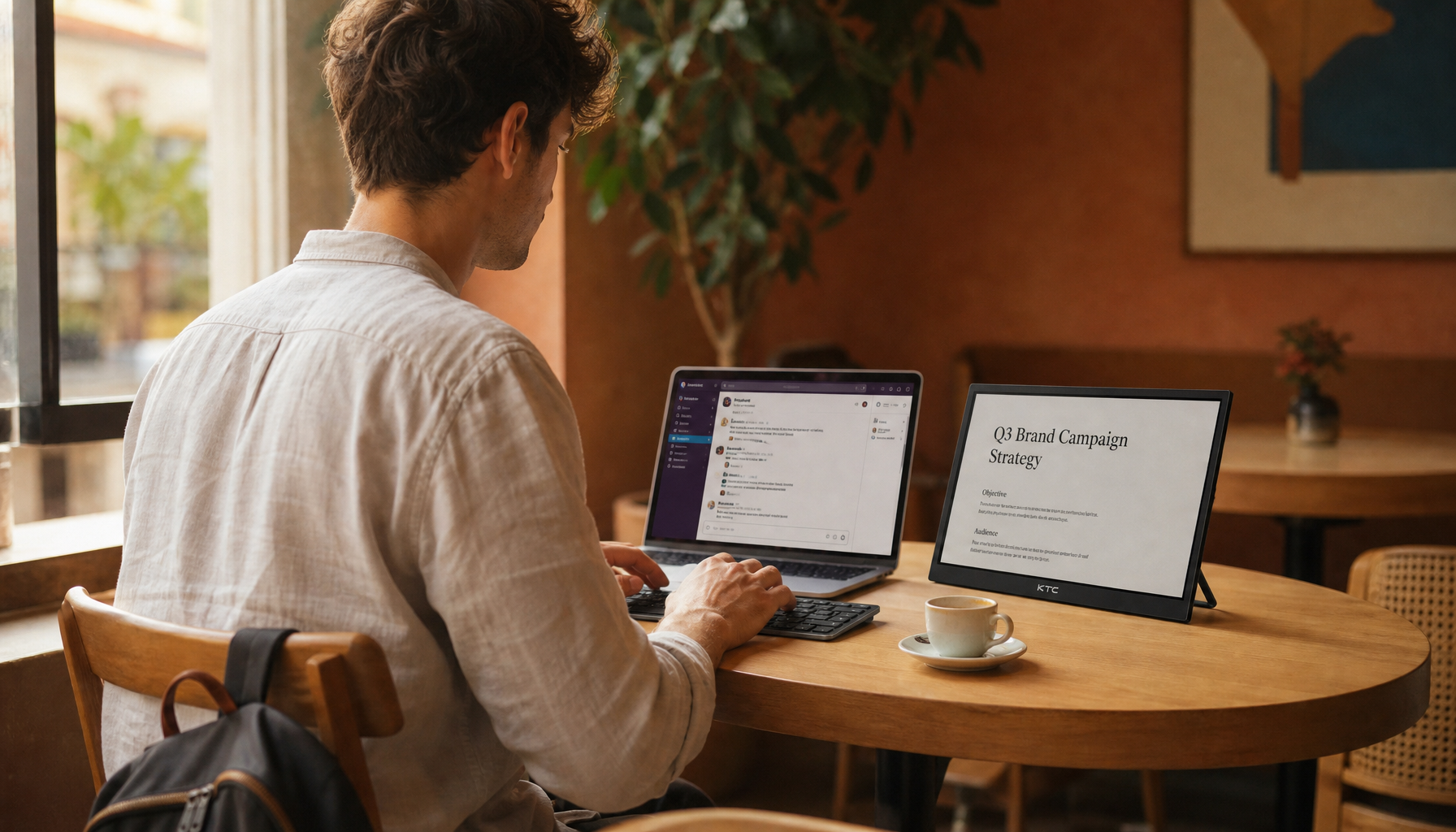
A USB-C KVM monitor setup guide is most useful when you want fewer cables without trading away video stability or easy switching. The clean result usually depends on three things working together: the monitor must support USB-C video, the laptop must support display output over USB-C, and the cable must carry the right modes for both power and data.
Why One-Cable USB-C Desk Setups Work
For most hybrid desks, the appeal is simple: one cable can replace a charger, a video lead, and part of the peripheral chain. That only works when the whole path is capable of carrying display output and power at the same time. USB Power Delivery supports charging over USB-C, but display output still depends on the device chain and Alt Mode support, not just the connector shape. USB Power Delivery provides useful background on the charging side of any USB-C KVM monitor setup guide.
KVM matters because it lets one monitor share keyboard and mouse control across two computers. In plain terms, it reduces the need to replug accessories every time you switch from a work laptop to a desktop. A built-in KVM switch is especially helpful when the desk stays fixed and the switching pattern repeats all day. A specific KVM monitor guide adds further context on shared-peripheral workflows.
If a cable only charges, that is not a failure of the monitor. It usually means the laptop, cable, or port path is missing the video side of the connection. That is why the first test should be direct USB-C, not an adapter stack.
One useful checkpoint is the cable itself. Why some USB-C cables charge your laptop but do not transmit video matches the real-world failure most people hit first. If your cable is charge-only, the desk may look connected but still fail to display an image.
The practical rule is this: if you want the cleanest setup, start with direct USB-C and confirm video first, then add KVM behavior and peripheral sharing after the display is stable.
What Your Monitor Needs to Handle
Before you buy or rearrange the desk, check the monitor's USB-C video support, charging capability, and KVM behavior separately. Those are related, but they are not always bundled in the same way.
A monitor like the KTC 27" 4K 160Hz/320Hz 90W Gaming Monitor | H27P6 is a useful reference point because it combines USB-C charging with a desktop-friendly KVM-style workflow in one display category. That does not make it right for every desk, but it does match the kind of setup this guide is about.
If you need a more office-leaning option, the Office Monitor collection is the better place to browse. If your desk mixes work and gaming, the Gaming Monitor collection is a more natural filter. The All Monitors collection offers the full range when you want to compare every option at once. The point is to match the monitor class to the workflow first, then compare the port details.
Here is the check that matters most:
- USB-C video support: needed for the laptop-to-monitor one-cable path.
- Power delivery: useful when you want the monitor to charge the laptop while in use.
- KVM support: needed when you want keyboard and mouse to follow the active source.
- Stand and desk fit: still matters, because cable savings do not fix a bad viewing height.
A monitor can be technically capable and still be awkward on a small desk. If the stand is fixed and the screen sits too low, the setup may still feel cluttered because you will keep compensating with laptop placement, cable slack, or a second riser.
The same caution applies to charging wattage. How to identify whether USB-C monitor power delivery is sufficient is the right mental model here: use the monitor's wattage as a compatibility check, not as a universal promise that every laptop will stay charged the same way.
This is the first real decision layer: if your laptop needs only a basic charging path and your desk is simple, a direct USB-C monitor makes sense. If you need extra ports, unusual adapters, or a legacy device mix, the setup becomes more conditional.
Set Up the One-Cable Path
A clean setup is easier to verify when you build it in stages.
- Connect the laptop to the monitor with one direct USB-C cable.
- Confirm that the monitor receives video before adding any hub, dock, or adapter.
- Connect the desktop to the monitor's other video input.
- Add keyboard and mouse after the display is stable, then confirm that KVM switching follows the active source.
The reason for this order is practical. If you start with everything at once, a no-signal issue can come from the cable, the laptop port, the monitor input, the dock, or the KVM path. A direct connection strips away most of those variables.

If the monitor shows an image but the keyboard and mouse do not switch, the video path is working but the USB upstream path is not. That is common with KVM-style desks because video and peripheral sharing can fail independently.
A practical decision sentence: if you are still validating the setup, use the shortest direct path first; if everything works cleanly, then a dock or adapter can be added later for convenience.
Where Hubs and Adapters Help
A hub or dock is useful when the laptop does not have enough ports, or when the desk needs a more permanent cable layout. It is less useful when you are still trying to prove the basic connection works.
The trade-off is simple. Direct USB-C is usually the cleanest path because it reduces the number of handshakes and failure points. A dock or adapter can solve a real limitation, but it also adds another part that can break video, charging, or switching.
| Setup Path | Best When | Main Benefit | Main Trade-Off |
|---|---|---|---|
| Direct USB-C | You want the cleanest first test | Fewest cables and simplest troubleshooting | Limited if the laptop lacks the right port behavior |
| Dock / Hub | You need extra ports or a fixed desk | More expansion and easier device grouping | More complexity and another failure point |
| Adapter-based | You need to bridge a legacy device or port mismatch | Can make mixed devices usable | Often the hardest to diagnose when something fails |
Direct USB-C is usually the cleanest starting point. Hubs, docks, and adapters become worth the extra complexity only when they solve a real port, cable, or compatibility constraint.
If you already know your laptop needs extra ports or a dock for other reasons, that can be a valid choice. But if your only goal is a cleaner desk, the extra layer should earn its place by solving a specific problem, not by default.
For some people, the direct route breaks down when the laptop port is unreliable, the cable is too weak, or the dock is doing too much. In those cases, simplify the chain before assuming the monitor is at fault.
Tuning the Desk for Daily Use
Once the cables work, the daily friction shifts to ergonomics and cable slack. A one-cable desk still feels bad if the screen sits too low, the laptop is awkwardly placed, or the cable gets tugged every time you adjust the monitor.
Keep the top of the screen near eye level if you can. Leave enough slack for the stand to move without stressing the port. If you use the laptop open beside the display, place it where it does not force your wrist path or spill into your mouse area.
The other common mistake is hiding the laptop so well that you create a new annoyance. If you still need the laptop for calls or occasional typing, keep it accessible instead of burying it behind the monitor arm or under the desk.
The KTC 32" 4K 60Hz Smart Monitor with Google TV in Netflix Audio Licensed is an example of a larger all-in-one display that fits a more relaxed desk rhythm, but the main question is still the same: does the monitor's physical setup support how you actually work every day?
A useful self-check: if you keep reaching for the cable or moving the laptop to fix posture, the setup is not done yet. A clean desk should reduce handling, not create a new routine.
Check Signal Stability Before You Call It Done
If the setup looks right but still behaves inconsistently, test the path in a fixed order.
- If the laptop charges but shows no image, the cable or laptop port may not support display output.
- If the desktop is visible but switching is unreliable, check input selection and cable quality before replacing the monitor.
- If keyboard and mouse do not follow the active source, verify the KVM path, not only the video input.
- If a direct cable works but a dock does not, the dock is probably the limiting factor.
The USB-C hubs and adapters pass-through guide is useful background when you are deciding whether a dock should stay in the chain. The key idea is that success depends on the whole setup, including Alt Mode support and cable quality, not just the port label.
A practical troubleshooting sentence: if the direct cable works, do not keep stacking adapters to rescue the dock; remove layers until the signal is stable, then add complexity back only if you still need it.
Related Resources
- Premium Display Signal Cables for Gaming & Productivity Monitors
- Managing Two Computers on One Screen
- USB-C Cable E-Marker Chips: How They Affect Power, Data, and Video Capability
FAQs
Q1. How Do I Know If My USB-C Monitor Can Run One Cable for Video and Charging?
Check three things: the monitor must support USB-C video, the laptop must support display output over USB-C, and the cable must carry the right mode for the connection. If any one of those is missing, you may still get charging but not a picture.
Q2. What Is the Difference Between USB-C Video Support and a Charging-Only Cable?
A charging-only cable can power a device but may not carry the data lanes needed for video. That is why a laptop can appear connected while the screen stays blank. For setup work, the cable spec matters as much as the monitor port.
Q3. Why Does KVM Switching Sometimes Stop My Keyboard and Mouse From Following the Active Input?
Because the video path and the USB peripheral path can be separate. The monitor may switch the image correctly while the keyboard and mouse stay on the wrong source if the KVM path or upstream connection is not set up the same way.
Q4. Can a USB-C Dock Replace the Direct Cable in a Clean Desk Setup?
Yes, but only when the dock solves a real problem, such as limited ports or a more permanent workstation layout. If you are still troubleshooting video or charging, direct USB-C is usually easier to validate because it removes extra variables.
Q5. What Should I Test First If the Monitor Says No Signal After Switching Devices?
Start with the source device, then confirm the correct input, reseat the cable, and try a direct connection before blaming the monitor. If the direct path works, the issue is usually the dock, adapter, or cable chain rather than the display itself.
Build the Cleanest Version First
The best USB-C KVM desk setup is usually the simplest one that fully works. Start with direct USB-C, confirm that the laptop gets video and charging, then add KVM switching and only bring in a dock or adapter if it solves a real constraint. If the path feels fragile, reduce layers before you upgrade anything. Test each addition one at a time so you know exactly which change improved or harmed stability. Keep the final cable route short and visible so future adjustments stay easy.