

The 480Hz OLED monitor 2026 question is less about hype and more about control: if your FPS is steady enough, OLED can look cleaner in motion, but IPS is still the safer pick when you care more about repeatable frame delivery than the sharpest pixel transition. The practical cutoff is whether your setup can keep the image stable enough that jitter, not spec sheet speed, becomes the real problem.
What the 480Hz Jitter Threshold Actually Means
At this refresh level, the question is not whether the monitor is fast. It is whether your eyes can see small frame-pacing errors that were easier to hide at lower refresh rates. A 480Hz panel redraws so often that uneven timing can show up as subtle wobble, especially during fast strafes, micro-corrections, and repeated flicks.
For competitive shooters, that matters most when the GPU is already pushing very high FPS and the game is light enough that the display stops being the obvious bottleneck. In practice, the 480Hz OLED monitor 2026 conversation belongs to players who are already chasing consistency, not just higher numbers. A useful self-check is simple: if your frame delivery still feels uneven at 240Hz or 360Hz, 480Hz will expose that more clearly, not fix it.
OLED Response Time at Extreme Refresh Rates
OLED’s main advantage is easy to understand: pixels change very quickly, so motion can look cleaner when the camera is whipping across the screen. Why Do OLED Monitors Claim 0.03ms Response Time While LCDs Stop at 1ms? frames that advantage around faster switching and less blur, and the 0.03ms response time explainer gives the same basic idea in more detail. That is useful context, but it is not proof of 480Hz performance by itself.

What this means for buyers is narrower than the marketing language suggests. OLED can improve perceived motion clarity, but only if the source frame pacing is already good. If your GPU output is uneven, the monitor cannot erase that. So OLED is best treated as a clarity upgrade, not a guarantee of lower latency or better aim by itself.
A good decision sentence here is: if your main complaint is blur during fast camera movement, OLED is usually the better fit; if your complaint is inconsistent feeling from match to match, the panel choice matters less than frame delivery stability.
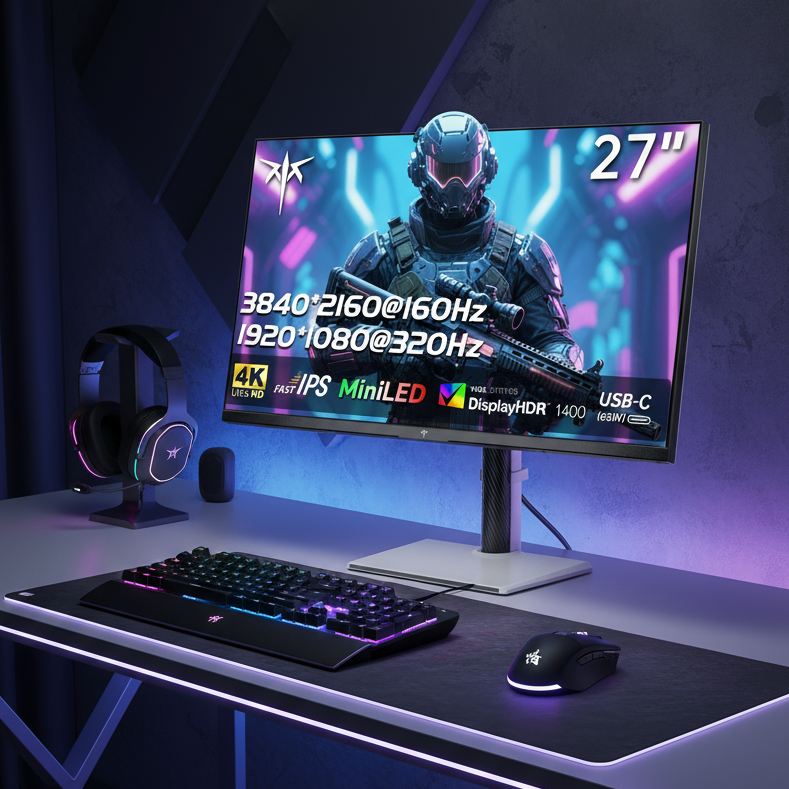
For a concrete reference point, the KTC OLED 27" 2K 240Hz/0.03ms USB-C Gaming Monitor | G27P6 lists 240Hz, 0.03ms GTG, 2560×1440 resolution, and OLED contrast. That is a useful baseline for understanding the OLED side of the trade-off, even though it is not a 480Hz panel.
IPS Stability When Frame Time Is the Priority
IPS still makes sense when the player wants the most predictable feel, even if the pixel response is slower on paper. In esports terms, consistency often beats novelty. A stable IPS panel can feel easier to read during long sessions because the image behaves more like a repeatable instrument than a sharp but highly revealing one.
| Decision Factor | OLED Tendency | IPS Tendency | What The Player Notices |
|---|---|---|---|
| Moving-image clarity | Cleaner transitions and less blur | Slightly less crisp during fast motion | OLED can make flicks look more precise |
| Frame-time stability | Depends more on source pacing | Often feels more forgiving | IPS can feel steadier when FPS varies |
| Jitter visibility | More revealing of timing errors | Can mask small inconsistencies a bit better | IPS may feel calmer in rougher sessions |
| Best use case | Cleanest motion at very high FPS | Repeatable competitive feel | Choose based on what bothers you more |
That trade-off is why a fast IPS reference still matters. The KTC 24.5 inch 360Hz/400Hz OC Fast IPS Gaming Monitor HDR 400 | H25X7 is built around 360Hz native and 400Hz overclocked output, plus Adaptive Sync and 1ms response. Those are strong competitive signals, but the decision value comes from the profile, not just the numbers: it is the more straightforward pick when you want a familiar, stable-feeling esports display.
A practical filter sentence: if you play long ranked sessions and notice that small timing irregularities bother you more than motion blur, IPS is usually the safer choice; if you are chasing the cleanest moving image and can keep FPS high and steady, OLED is the more appealing option.
For readers who want a broader browse path, the 240Hz-400Hz Monitors collection is the right place to compare fast IPS, OLED, and other high-refresh options in one place.

Input Lag, Jitter, and the 400-FPS Problem
-
Start with the source FPS. If the GPU cannot hold high output, the monitor cannot create smoothness from nothing. That is why The Pursuit of Speed: Specs to Prioritize for the Fastest Gaming Experience matters as a general setup check before you overfocus on refresh rate.
-
Separate input lag from jitter. Input lag is the delay between your action and the screen showing it. Jitter is the unevenness you feel when frame timing wobbles. A panel can feel responsive but still look irregular if timing is unstable.
-
Check sustained behavior, not peak spikes. Short bursts above 400 FPS do not tell you much if the game drops back down during real play. In actual matches, the repeatability of the frame stream matters more than one lucky benchmark run.
-
Treat 480Hz as a scrutiny level, not a magic fix. At this level, the display shows you more of what the system is already doing. That is useful if your setup is dialed in, and frustrating if it is not.
A reasonable decision sentence is: if your game and hardware cannot stay near the upper-FPS range consistently, 480Hz will mostly reveal problems rather than solve them; if you already hold very high FPS with low variance, the extra refresh can be easier to justify.
RTX 6070 Ti and 6080 at 1440P 480Hz
At 1440p, the real question is not whether RTX 6070 Ti or 6080 can ever hit high FPS. It is whether they can hold it long enough for a 480Hz panel to be worth the effort. That makes frame pacing the key variable, especially in Valorant and CS2, where scene complexity and fight density can change output from one moment to the next.
For lighter esports titles, a strong RTX 60-series card may make a 480Hz setup plausible if settings are tuned for speed rather than image quality. For heavier or less predictable scenes, the conversation often shifts downward toward 360Hz or 400Hz-class panels because consistency becomes the more realistic target.
The practical check is simple: if your usual match settings already keep frame time smooth at 1440p and your GPU has headroom, the higher ceiling is worth discussing; if not, the smarter move is to favor a panel that matches the FPS you can sustain today. The display can only benefit from speed you can actually feed it.
Choose the Panel That Matches Your Aim Style
- Choose OLED if your priority is the cleanest moving image and you are willing to verify that your FPS is stable enough to benefit from it. The All-OLED Monitor collection is the natural browse path if you want to stay inside that category.
- Choose IPS if you want the most predictable feel from session to session and you value consistency over the absolute fastest pixel transition. The fast IPS monitor path makes more sense when the panel should disappear into the background and behave the same way every match.
- Choose the highest refresh rate you can actually feed. A 480Hz panel is only a win if your setup can sustain the FPS target in the games you play most.
A 480Hz OLED monitor 2026 purchase is easiest to defend when you already know your frame-rate ceiling. If you are still debating whether your system is more comfortable around 240Hz, 360Hz, or 400Hz, the right answer is usually to stay closer to the FPS you can hold consistently.
FAQs
Q1. How Visible Is Jitter at 480Hz in Fast Shooters?
Jitter is easiest to see when the camera is making small, repeated corrections and the frame timing is uneven. At 480Hz, the screen refreshes often enough that those timing errors can look like tiny wobbles instead of normal motion. If your FPS is already stable, the effect is much less obvious.
Q2. Can RTX 6070 Ti or 6080 Really Benefit From 480Hz at 1440P?
Yes, but only in the right games and settings. The benefit depends on sustained FPS and frame-time consistency, not peak benchmark spikes. In lighter esports titles, the pair can make 480Hz worth considering; in heavier scenes, 360Hz or 400Hz may be the more realistic fit.
Q3. What FPS Range Makes 480Hz Worth Considering in Valorant?
It becomes most interesting when your system can hold very high FPS with low variance across normal ranked play, not just in an empty practice range. The more stable your output is above the 400-FPS neighborhood, the more likely 480Hz is to feel like a real upgrade instead of excess headroom.
Q4. Why Can IPS Feel More Stable Than OLED at Extreme Refresh Rates?
IPS can feel more stable because it is often less revealing of small timing changes in day-to-day play. OLED may look cleaner in motion, but that also means it exposes frame pacing problems more clearly. If you care more about repeatable feel than sharpest motion, IPS is often the calmer choice.
Q5. What Should I Check Before Buying a 480Hz Esports Monitor?
Check your sustained FPS in the games you actually play, confirm your connection supports the target refresh rate, and decide whether motion clarity or consistency matters more to you. If you cannot hold high FPS steadily, the best monitor is usually the one that matches your real output instead of your best-case benchmark.
The Safer Buy Is the One That Matches Your Frame Ceiling
The cleanest choice is usually not the fastest panel on paper. It is the one that matches your real FPS, your game mix, and what your eyes notice first: blur or inconsistency. If you want the sharpest motion and can feed it, OLED is compelling. If you want the most repeatable feel, IPS is still the safer esports buy. Verify sustained frame times in your main titles, test for visible jitter during strafes, and match the panel to whether clarity or consistency bothers you more during long sessions.