For a portable smart display vs tablet decision, the right choice usually comes down to who the screen serves. If it needs to stay visible to a room, move between rooms, or sit at eye level for shared use, a rolling smart display is often the better fit. If it is mainly for one person to hold, carry, and use anywhere, a tablet still wins on convenience.

Why the Form Factor Matters
The first question is not screen quality. It is whether the screen is personal or shared.
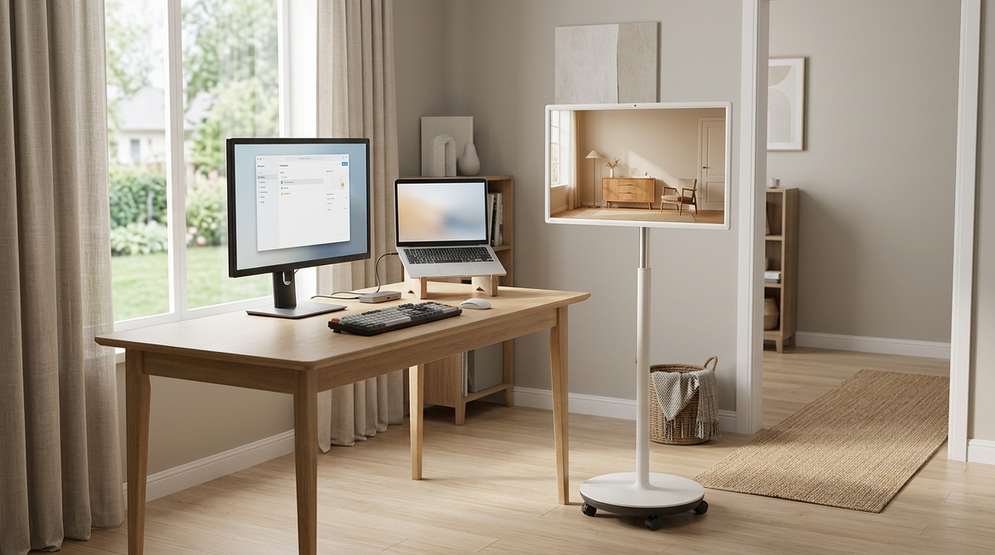
A tablet is built around handheld use, so it is easiest when one person wants quick access in a bag, on a couch, or in bed. A rolling smart display is built around a different job: staying visible to a group, moving from room to room, and keeping the screen upright without a separate stand.
That difference shows up fast in kitchens, living rooms, and floor workouts. A mobile display with a wheeled stand is designed for that kind of movement, while tablet setups often depend on whatever stand or surface you already have. In practice, this is the portable smart display vs tablet question in plain English: do you need a screen that travels with the room, or one that travels with you?
Shared Use vs Personal Use
Use the device that matches the actual job, not the one that sounds more flexible on paper.
| Decision Factor | Portable Smart Display | Tablet |
|---|---|---|
| Primary use | Shared viewing, room-to-room placement, eye-level use | Personal, handheld, one-person tasks |
| Best viewing setup | Upright and visible across a room | Close-up and held in hand or propped nearby |
| Stability | Built for a stand and wheeled base | Depends on a stand, case, or surface |
| Movement | Easier to roll between spaces | Easier to carry in a bag |
| Battery trade-off | Larger screen, so runtime matters more | Smaller screen, usually more portable to live with |
| Setup friction | More like moving furniture into place | Faster for quick personal checks |
| Shared-room fit | Strong | Limited unless everyone is close together |
A rolling display is the better fit when the screen needs to stay in one place long enough for everyone to use it. A tablet is the better fit when the person using it changes often, or when the screen should disappear back into a bag after the task is done.
Where a Rolling Display Wins
For floor workouts, the benefit is simple: the screen can sit at a more natural viewing height instead of living on the floor or a low stand. That makes it easier to follow a routine without constantly looking down. A review of rolling displays in floor and kitchen settings describes that eye-level advantage as one of the main reasons buyers reach for the category.
The same logic applies in kitchens. If you are reading a recipe, watching a cooking tutorial, or following a timer while your hands are busy, a display on wheels is easier to see from across the counter than a tablet on a lightweight stand. Tablet-stand guides for cooking also note that stands may need readjustment on counters or soft surfaces, which is exactly where shared use gets annoying.

Room-to-room use is another strong case. A wheeled display is less fiddly than moving a tablet, its case, and a stand every time the scene changes. If you want one screen for recipes, family viewing, and video calls in different parts of the home, a rolling design is usually the cleaner workflow.
If you want to see how that setup works in a real home flow, the Rolling Smart Display Home Workflows Guide gives a useful follow-up path.
Floor Workouts and Stretch Sessions
For yoga, stretching, or mat-based training, the key issue is sightline. A screen that stays upright at a comfortable height is easier to follow than a tablet angled on the floor. That does not make the rolling option automatically better for every workout, but it does make it a stronger choice when the session is longer, the screen is shared, or you keep reaching for a more readable angle.
Kitchen Counters and Family Viewing
Kitchen use is where a rolling display often feels less like a gadget and more like a utility screen. It can stay visible while someone cooks, and it is easier for multiple people to glance at without crowding around a small display. If your main use is recipe viewing, timers, or family streaming in the same room, a rolling screen usually feels less compromised.
Video Calls and Room-To-Room Tasks
For calls, tutoring, or a screen that moves from desk to living room, the rolling format wins when the goal is shared visibility. It is not about replacing a laptop or a phone. It is about having a screen that can be parked where the room needs it. That is the point where a portable smart display vs tablet comparison usually flips toward the mobile display.
Where a Tablet Still Makes Sense
A tablet still makes sense when the screen needs to disappear into a bag, sit in one hand, or move with the person rather than the room.
- Choose a tablet if you mainly read, browse, or watch solo.
- Choose a tablet if you want the lightest possible option for travel or quick errands.
- Choose a tablet if you do not need the screen to stay visible to other people.
- Choose a tablet if you value spontaneous use over a larger shared viewing area.
This is the main not-a-fit filter: if your use case is mostly one person, one seat, one device, the extra size and stand of a rolling display can feel like more setup than payoff.
Battery, Apps, and Setup Trade-Offs
Battery is easier to judge when you compare it to the way the screen is actually used. Larger portable displays naturally ask more of the battery because they are built to stay visible across a room, not just to light up a personal page. The A25Q5 portable touch monitor lists runtime of up to 11 hours at lower brightness and volume, then drops as brightness and volume rise. That is the right way to think about it: runtime depends on how hard the screen is working.
The same logic holds for the larger KTC MEGAPAD 27" FHD Android 14 Google EDLA Smart Touch Monitor with 9500mAh Battery and the 32-inch model, both of which are built around room-friendly placement rather than pocket portability. The 32-inch model supports direct app use on Android 14, plus HDMI, Type-C, Wi-Fi, Bluetooth, a built-in speaker, and touch input, which matters if you want fewer extra devices in the workflow.
App behavior is another real-world divider. If your setup depends on direct apps, casting, or HDMI input, check that workflow before buying. A screen that is easy to place but awkward to feed content to is still the wrong fit. In this category, the best setup is the one that matches how you already use video calls, streaming, and shared viewing.
How to Decide in Five Checks
Start with the scene, then work outward.
- Identify the main room or use case. Kitchen, living room, workout space, and travel all point to different solutions.
- Ask whether the screen must stay visible to more than one person. If yes, a rolling display moves up the list.
- Check how often you will move it. Room-to-room movement favors a wheeled display; bag carry favors a tablet.
- Confirm the app path. Direct apps, casting, and HDMI all change the setup experience.
- Judge battery against brightness and session length, not against the largest number on the spec sheet.
If you want a browse-by-category next step, the Mobile Touch Screen collection is the cleanest place to compare screen sizes and mobility options side by side.
For buyers who already know they want a room-friendly touch display, the 32-inch model is the strongest example in this group because it pairs a large screen with rolling mobility, Android apps, and multiple input paths. If you want a more general browsing path instead, the All Monitors page is the broader starting point.
If you want a closer look at how the category behaves in home use, the Rolling Smart Display vs Wall Tablet Decision Guide is a useful follow-up, especially if you are comparing mounted versus mobile setups.
When the Choice Flips
The portable smart display vs tablet decision flips when the screen stops being personal and starts acting like a shared fixture.
If the screen stays in one room, supports multiple people, and needs to be readable without constant repositioning, the rolling display usually wins. If the screen needs to travel in a bag, be held in one hand, or disappear between quick solo sessions, the tablet is still the smarter purchase.
That is the cleanest rule: shared room, rolling display; personal carry, tablet.
Related Resources
- MegPad for Culinary Arts: The Ultimate Rolling Kitchen Command Center
- The AI Command Center: Using Rolling Smart Displays for Real-Time LLM Monitoring
- portable smart display buying checklist
FAQs
Q1. How Do I Know If a Rolling Smart Display Is Better Than a Tablet for My Home?
If the screen is meant to serve a room instead of a person, the rolling option usually makes more sense. Kitchens, family viewing, floor workouts, and shared calls are the strongest signals. If the main use is handheld reading, browsing, or travel, a tablet is still the easier fit.
Q2. What Is the Biggest Downside of Using a Tablet on a Stand?
The biggest downside is friction. You may need to reposition it often, and the setup can feel less stable on soft surfaces or active counters. That does not make tablets bad, but it does make them less convenient when the screen has to stay visible and upright for longer sessions.
Q3. Can a Rolling Smart Display Replace a Tablet for Video Calls?
Yes, when the call is happening in a shared room or the screen needs to stay upright for multiple people. No, when the user wants a lightweight personal device they can grab and move instantly. The better choice depends on whether the call is a room fixture or a personal task.
Q4. What Should I Check Before Buying a Portable Smart Display?
Check the battery, stand stability, app workflow, and how often you will move it. Also confirm whether you will use apps directly, cast from another device, or connect by HDMI. Those details matter more than the marketing description, because they determine whether the screen feels natural in daily use.
Q5. Why Does Battery Runtime Matter More on a Bigger Screen?
Because a bigger screen is usually doing more work to stay readable across a room. Runtime should be judged against brightness, volume, and session length, not just the battery size on the spec page. A large display can still be practical, but only if the unplugged time matches how you plan to use it.
The Short Answer for Shared Rooms
For shared-room use, the portable smart display vs tablet choice is usually not close. A rolling display is better when the screen needs to stay visible, move between rooms, or support more than one person at once. A tablet is better when portability, one-handed use, and quick personal access matter more than shared visibility. Reviews of similar rolling models confirm the stability edge for group viewing over repositioned tablets.