Overscan happens when the image sent to your monitor extends beyond the visible edges of the screen, cutting off parts of the taskbar, desktop icons, or application menus. The fastest way to diagnose it is the 30-second Sharpness Test: if the cut-off areas still show crisp, sharp text and edges, the cause is usually signaling overscan that a monitor OSD setting can fix losslessly. If the cut-off text also looks blurry or smeared, the root issue is more likely a resolution or refresh-rate mismatch that Windows or your GPU driver must correct first.

The 30-Second Diagnosis: Is it Overscan or a Resolution Mismatch?
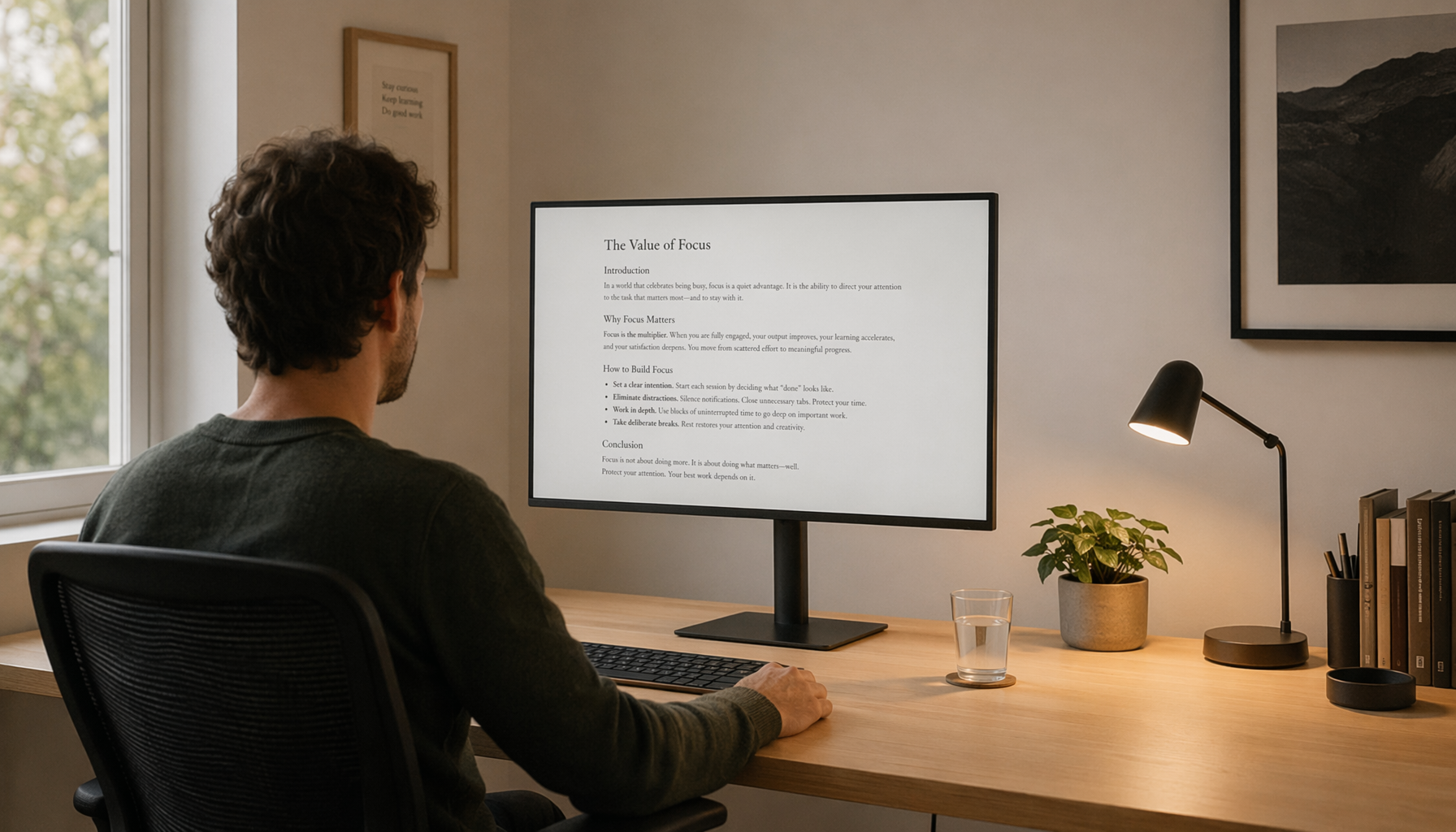
Before changing any settings, perform a simple visual check that separates signaling problems from resolution problems. Open a window with sharp black text on a white background, such as a browser showing this article. If the text remains perfectly crisp right up to the cut-off edge, the monitor is receiving a full-resolution signal but applying internal overscan—typically because it detected a TV-style input. This scenario favors the lossless monitor OSD fix first.
Conversely, if the text near the edge appears fuzzy, anti-aliased, or smeared, the signal itself is not matching the panel’s native pixel count or refresh rate. In that case, correcting the Windows recommended resolution and refresh rate usually restores the full desktop without introducing scaling artifacts.
This triage step prevents the common mistake of applying GPU resizing (a lossy process that re-samples the image) when a simpler upstream fix would have preserved perfect 1:1 pixel mapping. The pattern also explains why the same monitor can look perfect on one cable but overscanned on another.
Step 1: Fix Overscan Using the Monitor OSD (The Lossless Method)
The most effective and highest-quality solution is almost always on the monitor itself. Access the on-screen display (OSD) menu using the joystick or buttons on your KTC monitor and look for options labeled Just Scan, Screen Fit, 1:1, Point to Point, or Aspect Ratio: Full Pixel. Enabling any of these disables the monitor’s internal scaler and maps incoming pixels directly to the panel.
On many displays these options become greyed out when the connected device sends a TV-compatible signal. In that situation, the GPU or cable is the real culprit; changing the monitor setting alone will not help until the source metadata is corrected. This is why the diagnostic flowchart places OSD first yet still requires the follow-on steps when the option is unavailable.
The chart below summarizes the typical decision path based on what you see on screen.
Which Fix to Try First When Text Looks Wrong on Screen
Use the symptom pattern to choose the safest first fix: sharp text with cut-off edges usually points to display signaling or TV-style overscan, while blurry text with cut-off edges usually points to a resolution or scaling mismatch.
View chart data
| Category | Monitor OSD first | Windows native resolution second | GPU scaling last resort |
|---|---|---|---|
| Crisp text + cut edges | 3.0 | 1.0 | 0.0 |
| Blurry text + cut edges | 1.0 | 3.0 | 2.0 |

Step 2: Check Windows 11 Resolution and Scaling
If the OSD setting is unavailable or does not solve the problem, open Settings > System > Display. Make sure the resolution is set to the Recommended value that exactly matches your monitor’s native pixel count. According to Microsoft’s official guidance, using anything else forces the operating system or GPU to scale the image, which can produce both cut-off edges and reduced sharpness.
Also verify that Scale is at 100 % (or the percentage Windows recommends for your panel size). Higher scaling percentages sometimes interact with overscan detection and hide parts of the UI even when the resolution is technically correct. Finally, change the refresh rate from 59 Hz or 60 Hz (common TV defaults) to the monitor’s rated 144 Hz or higher; this often forces the GPU to switch from TV to PC timing metadata and removes the overscan automatically.
Step 3: Adjusting GPU Settings (NVIDIA and AMD)
When the monitor and Windows settings still leave edges cut off, the graphics driver is the next layer to adjust. For NVIDIA cards, right-click the desktop and open NVIDIA Control Panel > Display > Adjust Desktop Size and Position. On the Size tab, check Enable desktop resizing and drag the four corner sliders until the image fits perfectly. NVIDIA’s official documentation notes that this feature is intended as a final compensation when source timing cannot be corrected upstream.
AMD users open AMD Software: Adrenalin Edition, navigate to the Display tab, and locate the HDMI Scaling slider. Moving it left shrinks the image until the full desktop is visible. AMD warns that the slider may be greyed out until native resolution and correct refresh rate are confirmed first.
In both cases, also check the resolution list: if your chosen resolution appears under an Ultra HD, HD, or SD category instead of a PC category, the driver is treating the monitor as a television. Forcing a PC-labeled resolution often eliminates overscan at the metadata level without any manual resizing.
Intel integrated graphics users can open the Intel Graphics Command Center and adjust the Scale setting under Display.
Solving Overscan on macOS External Displays
Mac users connected via HDMI will usually see an Underscan slider in System Settings > Displays. Dragging this slider to the left pulls the image inward until it fits the screen borders. Apple’s support article confirms the slider appears only for HDMI-connected external displays and projectors.
On M1/M2 Macs paired with 1440p or 4K monitors, overscan is especially common over HDMI. Switching to a USB-C cable that supports DisplayPort Alt Mode often makes the slider unnecessary because the connection sends cleaner PC timings. If the native slider is missing or ineffective, third-party utilities such as BetterDisplay can create a custom EDID profile that forces the correct scaling.
Hardware Troubleshooting: Cables, Adapters, and KVMs
Many overscan cases trace back to the physical connection rather than software. HDMI cables and adapters are significantly more likely to trigger overscan than DisplayPort or native USB-C because HDMI defaults to consumer-electronics (CE) timings that include a small overscan buffer for older TVs. DisplayPort and DP Alt Mode over USB-C almost always negotiate proper PC timings and avoid the problem entirely.
Passive DP-to-HDMI adapters frequently strip the EDID information that tells the GPU to use PC mode, forcing TV-style overscan. Replacing a passive adapter with an active one or a direct HDMI 2.1 cable often restores the full desktop without touching any settings. KVM switches and docking stations can introduce the same metadata loss; testing the monitor with a direct cable is a quick way to isolate whether intermediate hardware is the cause.
Our guide on DisplayPort Alternate Mode Over USB-C explains why USB-C connections tend to produce cleaner signaling than HDMI in mixed setups.
Final Verification: How to Confirm a Perfect Fit
After applying changes, verify the fix with two quick checks. First, confirm that the entire taskbar, Start button, and all four desktop corners are visible with no hidden pixels. Second, open a 1:1 pixel test pattern or a page with fine black text on white; every letter should appear perfectly sharp with no interpolation softness. Re-check these indicators after any driver update, cable swap, or resolution change, because Windows and GPU drivers can silently revert settings.
If you continue to experience issues with specific KTC models such as the H27T6 or H27P22S, the monitor OSD labels may vary slightly; look for Just Scan under the Picture or Aspect submenu.
Frequently Asked Questions
Why does overscan only appear on HDMI and not on DisplayPort?
HDMI defaults to TV (CE) timings that reserve a few percent of the image for overscan on legacy televisions. DisplayPort and USB-C DP Alt Mode use IT (PC) timings by default, so overscan is rare. Switching cables is often the fastest hardware-level fix.
My GPU scaling slider is greyed out—what should I do first?
The option is usually locked until the monitor is running at its exact native resolution and a PC-compatible refresh rate. Set those values in Windows Display settings before returning to the GPU control panel.
Can a bad cable or adapter permanently damage my monitor?
No. Overscan caused by signaling or handshake problems is not harmful to the panel; it is simply a metadata mismatch. Replacing the cable or adapter restores normal behavior.
Should I use GPU desktop resizing as my everyday solution?
Only as a last resort. GPU resizing forces the graphics card to re-sample the image, which can introduce slight softness. Correcting the monitor OSD or Windows native resolution preserves the original pixel mapping and maximum sharpness.
Why does my external monitor look fine on my laptop’s USB-C port but overscanned on HDMI?
The USB-C port is likely using native DisplayPort signaling that negotiates PC timings correctly, while the HDMI port is falling back to TV timings. This is common on both Windows laptops and M-series Macs.
Do I need to reset my monitor to factory settings to fix overscan?
Usually not. Most monitors retain the Just Scan or 1:1 setting once selected. A full reset is only helpful if the OSD menu itself has become unresponsive after multiple failed attempts.
For more on related display issues, see our articles on What Is Screen Tearing And How Do You Fix It?, What Happens When Your GPU Can’t Keep Up With Your Monitor’s Refresh Rate?, and the full range of Gaming Monitor and Office Monitor options designed for clean, full-screen performance out of the box.