For people who cannot blink normally, the most helpful monitor changes are usually lower glare, room-matched brightness, moderate contrast, warmer evening color temperature, larger text, and a screen position slightly below eye level.
If your eyes start burning, watering, or feeling gritty within minutes of opening email or a document, the problem is often not just screen time. Low blink rate and incomplete blinking leave more of the eye surface exposed, and the wrong monitor settings can make that exposure feel much worse. The guidance below focuses on the display changes that most often improve comfort on office monitors, gaming monitors, ultrawides, and portable screens.
Start With the Settings That Matter Most
Digital eye strain commonly includes dry eyes, irritation, blurry vision, light sensitivity, and headaches, and reduced blinking is a major reason screens feel harsher than paper. For someone who cannot blink normally because of a medical condition, the first priority is to reduce how aggressively the screen dries and overstimulates the eye surface.
Brightness is the first setting to fix. Matching screen brightness to room light helps because a white page should not look like a lamp, but it also should not look dull or gray. In practice, that means lowering brightness in dim rooms, raising it in bright rooms, and avoiding the common mistake of leaving the monitor at a showroom-style maximum setting all day.

Contrast and text size come next. A contrast range around 60% to 70% is a practical starting point because it keeps letters distinct without turning white backgrounds painfully stark. For reading-heavy work, zooming text to 125% to 150%, using at least 12 pt to 14 pt type, and enabling font smoothing can reduce squinting and refocusing, which matters when blinking is already compromised.
A practical baseline you can set in 5 minutes
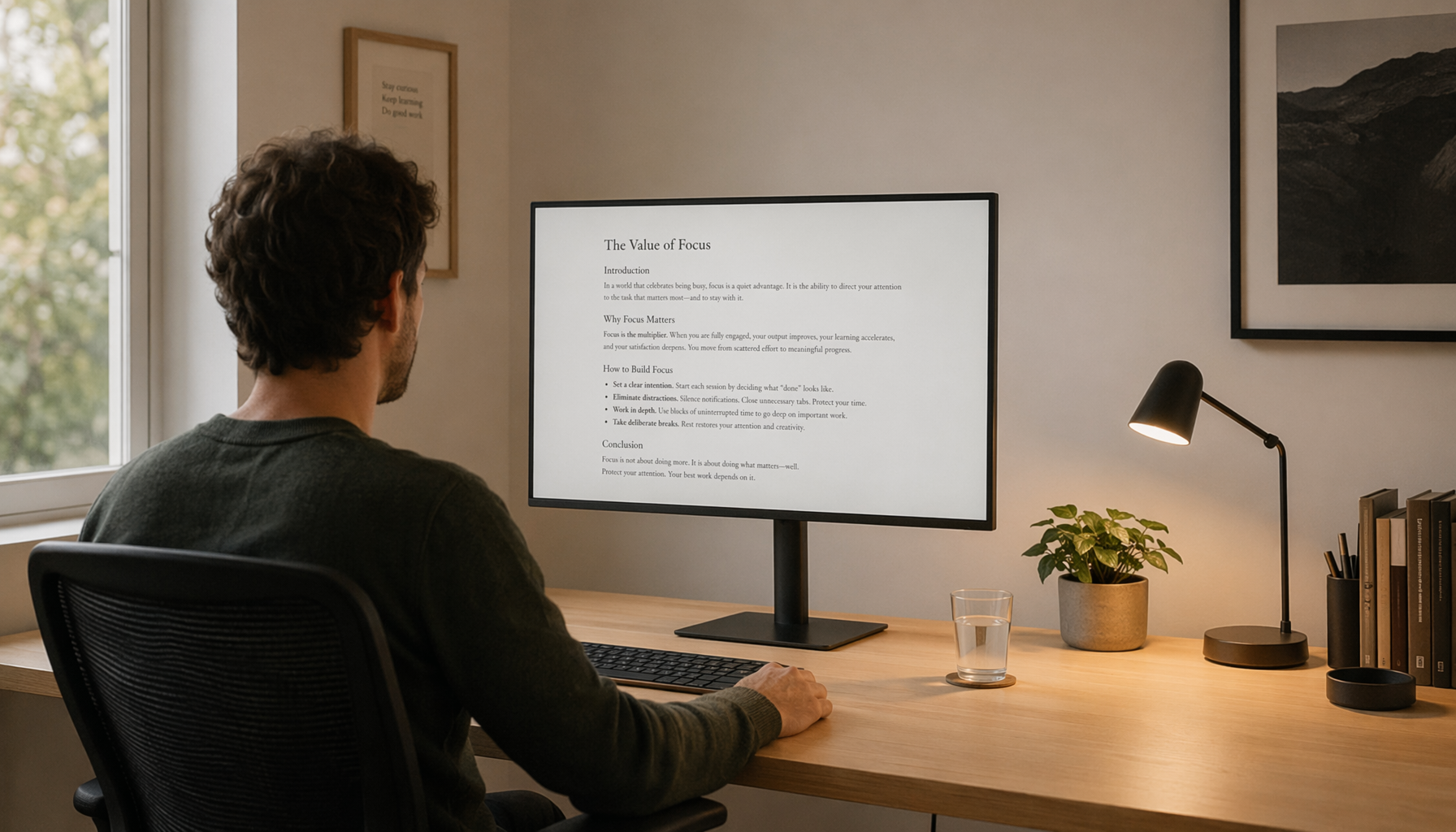
A medically sensitive user editing documents on a 27-inch monitor at about 24 inches away will often do better with moderate brightness, 60% to 70% contrast, 125% scaling, and a slightly warm image rather than a cold blue-white one. Those changes do not cure dry eye, but they reduce the extra strain that comes from tiny text, harsh whites, and constant pupil adjustment.
If your pain is worst on white webpages, try reducing brightness first, then increasing text size, then testing a slightly warmer preset. That order matters because brightness mismatch and small text are supported more consistently than dramatic color-mode changes.
Use Positioning to Reduce Eye Surface Exposure
Monitor height and distance affect more than posture. When the screen is too high, many users open their eyes wider and expose more of the eye surface, which can increase tear evaporation. For low-blink users, that matters immediately.
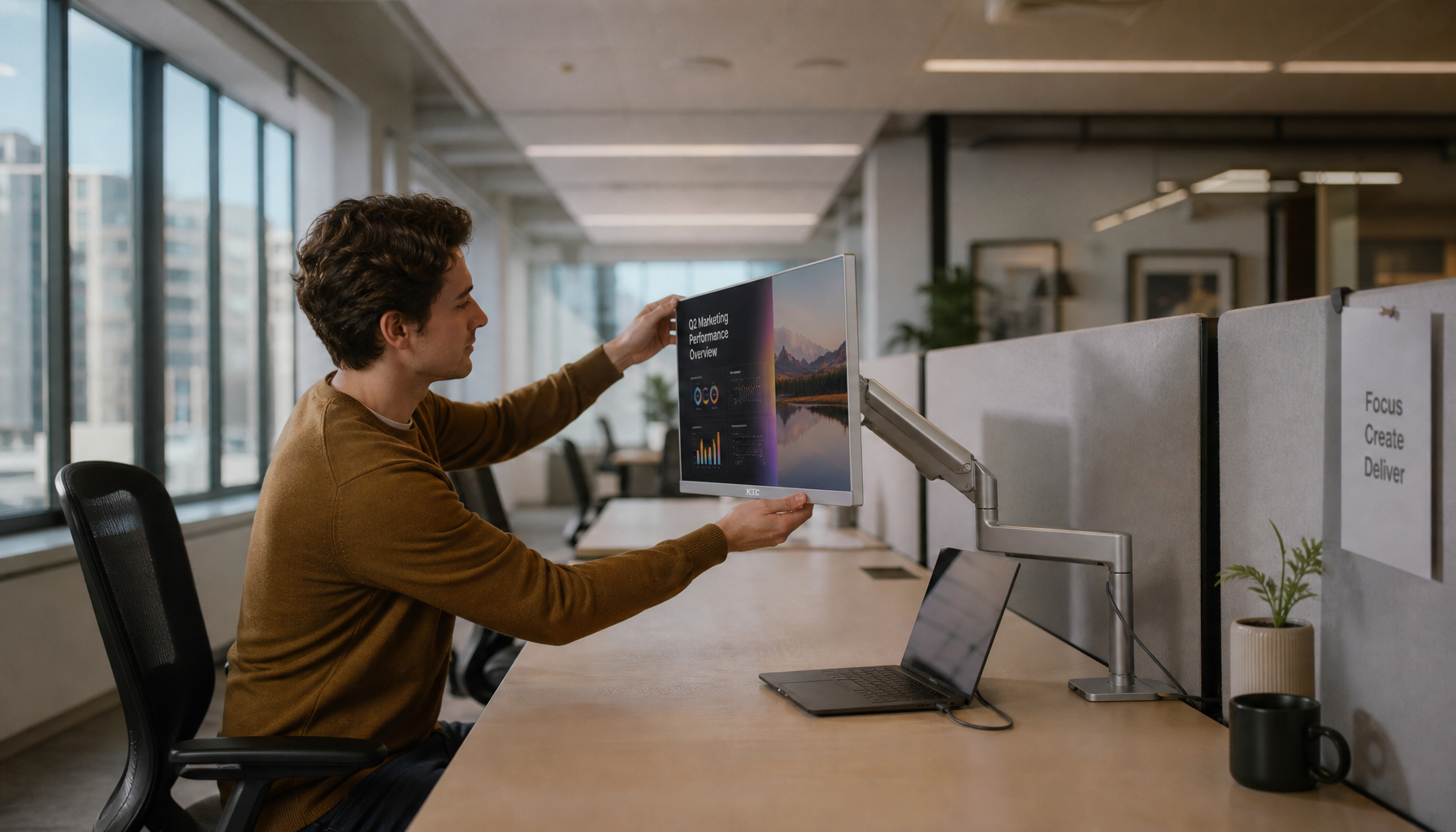
A strong starting point is to place the screen about 20 to 30 inches away, with the top edge at or slightly below eye level and the middle of the screen roughly 4 to 5 inches below eye level. Dry-eye guidance for screen users and general monitor ergonomics both point to a slightly downward gaze as a comfort advantage because it can reduce ocular exposure compared with looking straight ahead or upward.

A modest backward tilt, around 10 to 20 degrees, also helps in real setups because it reduces overhead reflections and lines the panel up with the eye’s natural resting angle. On a desk with a bright window behind you, moving the display and changing its tilt often does more than switching between light mode and dark mode.
Why larger monitors can help
A larger monitor may reduce strain if it lets you read comfortably without leaning in. A 27-inch or 32-inch monitor at proper distance often works better than a small laptop or portable monitor because you can keep text large while maintaining a neutral posture; for comparison, a 27-inch 2K office display such as a 24”/27” 2K IPS 100Hz home and office monitor is the kind of setup that makes larger text and a moderate 100Hz refresh easy to configure.

That benefit disappears if the larger screen forces too much head or eye travel. The goal is not maximum size. It is readable content at a comfortable distance with less squinting, less hunching, and less exposed eye surface.
Glare, Coating, and White Backgrounds Are Often the Hidden Triggers
Screen glare can make users squint, and squinting on top of incomplete blinking is a bad combination. Put lamps to the side of the monitor, not directly in front of or behind it, and control sunlight before you start changing advanced picture settings.

Monitor coating matters too, but not in a simple “matte is better” or “glossy is better” way. Glossy and matte coatings behave differently: glossy screens tend to look clearer in darker rooms, while matte coatings cut mirror-like reflections but can spread glare and slightly soften the image. For someone who struggles with dry eye during reading, either problem can be irritating.
A useful real-world clue comes from user reports on white-background discomfort. One user found that bright white pages were more troublesome than gaming or video, and switching from a PWM-based display to a marketed flicker-free screen did not fully solve the issue. That does not prove matte coating was the cause, but it does show that text clarity, white-page harshness, and coating behavior can matter as much as the marketing label on the box.
Light mode, dark mode, and “paper white”
Light mode tends to work better for precision reading in bright rooms, while dark mode may feel better in dim rooms where white backgrounds flare. For low-blink users, the better rule is simpler: use the mode that lets you relax your eyes instead of bracing against the page.
If white backgrounds feel like a flashlight, reduce brightness first. If black backgrounds make text bloom or smear, switch back to light mode but keep the page less intense by warming the color temperature and avoiding excessive contrast.
Refresh Rate and Flicker: Important, but Usually Secondary to Dryness Control
High-refresh-rate gaming monitors can feel smoother during scrolling, mouse movement, and fast camera motion. That can reduce a sense of visual roughness for some users, especially on 120 Hz to 240 Hz panels. But for people who cannot blink normally, smoother motion is usually not the main fix. Dryness, glare, white-background intensity, and poor positioning tend to be more decisive.
The more relevant buying feature is often flicker behavior. One forum example began with suspicion around 200 Hz PWM dimming on an older monitor from a brand and then compared it with a marketed flicker-free monitor from another brand. That kind of anecdote is not clinical proof, but it matches a practical buying principle: if you are medically sensitive, prioritize monitors advertised as flicker-free or DC-dimmed, then test them yourself under your actual work conditions.
Color temperature also belongs in this section because many gaming monitors ship with a very cool, vivid factory preset. Warmer settings around 5,000K in daytime and about 3,700K in the evening are reasonable starting points for comfort. You do not need to force everything amber all day. The goal is to remove the cold, high-energy look that often makes white screens feel sharper than necessary at night.
What to prioritize on a gaming monitor
Choose a gaming monitor for low-blink comfort the same way you would choose a work monitor: readable text, low glare, stable brightness control, and enough size to avoid leaning in. High refresh is a nice extra, not the core treatment.
If you are deciding between a flashy 240 Hz panel and a calmer 144 Hz panel with better text clarity, better ergonomics, and verified flicker-free behavior, the second option is often the safer buy for dry-eye-prone users.
How Ultrawide and Portable Monitors Change the Comfort Equation
Ultrawides can be excellent for productivity because they let you keep large windows side by side without shrinking text. For users with dry eye or incomplete blinking, that can reduce the urge to lean toward a smaller display. But they also introduce edge distance and eye-travel issues, especially on very wide 49-inch models.
One ultrawide eyestrain discussion compared two 49-inch 32:9 displays with different curvature. The practical takeaway is not that one curve is universally safer. It is that stronger curvature may help keep the left and right edges from feeling visually “far away,” which can reduce awkward viewing angles on extra-wide screens. On a shallow desk, though, even a curved ultrawide may still sit too close.
Portable monitors need the most caution. Their smaller size often pushes users to sit too close, crank brightness, and work from poor angles. If you must use one, compensate aggressively: raise text scaling, lower brightness, keep the panel slightly below eye level, and use it for short sessions rather than all-day reading.
Comparison table: comfort-focused monitor setup choices
Setting or feature |
Best starting point for low-blink users |
Why it helps |
Watch out for |
Brightness |
Match room light; white pages should not glow like a lamp |
Reduces harshness and pupil stress |
Max brightness in dim rooms |
Contrast |
About 60% to 70% |
Keeps text clear without extreme white-black punch |
Very high contrast on white-heavy work |
Color temperature |
Neutral-warm by day, warmer at night |
Cuts the cold look of bright white screens |
Over-warming that distorts color-critical work |
Text scaling |
125% to 150% when needed |
Reduces squinting and refocusing |
Leaving text tiny on high-resolution panels |
Screen position |
Top at or slightly below eye level; center 4 to 5 inches lower |
Helps reduce eye exposure and neck strain |
Mounting the monitor too high |
Viewing distance |
About 20 to 30 inches for many desks |
Supports readable text without leaning in |
Sitting too close to small screens |
Coating |
Match coating to room lighting |
Better balance of reflections and clarity |
Assuming matte is always easier on the eyes |
Refresh rate |
120 Hz+ if comfortable, but not at the expense of other factors |
Smoother motion on gaming and work screens |
Treating refresh rate as the main dry-eye fix |
Dimming method |
Flicker-free or DC-dimmed if possible |
May reduce discomfort in sensitive users |
Relying on marketing without testing |
Monitor type |
27-inch to 32-inch desktop monitor for most desks |
Easier readable text than a small portable panel |
Oversized ultrawide on a shallow desk |
A Setup Checklist You Can Actually Use
A 20-20-20 break routine is still important because even perfect monitor settings cannot fully offset reduced blinking. A clinic source also notes that screen users may blink only 3 to 7 times per minute and may not fully close their eyes, which explains why comfort can collapse during long uninterrupted sessions.
Use this checklist when setting up a new monitor or trying to rescue an uncomfortable one:
- Put the monitor 20 to 30 inches away.
- Lower it so the top edge is at or just below eye level.
- Set contrast around 60% to 70%.
- Adjust brightness until white pages look like paper in your room, not a light source.
- Increase scaling to 125% to 150% before you decide a display is “too sharp” or “too tiring.”
- Use a warmer color setting in the evening and reduce glare from windows and overhead lights.
- Prefer flicker-free monitors and test them with the tasks that usually trigger symptoms, especially web browsing and document work.
If symptoms are worst after about 2 hours, that pattern also fits digital eye strain risk. In practice, many users discover that the painful combination is not one bad setting but three or four smaller problems stacked together: a bright panel, tiny text, a high mount, and long sessions without breaks.
FAQ
Q: Is dark mode the best choice for someone who cannot blink normally?
A: Not always. Dark mode may feel better in dim rooms because it reduces glare, but light mode can be better for careful reading in bright rooms. The better choice is the one that lets you read without squinting or feeling blasted by the background.
Q: Will a high-refresh gaming monitor fix dry-eye-related screen pain?
A: Usually not by itself. A higher refresh rate can make motion look smoother, but medically sensitive users often get more relief from correct brightness, larger text, lower glare, proper screen height, and flicker-free dimming.
Q: Are matte monitors better than glossy monitors for eye strain?
A: It depends on the room and the panel. Matte coatings reduce mirror-like reflections, but some can soften text or spread glare. Glossy screens can look clearer in darker rooms. Choose based on your lighting, not the coating label alone.
Practical Next Steps
If you cannot blink normally, treat monitor comfort as a buying and setup problem, not just a willpower problem. Start with brightness matched to room light, 60% to 70% contrast, larger text, a slightly lowered screen, and a warmer evening preset. When shopping, prioritize flicker-free dimming, readable text, manageable glare, and a monitor size that lets you keep distance without leaning in.
For most people, a well-positioned 27-inch or 32-inch desktop monitor is easier to tame than a tiny portable display, and a sensible 144 Hz gaming monitor is often a better real-world choice than an ultra-bright esports panel pushed for maximum impact. If discomfort remains severe despite careful setup, that is a sign to involve your eye-care clinician while keeping the display environment as forgiving as possible.
References
- A clinic: Computer Vision Syndrome
- A health publisher: Computer Use and Dry Eye
- An eye-care provider: Screen Time and Dry Eye Remedies
- An eye-care provider: Managing Digital Eye Strain and Dry Eyes
- A company: The Best Monitor Settings for Your Eyes
- A company: Best Monitor Settings for Eyes
- A workplace wellness publisher: Best Screen Settings for Eyes
- A brand: Optimal Monitor Viewing Angle
- A review platform: Glossy vs Matte Monitor Coating
- A platform: Eyestrain Only on Monitors With Matte Finish?
- A platform: Ultrawide Monitor Eyestrain Issues
- An eye-care provider: Dry Eyes and Digital Screens