If your monitor brightness seems reasonable but you still squint, the problem is often contrast, glare, text clarity, viewing distance, refresh behavior, or mismatched screens rather than brightness alone.
You open a document, lean toward your monitor, narrow your eyes, and wonder why a screen that is not obviously bright still feels hard to read. A few practical changes, such as matching screen brightness to the room, moving the monitor to about 20 to 28 inches away, and increasing text scaling on dense displays, can often make the screen feel easier within minutes. Here is how to diagnose the real cause and tune your monitor setup before replacing the display.
Brightness Is Not the Same as Visual Comfort
Why “looks fine” can still feel wrong
Monitor brightness is only one part of the viewing experience. Your eyes also respond to room lighting, reflections, text contrast, screen coating, font size, viewing distance, and how often the image changes. Digital eye strain can show up as eyestrain, headaches, blurred vision, dry eyes, and neck or shoulder discomfort, especially after long screen sessions involving computers, tablets, and phones digital eye strain.
A common mistake is adjusting brightness while ignoring the room. If a monitor is technically “not too bright” but sits under overhead light or near a window, reflections can wash out text and make you squint. A university’s ergonomics guidance notes that glare is present when you can see your reflection, windows, or lights reflected in the screen reflected in the monitor.
The white-page test is more useful than the brightness number

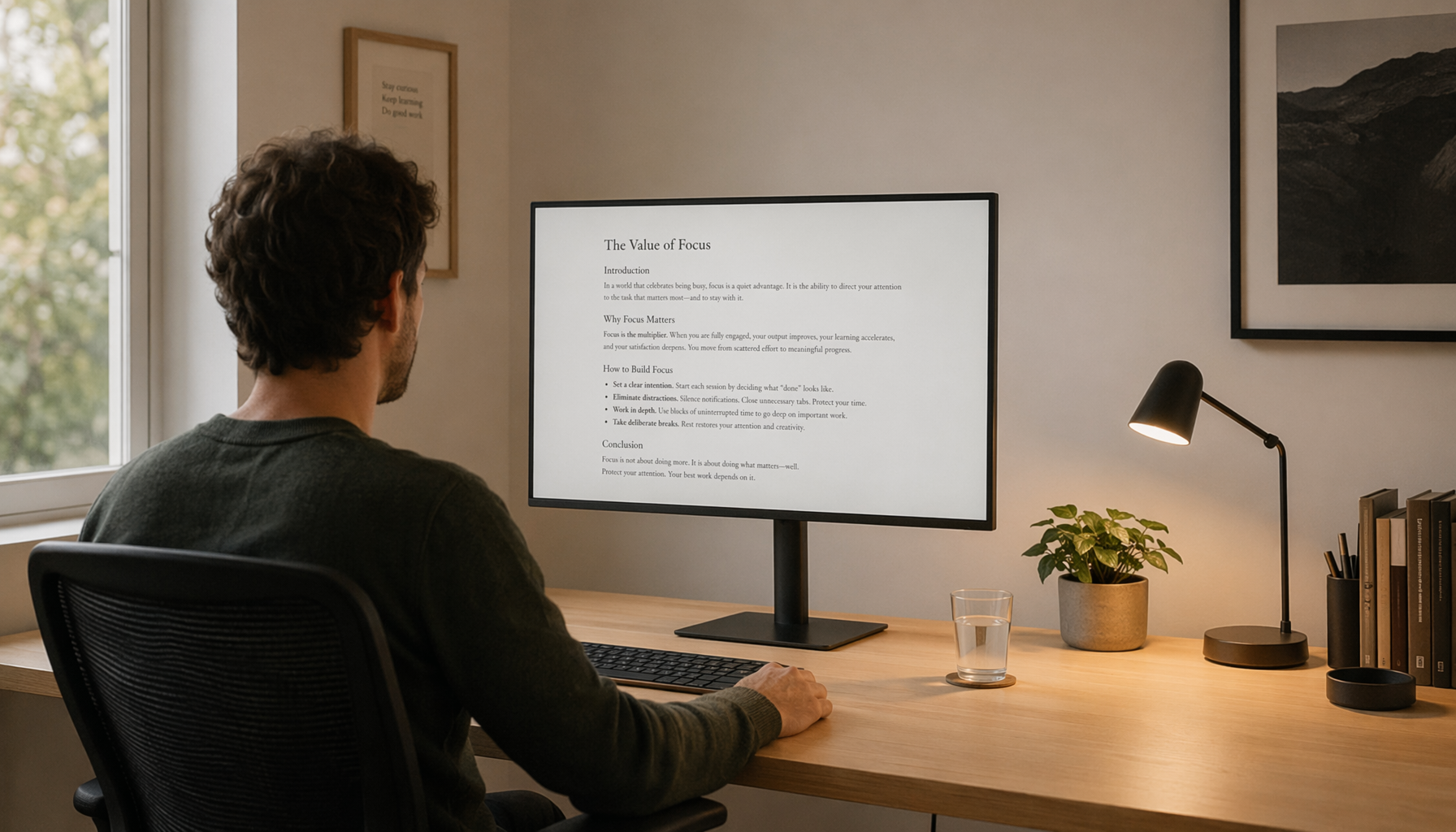
A monitor set to 35% brightness is not necessarily dimmer than another monitor at 60%. Different panels, backlights, and factory presets produce different light output at the same menu percentage. For a practical test, open a white document or browser page and compare it with a sheet of white paper under your room lighting. If the screen glows like a light source, reduce brightness; if it looks gray and dull, raise it.
For typical office-style rooms, a practical starting point is around 100 to 150 nits, while darker rooms often feel better around 80 to 100 nits. Factory monitor presets, especially on gaming monitors, are often tuned for bright retail displays and may exceed 300 nits with aggressive contrast factory monitor presets.
Text Sharpness, Scaling, and Contrast Can Make You Squint
Small text is a monitor setup problem, not just an eyesight problem

If you squint mostly while reading spreadsheets, emails, code, or browser text, the issue may be text rendering rather than brightness. Digital text can be harder to view than printed text because screen characters may have lower contrast, less defined edges, and more interference from glare or reflections digital text.
This is especially common with 27-inch 1440p monitors, 32-inch 4K monitors, portable 14-inch to 16-inch displays, and ultrawides used at the wrong scaling level. A dense 4K monitor can look crisp, but if scaling is set too low, text becomes physically small. On dense displays, 125% to 150% text scaling is often more comfortable than forcing everything to 100% for more desktop space text scaling.
If a lower-density display still makes text look fuzzy after native resolution and scaling checks, compare it with a 27-inch 4K IPS panel such as a 27-inch 4K IPS 60Hz low-blue-light home and office monitor. The point of the comparison is text density and rendering, not brightness alone: keep distance, scaling, and room lighting the same before judging the panel.

Contrast helps until it becomes harsh
Good contrast makes text easier to separate from the background, but extreme contrast can feel harsh during long sessions, especially in dark rooms or on bright Mini-LED and HDR-capable monitors. A practical starting point for SDR desktop use is contrast around 60% to 70%, then adjust by looking at small text on a white page and gray UI panels rather than using a game menu as the only reference.
If you use dark mode, watch for another problem: bright white text on a pure black background can cause halo-like discomfort for some people, particularly on high-brightness displays. A softer dark gray background and slightly reduced contrast may be easier than maximum contrast. For mixed SDR and HDR use, lower SDR content brightness and modest local dimming settings are often better for desktop work than full HDR intensity mixed SDR/HDR use.
Symptom |
Likely Monitor Cause |
First Adjustment |
What to Check Next |
Squinting at text |
Text too small or scaling too low |
Increase OS scaling to 125% or 150% |
Confirm native resolution is enabled |
Screen feels washed out |
Glare or low contrast |
Reduce reflections, then tune contrast |
Check matte coating haze or window glare |
Screen feels harsh |
Brightness or contrast too high |
Lower brightness and contrast slightly |
Disable vivid retail/game presets |
Eyes tire in games |
Motion blur, flicker, or low refresh |
Use the highest stable refresh rate |
Check overdrive and motion settings |
One screen feels worse |
Laptop and external monitor mismatch |
Match apparent brightness on a white page |
Align height, color temperature, and scaling |
Ultrawide edges feel hard to read |
Too close or poor viewing angle |
Move back to 2 ft to 3 ft 4 in |
Consider curvature and panel type |
Glare, Distance, and Position Change How Hard Your Eyes Work
Reflections can make a good monitor feel bad
Glare does not always look dramatic. Sometimes it is just a faint reflection across the top half of the panel or a bright patch from a nearby window. That small reflection lowers perceived contrast, so your eyes try to compensate by narrowing, leaning in, or changing posture.
Before buying a new monitor, turn the display off and look at the dark screen. If you can see a window, ceiling light, lamp, or your own face clearly, fix the environment first. Move the monitor perpendicular to windows when possible, angle overhead lights away from the panel, and avoid placing a glossy portable monitor where it reflects a lamp behind you.

Distance and height matter more on large monitors
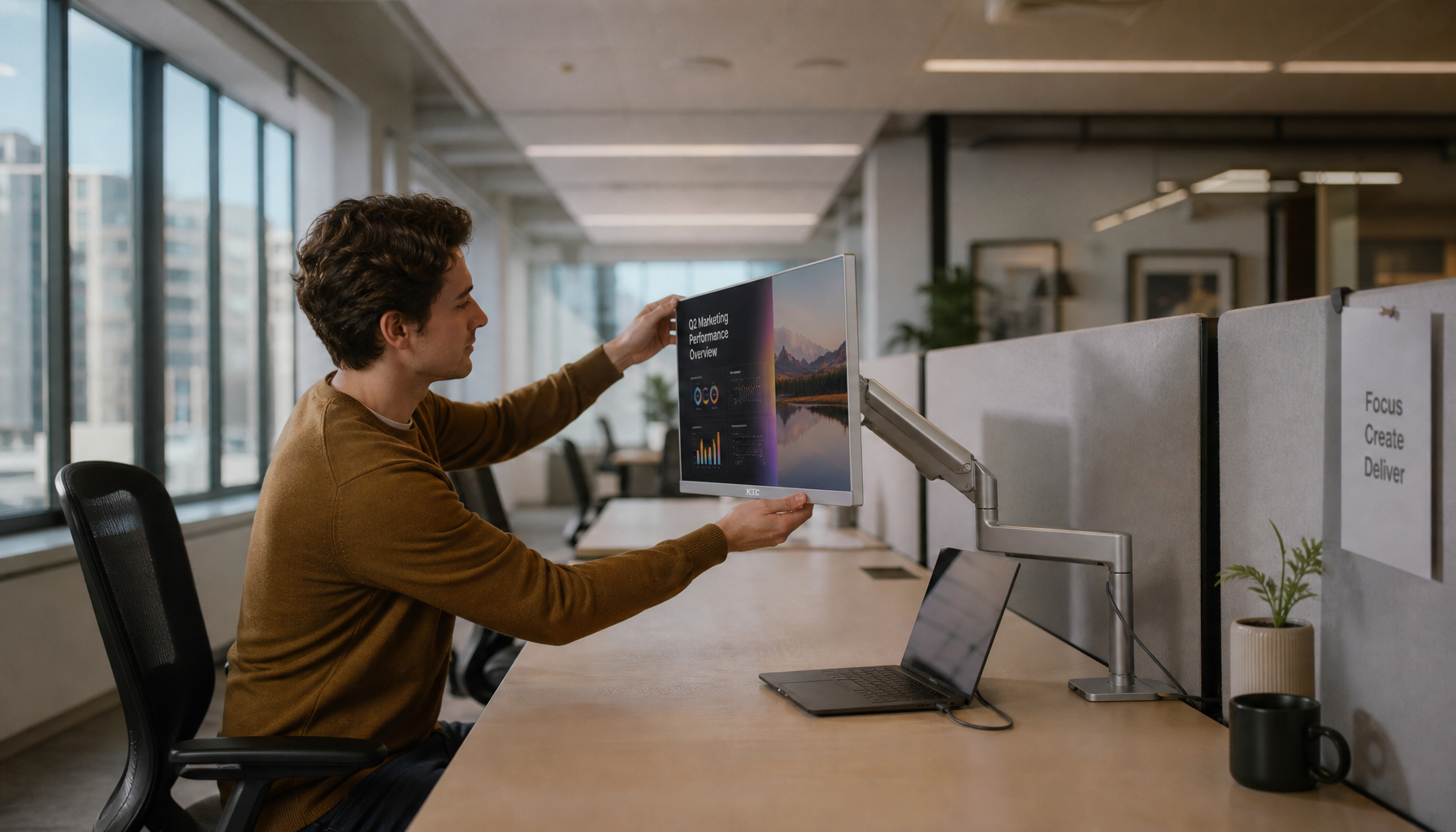
For most desktop monitors, a comfortable viewing distance is roughly 20 to 28 inches, with the screen about 15 to 20 degrees below eye level 20 to 28 inches. A university ergonomics guide gives a similar workstation range, recommending at least 20 to 26 inches, and often 30 to 40 inches if that remains comfortable viewing distance.
Large and ultrawide monitors need more space. A 34-inch ultrawide placed at the same distance as a 24-inch office monitor can push the edges outside your easy viewing zone, which encourages scanning, head turning, and squinting at side content. For larger monitors and ultrawides, try 2 ft to 3 ft 4 in away, then increase scaling so text stays readable rather than pulling the screen closer.
Refresh Rate, Flicker, and Motion Settings Can Affect Comfort
Refresh rate is not only for gaming

Refresh rate describes how many times per second the screen updates; a 60 Hz display refreshes 60 times each second display refresh rate. Higher refresh rates can make scrolling, pointer movement, and fast game motion feel smoother, and a company notes that they may reduce eye strain and fatigue by minimizing flicker and ghosting.
For a gaming monitor, check that the operating system is actually using the monitor’s advertised refresh rate. It is common to buy a 144 Hz, 165 Hz, or 240 Hz display and accidentally run it at 60 Hz after setup. In your operating system’s display settings, open the advanced display panel, choose the monitor, and select the highest stable refresh rate supported by your cable and GPU.
Flicker sensitivity varies from person to person
The point where flicker starts to look steady is called the critical flicker fusion threshold, and typical values are around 35 to 50 Hz in research contexts critical flicker fusion threshold. That does not mean every monitor above 50 Hz will feel comfortable, because real displays also involve backlight behavior, motion blur, overdrive artifacts, frame pacing, and room lighting.
If your eyes feel strained within 15 to 30 minutes on one monitor but not another, test motion-related settings. Turn off backlight strobing, black-frame insertion, “MPRT” modes, extreme overdrive, and unnecessary dynamic contrast. Then test a stable high refresh rate, such as 120 Hz or 144 Hz, with adaptive sync enabled if your system supports it.
Why Gaming Monitors, Ultrawides, and Portable Monitors Can Feel Different
Gaming monitors can be too intense out of the box
Many gaming monitors ship in vivid, high-brightness modes with boosted contrast, oversaturated color, and sharpness enhancements. Those settings can make a store demo look punchy, but they are not always comfortable for reading, coding, browsing, or working for several hours.
Start with the monitor’s standard, sRGB, or creator mode for desktop use. Set brightness to match the room, contrast around a moderate level, sharpness near the default neutral setting, and color temperature near a comfortable white point. If the monitor has separate picture modes, keep a calmer SDR desktop profile and a brighter game profile instead of forcing one preset to do everything.
Ultrawide and portable monitors have special comfort tradeoffs
Ultrawide monitors are excellent for timelines, spreadsheets, trading dashboards, and immersive games, but comfort depends on distance, curvature, and panel uniformity. A flat 34-inch or 49-inch screen at close range can make the edges harder to read because your viewing angle changes across the panel. Curvature can help keep the sides more visually consistent, but it does not fix text that is too small or a desk that is too shallow.
Portable monitors create a different problem: they are often smaller, glossier, and positioned lower than a desktop display. If you use a 15.6-inch portable screen beside a laptop, match apparent brightness on the same white page, align the top edges as closely as possible, and set scaling so text size is similar across both screens. Eye strain in laptop-plus-monitor setups often comes from repeated adaptation between screens with different brightness, contrast, glare, text rendering, and position dual-screen setups.
A Practical Troubleshooting Checklist
Use this sequence before assuming your monitor is defective. Change one variable at a time and test with the same task, such as reading a document, browsing text-heavy pages, or playing the same game for 20 minutes.
- Step 1: Match brightness to the room using a white page and a sheet of white paper.
- Step 2: Remove glare by checking the dark screen for reflected windows, lamps, or ceiling lights.
- Step 3: Increase text scaling, especially on 1440p, 4K, ultrawide, and portable displays.
- Step 4: Set contrast to a moderate level, often around 60% to 70%, then fine-tune with small text.
- Step 5: Confirm the monitor is running at its intended refresh rate in system settings.
- Step 6: Disable harsh motion features, including backlight strobing, extreme overdrive, and dynamic contrast.
- Step 7: Move the monitor to a better distance: about 20 to 28 inches for common desktop displays, farther for large ultrawides.
If discomfort still appears quickly on one monitor, compare it with another display under the same lighting. Use the same browser page, the same font scaling, and the same distance. If one panel still causes squinting within 15 to 30 minutes while another does not, the issue may be panel coating, flicker behavior, pixel layout, viewing angle, or a setting that is difficult to fully correct.
FAQ
Q: Why do I squint if my monitor brightness is already low?
A: The monitor may be too dim for the room, making text harder to separate from the background. Squinting can also come from glare, small fonts, low scaling, weak contrast, or sitting too far away. A dim screen is not automatically a comfortable screen.
Q: Is a higher refresh rate monitor better for eye comfort?
A: Often, yes, especially if you notice discomfort during scrolling, fast games, or mouse movement. Higher refresh rates can reduce motion blur, tearing, input lag, and may reduce fatigue related to flicker or ghosting. However, refresh rate will not fix glare, poor scaling, or harsh contrast by itself.
Q: Should I buy a 4K monitor to stop squinting?
A: A 4K monitor can improve text sharpness, but only if you use appropriate scaling and sit at a comfortable distance. A 32-inch 4K monitor at 125% or 150% scaling may feel easier than a 27-inch 4K monitor forced to 100% scaling. Pixel density helps most when text remains physically large enough to read.
Key Takeaways
If brightness seems fine but you still squint, treat the problem as a full display-comfort issue. Start with the easiest fixes: remove glare, match brightness to the room, increase scaling, moderate contrast, and confirm the correct refresh rate. These changes cost nothing and often solve the real cause faster than replacing the monitor.
When buying a new monitor, prioritize comfort-oriented specs alongside gaming or productivity specs. Look for enough resolution for crisp text, a refresh rate you will actually run, a size that fits your desk depth, flexible height adjustment, a coating that works in your lighting, and picture modes that let you separate desktop comfort from game intensity.
References
- A method for achieving an order-of-magnitude increase in the temporal resolution of a standard computer monitor
- Eye Discomfort
- Computer Vision Syndrome
- Ergonomic Brightness: Monitor Contrast for Eye Comfort
- Eye Strain from Laptop & External Monitor: Causes & Fixes
- Change the refresh rate on your monitor in Windows